Looking for huge power in small size? Our range includes complete range of disc, cylindrical and ring magnets. Best choice for domestic applications, workshop and industrial tasks. Check our offer in stock.
Begin your hobby involving underwater treasure hunting! Our double-handle grips (F200, F400) provide safety guarantee and immense power. Solid, corrosion-resistant housing and strong lines are reliable in rivers and lakes.
Professional solutions for mounting without drilling. Threaded grips (external or internal) provide quick improvement of work on production halls. Perfect for mounting lighting, sensors and ads.
A magnetic separator does one job. It pulls ferrous contamination out of a material stream before that contamination reaches a mill, a pump, an extruder or a customer. Everything else on this page follows from that single purpose.
This guide covers what we actually manufacture and sell: separating rods for in-line installation, magnetic beams over conveyor belts, hand-held separators, magnetic grippers and grate separators for hoppers. It also states plainly what we do not offer, because a guide that pretends to cover everything is no use when you have to place an order on Monday morning.
Choose a separator for the installation
Start with how the material moves through the process. Dimensions or a gauss value alone cannot establish separation performance.
Insert inside an installation
For a separating element installed inside the process. Check the cross-section, mounting and access for cleaning.
Gauss measures induction at the measuring point, not capture distance or performance in your line. Missing data is not zero. Check availability on the product page.
Include material, throughput, temperature and installation dimensions. You can attach one drawing or photo.
Separator construction and field — DHIT materials
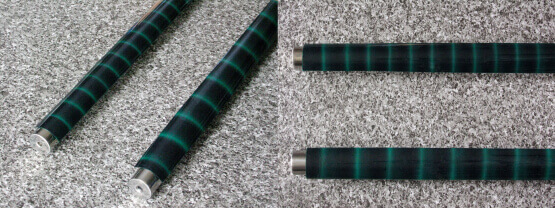
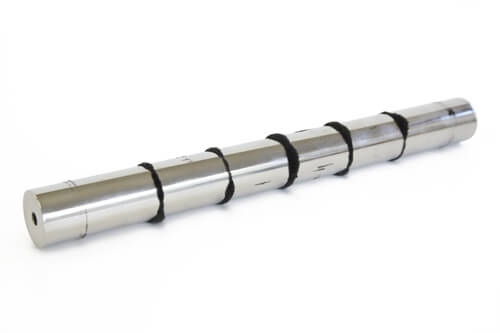
Materials from the existing guide show the magnet arrangement and where filings collect. They illustrate operation, not measured performance in your process. View the technical guide.
Visualisation of pole boundaries on the casingFilings distributed on the separator surfaceMagnet arrangement inside a rod
Safety and operating rules
Neodymium magnets in a separator core are strong enough to injure. Two rods brought close together will snap shut with enough force to break a finger. This is not a warning label added for form's sake - it is the first thing anyone handling these devices needs to understand.
Keep separators away from pacemakers and implanted medical electronics. Keep them away from magnetic storage media, mechanical watches and payment cards. Store rods and beams separately, on wooden or plastic shelving, never stacked loose in a crate where they can fly together when someone reaches in.
Magnetic grippers are lifting devices. Never move a load over a person. Never use a gripper as a permanent support - it is a handling tool, not a structural fixing. If the load surface is painted, scaled, curved or thinner than the gripper was rated for, the holding force is lower than the catalogue figure and you have to allow for it.
When a separator has been in service, treat the collected material as sharp. Steel swarf, broken drill tips and wire fragments come off a rod under spring tension. Gloves, not bare hands.
Five types of separator in our range
Separating rods for in-line installation
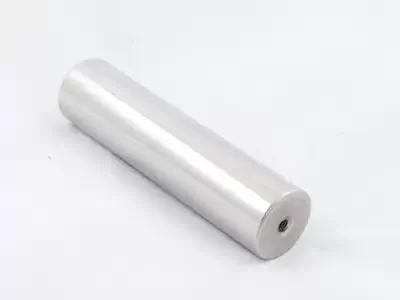
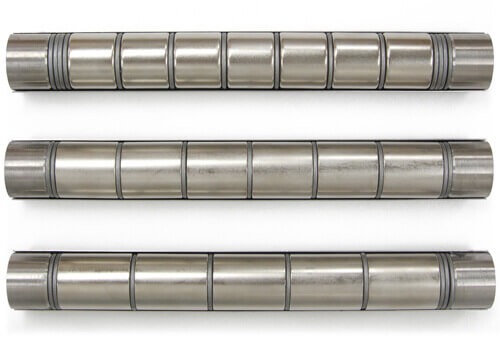
A rod is a sealed stainless tube with a neodymium core inside and a threaded fixing at each end. It is the workhorse of the range. You bolt it across a duct, a chute or a tank opening and the material stream has to pass the surface.
Fixing is 2 × M8, one thread at each end, which means the rod carries its own weight in shear and can be pulled for cleaning without dismantling the surrounding structure. That last point matters more in practice than any parameter on a data sheet: a separator that requires an hour of fitting work to clean will not be cleaned often enough.
Two core diameters are available. Ø 25 mm gives around 8 500 Gs at the surface and Ø 32 mm gives around 10 000 Gs. Both come in core lengths of 100, 125, 150 and 175 mm.
Magnetic beams over conveyor belts
A beam hangs above a moving belt and lifts ferrous pieces out of the layer as it passes underneath. Nothing enters the material path, nothing narrows the cross-section and there is no pressure drop to design around. For a plant that cannot tolerate an obstruction in the flow, this is the only sensible answer.
The catch is distance. Magnetic field strength falls away from the pole face very quickly, so the two things that decide whether a beam works are the suspension height and the thickness of the material layer. A beam set 300 mm above a 200 mm bed of aggregate is doing almost nothing at the bottom of that bed. Bring it down or thin the layer.
Hand-held separators (SMZR)
The SMZR is a rod with a handle. No installation, no downtime, no modification to the line. An operator draws it through a sack, a bin, a mixing vessel or a heap of granulate and pulls the swarf out.
It is the right tool for spot checks, for material that arrives in bags rather than by pipe, and for any situation where a fixed separator cannot be justified. Use Ø 32 mm - around 10 000 Gs - for fine contamination such as grinding dust and scale. Use Ø 25 mm at around 8 500 Gs where the contamination is larger: bolts, washers, nails, broken tooling.
Magnetic grippers
A gripper picks steel up and puts it down again. It is a manipulation device and it sits in the separator category for one reason only: it is built from the same magnetic assemblies. It does not separate anything.
Selection follows the same rules as for magnetic clamps and lifting fixtures. Rated force assumes a flat, clean, thick, unpainted contact face. Every departure from that reduces the real figure. Curvature, paint, rust, scale, machining marks and thin sheet all cost holding force, and they cost it in combination rather than one at a time.
Grate separators and hopper filters
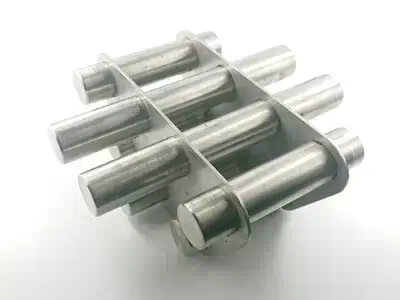
A grate is a lattice of rods filling the whole cross-section of a hopper outlet. Material cannot get past without touching a pole face somewhere on its way through. Of everything described here, this design gives the best contact between the product and the field, which is why it is the default choice for gravity transfer between floors.
Single-level and twin-level versions exist and the choice is not about being thorough. Twin-level suits fine, free-flowing material where the second row catches what the first row missed. Single-level suits material that tends to bridge or cake, because a second row of rods gives it another place to hang up and block the outlet. Choosing twin-level for a sticky powder produces a very effective plug.
Selecting a separator by its place in the process
Start from where the material is and what it is doing, not from a parameter table. The table below maps process locations onto device types.
Place in the process
Type of device
Notes
Transfer point for bulk material, gravity drop between floors
Grate or filter in the hopper
Best contact between material and field - the entire cross-section is filled with a lattice of rods. Twin-level for fine material, single-level where the material tends to cake.
Material on a conveyor belt, layer moving horizontally
Magnetic beam
Does not interfere with the material path and does not narrow the cross-section. Effectiveness depends on suspension height and layer thickness - the field falls off with distance very quickly.
Pipeline, duct or tank - material in a closed conduit
Rod for in-line installation
Fixing 2 × M8 at both ends. Length chosen so that the whole cross-section is covered. Removal for cleaning without dismantling the structure.
Picking swarf out by hand, without rebuilding the line
Hand-held separator (SMZR)
No installation, no production stoppage. Ø 32 (10 000 Gs) for fine contamination, Ø 25 (8 500 Gs) for larger swarf.
Moving steel components, loading, feeding parts
Magnetic gripper
A handling device, not a separating one. Selection rules are those for magnetic clamps. Never move a load over people.
Unusual geometry, dimension outside the catalogue, special conditions
Manufacture to order
We build to individual specification. Get in touch with the installation dimensions, the type of material and the operating temperature.
Parameters that make a real difference
Core diameter and magnetic flux
Two diameters, two flux figures. Ø 25 mm gives around 8 500 Gs and Ø 32 mm gives around 10 000 Gs at the surface.
The larger core is not simply better. It is stronger and it takes up more of the flow cross-section, and there are ducts where you cannot afford that. Where fine contamination is the problem - scale, grinding dust, wire brush bristles - the extra field of the Ø 32 mm core is what does the work, because fine particles carry very little mass for the field to act on. Where the contamination is coarse, Ø 25 mm has plenty of margin and leaves more room for material to pass.
Core diameter
Magnetic flux
Available core lengths
Ø 25 mm
approx. 8 500 Gs
100, 125, 150, 175 mm
Ø 32 mm
approx. 10 000 Gs
100, 125, 150, 175 mm
Core length
Four lengths are stocked: 100, 125, 150 and 175 mm. Length has nothing to do with strength - a 175 mm rod is no stronger at the surface than a 100 mm one. What it does is cover the cross-section.
Choose the length that spans the duct with the fixing threads landing where you can bolt them. A rod that leaves 40 mm of unswept width at one side of a chute has created a bypass, and material will find it. If the catalogue lengths do not span your opening, use two rods or ask about manufacture to order.
Housing material
The housing is what the material actually touches, so it decides how long the separator survives and whether it is acceptable in the process at all. Two grades are used.
Grade
Characteristics
Typical application
AISI 304
Austenitic Cr-Ni, around 18% chromium and 8-10% nickel. Good resistance to atmospheric corrosion and to moderately aggressive environments.
Dry bulk materials, timber industry, plastics, most general industrial applications.
AISI 316L
Austenitic Cr-Ni-Mo with a molybdenum addition and reduced carbon content (the L designation). Higher resistance to pitting corrosion and to chlorides.
Damp environments, presence of chlorides, washing with aggressive agents, hygiene requirements.
The short version: 304 unless there are chlorides, standing moisture or aggressive cleaning chemicals, in which case 316L. Chlorides are the deciding factor because they attack the passive layer on 304 locally, producing pitting rather than general thinning, and a pit that reaches the core lets material into the assembly.
Magnet grade
Grade is the least useful number for choosing a separator and the one most often quoted. What matters at the surface is the flux figure quoted for the assembly - the 8 500 Gs and 10 000 Gs above - because that is the result of the grade, the geometry and the magnetic circuit taken together. A high grade in a poor circuit gives a poor separator.
Grade becomes relevant at elevated temperature, where standard neodymium grades lose remanence as they warm and can lose it permanently above their rated working temperature. If your material stream is warm, that is a conversation about grade. If it is at ambient, quote the flux and ignore the grade.
What we do not offer
This section exists so that you do not spend a morning on an enquiry we cannot answer.
Drum separators
We do not make drum separators. A rotating drum with a fixed internal magnet assembly, continuously discharging captured material at one side, is a different class of machine with its own drive, bearings and enclosure. If your process needs continuous automatic discharge at high throughput, a drum is the right answer and it is not one we can supply.
Electromagnetic separators
Everything we build uses permanent neodymium magnets. We do not supply electromagnetic separators - no coils, no power supplies, no control cabinets, no facility to switch the field off on command.
The practical difference is release. An electromagnet drops its load when you cut the current. A permanent separator has to be wiped, scraped or drawn clear by hand. If your process needs the field to be switchable, we are not the supplier.
Separators with automatic cleaning
We do not offer self-cleaning designs: no pneumatic wipers, no motorised scrapers, no automatic discharge cycles. Every separator in the range is cleaned by hand.
Where that becomes a problem is in heavily contaminated streams running continuously, because the cleaning interval falls to the point where somebody has to attend the machine several times a shift. That is a genuine limitation and it is better to know it now than after installation.
Cleaning and maintenance
Why cleaning decides effectiveness
A separator that has not been cleaned is not a separator. Captured swarf sits on the pole faces and increases the effective air gap between the magnet and everything arriving afterwards. Field strength falls off very steeply with distance, so a 3 mm mat of accumulated steel wool does not reduce performance by a few per cent - it can reduce it to almost nothing.
Worse, the accumulated layer eventually sheds. A clump of swarf that lets go and travels downstream is a bigger problem than the individual particles ever were, because it arrives all at once and it arrives at the machine you were protecting.
This is why the ability to remove a rod without dismantling the structure is worth more than an extra 1 500 Gs. Nobody skips a two-minute job. Plenty of people skip an hour-long one.
Frequency
There is no universal interval, because it depends entirely on how much iron is in the stream. Set the interval by observation, not by the calendar.
Start by cleaning at the end of every shift and look at what comes off. If the pole faces are barely marked, extend the interval. If the rod is carrying a continuous coat of swarf, shorten it. Once you know the loading, the interval will look after itself - and then check it again whenever the material source changes, because a new supplier can change the contamination level completely.
Procedure
Stop the flow. Never clean a separator with material moving past it.
Withdraw the rod, or gain access to the beam or grate. Wearing gloves, wipe the captured material off with a cloth, a plastic scraper or a wooden wedge, working along the length of the pole face and collecting the debris in a container rather than letting it fall back into the process. On grates, pay attention to the corners where rods meet the frame: that is where material bridges and stays.
Check the housing while it is out. You are looking for scoring, dents, pitting on the welds and any sign of the seal being compromised. A rod that has been struck hard enough to dent may be dented around the core.
Refit and torque the M8 fixings properly. A rod that works loose in service can be dragged into the flow.
What not to do
Do not clean with a hammer, a steel scraper or a wire brush. You will damage the passive layer on the stainless housing and start pitting corrosion in the scratches.
Do not heat a separator to loosen deposits. Neodymium loses remanence as it warms and loses it permanently above the rated working temperature. A blowtorch will destroy the magnet without visibly changing anything on the outside, which is the worst kind of failure - it looks fine and it does not work.
Do not lay a cleaned rod down next to another one. They will find each other.
Do not use a separator with a visibly damaged or dented housing. If material has reached the core assembly, the rod is scrap.
Periodic inspection
Alongside routine cleaning, inspect properly at intervals. Look at the housing along its whole length under good light, check the threads, and confirm that the fixings and any suspension components are sound.
Where separation is part of a quality system, measure the surface flux with a gaussmeter and record it. A trend line over months tells you something a single reading cannot: whether you are looking at normal variation or at a real loss. Do not treat one low reading as proof of anything until you have checked that the meter probe was flat against the pole face and that the pole face was clean.
My installation is a non-standard size. Will you build a separator to order?
Yes. Send us the installation dimensions, the material being processed and the actual operating temperature. Check the catalogue models first: an available size may meet the requirement without the setup cost of a custom build.
Does a separator replace quality control?
No. A separator removes ferrous contamination from a stream. It does nothing about non-ferrous metal, stone, glass, plastic, wood or organic matter, and it does not tell you whether it caught everything. Treat it as one protective layer among several - it protects downstream machinery, it does not certify the product.
Magnetic grippers are listed under separators. Is that a mistake?
No, but the grouping is about construction rather than function. Grippers are built from the same magnetic assemblies as the separators, which is why they sit in the same part of the catalogue. Functionally a gripper is a handling device: it picks steel components up and puts them down. It separates nothing, and it is selected using the rules that apply to magnetic clamps and lifting fixtures rather than the rules on this page.
Sources and material descriptions
Calculators and supplementary material
Flux figures quoted here - approximately 8 500 Gs for the Ø 25 mm core and approximately 10 000 Gs for the Ø 32 mm core - are surface values for the complete assembly, not for a bare magnet. They already account for the housing wall and the magnetic circuit, which is why they are the numbers worth comparing between suppliers.
Where you need to compare a quoted figure against a measurement, take the measurement with the probe flat against a clean pole face at the midpoint of the core. Readings taken at the ends, over a fixing thread, or through a layer of captured swarf will all be lower and none of them tell you anything about the separator.
Separator catalogue
The range described on this page comprises separating rods for in-line installation in two core diameters and four core lengths, magnetic beams for suspension over conveyor belts, hand-held SMZR separators, magnetic grippers and grate separators for hopper outlets in single-level and twin-level configurations. Housings are supplied in AISI 304 or AISI 316L.
For dimensions outside those listed, for elevated operating temperatures, or for unusual installation geometry, contact us with the installation dimensions, the material being handled and the operating temperature. Manufacture to order is part of our normal work.
Frequently asked questions
Almost certainly not. Neodymium magnets in normal service do not weaken measurably over years. Check three things in this order: whether the pole faces are clean, whether the rod is still positioned where it was installed, and whether the material has changed - a new supplier, a finer grade or a higher throughput will all reduce apparent effectiveness without touching the magnet. Genuine permanent loss happens when a magnet has been overheated or physically shattered, and both of those leave evidence.
Use a hand-held SMZR to find out. Draw it through the material, look at what comes off and size the fixed installation from that. Coarse pieces mean Ø 25 mm is enough; a fine grey coating of scale or grinding dust means you want Ø 32 mm and its 10 000 Gs. This is a twenty-minute job that saves a wrong purchase.
It depends on the grade of the stainless, and this catches people out. Austenitic grades such as 304 and 316 are essentially non-magnetic in the annealed condition and a separator will not lift them. However, cold working - machining, grinding, bending, drawing - can induce enough martensite in the surface for swarf from those same grades to become weakly magnetic and recoverable. Ferritic and martensitic stainless grades are magnetic and behave like ordinary steel. If in doubt, test with a hand-held separator on the actual swarf rather than reasoning from the grade designation.
They solve different problems, so the comparison only makes sense once the geometry is fixed. A rod in a duct is in direct contact with the whole stream and will always outperform a beam suspended above an open belt, because the beam is fighting distance. If the material is on a belt and cannot be diverted, the beam is the only option and the question becomes how low you can hang it. If the material passes through a pipe or a chute, use a rod or a grate.
Not with a standard assembly. Standard neodymium loses remanence as it warms, and above its rated working temperature the loss is permanent - the separator comes out of the duct weaker than it went in, with nothing visible to show why. Tell us the operating temperature when you enquire and we will advise on a grade suited to it, or on manufacture to order. Do not assume a stainless housing implies a high temperature rating; the housing is not the limiting part.
As often as the contamination load requires, which you determine by observation. Begin with end-of-shift cleaning, inspect what comes off and adjust from there. Review the interval whenever the material, the supplier or the throughput changes.
316L contains molybdenum and has reduced carbon content, giving it markedly better resistance to pitting corrosion and to chlorides. In dry bulk handling, timber, plastics and general industry, 304 is entirely adequate. Choose 316L where there is moisture, where chlorides are present, where cleaning uses aggressive chemicals, or where hygiene requirements apply.
Twin-level for fine, free-flowing material, where the second row of rods catches what passed the first. Single-level for material that tends to bridge or cake, where a second row simply gives it somewhere else to hang up and block the outlet. If you are unsure, err towards single-level: an under-performing separator is a smaller problem than a blocked hopper.
Yes. We manufacture to individual specification. Send us the installation dimensions, the type of material and the operating temperature, and we will come back with a proposal. Non-standard geometry is normal work rather than an exception.