

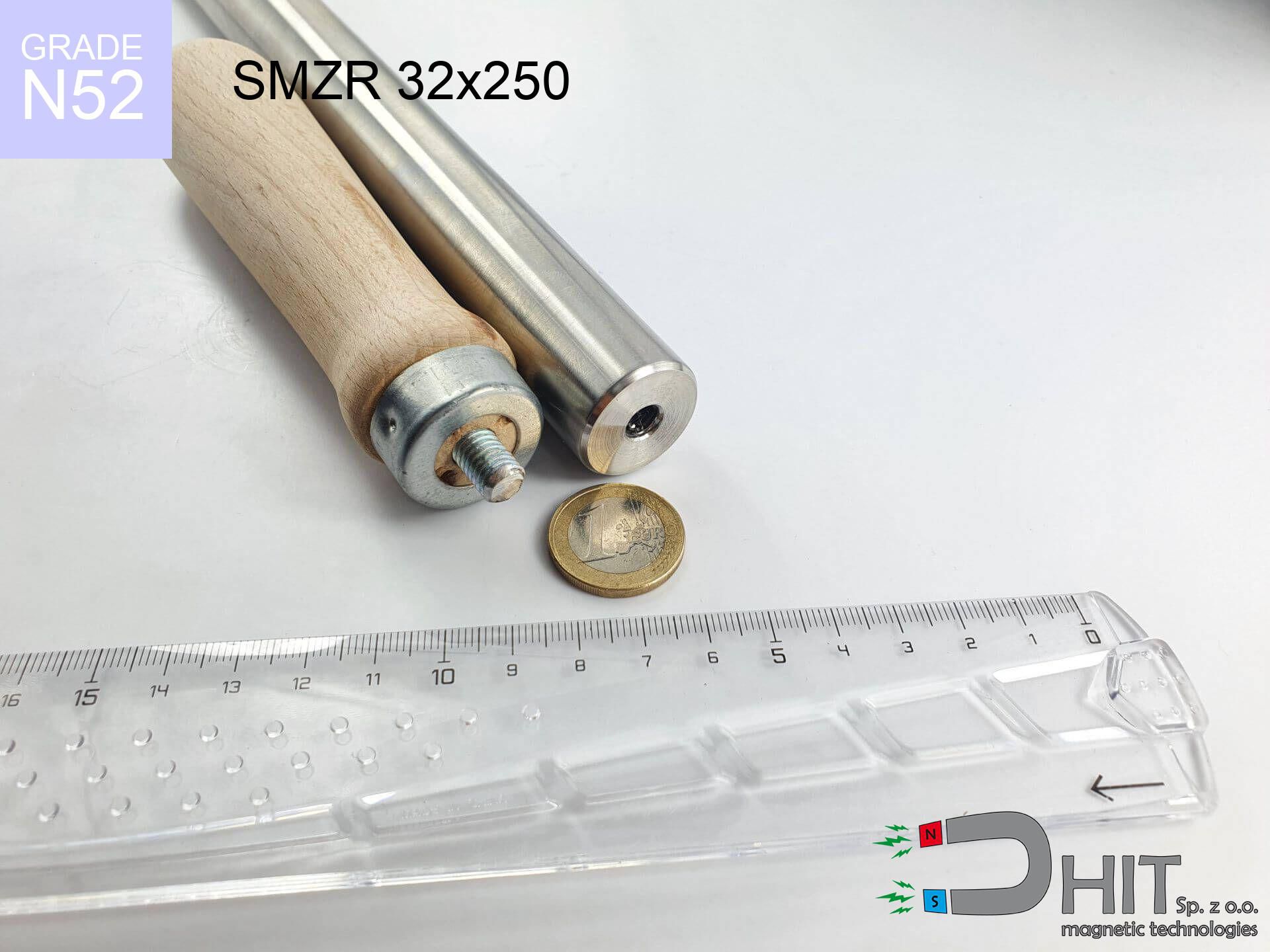
SMZR 32x250 / N52 - magnetic separator with handle
magnetic separator with handle
Catalog no 140469
GTIN/EAN: 5906301813538
- Diameter Ø
- 32 mm [±1 mm]
- Height
- 250 mm [±1 mm]
- Weight
- 1490 g
- Magnetic Flux
- ~ 10 000 Gauss [±5%]
How we measure these parameters — certificates and measurements
660.00 zł net / pcs
811.80 zł with VAT (23% VAT) / pcs
630.00 zł net was the lowest price in the last 30 days
bulk discounts:
Need more?Frequently asked questions
How do I choose a separator for fine contamination and check availability?
Where can I order a separator for a production line, and what should I check?
How can I verify a separator's declared magnetic parameters before purchase?
Can a magnetic beam withstand continuous work on a production line?
What roller design is suitable for a dusty environment?
How do I choose the size of a hand-held separator?
What is a hand-held separator for, and how is it different from a built-in rod?
Which separator type suits a small production plant?
Call us now
+48 888 99 98 98
alternatively let us know using
contact form
the contact section.
Specifications and structure of a neodymium magnet can be estimated using our
power calculator.
Order by 14:00 and we’ll ship today!
Technical parameters of the product - SMZR 32x250 / N52 - magnetic separator with handle
Specification / characteristics - SMZR 32x250 / N52 - magnetic separator with handle
| properties | values |
|---|---|
| Cat. no. | 140469 |
| GTIN/EAN | 5906301813538 |
| Production/Distribution | Dhit sp. z o.o. |
| Country of origin | Poland / China / Germany |
| Customs code | 85059029 |
| Diameter Ø | 32 mm [±1 mm] |
| Height | 250 mm [±1 mm] |
| Weight | 1490 g |
| Material Type | Stainless steel AISI 304 / A2 |
| Magnetic Flux | ~ 10 000 Gauss [±5%] |
| Size/Mount Quantity | 2xM8 |
| Polarity | circumferential - 8 poles |
| Casing Tube Thickness | 1 mm |
| Manufacturing Tolerance | ±1 mm |
Magnetic properties of material N52
| properties | values | units |
|---|---|---|
| Remanence Br ? | 14.2-14.7 | kGs |
| Remanence Br ? | 1420-1470 | mT |
| Coercivity bHc ? | 10.8-12.5 | kOe |
| Coercivity bHc ? | 860-995 | kA/m |
| Intrinsic coercivity iHc | ≥ 12 | kOe |
| Intrinsic coercivity iHc | ≥ 955 | kA/m |
| Energy product BHmax ? | 48-53 | BH max MGOe |
| Energy product BHmax ? | 380-422 | BH max KJ/m |
| Maximum working temperature ? | ≤ 60 | °C |
Physical properties of sintered neodymium magnets Nd2Fe14B at 20°C
| properties | values | units |
|---|---|---|
| Vickers hardness | ≥550 | Hv |
| Density | ≥7.4 | g/cm3 |
| Curie Temperature TC | 310 | °C |
| Curie Temperature TF | 590 | °F |
| Specific resistance | 150 | μΩ⋅cm |
| Bending strength | 250 | MPa |
| Compressive strength | 1000~1100 | MPa |
| Thermal expansion parallel (∥) to orientation (M) | (3-4) x 10-6 | °C-1 |
| Thermal expansion perpendicular (⊥) to orientation (M) | -(1-3) x 10-6 | °C-1 |
| Young's modulus | 1.7 x 10⁴ | kg/mm² |
Table 1: Rod construction
SMZR 32x250 / N52
| Parameter | Value | Description / Unit |
|---|---|---|
| Diameter (Ø) | 32 | mm |
| Total length | 250 | mm (L) |
| Active length | 230 | mm |
| Section count | 10 | modules |
| Dead zone | 20 | mm (Blaszka 2mm + Gwint 18mm) |
| Weight (est.) | ~1528 | g |
| Active area | 231 | cm² (Area) |
| Housing material | AISI 304 | 1.4301 (Inox) |
| Surface finish | Ra < 0.8 µm | Polished |
| Temp. class | 60°C | N52 |
| Force loss (at max °C) | -8.6% | Reversible loss (physics) |
| Force (calculated) | 41 | kg (theor.) |
| Induction (surface) | ~10 000 | Gauss (Max) |
Chart 2: Field profile (10 sections)
Chart 3: Temperature performance
Chemical composition
| iron (Fe) | 64% – 68% |
| neodymium (Nd) | 29% – 32% |
| boron (B) | 1.1% – 1.2% |
| dysprosium (Dy) | 0.5% – 2.0% |
| coating (Ni-Cu-Ni) | < 0.05% |
Ecology and recycling (GPSR)
| recyclability (EoL) | 100% |
| recycled raw materials | ~10% (pre-cons) |
| carbon footprint | low / zredukowany |
| waste code (EWC) | 16 02 16 |
View also deals
![SM 25x400 [2xM8] / N52 - magnetic separator](https://cdn3.dhit.pl/graphics/products/sm-25x400-2xm8-hoj.jpg "SM 25x400 [2xM8] / N52 - magnetic separator")
![MPL 40x10x4x2[7/3.5] / N38 - lamellar magnet](https://cdn3.dhit.pl/graphics/products/mpl40x10x4x27-3.5-suw.jpg "MPL 40x10x4x2[7/3.5] / N38 - lamellar magnet")
Strengths and weaknesses of rare earth magnets.
Pros
- They do not lose power, even during nearly ten years – the decrease in lifting capacity is only ~1% (based on measurements),
- Neodymium magnets are characterized by extremely resistant to loss of magnetic properties caused by external interference,
- By covering with a smooth layer of nickel, the element presents an nice look,
- Magnetic induction on the top side of the magnet remains impressive,
- Through (adequate) combination of ingredients, they can achieve high thermal resistance, enabling operation at temperatures approaching 230°C and above...
- Possibility of custom machining as well as modifying to defined applications,
- Key role in modern industrial fields – they find application in HDD drives, electromotive mechanisms, diagnostic systems, also technologically advanced constructions.
- Thanks to their power density, small magnets offer high operating force, in miniature format,
Weaknesses
- Susceptibility to cracking is one of their disadvantages. Upon strong impact they can break. We advise keeping them in a steel housing, which not only protects them against impacts but also increases their durability
- Do not exceed this material temperature limit: 60°C. Overheating may permanently weaken the magnet.
- They rust in a humid environment. For use outdoors we advise using waterproof magnets e.g. in rubber, plastic
- Limited ability of creating nuts in the magnet and complicated forms - preferred is casing - magnet mounting.
- Possible danger resulting from small fragments of magnets can be dangerous, if swallowed, which is particularly important in the context of child safety. Furthermore, small elements of these devices can be problematic in diagnostics medical when they are in the body.
- High unit price – neodymium magnets have a higher price than other types of magnets (e.g. ferrite), which can limit application in large quantities
Holding force characteristics
Best holding force of the magnet in ideal parameters – what affects it?
- on a plate made of structural steel, optimally conducting the magnetic flux
- possessing a massiveness of min. 10 mm to ensure full flux closure
- characterized by smoothness
- with zero gap (no coatings)
- under axial application of breakaway force (90-degree angle)
- at standard ambient temperature
Determinants of practical lifting force of a magnet
- Distance – existence of any layer (paint, tape, gap) interrupts the magnetic circuit, which lowers power rapidly (even by 50% at 0.5 mm).
- Loading method – catalog parameter refers to detachment vertically. When attempting to slide, the magnet exhibits much less (typically approx. 20-30% of maximum force).
- Metal thickness – the thinner the sheet, the weaker the hold. Magnetic flux penetrates through instead of generating force.
- Material composition – different alloys reacts the same. Alloy additives weaken the attraction effect.
- Plate texture – smooth surfaces ensure maximum contact, which increases force. Uneven metal weaken the grip.
- Temperature influence – high temperature reduces magnetic field. Too high temperature can permanently damage the magnet.
Holding force was tested on a smooth steel plate of 20 mm thickness, when a perpendicular force was applied, in contrast under attempts to slide the magnet the load capacity is reduced by as much as 5 times. Additionally, even a small distance between the magnet’s surface and the plate decreases the lifting capacity.
Warnings
Handling rules
Before use, check safety instructions. Sudden snapping can break the magnet or injure your hand. Be predictive.
No play value
Always store magnets away from children. Choking hazard is significant, and the consequences of magnets connecting inside the body are very dangerous.
Thermal limits
Regular neodymium magnets (grade N) undergo demagnetization when the temperature exceeds 80°C. This process is irreversible.
Beware of splinters
Despite metallic appearance, the material is delicate and not impact-resistant. Do not hit, as the magnet may shatter into hazardous fragments.
Magnetic interference
GPS units and smartphones are extremely sensitive to magnetic fields. Close proximity with a powerful NdFeB magnet can permanently damage the internal compass in your phone.
Skin irritation risks
Studies show that nickel (the usual finish) is a potent allergen. For allergy sufferers, avoid direct skin contact and select encased magnets.
Pacemakers
Health Alert: Neodymium magnets can deactivate heart devices and defibrillators. Stay away if you have medical devices.
Crushing risk
Pinching hazard: The attraction force is so great that it can result in hematomas, pinching, and broken bones. Protective gloves are recommended.
Electronic devices
Do not bring magnets close to a purse, computer, or screen. The magnetism can irreversibly ruin these devices and wipe information from cards.
Fire warning
Dust generated during grinding of magnets is flammable. Do not drill into magnets without proper cooling and knowledge.
Tabela kosztu i czasu dostawy
Płatność przed wysyłką:

GLS kurier
Przesyłka będzie u Ciebie za 2-3 dni
14.99 ZŁ

InPost Paczkomaty 24/7
Przesyłka będzie u Ciebie za 1-2 dni
12.30 ZŁ
Płatność przy odbiorze (pobranie):
GLS kurier
Przesyłka będzie u Ciebie za 1-2 dni
23.00 ZŁ