

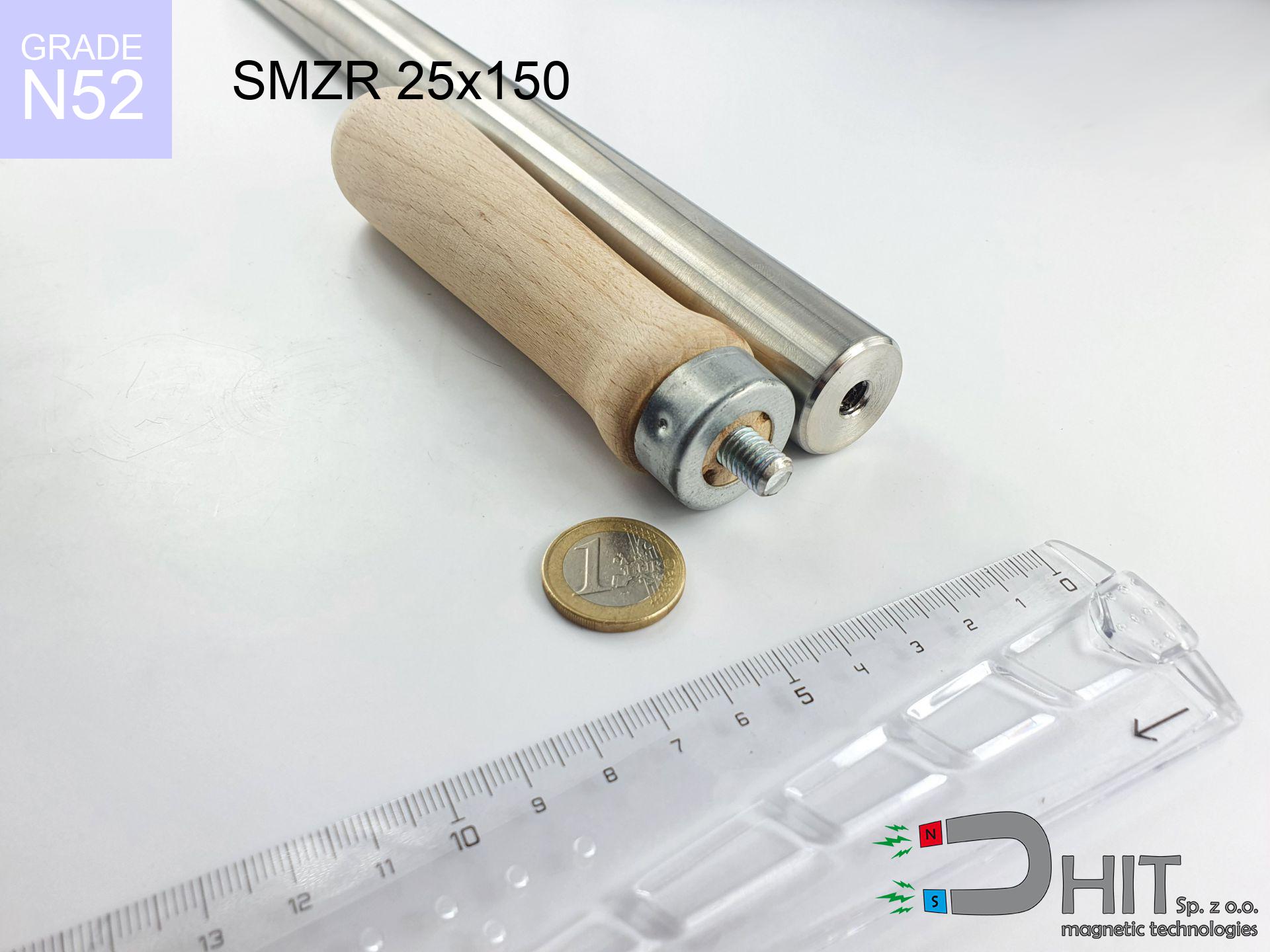
SMZR 25x150 / N52 - magnetic separator with handle
magnetic separator with handle
Catalog no 140234
GTIN/EAN: 5906301813422
- Diameter Ø
- 25 mm [±1 mm]
- Height
- 150 mm [±1 mm]
- Weight
- 640 g
- Magnetic Flux
- ~ 8 500 Gauss [±5%]
How we measure these parameters — certificates and measurements
440.00 zł net / pcs
541.20 zł with VAT (23% VAT) / pcs
350.00 zł net was the lowest price in the last 30 days
bulk discounts:
Need more?Frequently asked questions
How do I choose a separator for fine contamination and check availability?
Where can I order a separator for a production line, and what should I check?
How can I verify a separator's declared magnetic parameters before purchase?
Can a magnetic beam withstand continuous work on a production line?
What roller design is suitable for a dusty environment?
How do I choose the size of a hand-held separator?
What is a hand-held separator for, and how is it different from a built-in rod?
Which separator type suits a small production plant?
Call us now
+48 888 99 98 98
alternatively let us know using
contact form
the contact section.
Specifications and structure of a neodymium magnet can be estimated using our
power calculator.
Order by 14:00 and we’ll ship today!
Physical properties - SMZR 25x150 / N52 - magnetic separator with handle
Specification / characteristics - SMZR 25x150 / N52 - magnetic separator with handle
| properties | values |
|---|---|
| Cat. no. | 140234 |
| GTIN/EAN | 5906301813422 |
| Production/Distribution | Dhit sp. z o.o. |
| Country of origin | Poland / China / Germany |
| Customs code | 85059029 |
| Diameter Ø | 25 mm [±1 mm] |
| Height | 150 mm [±1 mm] |
| Weight | 640 g |
| Material Type | Stainless steel AISI 304 / A2 |
| Magnetic Flux | ~ 8 500 Gauss [±5%] |
| Size/Mount Quantity | M8x2 |
| Polarity | circumferential - 5 poles |
| Casing Tube Thickness | 1 mm |
| Manufacturing Tolerance | ±1 mm |
Magnetic properties of material N52
| properties | values | units |
|---|---|---|
| Remanence Br ? | 14.2-14.7 | kGs |
| Remanence Br ? | 1420-1470 | mT |
| Coercivity bHc ? | 10.8-12.5 | kOe |
| Coercivity bHc ? | 860-995 | kA/m |
| Intrinsic coercivity iHc | ≥ 12 | kOe |
| Intrinsic coercivity iHc | ≥ 955 | kA/m |
| Energy product BHmax ? | 48-53 | BH max MGOe |
| Energy product BHmax ? | 380-422 | BH max KJ/m |
| Maximum working temperature ? | ≤ 60 | °C |
Physical properties of sintered neodymium magnets Nd2Fe14B at 20°C
| properties | values | units |
|---|---|---|
| Vickers hardness | ≥550 | Hv |
| Density | ≥7.4 | g/cm3 |
| Curie Temperature TC | 310 | °C |
| Curie Temperature TF | 590 | °F |
| Specific resistance | 150 | μΩ⋅cm |
| Bending strength | 250 | MPa |
| Compressive strength | 1000~1100 | MPa |
| Thermal expansion parallel (∥) to orientation (M) | (3-4) x 10-6 | °C-1 |
| Thermal expansion perpendicular (⊥) to orientation (M) | -(1-3) x 10-6 | °C-1 |
| Young's modulus | 1.7 x 10⁴ | kg/mm² |
Table 1: Rod construction
SMZR 25x150 / N52
| Parameter | Value | Description / Unit |
|---|---|---|
| Diameter (Ø) | 25 | mm |
| Total length | 150 | mm (L) |
| Active length | 130 | mm |
| Section count | 5 | modules |
| Dead zone | 20 | mm (Blaszka 2mm + Gwint 18mm) |
| Weight (est.) | ~560 | g |
| Active area | 102 | cm² (Area) |
| Housing material | AISI 304 | 1.4301 (Inox) |
| Surface finish | Ra < 0.8 µm | Polished |
| Temp. class | 60°C | N52 |
| Force loss (at max °C) | -8.6% | Reversible loss (physics) |
| Force (calculated) | 18.1 | kg (theor.) |
| Induction (surface) | ~8 500 | Gauss (Max) |
Chart 2: Field profile (5 sections)
Chart 3: Temperature performance
Material specification
| iron (Fe) | 64% – 68% |
| neodymium (Nd) | 29% – 32% |
| boron (B) | 1.1% – 1.2% |
| dysprosium (Dy) | 0.5% – 2.0% |
| coating (Ni-Cu-Ni) | < 0.05% |
Sustainability
| recyclability (EoL) | 100% |
| recycled raw materials | ~10% (pre-cons) |
| carbon footprint | low / zredukowany |
| waste code (EWC) | 16 02 16 |
View also offers

![UMP 107x40 [M8+M10] GW F400 Lina / N38 - search holder](https://cdn3.dhit.pl/graphics/products/ump-107x40-m8+m10-gw-f400-+lina-bel.jpg "UMP 107x40 [M8+M10] GW F400 Lina / N38 - search holder")
Pros as well as cons of Nd2Fe14B magnets.
Pros
- They virtually do not lose strength, because even after ten years the performance loss is only ~1% (according to literature),
- They are noted for resistance to demagnetization induced by external disturbances,
- In other words, due to the smooth surface of nickel, the element gains visual value,
- They feature high magnetic induction at the operating surface, making them more effective,
- Neodymium magnets are characterized by extremely high magnetic induction on the magnet surface and are able to act (depending on the form) even at a temperature of 230°C or more...
- Thanks to freedom in forming and the capacity to customize to individual projects,
- Key role in advanced technology sectors – they are utilized in data components, electric motors, medical equipment, and multitasking production systems.
- Relatively small size with high pulling force – neodymium magnets offer strong magnetic field in tiny dimensions, which makes them useful in miniature devices
Cons
- Brittleness is one of their disadvantages. Upon intense impact they can fracture. We advise keeping them in a special holder, which not only protects them against impacts but also increases their durability
- Do not exceed this material temperature limit: 60°C. Overheating may permanently weaken the magnet.
- When exposed to humidity, magnets usually rust. To use them in conditions outside, it is recommended to use protective magnets, such as magnets in rubber or plastics, which secure oxidation as well as corrosion.
- We recommend casing - magnetic mount, due to difficulties in realizing threads inside the magnet and complicated shapes.
- Possible danger to health – tiny shards of magnets can be dangerous, in case of ingestion, which is particularly important in the context of child health protection. Additionally, tiny parts of these magnets can be problematic in diagnostics medical in case of swallowing.
- Due to complex production process, their price exceeds standard values,
Holding force characteristics
Optimal lifting capacity of a neodymium magnet – what contributes to it?
- on a plate made of structural steel, optimally conducting the magnetic flux
- possessing a massiveness of min. 10 mm to ensure full flux closure
- characterized by smoothness
- under conditions of gap-free contact (metal-to-metal)
- during pulling in a direction perpendicular to the mounting surface
- in temp. approx. 20°C
Impact of factors on magnetic holding capacity in practice
- Distance (between the magnet and the plate), since even a microscopic clearance (e.g. 0.5 mm) results in a reduction in lifting capacity by up to 50% (this also applies to paint, corrosion or dirt).
- Angle of force application – maximum parameter is available only during perpendicular pulling. The force required to slide of the magnet along the plate is usually several times smaller (approx. 1/5 of the lifting capacity).
- Metal thickness – thin material does not allow full use of the magnet. Part of the magnetic field penetrates through instead of converting into lifting capacity.
- Material composition – not every steel attracts identically. High carbon content worsen the attraction effect.
- Surface structure – the smoother and more polished the plate, the better the adhesion and higher the lifting capacity. Unevenness creates an air distance.
- Operating temperature – NdFeB sinters have a negative temperature coefficient. At higher temperatures they are weaker, and at low temperatures they can be stronger (up to a certain limit).
Holding force was checked on the plate surface of 20 mm thickness, when a perpendicular force was applied, however under shearing force the lifting capacity is smaller. Moreover, even a slight gap between the magnet and the plate decreases the holding force.
Warnings
Heat warning
Standard neodymium magnets (grade N) lose magnetization when the temperature exceeds 80°C. Damage is permanent.
Threat to navigation
GPS units and mobile phones are extremely susceptible to magnetic fields. Direct contact with a powerful NdFeB magnet can ruin the internal compass in your phone.
Dust explosion hazard
Fire warning: Neodymium dust is highly flammable. Do not process magnets in home conditions as this risks ignition.
Medical interference
Warning for patients: Strong magnetic fields affect medical devices. Maintain at least 30 cm distance or request help to work with the magnets.
Eye protection
Beware of splinters. Magnets can fracture upon violent connection, launching sharp fragments into the air. We recommend safety glasses.
Handling rules
Be careful. Neodymium magnets attract from a long distance and connect with massive power, often quicker than you can move away.
Skin irritation risks
Allergy Notice: The nickel-copper-nickel coating consists of nickel. If redness occurs, cease working with magnets and use protective gear.
Adults only
Neodymium magnets are not suitable for play. Accidental ingestion of several magnets can lead to them pinching intestinal walls, which constitutes a critical condition and requires urgent medical intervention.
Bodily injuries
Mind your fingers. Two large magnets will join immediately with a force of massive weight, crushing anything in their path. Exercise extreme caution!
Cards and drives
Do not bring magnets near a purse, laptop, or TV. The magnetism can destroy these devices and wipe information from cards.
Tabela kosztu i czasu dostawy
Płatność przed wysyłką:

GLS kurier
Przesyłka będzie u Ciebie za 2-3 dni
14.99 ZŁ

InPost Paczkomaty 24/7
Przesyłka będzie u Ciebie za 1-2 dni
12.30 ZŁ
Płatność przy odbiorze (pobranie):
GLS kurier
Przesyłka będzie u Ciebie za 1-2 dni
23.00 ZŁ