

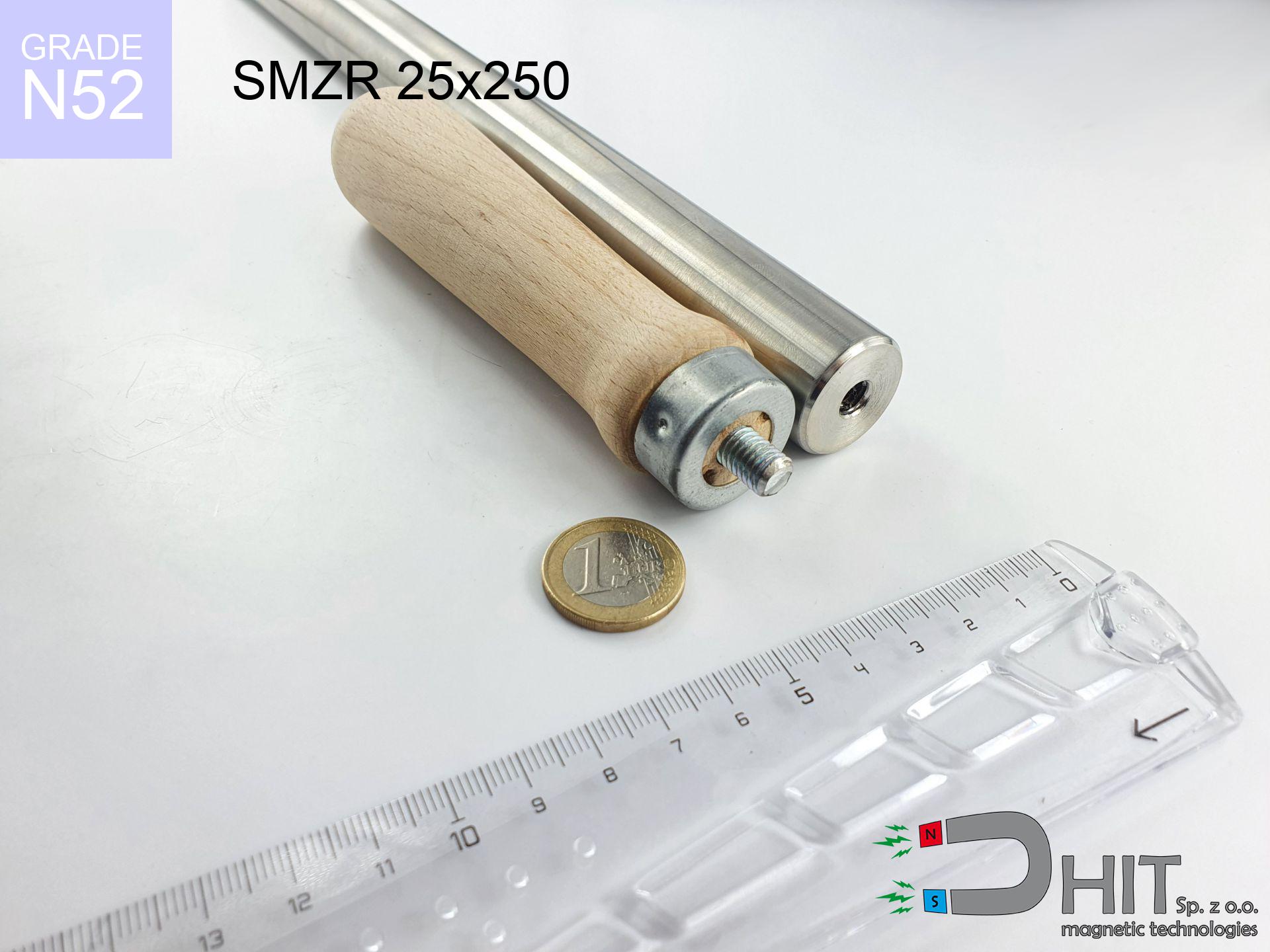
SMZR 25x250 / N52 - magnetic separator with handle
magnetic separator with handle
Catalog no 140236
GTIN/EAN: 5906301813446
- Diameter Ø
- 25 mm [±1 mm]
- Height
- 250 mm [±1 mm]
- Weight
- 840 g
- Magnetic Flux
- ~ 8 500 Gauss [±5%]
How we measure these parameters — certificates and measurements
600.00 zł net / pcs
738.00 zł with VAT (23% VAT) / pcs
550.00 zł net was the lowest price in the last 30 days
bulk discounts:
Need more?Frequently asked questions
How do I choose a separator for fine contamination and check availability?
Where can I order a separator for a production line, and what should I check?
How can I verify a separator's declared magnetic parameters before purchase?
Can a magnetic beam withstand continuous work on a production line?
What roller design is suitable for a dusty environment?
How do I choose the size of a hand-held separator?
What is a hand-held separator for, and how is it different from a built-in rod?
Which separator type suits a small production plant?
Call us now
+48 888 99 98 98
alternatively let us know using
contact form
the contact section.
Specifications and structure of a neodymium magnet can be estimated using our
power calculator.
Order by 14:00 and we’ll ship today!
Technical details - SMZR 25x250 / N52 - magnetic separator with handle
Specification / characteristics - SMZR 25x250 / N52 - magnetic separator with handle
| properties | values |
|---|---|
| Cat. no. | 140236 |
| GTIN/EAN | 5906301813446 |
| Production/Distribution | Dhit sp. z o.o. |
| Country of origin | Poland / China / Germany |
| Customs code | 85059029 |
| Diameter Ø | 25 mm [±1 mm] |
| Height | 250 mm [±1 mm] |
| Weight | 840 g |
| Material Type | Stainless steel AISI 304 / A2 |
| Magnetic Flux | ~ 8 500 Gauss [±5%] |
| Size/Mount Quantity | M8x2 |
| Polarity | circumferential - 9 poles |
| Casing Tube Thickness | 1 mm |
| Manufacturing Tolerance | ±1 mm |
Magnetic properties of material N52
| properties | values | units |
|---|---|---|
| Remanence Br ? | 14.2-14.7 | kGs |
| Remanence Br ? | 1420-1470 | mT |
| Coercivity bHc ? | 10.8-12.5 | kOe |
| Coercivity bHc ? | 860-995 | kA/m |
| Intrinsic coercivity iHc | ≥ 12 | kOe |
| Intrinsic coercivity iHc | ≥ 955 | kA/m |
| Energy product BHmax ? | 48-53 | BH max MGOe |
| Energy product BHmax ? | 380-422 | BH max KJ/m |
| Maximum working temperature ? | ≤ 60 | °C |
Physical properties of sintered neodymium magnets Nd2Fe14B at 20°C
| properties | values | units |
|---|---|---|
| Vickers hardness | ≥550 | Hv |
| Density | ≥7.4 | g/cm3 |
| Curie Temperature TC | 310 | °C |
| Curie Temperature TF | 590 | °F |
| Specific resistance | 150 | μΩ⋅cm |
| Bending strength | 250 | MPa |
| Compressive strength | 1000~1100 | MPa |
| Thermal expansion parallel (∥) to orientation (M) | (3-4) x 10-6 | °C-1 |
| Thermal expansion perpendicular (⊥) to orientation (M) | -(1-3) x 10-6 | °C-1 |
| Young's modulus | 1.7 x 10⁴ | kg/mm² |
Table 1: Rod construction
SMZR 25x250 / N52
| Parameter | Value | Description / Unit |
|---|---|---|
| Diameter (Ø) | 25 | mm |
| Total length | 250 | mm (L) |
| Active length | 230 | mm |
| Section count | 10 | modules |
| Dead zone | 20 | mm (Blaszka 2mm + Gwint 18mm) |
| Weight (est.) | ~933 | g |
| Active area | 181 | cm² (Area) |
| Housing material | AISI 304 | 1.4301 (Inox) |
| Surface finish | Ra < 0.8 µm | Polished |
| Temp. class | 60°C | N52 |
| Force loss (at max °C) | -8.6% | Reversible loss (physics) |
| Force (calculated) | 18.1 | kg (theor.) |
| Induction (surface) | ~8 500 | Gauss (Max) |
Chart 2: Field profile (10 sections)
Chart 3: Temperature performance
Chemical composition
| iron (Fe) | 64% – 68% |
| neodymium (Nd) | 29% – 32% |
| boron (B) | 1.1% – 1.2% |
| dysprosium (Dy) | 0.5% – 2.0% |
| coating (Ni-Cu-Ni) | < 0.05% |
Ecology and recycling (GPSR)
| recyclability (EoL) | 100% |
| recycled raw materials | ~10% (pre-cons) |
| carbon footprint | low / zredukowany |
| waste code (EWC) | 16 02 16 |
Other offers
![BM 750x180x70 [4x M8] - magnetic beam](https://cdn3.dhit.pl/graphics/products/bm-750x180x70-4x-m8-zif.jpg "BM 750x180x70 [4x M8] - magnetic beam")

![SM 32x300 [2xM8] / N42 - magnetic separator](https://cdn3.dhit.pl/graphics/products/sm-32x300-2xm8-pel.jpg "SM 32x300 [2xM8] / N42 - magnetic separator")
Advantages and disadvantages of Nd2Fe14B magnets.
Pros
- Their magnetic field is maintained, and after approximately 10 years it drops only by ~1% (theoretically),
- Magnets perfectly resist against demagnetization caused by foreign field sources,
- The use of an elegant coating of noble metals (nickel, gold, silver) causes the element to be more visually attractive,
- The surface of neodymium magnets generates a powerful magnetic field – this is a key feature,
- Thanks to resistance to high temperature, they are capable of working (depending on the shape) even at temperatures up to 230°C and higher...
- Possibility of accurate forming as well as optimizing to complex conditions,
- Significant place in innovative solutions – they are used in HDD drives, brushless drives, precision medical tools, also other advanced devices.
- Relatively small size with high pulling force – neodymium magnets offer strong magnetic field in compact dimensions, which enables their usage in miniature devices
Limitations
- At very strong impacts they can break, therefore we recommend placing them in special holders. A metal housing provides additional protection against damage, as well as increases the magnet's durability.
- Do not exceed this material temperature limit: 60°C. Overheating may permanently weaken the magnet.
- They oxidize in a humid environment - during use outdoors we advise using waterproof magnets e.g. in rubber, plastic
- We recommend casing - magnetic mechanism, due to difficulties in creating nuts inside the magnet and complicated forms.
- Potential hazard related to microscopic parts of magnets can be dangerous, if swallowed, which is particularly important in the context of child health protection. It is also worth noting that small elements of these magnets can disrupt the diagnostic process medical in case of swallowing.
- Due to complex production process, their price exceeds standard values,
Lifting parameters
Maximum holding power of the magnet – what it depends on?
- on a block made of structural steel, perfectly concentrating the magnetic field
- with a cross-section no less than 10 mm
- with an polished touching surface
- under conditions of gap-free contact (surface-to-surface)
- during detachment in a direction vertical to the plane
- in stable room temperature
Practical lifting capacity: influencing factors
- Space between magnet and steel – even a fraction of a millimeter of separation (caused e.g. by varnish or dirt) significantly weakens the magnet efficiency, often by half at just 0.5 mm.
- Angle of force application – highest force is obtained only during pulling at a 90° angle. The shear force of the magnet along the surface is standardly many times lower (approx. 1/5 of the lifting capacity).
- Substrate thickness – to utilize 100% power, the steel must be sufficiently thick. Paper-thin metal restricts the attraction force (the magnet "punches through" it).
- Steel grade – the best choice is high-permeability steel. Stainless steels may attract less.
- Surface structure – the more even the surface, the larger the contact zone and stronger the hold. Unevenness acts like micro-gaps.
- Temperature influence – high temperature weakens pulling force. Too high temperature can permanently demagnetize the magnet.
Holding force was checked on the plate surface of 20 mm thickness, when the force acted perpendicularly, in contrast under attempts to slide the magnet the load capacity is reduced by as much as 5 times. In addition, even a slight gap between the magnet’s surface and the plate decreases the lifting capacity.
H&S for magnets
Safe distance
Powerful magnetic fields can erase data on credit cards, HDDs, and other magnetic media. Maintain a gap of at least 10 cm.
Medical interference
Warning for patients: Strong magnetic fields disrupt medical devices. Maintain minimum 30 cm distance or ask another person to handle the magnets.
Flammability
Dust created during cutting of magnets is flammable. Avoid drilling into magnets unless you are an expert.
Protective goggles
Beware of splinters. Magnets can fracture upon uncontrolled impact, ejecting shards into the air. Eye protection is mandatory.
Warning for allergy sufferers
Certain individuals have a contact allergy to Ni, which is the common plating for NdFeB magnets. Extended handling might lead to skin redness. We strongly advise wear protective gloves.
Immense force
Before starting, check safety instructions. Sudden snapping can destroy the magnet or injure your hand. Be predictive.
Permanent damage
Watch the temperature. Heating the magnet to high heat will permanently weaken its properties and strength.
Crushing force
Big blocks can smash fingers instantly. Never place your hand between two attracting surfaces.
Adults only
Adult use only. Tiny parts pose a choking risk, causing intestinal necrosis. Store away from children and animals.
Phone sensors
An intense magnetic field interferes with the operation of magnetometers in smartphones and navigation systems. Keep magnets close to a smartphone to avoid damaging the sensors.
Tabela kosztu i czasu dostawy
Płatność przed wysyłką:

GLS kurier
Przesyłka będzie u Ciebie za 2-3 dni
14.99 ZŁ

InPost Paczkomaty 24/7
Przesyłka będzie u Ciebie za 1-2 dni
12.30 ZŁ
Płatność przy odbiorze (pobranie):
GLS kurier
Przesyłka będzie u Ciebie za 1-2 dni
23.00 ZŁ