

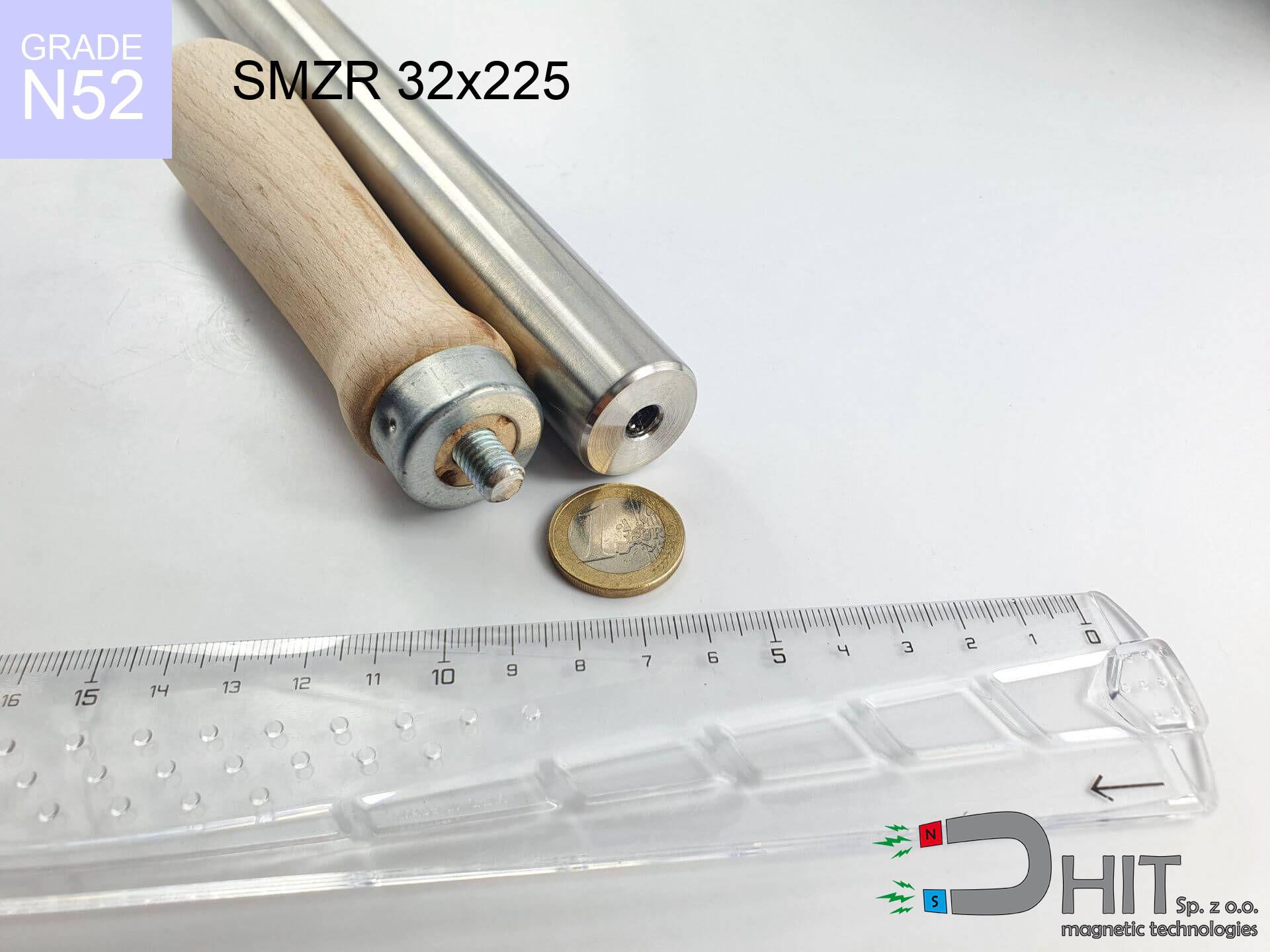
SMZR 32x225 / N52 - magnetic separator with handle
magnetic separator with handle
Catalog no 140468
GTIN/EAN: 5906301813521
- Diameter Ø
- 32 mm [±1 mm]
- Height
- 225 mm [±1 mm]
- Weight
- 1245 g
- Magnetic Flux
- ~ 10 000 Gauss [±5%]
How we measure these parameters — certificates and measurements
620.00 zł net / pcs
762.60 zł with VAT (23% VAT) / pcs
590.00 zł net was the lowest price in the last 30 days
bulk discounts:
Need more?Frequently asked questions
How do I choose a separator for fine contamination and check availability?
Where can I order a separator for a production line, and what should I check?
How can I verify a separator's declared magnetic parameters before purchase?
Can a magnetic beam withstand continuous work on a production line?
What roller design is suitable for a dusty environment?
How do I choose the size of a hand-held separator?
What is a hand-held separator for, and how is it different from a built-in rod?
Which separator type suits a small production plant?
Call us now
+48 888 99 98 98
alternatively let us know using
contact form
the contact section.
Specifications and structure of a neodymium magnet can be estimated using our
power calculator.
Order by 14:00 and we’ll ship today!
Technical data - SMZR 32x225 / N52 - magnetic separator with handle
Specification / characteristics - SMZR 32x225 / N52 - magnetic separator with handle
| properties | values |
|---|---|
| Cat. no. | 140468 |
| GTIN/EAN | 5906301813521 |
| Production/Distribution | Dhit sp. z o.o. |
| Country of origin | Poland / China / Germany |
| Customs code | 85059029 |
| Diameter Ø | 32 mm [±1 mm] |
| Height | 225 mm [±1 mm] |
| Weight | 1245 g |
| Material Type | Stainless steel AISI 304 / A2 |
| Magnetic Flux | ~ 10 000 Gauss [±5%] |
| Size/Mount Quantity | 2xM8 |
| Polarity | circumferential - 7 poles |
| Casing Tube Thickness | 1 mm |
| Manufacturing Tolerance | ±1 mm |
Magnetic properties of material N52
| properties | values | units |
|---|---|---|
| Remanence Br ? | 14.2-14.7 | kGs |
| Remanence Br ? | 1420-1470 | mT |
| Coercivity bHc ? | 10.8-12.5 | kOe |
| Coercivity bHc ? | 860-995 | kA/m |
| Intrinsic coercivity iHc | ≥ 12 | kOe |
| Intrinsic coercivity iHc | ≥ 955 | kA/m |
| Energy product BHmax ? | 48-53 | BH max MGOe |
| Energy product BHmax ? | 380-422 | BH max KJ/m |
| Maximum working temperature ? | ≤ 60 | °C |
Physical properties of sintered neodymium magnets Nd2Fe14B at 20°C
| properties | values | units |
|---|---|---|
| Vickers hardness | ≥550 | Hv |
| Density | ≥7.4 | g/cm3 |
| Curie Temperature TC | 310 | °C |
| Curie Temperature TF | 590 | °F |
| Specific resistance | 150 | μΩ⋅cm |
| Bending strength | 250 | MPa |
| Compressive strength | 1000~1100 | MPa |
| Thermal expansion parallel (∥) to orientation (M) | (3-4) x 10-6 | °C-1 |
| Thermal expansion perpendicular (⊥) to orientation (M) | -(1-3) x 10-6 | °C-1 |
| Young's modulus | 1.7 x 10⁴ | kg/mm² |
Table 1: Rod construction
SMZR 32x225 / N52
| Parameter | Value | Description / Unit |
|---|---|---|
| Diameter (Ø) | 32 | mm |
| Total length | 225 | mm (L) |
| Active length | 205 | mm |
| Section count | 8 | modules |
| Dead zone | 20 | mm (Blaszka 2mm + Gwint 18mm) |
| Weight (est.) | ~1375 | g |
| Active area | 206 | cm² (Area) |
| Housing material | AISI 304 | 1.4301 (Inox) |
| Surface finish | Ra < 0.8 µm | Polished |
| Temp. class | 60°C | N52 |
| Force loss (at max °C) | -8.6% | Reversible loss (physics) |
| Force (calculated) | 41 | kg (theor.) |
| Induction (surface) | ~10 000 | Gauss (Max) |
Chart 2: Field profile (8 sections)
Chart 3: Temperature performance
Material specification
| iron (Fe) | 64% – 68% |
| neodymium (Nd) | 29% – 32% |
| boron (B) | 1.1% – 1.2% |
| dysprosium (Dy) | 0.5% – 2.0% |
| coating (Ni-Cu-Ni) | < 0.05% |
Environmental data
| recyclability (EoL) | 100% |
| recycled raw materials | ~10% (pre-cons) |
| carbon footprint | low / zredukowany |
| waste code (EWC) | 16 02 16 |
See more offers
![UMP 75x25 [M10x3] GW F200 PLATINIUM Lina / N52 - search holder](https://cdn3.dhit.pl/graphics/products/ump-75x25-m10x3-gw-f200-platinium-lina-wiz.jpg "UMP 75x25 [M10x3] GW F200 PLATINIUM Lina / N52 - search holder")

![SM 25x275 [2xM8] / N42 - magnetic separator](https://cdn3.dhit.pl/graphics/products/sm-25x275-2xm8-boc.jpg "SM 25x275 [2xM8] / N42 - magnetic separator")
Strengths and weaknesses of neodymium magnets.
Strengths
- They retain magnetic properties for nearly 10 years – the drop is just ~1% (in theory),
- They have excellent resistance to weakening of magnetic properties due to opposing magnetic fields,
- The use of an refined finish of noble metals (nickel, gold, silver) causes the element to be more visually attractive,
- Magnets are characterized by impressive magnetic induction on the surface,
- Through (appropriate) combination of ingredients, they can achieve high thermal resistance, allowing for functioning at temperatures reaching 230°C and above...
- Thanks to the option of precise forming and adaptation to unique projects, magnetic components can be modeled in a wide range of shapes and sizes, which makes them more universal,
- Huge importance in innovative solutions – they find application in computer drives, motor assemblies, precision medical tools, as well as other advanced devices.
- Thanks to their power density, small magnets offer high operating force, with minimal size,
Limitations
- They are prone to damage upon too strong impacts. To avoid cracks, it is worth protecting magnets in special housings. Such protection not only shields the magnet but also improves its resistance to damage
- Do not exceed this material temperature limit: 60°C. Overheating may permanently weaken the magnet.
- Due to the susceptibility of magnets to corrosion in a humid environment, we recommend using waterproof magnets made of rubber, plastic or other material stable to moisture, in case of application outdoors
- Due to limitations in producing nuts and complicated forms in magnets, we recommend using casing - magnetic mechanism.
- Potential hazard to health – tiny shards of magnets pose a threat, if swallowed, which becomes key in the context of child health protection. Additionally, small elements of these devices can complicate diagnosis medical in case of swallowing.
- Due to expensive raw materials, their price is higher than average,
Holding force characteristics
Best holding force of the magnet in ideal parameters – what contributes to it?
- with the use of a sheet made of low-carbon steel, ensuring full magnetic saturation
- with a cross-section of at least 10 mm
- with a plane free of scratches
- without any air gap between the magnet and steel
- during pulling in a direction vertical to the plane
- in neutral thermal conditions
What influences lifting capacity in practice
- Distance – existence of any layer (rust, dirt, gap) acts as an insulator, which reduces capacity rapidly (even by 50% at 0.5 mm).
- Angle of force application – maximum parameter is obtained only during pulling at a 90° angle. The force required to slide of the magnet along the surface is standardly many times lower (approx. 1/5 of the lifting capacity).
- Base massiveness – too thin plate does not accept the full field, causing part of the flux to be wasted into the air.
- Steel grade – ideal substrate is pure iron steel. Stainless steels may generate lower lifting capacity.
- Plate texture – smooth surfaces ensure maximum contact, which increases force. Uneven metal reduce efficiency.
- Thermal environment – heating the magnet results in weakening of force. It is worth remembering the maximum operating temperature for a given model.
Lifting capacity was assessed by applying a polished steel plate of optimal thickness (min. 20 mm), under perpendicular pulling force, in contrast under shearing force the lifting capacity is smaller. Additionally, even a minimal clearance between the magnet’s surface and the plate decreases the load capacity.
Safe handling of neodymium magnets
Thermal limits
Regular neodymium magnets (grade N) lose magnetization when the temperature goes above 80°C. The loss of strength is permanent.
Impact on smartphones
An intense magnetic field disrupts the operation of magnetometers in smartphones and GPS navigation. Keep magnets near a device to prevent breaking the sensors.
Serious injuries
Big blocks can smash fingers in a fraction of a second. Under no circumstances place your hand between two strong magnets.
Electronic devices
Equipment safety: Strong magnets can ruin payment cards and delicate electronics (pacemakers, medical aids, mechanical watches).
Nickel coating and allergies
Warning for allergy sufferers: The nickel-copper-nickel coating contains nickel. If skin irritation occurs, cease working with magnets and use protective gear.
Danger to pacemakers
Individuals with a ICD should maintain an absolute distance from magnets. The magnetism can stop the operation of the life-saving device.
Machining danger
Combustion risk: Neodymium dust is explosive. Do not process magnets in home conditions as this risks ignition.
Shattering risk
Despite the nickel coating, the material is delicate and not impact-resistant. Avoid impacts, as the magnet may shatter into sharp, dangerous pieces.
Choking Hazard
These products are not intended for children. Accidental ingestion of a few magnets can lead to them attracting across intestines, which poses a direct threat to life and necessitates urgent medical intervention.
Caution required
Handle with care. Neodymium magnets act from a distance and snap with massive power, often quicker than you can react.
Tabela kosztu i czasu dostawy
Płatność przed wysyłką:

GLS kurier
Przesyłka będzie u Ciebie za 2-3 dni
14.99 ZŁ

InPost Paczkomaty 24/7
Przesyłka będzie u Ciebie za 1-2 dni
12.30 ZŁ
Płatność przy odbiorze (pobranie):
GLS kurier
Przesyłka będzie u Ciebie za 1-2 dni
23.00 ZŁ