

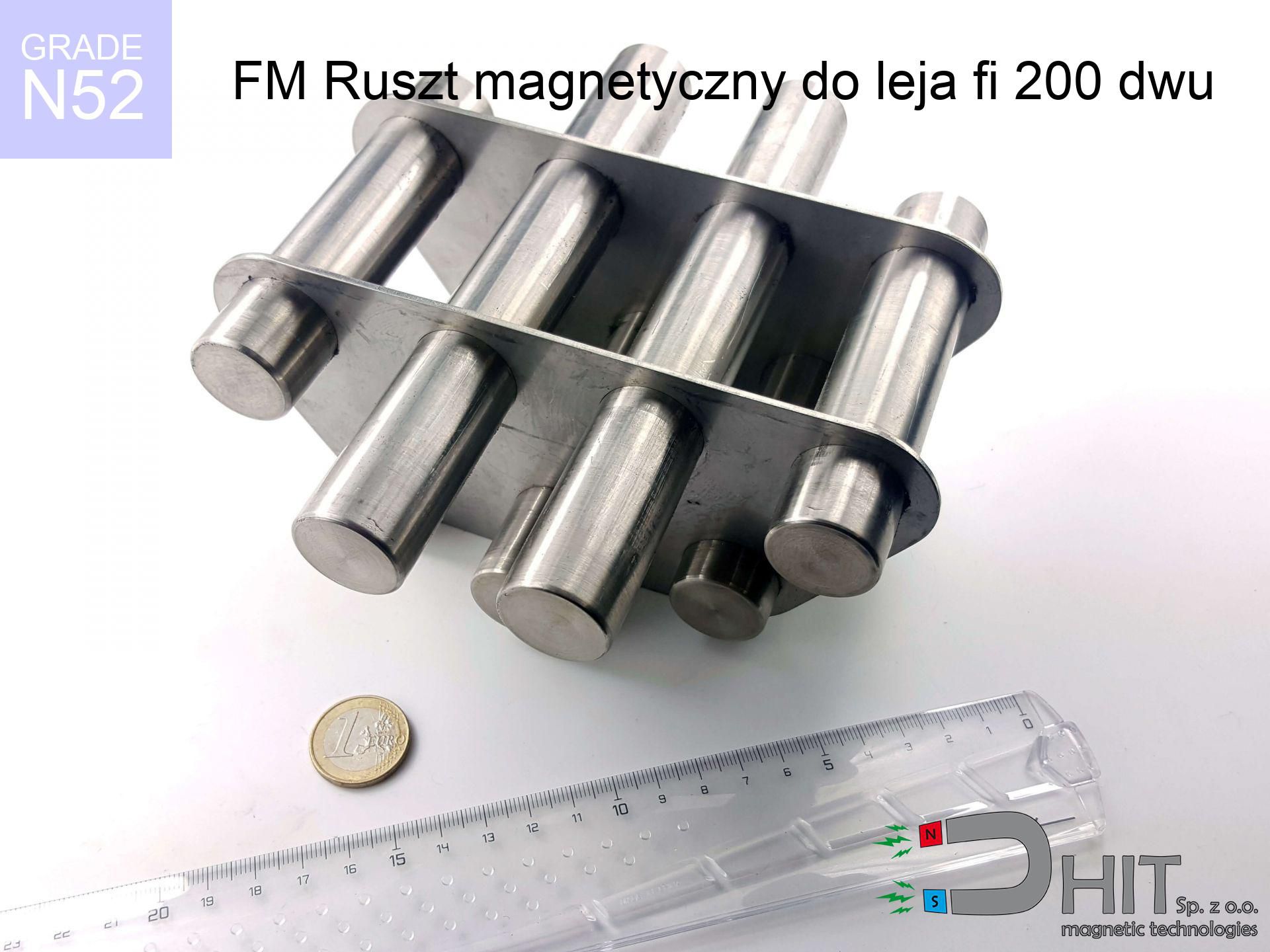
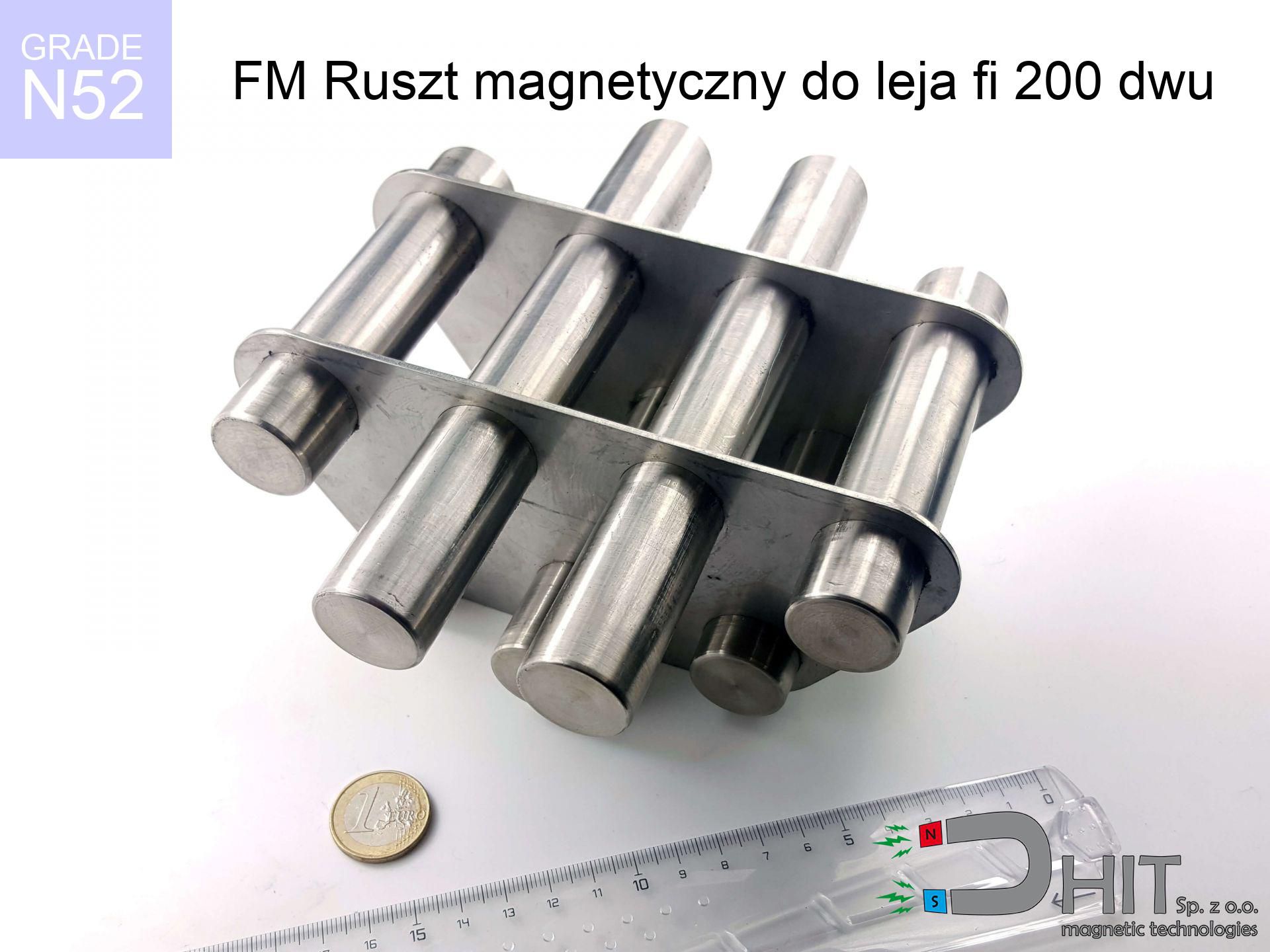
FM Ruszt magnetyczny do leja fi 200 dwupoziomowy / N52 - magnetic filter
magnetic filter
Catalog no 110456
GTIN/EAN: 5906301815143
- Weight
- 3500 g
- Coating
- [NiCuNi] Nickel
How we measure these parameters — certificates and measurements
3625.00 zł net / pcs
4458.75 zł with VAT (23% VAT) / pcs
bulk discounts:
Need more?Frequently asked questions
How do I choose a separator for fine contamination and check availability?
Where can I order a separator for a production line, and what should I check?
How can I verify a separator's declared magnetic parameters before purchase?
Can a magnetic beam withstand continuous work on a production line?
What roller design is suitable for a dusty environment?
How do I choose the size of a hand-held separator?
What is a hand-held separator for, and how is it different from a built-in rod?
Which separator type suits a small production plant?
Call us now
+48 888 99 98 98
alternatively let us know using
contact form
the contact section.
Specifications and structure of a neodymium magnet can be estimated using our
power calculator.
Order by 14:00 and we’ll ship today!
Technical specification of the product - FM Ruszt magnetyczny do leja fi 200 dwupoziomowy / N52 - magnetic filter
Specification / characteristics - FM Ruszt magnetyczny do leja fi 200 dwupoziomowy / N52 - magnetic filter
| properties | values |
|---|---|
| Cat. no. | 110456 |
| GTIN/EAN | 5906301815143 |
| Production/Distribution | Dhit sp. z o.o. |
| Country of origin | Poland / China / Germany |
| Customs code | 85059029 |
| Weight | 3500 g |
| Coating | [NiCuNi] Nickel |
| Manufacturing Tolerance | ±1 mm |
Magnetic properties of material N52
| properties | values | units |
|---|---|---|
| Remanence Br ? | 14.2-14.7 | kGs |
| Remanence Br ? | 1420-1470 | mT |
| Coercivity bHc ? | 10.8-12.5 | kOe |
| Coercivity bHc ? | 860-995 | kA/m |
| Intrinsic coercivity iHc | ≥ 12 | kOe |
| Intrinsic coercivity iHc | ≥ 955 | kA/m |
| Energy product BHmax ? | 48-53 | BH max MGOe |
| Energy product BHmax ? | 380-422 | BH max KJ/m |
| Maximum working temperature ? | ≤ 60 | °C |
Physical properties of sintered neodymium magnets Nd2Fe14B at 20°C
| properties | values | units |
|---|---|---|
| Vickers hardness | ≥550 | Hv |
| Density | ≥7.4 | g/cm3 |
| Curie Temperature TC | 310 | °C |
| Curie Temperature TF | 590 | °F |
| Specific resistance | 150 | μΩ⋅cm |
| Bending strength | 250 | MPa |
| Compressive strength | 1000~1100 | MPa |
| Thermal expansion parallel (∥) to orientation (M) | (3-4) x 10-6 | °C-1 |
| Thermal expansion perpendicular (⊥) to orientation (M) | -(1-3) x 10-6 | °C-1 |
| Young's modulus | 1.7 x 10⁴ | kg/mm² |
Material specification
| iron (Fe) | 64% – 68% |
| neodymium (Nd) | 29% – 32% |
| boron (B) | 1.1% – 1.2% |
| dysprosium (Dy) | 0.5% – 2.0% |
| coating (Ni-Cu-Ni) | < 0.05% |
Ecology and recycling (GPSR)
| recyclability (EoL) | 100% |
| recycled raw materials | ~10% (pre-cons) |
| carbon footprint | low / zredukowany |
| waste code (EWC) | 16 02 16 |
View also proposals
![SM 32x400 [2xM8] / N42 - magnetic separator](https://cdn3.dhit.pl/graphics/products/sm-32x400-2xm8-tep.jpg "SM 32x400 [2xM8] / N42 - magnetic separator")
![SM 32x150 [2xM8] / N42 - magnetic separator](https://cdn3.dhit.pl/graphics/products/sm-32x150-2xm8-xus.jpg "SM 32x150 [2xM8] / N42 - magnetic separator")

Strengths as well as weaknesses of Nd2Fe14B magnets.
Pros
- They virtually do not lose strength, because even after ten years the decline in efficiency is only ~1% (in laboratory conditions),
- Neodymium magnets prove to be extremely resistant to loss of magnetic properties caused by external interference,
- A magnet with a shiny gold surface has an effective appearance,
- Magnetic induction on the surface of the magnet is impressive,
- Neodymium magnets are characterized by extremely high magnetic induction on the magnet surface and can work (depending on the form) even at a temperature of 230°C or more...
- Possibility of exact machining and adapting to complex conditions,
- Universal use in high-tech industry – they are utilized in magnetic memories, motor assemblies, diagnostic systems, and technologically advanced constructions.
- Thanks to efficiency per cm³, small magnets offer high operating force, occupying minimum space,
Cons
- To avoid cracks upon strong impacts, we recommend using special steel housings. Such a solution secures the magnet and simultaneously improves its durability.
- Do not exceed this material temperature limit: 60°C. Overheating may permanently weaken the magnet.
- Magnets exposed to a humid environment can corrode. Therefore during using outdoors, we recommend using waterproof magnets made of rubber, plastic or other material resistant to moisture
- We suggest cover - magnetic mount, due to difficulties in producing threads inside the magnet and complicated shapes.
- Health risk resulting from small fragments of magnets can be dangerous, when accidentally swallowed, which is particularly important in the context of child health protection. It is also worth noting that small elements of these products are able to complicate diagnosis medical when they are in the body.
- High unit price – neodymium magnets are more expensive than other types of magnets (e.g. ferrite), which increases costs of application in large quantities
Lifting parameters
Best holding force of the magnet in ideal parameters – what it depends on?
- with the application of a yoke made of low-carbon steel, guaranteeing full magnetic saturation
- possessing a massiveness of minimum 10 mm to avoid saturation
- characterized by lack of roughness
- without any insulating layer between the magnet and steel
- under vertical force vector (90-degree angle)
- in neutral thermal conditions
Lifting capacity in practice – influencing factors
- Gap (betwixt the magnet and the metal), since even a very small clearance (e.g. 0.5 mm) results in a reduction in lifting capacity by up to 50% (this also applies to paint, corrosion or debris).
- Direction of force – highest force is obtained only during pulling at a 90° angle. The resistance to sliding of the magnet along the plate is typically several times smaller (approx. 1/5 of the lifting capacity).
- Plate thickness – too thin steel does not close the flux, causing part of the power to be lost into the air.
- Steel grade – the best choice is pure iron steel. Cast iron may have worse magnetic properties.
- Surface finish – ideal contact is obtained only on smooth steel. Any scratches and bumps create air cushions, reducing force.
- Temperature – heating the magnet causes a temporary drop of force. It is worth remembering the maximum operating temperature for a given model.
Lifting capacity was determined using a polished steel plate of suitable thickness (min. 20 mm), under perpendicular detachment force, however under shearing force the load capacity is reduced by as much as 75%. Additionally, even a slight gap between the magnet and the plate reduces the lifting capacity.
Warnings
Shattering risk
Beware of splinters. Magnets can explode upon violent connection, launching sharp fragments into the air. We recommend safety glasses.
Sensitization to coating
Allergy Notice: The Ni-Cu-Ni coating contains nickel. If an allergic reaction appears, cease handling magnets and wear gloves.
Maximum temperature
Avoid heat. Neodymium magnets are susceptible to heat. If you require resistance above 80°C, look for HT versions (H, SH, UH).
Physical harm
Danger of trauma: The pulling power is so great that it can result in blood blisters, crushing, and even bone fractures. Use thick gloves.
Do not give to children
Strictly store magnets away from children. Risk of swallowing is high, and the consequences of magnets clamping inside the body are tragic.
Caution required
Use magnets with awareness. Their huge power can surprise even experienced users. Plan your moves and do not underestimate their power.
Keep away from electronics
GPS units and mobile phones are extremely susceptible to magnetic fields. Close proximity with a strong magnet can ruin the sensors in your phone.
Mechanical processing
Fire hazard: Rare earth powder is explosive. Avoid machining magnets in home conditions as this may cause fire.
Pacemakers
Patients with a heart stimulator must maintain an absolute distance from magnets. The magnetic field can interfere with the operation of the implant.
Magnetic media
Intense magnetic fields can corrupt files on credit cards, HDDs, and storage devices. Stay away of at least 10 cm.
Tabela kosztu i czasu dostawy
Płatność przed wysyłką:

GLS kurier
Przesyłka będzie u Ciebie za 2-3 dni
14.99 ZŁ

InPost Paczkomaty 24/7
Przesyłka będzie u Ciebie za 1-2 dni
12.30 ZŁ
Płatność przy odbiorze (pobranie):
GLS kurier
Przesyłka będzie u Ciebie za 1-2 dni
23.00 ZŁ