

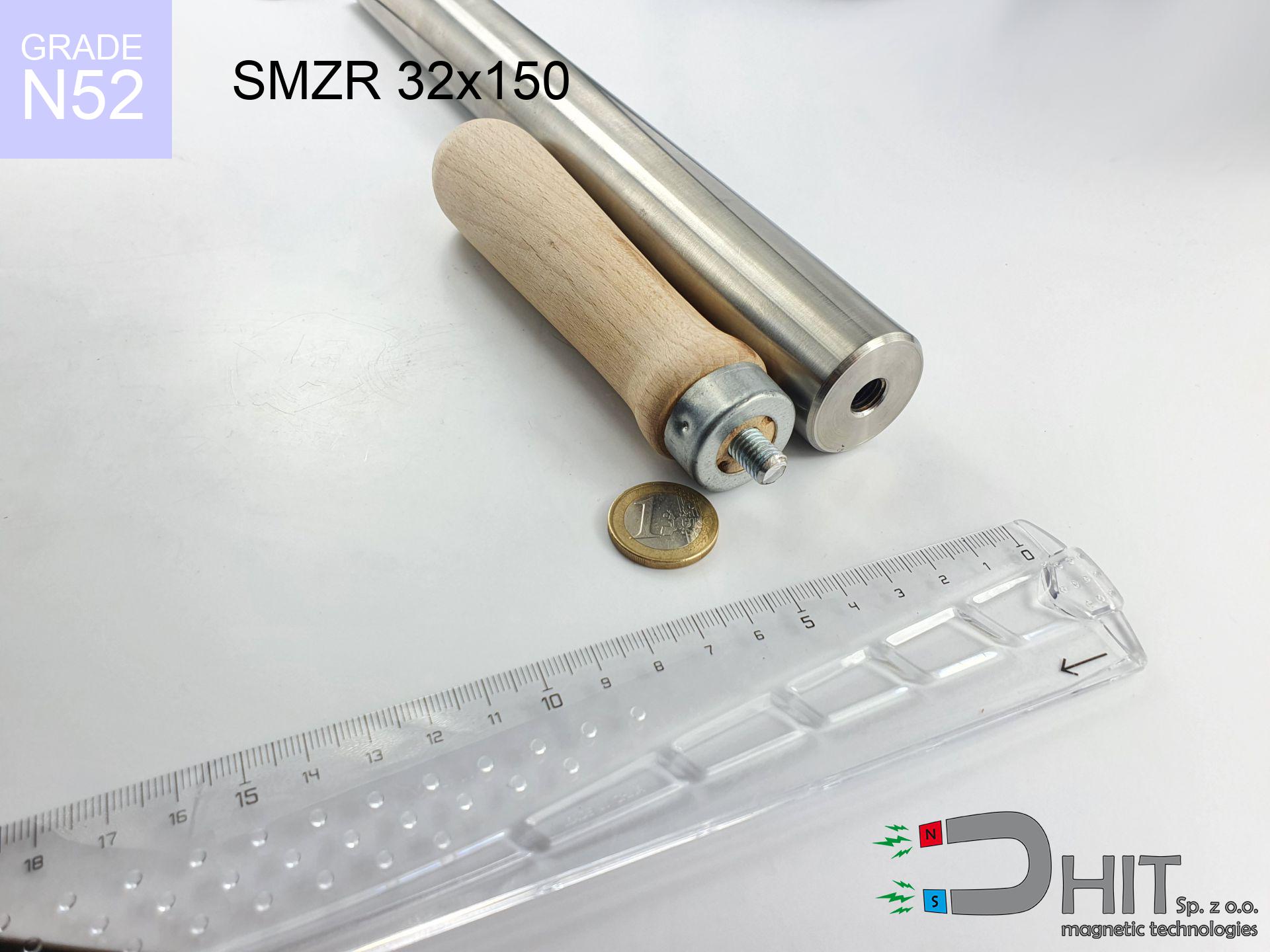
SMZR 32x150 / N52 - magnetic separator with handle
magnetic separator with handle
Catalog no 140239
GTIN/EAN: 5906301813477
- Diameter Ø
- 32 mm [±1 mm]
- Height
- 150 mm [±1 mm]
- Weight
- 935 g
- Magnetic Flux
- ~ 10 000 Gauss [±5%]
How we measure these parameters — certificates and measurements
500.00 zł net / pcs
615.00 zł with VAT (23% VAT) / pcs
bulk discounts:
Need more?Frequently asked questions
How do I choose a separator for fine contamination and check availability?
Where can I order a separator for a production line, and what should I check?
How can I verify a separator's declared magnetic parameters before purchase?
Can a magnetic beam withstand continuous work on a production line?
What roller design is suitable for a dusty environment?
How do I choose the size of a hand-held separator?
What is a hand-held separator for, and how is it different from a built-in rod?
Which separator type suits a small production plant?
Call us now
+48 888 99 98 98
alternatively let us know using
contact form
the contact section.
Specifications and structure of a neodymium magnet can be estimated using our
power calculator.
Order by 14:00 and we’ll ship today!
Technical - SMZR 32x150 / N52 - magnetic separator with handle
Specification / characteristics - SMZR 32x150 / N52 - magnetic separator with handle
| properties | values |
|---|---|
| Cat. no. | 140239 |
| GTIN/EAN | 5906301813477 |
| Production/Distribution | Dhit sp. z o.o. |
| Country of origin | Poland / China / Germany |
| Customs code | 85059029 |
| Diameter Ø | 32 mm [±1 mm] |
| Height | 150 mm [±1 mm] |
| Weight | 935 g |
| Material Type | Stainless steel AISI 304 / A2 |
| Magnetic Flux | ~ 10 000 Gauss [±5%] |
| Size/Mount Quantity | 2xM8 |
| Polarity | circumferential - 5 poles |
| Casing Tube Thickness | 1 mm |
| Manufacturing Tolerance | ±1 mm |
Magnetic properties of material N52
| properties | values | units |
|---|---|---|
| Remanence Br ? | 14.2-14.7 | kGs |
| Remanence Br ? | 1420-1470 | mT |
| Coercivity bHc ? | 10.8-12.5 | kOe |
| Coercivity bHc ? | 860-995 | kA/m |
| Intrinsic coercivity iHc | ≥ 12 | kOe |
| Intrinsic coercivity iHc | ≥ 955 | kA/m |
| Energy product BHmax ? | 48-53 | BH max MGOe |
| Energy product BHmax ? | 380-422 | BH max KJ/m |
| Maximum working temperature ? | ≤ 60 | °C |
Physical properties of sintered neodymium magnets Nd2Fe14B at 20°C
| properties | values | units |
|---|---|---|
| Vickers hardness | ≥550 | Hv |
| Density | ≥7.4 | g/cm3 |
| Curie Temperature TC | 310 | °C |
| Curie Temperature TF | 590 | °F |
| Specific resistance | 150 | μΩ⋅cm |
| Bending strength | 250 | MPa |
| Compressive strength | 1000~1100 | MPa |
| Thermal expansion parallel (∥) to orientation (M) | (3-4) x 10-6 | °C-1 |
| Thermal expansion perpendicular (⊥) to orientation (M) | -(1-3) x 10-6 | °C-1 |
| Young's modulus | 1.7 x 10⁴ | kg/mm² |
Table 1: Rod construction
SMZR 32x150 / N52
| Parameter | Value | Description / Unit |
|---|---|---|
| Diameter (Ø) | 32 | mm |
| Total length | 150 | mm (L) |
| Active length | 130 | mm |
| Section count | 5 | modules |
| Dead zone | 20 | mm (Blaszka 2mm + Gwint 18mm) |
| Weight (est.) | ~917 | g |
| Active area | 131 | cm² (Area) |
| Housing material | AISI 304 | 1.4301 (Inox) |
| Surface finish | Ra < 0.8 µm | Polished |
| Temp. class | 60°C | N52 |
| Force loss (at max °C) | -8.6% | Reversible loss (physics) |
| Force (calculated) | 41 | kg (theor.) |
| Induction (surface) | ~10 000 | Gauss (Max) |
Chart 2: Field profile (5 sections)
Chart 3: Temperature performance
Material specification
| iron (Fe) | 64% – 68% |
| neodymium (Nd) | 29% – 32% |
| boron (B) | 1.1% – 1.2% |
| dysprosium (Dy) | 0.5% – 2.0% |
| coating (Ni-Cu-Ni) | < 0.05% |
Ecology and recycling (GPSR)
| recyclability (EoL) | 100% |
| recycled raw materials | ~10% (pre-cons) |
| carbon footprint | low / zredukowany |
| waste code (EWC) | 16 02 16 |
Other deals
![AM szekla [M10] - magnetic accessories](https://cdn3.dhit.pl/graphics/products/am-szekla-m10-zeh.jpg "AM szekla [M10] - magnetic accessories")


Strengths as well as weaknesses of Nd2Fe14B magnets.
Pros
- They have stable power, and over nearly 10 years their performance decreases symbolically – ~1% (according to theory),
- Magnets effectively resist against demagnetization caused by ambient magnetic noise,
- By applying a shiny coating of silver, the element acquires an nice look,
- Neodymium magnets achieve maximum magnetic induction on a contact point, which ensures high operational effectiveness,
- Made from properly selected components, these magnets show impressive resistance to high heat, enabling them to function (depending on their shape) at temperatures up to 230°C and above...
- Possibility of custom forming and modifying to atypical conditions,
- Huge importance in modern technologies – they serve a role in data components, electric motors, medical devices, and complex engineering applications.
- Compactness – despite small sizes they provide effective action, making them ideal for precision applications
Disadvantages
- To avoid cracks upon strong impacts, we recommend using special steel housings. Such a solution secures the magnet and simultaneously improves its durability.
- Do not exceed this material temperature limit: 60°C. Overheating may permanently weaken the magnet.
- They oxidize in a humid environment. For use outdoors we recommend using waterproof magnets e.g. in rubber, plastic
- We suggest casing - magnetic mechanism, due to difficulties in creating threads inside the magnet and complicated shapes.
- Potential hazard related to microscopic parts of magnets are risky, if swallowed, which is particularly important in the aspect of protecting the youngest. It is also worth noting that tiny parts of these products can complicate diagnosis medical when they are in the body.
- Higher cost of purchase is a significant factor to consider compared to ceramic magnets, especially in budget applications
Pull force analysis
Maximum lifting force for a neodymium magnet – what affects it?
- on a base made of structural steel, perfectly concentrating the magnetic field
- whose transverse dimension reaches at least 10 mm
- characterized by lack of roughness
- without any air gap between the magnet and steel
- under perpendicular force vector (90-degree angle)
- at room temperature
Key elements affecting lifting force
- Air gap (betwixt the magnet and the plate), because even a microscopic distance (e.g. 0.5 mm) leads to a reduction in lifting capacity by up to 50% (this also applies to paint, rust or dirt).
- Load vector – highest force is available only during pulling at a 90° angle. The shear force of the magnet along the plate is usually many times smaller (approx. 1/5 of the lifting capacity).
- Metal thickness – thin material does not allow full use of the magnet. Part of the magnetic field penetrates through instead of converting into lifting capacity.
- Material type – the best choice is pure iron steel. Stainless steels may attract less.
- Base smoothness – the more even the plate, the better the adhesion and stronger the hold. Unevenness acts like micro-gaps.
- Temperature – heating the magnet causes a temporary drop of force. It is worth remembering the maximum operating temperature for a given model.
Lifting capacity was determined with the use of a steel plate with a smooth surface of optimal thickness (min. 20 mm), under perpendicular pulling force, however under shearing force the load capacity is reduced by as much as 5 times. Moreover, even a minimal clearance between the magnet and the plate decreases the holding force.
Warnings
Magnet fragility
Watch out for shards. Magnets can fracture upon violent connection, ejecting sharp fragments into the air. Wear goggles.
Allergy Warning
Certain individuals have a contact allergy to Ni, which is the typical protective layer for neodymium magnets. Frequent touching may cause a rash. We strongly advise use safety gloves.
Adults only
Always keep magnets out of reach of children. Risk of swallowing is high, and the consequences of magnets connecting inside the body are life-threatening.
Bone fractures
Protect your hands. Two powerful magnets will join immediately with a force of several hundred kilograms, destroying everything in their path. Exercise extreme caution!
Magnetic interference
An intense magnetic field interferes with the functioning of compasses in smartphones and GPS navigation. Maintain magnets near a device to prevent breaking the sensors.
Data carriers
Data protection: Strong magnets can ruin data carriers and sensitive devices (pacemakers, medical aids, mechanical watches).
Caution required
Before starting, check safety instructions. Sudden snapping can break the magnet or hurt your hand. Be predictive.
Medical implants
For implant holders: Strong magnetic fields disrupt electronics. Maintain at least 30 cm distance or request help to work with the magnets.
Heat warning
Standard neodymium magnets (grade N) lose magnetization when the temperature exceeds 80°C. The loss of strength is permanent.
Fire warning
Powder produced during grinding of magnets is combustible. Avoid drilling into magnets unless you are an expert.
Tabela kosztu i czasu dostawy
Płatność przed wysyłką:

GLS kurier
Przesyłka będzie u Ciebie za 2-3 dni
14.99 ZŁ

InPost Paczkomaty 24/7
Przesyłka będzie u Ciebie za 1-2 dni
12.30 ZŁ
Płatność przy odbiorze (pobranie):
GLS kurier
Przesyłka będzie u Ciebie za 1-2 dni
23.00 ZŁ