

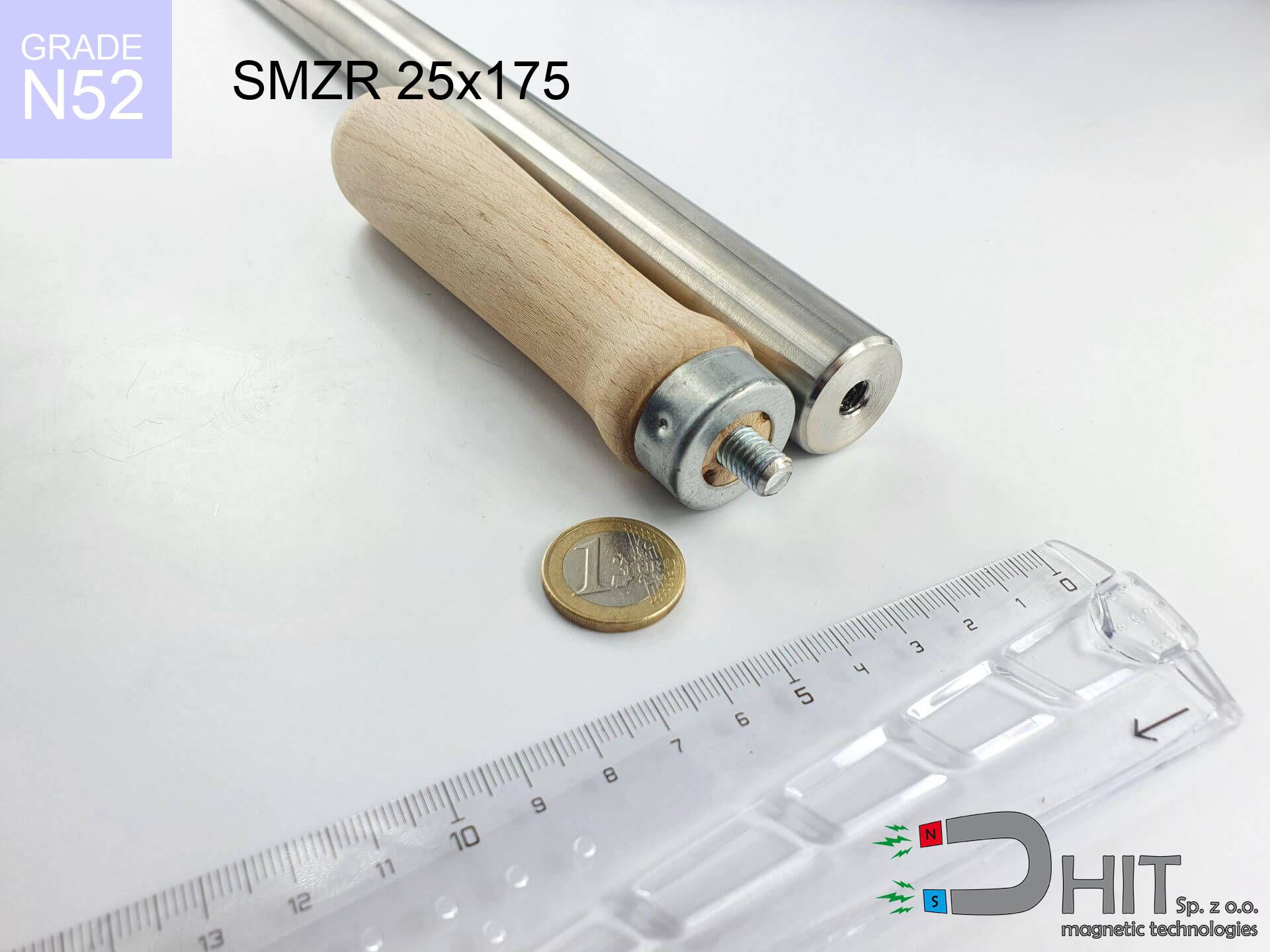
SMZR 25x175 / N52 - magnetic separator with handle
magnetic separator with handle
Catalog no 140443
GTIN/EAN: 5906301813491
- Diameter Ø
- 25 mm [±1 mm]
- Height
- 175 mm [±1 mm]
- Weight
- 0.01 g
- Magnetic Flux
- ~ 8 500 Gauss [±5%]
How we measure these parameters — certificates and measurements
460.00 zł net / pcs
565.80 zł with VAT (23% VAT) / pcs
400.00 zł net was the lowest price in the last 30 days
bulk discounts:
Need more?Frequently asked questions
How do I choose a separator for fine contamination and check availability?
Where can I order a separator for a production line, and what should I check?
How can I verify a separator's declared magnetic parameters before purchase?
Can a magnetic beam withstand continuous work on a production line?
What roller design is suitable for a dusty environment?
How do I choose the size of a hand-held separator?
What is a hand-held separator for, and how is it different from a built-in rod?
Which separator type suits a small production plant?
Call us now
+48 888 99 98 98
alternatively let us know using
contact form
the contact section.
Specifications and structure of a neodymium magnet can be estimated using our
power calculator.
Order by 14:00 and we’ll ship today!
Detailed specification - SMZR 25x175 / N52 - magnetic separator with handle
Specification / characteristics - SMZR 25x175 / N52 - magnetic separator with handle
| properties | values |
|---|---|
| Cat. no. | 140443 |
| GTIN/EAN | 5906301813491 |
| Production/Distribution | Dhit sp. z o.o. |
| Country of origin | Poland / China / Germany |
| Customs code | 85059029 |
| Diameter Ø | 25 mm [±1 mm] |
| Height | 175 mm [±1 mm] |
| Weight | 0.01 g |
| Material Type | Stainless steel AISI 304 / A2 |
| Magnetic Flux | ~ 8 500 Gauss [±5%] |
| Size/Mount Quantity | M8x2 |
| Polarity | circumferential - 6 poles |
| Casing Tube Thickness | 1 mm |
| Manufacturing Tolerance | ±1 mm |
Magnetic properties of material N52
| properties | values | units |
|---|---|---|
| Remanence Br ? | 14.2-14.7 | kGs |
| Remanence Br ? | 1420-1470 | mT |
| Coercivity bHc ? | 10.8-12.5 | kOe |
| Coercivity bHc ? | 860-995 | kA/m |
| Intrinsic coercivity iHc | ≥ 12 | kOe |
| Intrinsic coercivity iHc | ≥ 955 | kA/m |
| Energy product BHmax ? | 48-53 | BH max MGOe |
| Energy product BHmax ? | 380-422 | BH max KJ/m |
| Maximum working temperature ? | ≤ 60 | °C |
Physical properties of sintered neodymium magnets Nd2Fe14B at 20°C
| properties | values | units |
|---|---|---|
| Vickers hardness | ≥550 | Hv |
| Density | ≥7.4 | g/cm3 |
| Curie Temperature TC | 310 | °C |
| Curie Temperature TF | 590 | °F |
| Specific resistance | 150 | μΩ⋅cm |
| Bending strength | 250 | MPa |
| Compressive strength | 1000~1100 | MPa |
| Thermal expansion parallel (∥) to orientation (M) | (3-4) x 10-6 | °C-1 |
| Thermal expansion perpendicular (⊥) to orientation (M) | -(1-3) x 10-6 | °C-1 |
| Young's modulus | 1.7 x 10⁴ | kg/mm² |
Table 1: Rod construction
SMZR 25x175 / N52
| Parameter | Value | Description / Unit |
|---|---|---|
| Diameter (Ø) | 25 | mm |
| Total length | 175 | mm (L) |
| Active length | 155 | mm |
| Section count | 6 | modules |
| Dead zone | 20 | mm (Blaszka 2mm + Gwint 18mm) |
| Weight (est.) | ~653 | g |
| Active area | 122 | cm² (Area) |
| Housing material | AISI 304 | 1.4301 (Inox) |
| Surface finish | Ra < 0.8 µm | Polished |
| Temp. class | 60°C | N52 |
| Force loss (at max °C) | -8.6% | Reversible loss (physics) |
| Force (calculated) | 18.1 | kg (theor.) |
| Induction (surface) | ~8 500 | Gauss (Max) |
Chart 2: Field profile (6 sections)
Chart 3: Temperature performance
Elemental analysis
| iron (Fe) | 64% – 68% |
| neodymium (Nd) | 29% – 32% |
| boron (B) | 1.1% – 1.2% |
| dysprosium (Dy) | 0.5% – 2.0% |
| coating (Ni-Cu-Ni) | < 0.05% |
Ecology and recycling (GPSR)
| recyclability (EoL) | 100% |
| recycled raw materials | ~10% (pre-cons) |
| carbon footprint | low / zredukowany |
| waste code (EWC) | 16 02 16 |
View more proposals
![UI 40x12x7 [CA] - badge holder](https://cdn3.dhit.pl/graphics/products/ui40x12x7-vop.jpg "UI 40x12x7 [CA] - badge holder")
![AM szekla [M10] - magnetic accessories](https://cdn3.dhit.pl/graphics/products/am-szekla-m10-zeh.jpg "AM szekla [M10] - magnetic accessories")
Pros and cons of Nd2Fe14B magnets.
Strengths
- They virtually do not lose strength, because even after 10 years the decline in efficiency is only ~1% (based on calculations),
- Magnets very well defend themselves against loss of magnetization caused by foreign field sources,
- A magnet with a shiny silver surface has better aesthetics,
- The surface of neodymium magnets generates a maximum magnetic field – this is one of their assets,
- Thanks to resistance to high temperature, they can operate (depending on the shape) even at temperatures up to 230°C and higher...
- Due to the option of precise shaping and customization to unique requirements, magnetic components can be created in a wide range of shapes and sizes, which increases their versatility,
- Versatile presence in high-tech industry – they serve a role in magnetic memories, electromotive mechanisms, medical equipment, also technologically advanced constructions.
- Compactness – despite small sizes they generate large force, making them ideal for precision applications
Limitations
- They are fragile upon heavy impacts. To avoid cracks, it is worth protecting magnets using a steel holder. Such protection not only protects the magnet but also increases its resistance to damage
- Do not exceed this material temperature limit: 60°C. Overheating may permanently weaken the magnet.
- Magnets exposed to a humid environment can corrode. Therefore while using outdoors, we advise using waterproof magnets made of rubber, plastic or other material protecting against moisture
- Limited ability of making threads in the magnet and complicated shapes - preferred is casing - magnetic holder.
- Possible danger to health – tiny shards of magnets are risky, if swallowed, which is particularly important in the context of child health protection. It is also worth noting that tiny parts of these magnets can be problematic in diagnostics medical when they are in the body.
- High unit price – neodymium magnets are more expensive than other types of magnets (e.g. ferrite), which can limit application in large quantities
Lifting parameters
Highest magnetic holding force – what affects it?
- on a block made of structural steel, perfectly concentrating the magnetic field
- with a cross-section of at least 10 mm
- with an polished touching surface
- under conditions of gap-free contact (surface-to-surface)
- during detachment in a direction vertical to the plane
- at temperature room level
Determinants of practical lifting force of a magnet
- Distance (betwixt the magnet and the plate), as even a microscopic distance (e.g. 0.5 mm) results in a reduction in lifting capacity by up to 50% (this also applies to varnish, rust or dirt).
- Loading method – declared lifting capacity refers to pulling vertically. When applying parallel force, the magnet holds much less (typically approx. 20-30% of nominal force).
- Metal thickness – the thinner the sheet, the weaker the hold. Part of the magnetic field passes through the material instead of converting into lifting capacity.
- Metal type – different alloys reacts the same. Alloy additives weaken the attraction effect.
- Surface condition – ground elements guarantee perfect abutment, which improves field saturation. Rough surfaces weaken the grip.
- Operating temperature – neodymium magnets have a sensitivity to temperature. At higher temperatures they lose power, and at low temperatures gain strength (up to a certain limit).
Lifting capacity was determined by applying a polished steel plate of optimal thickness (min. 20 mm), under perpendicular pulling force, however under parallel forces the holding force is lower. In addition, even a minimal clearance between the magnet and the plate reduces the lifting capacity.
Precautions when working with NdFeB magnets
Do not underestimate power
Exercise caution. Neodymium magnets act from a distance and snap with massive power, often faster than you can move away.
Eye protection
NdFeB magnets are ceramic materials, meaning they are prone to chipping. Impact of two magnets leads to them shattering into small pieces.
Do not drill into magnets
Dust produced during cutting of magnets is self-igniting. Do not drill into magnets unless you are an expert.
Danger to the youngest
Only for adults. Tiny parts can be swallowed, causing intestinal necrosis. Keep away from kids and pets.
Demagnetization risk
Standard neodymium magnets (N-type) undergo demagnetization when the temperature exceeds 80°C. The loss of strength is permanent.
Safe distance
Avoid bringing magnets near a wallet, computer, or screen. The magnetism can irreversibly ruin these devices and erase data from cards.
Precision electronics
A strong magnetic field negatively affects the functioning of magnetometers in phones and GPS navigation. Maintain magnets near a smartphone to prevent damaging the sensors.
Health Danger
People with a pacemaker have to keep an safe separation from magnets. The magnetic field can stop the functioning of the implant.
Crushing force
Pinching hazard: The attraction force is so immense that it can cause hematomas, crushing, and broken bones. Use thick gloves.
Avoid contact if allergic
Some people suffer from a contact allergy to Ni, which is the typical protective layer for NdFeB magnets. Prolonged contact can result in an allergic reaction. It is best to wear protective gloves.
Tabela kosztu i czasu dostawy
Płatność przed wysyłką:

GLS kurier
Przesyłka będzie u Ciebie za 2-3 dni
14.99 ZŁ

InPost Paczkomaty 24/7
Przesyłka będzie u Ciebie za 1-2 dni
12.30 ZŁ
Płatność przy odbiorze (pobranie):
GLS kurier
Przesyłka będzie u Ciebie za 1-2 dni
23.00 ZŁ