

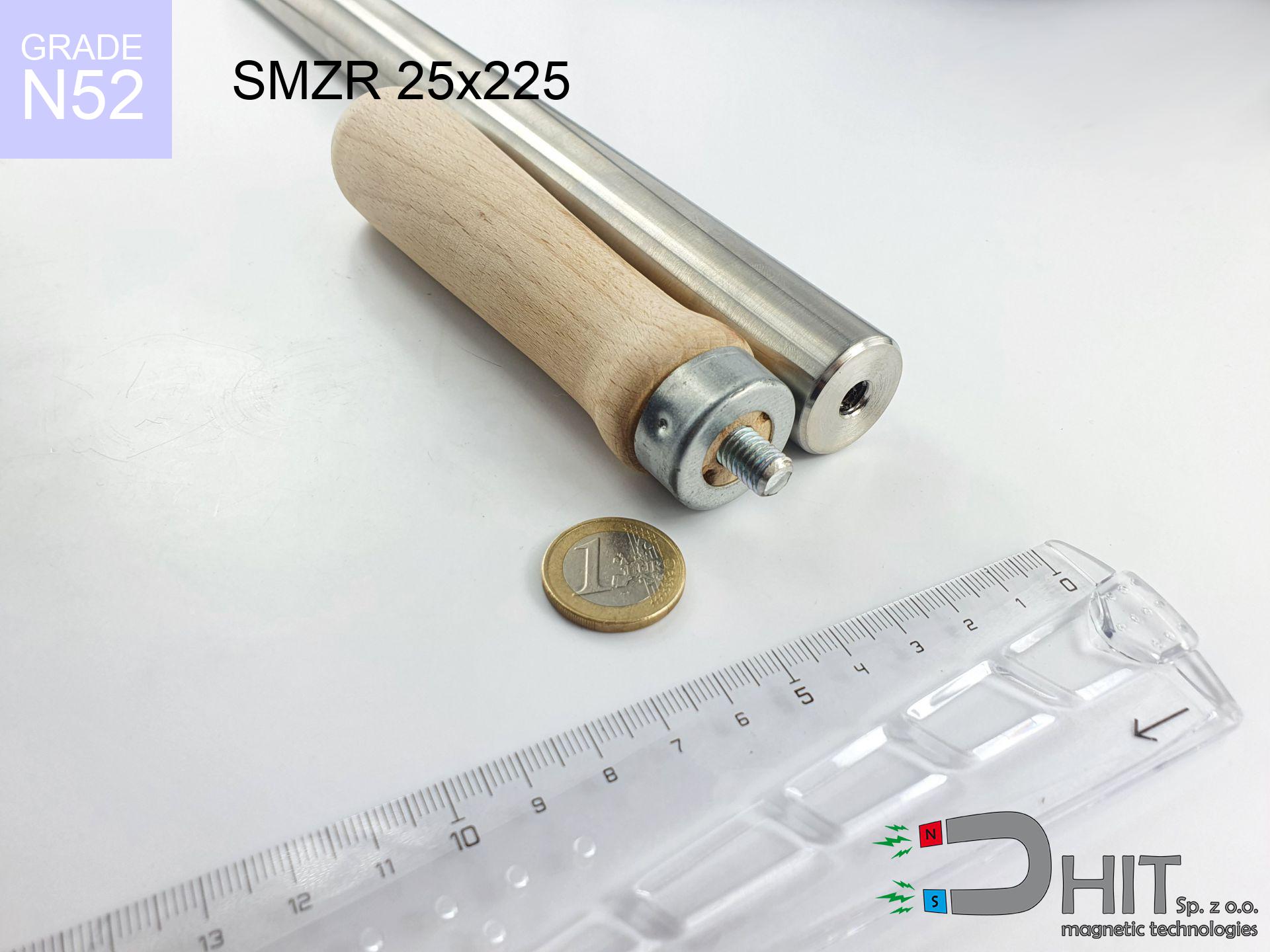
SMZR 25x225 / N52 - magnetic separator with handle
magnetic separator with handle
Catalog no 140235
GTIN/EAN: 5906301813439
- Diameter Ø
- 25 mm [±1 mm]
- Height
- 225 mm [±1 mm]
- Weight
- 740 g
- Magnetic Flux
- ~ 8 500 Gauss [±5%]
How we measure these parameters — certificates and measurements
550.00 zł net / pcs
676.50 zł with VAT (23% VAT) / pcs
500.00 zł net was the lowest price in the last 30 days
bulk discounts:
Need more?Frequently asked questions
How do I choose a separator for fine contamination and check availability?
Where can I order a separator for a production line, and what should I check?
How can I verify a separator's declared magnetic parameters before purchase?
Can a magnetic beam withstand continuous work on a production line?
What roller design is suitable for a dusty environment?
How do I choose the size of a hand-held separator?
What is a hand-held separator for, and how is it different from a built-in rod?
Which separator type suits a small production plant?
Call us now
+48 888 99 98 98
alternatively let us know using
contact form
the contact section.
Specifications and structure of a neodymium magnet can be estimated using our
power calculator.
Order by 14:00 and we’ll ship today!
Technical parameters - SMZR 25x225 / N52 - magnetic separator with handle
Specification / characteristics - SMZR 25x225 / N52 - magnetic separator with handle
| properties | values |
|---|---|
| Cat. no. | 140235 |
| GTIN/EAN | 5906301813439 |
| Production/Distribution | Dhit sp. z o.o. |
| Country of origin | Poland / China / Germany |
| Customs code | 85059029 |
| Diameter Ø | 25 mm [±1 mm] |
| Height | 225 mm [±1 mm] |
| Weight | 740 g |
| Material Type | Stainless steel AISI 304 / A2 |
| Magnetic Flux | ~ 8 500 Gauss [±5%] |
| Size/Mount Quantity | M8x2 |
| Polarity | circumferential - 8 poles |
| Casing Tube Thickness | 1 mm |
| Manufacturing Tolerance | ±1 mm |
Magnetic properties of material N52
| properties | values | units |
|---|---|---|
| Remanence Br ? | 14.2-14.7 | kGs |
| Remanence Br ? | 1420-1470 | mT |
| Coercivity bHc ? | 10.8-12.5 | kOe |
| Coercivity bHc ? | 860-995 | kA/m |
| Intrinsic coercivity iHc | ≥ 12 | kOe |
| Intrinsic coercivity iHc | ≥ 955 | kA/m |
| Energy product BHmax ? | 48-53 | BH max MGOe |
| Energy product BHmax ? | 380-422 | BH max KJ/m |
| Maximum working temperature ? | ≤ 60 | °C |
Physical properties of sintered neodymium magnets Nd2Fe14B at 20°C
| properties | values | units |
|---|---|---|
| Vickers hardness | ≥550 | Hv |
| Density | ≥7.4 | g/cm3 |
| Curie Temperature TC | 310 | °C |
| Curie Temperature TF | 590 | °F |
| Specific resistance | 150 | μΩ⋅cm |
| Bending strength | 250 | MPa |
| Compressive strength | 1000~1100 | MPa |
| Thermal expansion parallel (∥) to orientation (M) | (3-4) x 10-6 | °C-1 |
| Thermal expansion perpendicular (⊥) to orientation (M) | -(1-3) x 10-6 | °C-1 |
| Young's modulus | 1.7 x 10⁴ | kg/mm² |
Table 1: Rod construction
SMZR 25x225 / N52
| Parameter | Value | Description / Unit |
|---|---|---|
| Diameter (Ø) | 25 | mm |
| Total length | 225 | mm (L) |
| Active length | 205 | mm |
| Section count | 8 | modules |
| Dead zone | 20 | mm (Blaszka 2mm + Gwint 18mm) |
| Weight (est.) | ~839 | g |
| Active area | 161 | cm² (Area) |
| Housing material | AISI 304 | 1.4301 (Inox) |
| Surface finish | Ra < 0.8 µm | Polished |
| Temp. class | 60°C | N52 |
| Force loss (at max °C) | -8.6% | Reversible loss (physics) |
| Force (calculated) | 18.1 | kg (theor.) |
| Induction (surface) | ~8 500 | Gauss (Max) |
Chart 2: Field profile (8 sections)
Chart 3: Temperature performance
Material specification
| iron (Fe) | 64% – 68% |
| neodymium (Nd) | 29% – 32% |
| boron (B) | 1.1% – 1.2% |
| dysprosium (Dy) | 0.5% – 2.0% |
| coating (Ni-Cu-Ni) | < 0.05% |
Ecology and recycling (GPSR)
| recyclability (EoL) | 100% |
| recycled raw materials | ~10% (pre-cons) |
| carbon footprint | low / zredukowany |
| waste code (EWC) | 16 02 16 |
See also deals


![SM 32x125 [2xM8] / N52 - magnetic separator](https://cdn3.dhit.pl/graphics/products/sm-32x125-2xm8-moj.jpg "SM 32x125 [2xM8] / N52 - magnetic separator")
Advantages and disadvantages of neodymium magnets.
Strengths
- Their power is maintained, and after around ten years it drops only by ~1% (according to research),
- They are noted for resistance to demagnetization induced by presence of other magnetic fields,
- The use of an aesthetic coating of noble metals (nickel, gold, silver) causes the element to look better,
- Magnetic induction on the working part of the magnet remains impressive,
- Neodymium magnets are characterized by very high magnetic induction on the magnet surface and can function (depending on the shape) even at a temperature of 230°C or more...
- Possibility of individual forming as well as adjusting to complex needs,
- Significant place in future technologies – they are used in hard drives, motor assemblies, advanced medical instruments, also multitasking production systems.
- Compactness – despite small sizes they provide effective action, making them ideal for precision applications
Weaknesses
- They are prone to damage upon too strong impacts. To avoid cracks, it is worth protecting magnets in special housings. Such protection not only shields the magnet but also increases its resistance to damage
- Do not exceed this material temperature limit: 60°C. Overheating may permanently weaken the magnet.
- They rust in a humid environment. For use outdoors we advise using waterproof magnets e.g. in rubber, plastic
- We suggest casing - magnetic holder, due to difficulties in realizing nuts inside the magnet and complicated forms.
- Possible danger resulting from small fragments of magnets are risky, in case of ingestion, which gains importance in the context of child safety. It is also worth noting that tiny parts of these magnets can disrupt the diagnostic process medical in case of swallowing.
- Due to complex production process, their price is relatively high,
Holding force characteristics
Maximum lifting force for a neodymium magnet – what contributes to it?
- with the contact of a sheet made of low-carbon steel, guaranteeing maximum field concentration
- whose thickness equals approx. 10 mm
- characterized by even structure
- under conditions of ideal adhesion (metal-to-metal)
- for force acting at a right angle (pull-off, not shear)
- at temperature room level
Key elements affecting lifting force
- Gap (between the magnet and the metal), as even a tiny distance (e.g. 0.5 mm) can cause a reduction in force by up to 50% (this also applies to varnish, corrosion or debris).
- Direction of force – highest force is available only during perpendicular pulling. The shear force of the magnet along the surface is typically several times lower (approx. 1/5 of the lifting capacity).
- Substrate thickness – for full efficiency, the steel must be sufficiently thick. Paper-thin metal restricts the lifting capacity (the magnet "punches through" it).
- Plate material – mild steel attracts best. Higher carbon content decrease magnetic properties and lifting capacity.
- Surface finish – full contact is possible only on polished steel. Any scratches and bumps reduce the real contact area, reducing force.
- Temperature – heating the magnet causes a temporary drop of induction. Check the maximum operating temperature for a given model.
Holding force was checked on a smooth steel plate of 20 mm thickness, when a perpendicular force was applied, whereas under attempts to slide the magnet the holding force is lower. Additionally, even a minimal clearance between the magnet’s surface and the plate lowers the lifting capacity.
Safe handling of neodymium magnets
Safe distance
Avoid bringing magnets close to a purse, laptop, or screen. The magnetism can permanently damage these devices and erase data from cards.
Do not overheat magnets
Do not overheat. Neodymium magnets are susceptible to temperature. If you need operation above 80°C, ask us about HT versions (H, SH, UH).
Sensitization to coating
A percentage of the population have a sensitization to nickel, which is the typical protective layer for neodymium magnets. Prolonged contact can result in an allergic reaction. We strongly advise wear safety gloves.
Do not drill into magnets
Mechanical processing of NdFeB material carries a risk of fire hazard. Magnetic powder reacts violently with oxygen and is difficult to extinguish.
Do not underestimate power
Use magnets consciously. Their powerful strength can shock even experienced users. Plan your moves and do not underestimate their force.
Implant safety
Individuals with a ICD have to maintain an absolute distance from magnets. The magnetic field can interfere with the functioning of the implant.
Magnetic interference
Remember: rare earth magnets produce a field that confuses precision electronics. Maintain a separation from your mobile, tablet, and GPS.
Shattering risk
Beware of splinters. Magnets can fracture upon violent connection, ejecting shards into the air. Wear goggles.
Finger safety
Risk of injury: The pulling power is so great that it can result in hematomas, pinching, and even bone fractures. Protective gloves are recommended.
Choking Hazard
These products are not suitable for play. Eating multiple magnets can lead to them connecting inside the digestive tract, which constitutes a severe health hazard and requires urgent medical intervention.
Tabela kosztu i czasu dostawy
Płatność przed wysyłką:

GLS kurier
Przesyłka będzie u Ciebie za 2-3 dni
14.99 ZŁ

InPost Paczkomaty 24/7
Przesyłka będzie u Ciebie za 1-2 dni
12.30 ZŁ
Płatność przy odbiorze (pobranie):
GLS kurier
Przesyłka będzie u Ciebie za 1-2 dni
23.00 ZŁ