

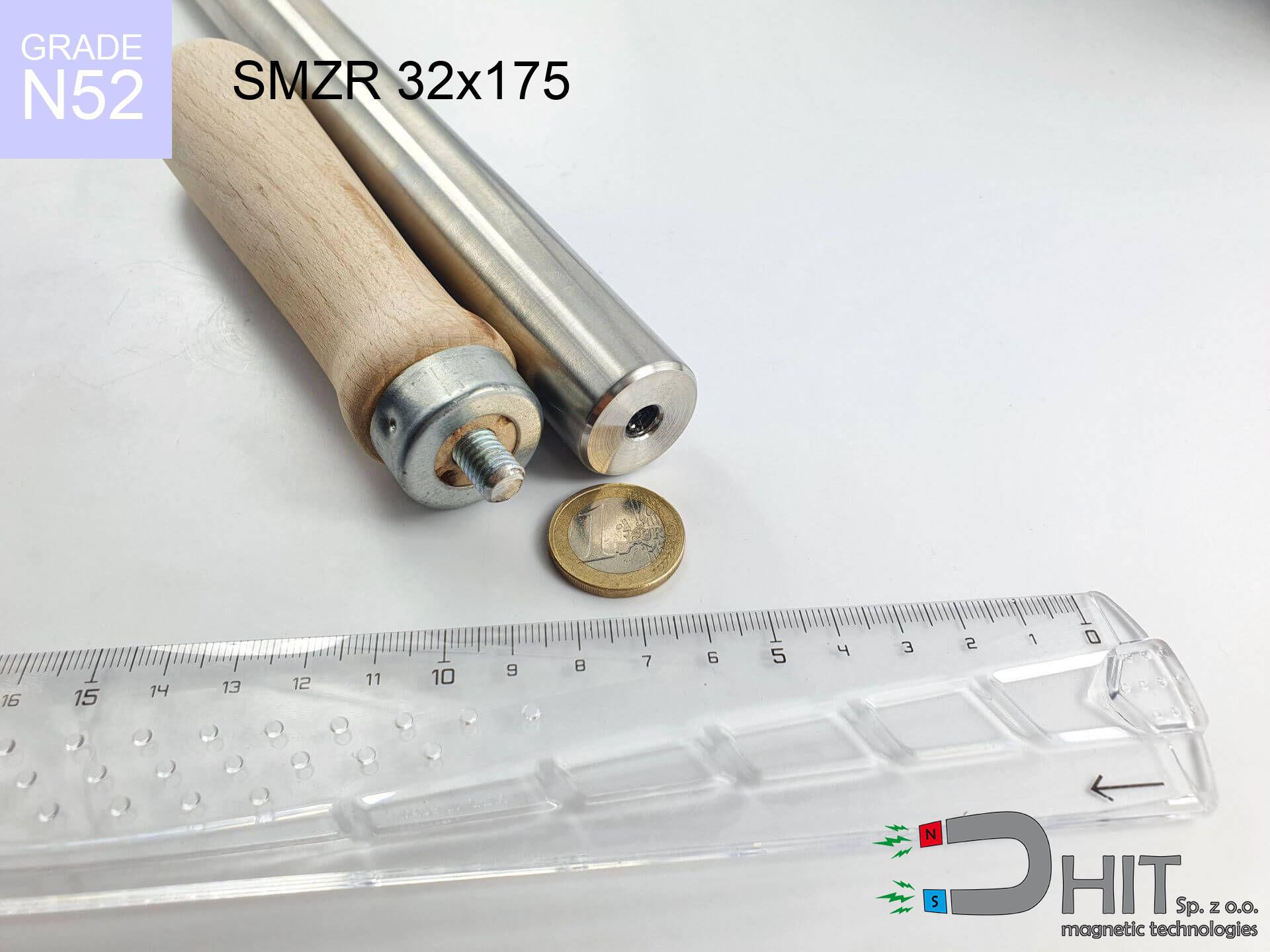
SMZR 32x175 / N52 - magnetic separator with handle
magnetic separator with handle
Catalog no 140445
GTIN/EAN: 5906301813514
- Diameter Ø
- 32 mm [±1 mm]
- Height
- 175 mm [±1 mm]
- Weight
- 1070 g
- Magnetic Flux
- ~ 10 000 Gauss [±5%]
How we measure these parameters — certificates and measurements
530.00 zł net / pcs
651.90 zł with VAT (23% VAT) / pcs
bulk discounts:
Need more?Frequently asked questions
How do I choose a separator for fine contamination and check availability?
Where can I order a separator for a production line, and what should I check?
How can I verify a separator's declared magnetic parameters before purchase?
Can a magnetic beam withstand continuous work on a production line?
What roller design is suitable for a dusty environment?
How do I choose the size of a hand-held separator?
What is a hand-held separator for, and how is it different from a built-in rod?
Which separator type suits a small production plant?
Call us now
+48 888 99 98 98
alternatively let us know using
contact form
the contact section.
Specifications and structure of a neodymium magnet can be estimated using our
power calculator.
Order by 14:00 and we’ll ship today!
Physical properties - SMZR 32x175 / N52 - magnetic separator with handle
Specification / characteristics - SMZR 32x175 / N52 - magnetic separator with handle
| properties | values |
|---|---|
| Cat. no. | 140445 |
| GTIN/EAN | 5906301813514 |
| Production/Distribution | Dhit sp. z o.o. |
| Country of origin | Poland / China / Germany |
| Customs code | 85059029 |
| Diameter Ø | 32 mm [±1 mm] |
| Height | 175 mm [±1 mm] |
| Weight | 1070 g |
| Material Type | Stainless steel AISI 304 / A2 |
| Magnetic Flux | ~ 10 000 Gauss [±5%] |
| Size/Mount Quantity | 2xM8 |
| Polarity | circumferential - 5 poles |
| Casing Tube Thickness | 1 mm |
| Manufacturing Tolerance | ±1 mm |
Magnetic properties of material N52
| properties | values | units |
|---|---|---|
| Remanence Br ? | 14.2-14.7 | kGs |
| Remanence Br ? | 1420-1470 | mT |
| Coercivity bHc ? | 10.8-12.5 | kOe |
| Coercivity bHc ? | 860-995 | kA/m |
| Intrinsic coercivity iHc | ≥ 12 | kOe |
| Intrinsic coercivity iHc | ≥ 955 | kA/m |
| Energy product BHmax ? | 48-53 | BH max MGOe |
| Energy product BHmax ? | 380-422 | BH max KJ/m |
| Maximum working temperature ? | ≤ 60 | °C |
Physical properties of sintered neodymium magnets Nd2Fe14B at 20°C
| properties | values | units |
|---|---|---|
| Vickers hardness | ≥550 | Hv |
| Density | ≥7.4 | g/cm3 |
| Curie Temperature TC | 310 | °C |
| Curie Temperature TF | 590 | °F |
| Specific resistance | 150 | μΩ⋅cm |
| Bending strength | 250 | MPa |
| Compressive strength | 1000~1100 | MPa |
| Thermal expansion parallel (∥) to orientation (M) | (3-4) x 10-6 | °C-1 |
| Thermal expansion perpendicular (⊥) to orientation (M) | -(1-3) x 10-6 | °C-1 |
| Young's modulus | 1.7 x 10⁴ | kg/mm² |
Table 1: Rod construction
SMZR 32x175 / N52
| Parameter | Value | Description / Unit |
|---|---|---|
| Diameter (Ø) | 32 | mm |
| Total length | 175 | mm (L) |
| Active length | 155 | mm |
| Section count | 6 | modules |
| Dead zone | 20 | mm (Blaszka 2mm + Gwint 18mm) |
| Weight (est.) | ~1070 | g |
| Active area | 156 | cm² (Area) |
| Housing material | AISI 304 | 1.4301 (Inox) |
| Surface finish | Ra < 0.8 µm | Polished |
| Temp. class | 60°C | N52 |
| Force loss (at max °C) | -8.6% | Reversible loss (physics) |
| Force (calculated) | 41 | kg (theor.) |
| Induction (surface) | ~10 000 | Gauss (Max) |
Chart 2: Field profile (6 sections)
Chart 3: Temperature performance
Chemical composition
| iron (Fe) | 64% – 68% |
| neodymium (Nd) | 29% – 32% |
| boron (B) | 1.1% – 1.2% |
| dysprosium (Dy) | 0.5% – 2.0% |
| coating (Ni-Cu-Ni) | < 0.05% |
Ecology and recycling (GPSR)
| recyclability (EoL) | 100% |
| recycled raw materials | ~10% (pre-cons) |
| carbon footprint | low / zredukowany |
| waste code (EWC) | 16 02 16 |
Other products
![BM 650x180x70 [4x M8] - magnetic beam](https://cdn3.dhit.pl/graphics/products/bm-650x180x70-4x-m8-laj.jpg "BM 650x180x70 [4x M8] - magnetic beam")
![SM 32x300 [2xM8] / N52 - magnetic separator](https://cdn3.dhit.pl/graphics/products/sm-32x300-2xm8-luf.jpg "SM 32x300 [2xM8] / N52 - magnetic separator")
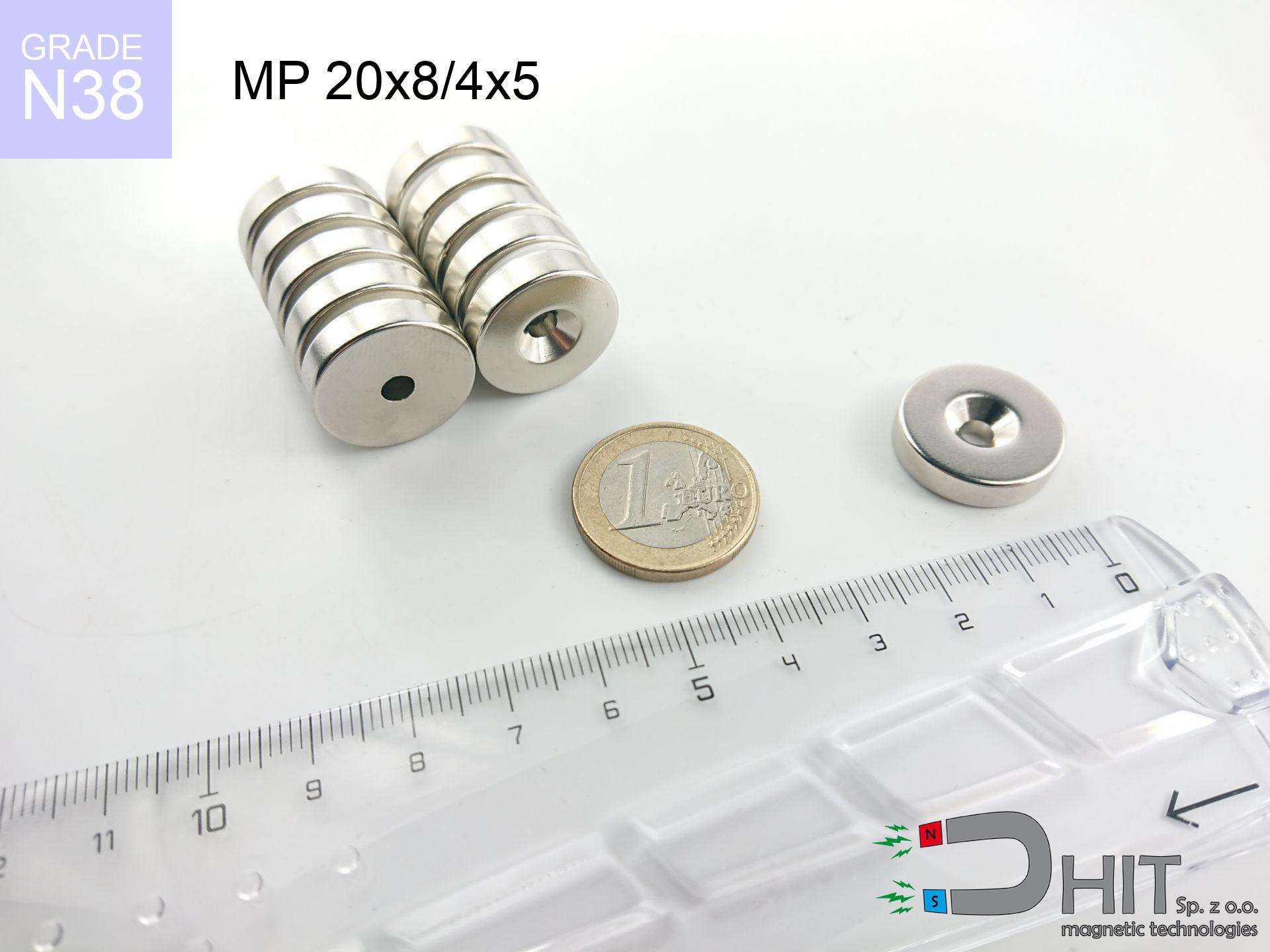

Advantages and disadvantages of Nd2Fe14B magnets.
Strengths
- They have constant strength, and over more than ten years their attraction force decreases symbolically – ~1% (according to theory),
- They possess excellent resistance to magnetism drop as a result of external fields,
- By using a shiny layer of silver, the element gains an elegant look,
- Magnetic induction on the surface of the magnet turns out to be exceptional,
- Due to their durability and thermal resistance, neodymium magnets can operate (depending on the form) even at high temperatures reaching 230°C or more...
- Considering the potential of flexible shaping and customization to individualized needs, neodymium magnets can be manufactured in a broad palette of geometric configurations, which expands the range of possible applications,
- Fundamental importance in innovative solutions – they are used in HDD drives, brushless drives, medical equipment, as well as complex engineering applications.
- Relatively small size with high pulling force – neodymium magnets offer high power in tiny dimensions, which makes them useful in compact constructions
Weaknesses
- They are fragile upon heavy impacts. To avoid cracks, it is worth protecting magnets using a steel holder. Such protection not only protects the magnet but also improves its resistance to damage
- Do not exceed this material temperature limit: 60°C. Overheating may permanently weaken the magnet.
- When exposed to humidity, magnets start to rust. To use them in conditions outside, it is recommended to use protective magnets, such as those in rubber or plastics, which prevent oxidation and corrosion.
- We recommend casing - magnetic mechanism, due to difficulties in creating threads inside the magnet and complicated shapes.
- Health risk resulting from small fragments of magnets pose a threat, in case of ingestion, which is particularly important in the context of child safety. It is also worth noting that small elements of these magnets can disrupt the diagnostic process medical when they are in the body.
- High unit price – neodymium magnets cost more than other types of magnets (e.g. ferrite), which increases costs of application in large quantities
Pull force analysis
Breakaway strength of the magnet in ideal conditions – what affects it?
- on a base made of structural steel, effectively closing the magnetic flux
- with a cross-section no less than 10 mm
- with an ideally smooth touching surface
- with direct contact (no coatings)
- during pulling in a direction vertical to the plane
- in temp. approx. 20°C
Determinants of practical lifting force of a magnet
- Distance – the presence of foreign body (paint, tape, gap) interrupts the magnetic circuit, which lowers power steeply (even by 50% at 0.5 mm).
- Force direction – remember that the magnet has greatest strength perpendicularly. Under shear forces, the holding force drops drastically, often to levels of 20-30% of the nominal value.
- Plate thickness – too thin plate does not accept the full field, causing part of the flux to be escaped into the air.
- Steel type – low-carbon steel gives the best results. Alloy admixtures decrease magnetic properties and lifting capacity.
- Surface quality – the more even the surface, the better the adhesion and stronger the hold. Roughness acts like micro-gaps.
- Temperature influence – high temperature weakens pulling force. Too high temperature can permanently damage the magnet.
Holding force was tested on the plate surface of 20 mm thickness, when a perpendicular force was applied, however under shearing force the lifting capacity is smaller. In addition, even a slight gap between the magnet and the plate decreases the holding force.
Safety rules for work with NdFeB magnets
Data carriers
Do not bring magnets near a wallet, computer, or screen. The magnetic field can irreversibly ruin these devices and wipe information from cards.
Protective goggles
Protect your eyes. Magnets can explode upon violent connection, launching sharp fragments into the air. Wear goggles.
Crushing force
Watch your fingers. Two large magnets will join immediately with a force of several hundred kilograms, crushing anything in their path. Exercise extreme caution!
Combustion hazard
Drilling and cutting of neodymium magnets poses a fire hazard. Neodymium dust reacts violently with oxygen and is hard to extinguish.
Operating temperature
Avoid heat. Neodymium magnets are sensitive to heat. If you require operation above 80°C, look for special high-temperature series (H, SH, UH).
Choking Hazard
Only for adults. Tiny parts can be swallowed, causing intestinal necrosis. Keep away from kids and pets.
Caution required
Before starting, check safety instructions. Uncontrolled attraction can destroy the magnet or injure your hand. Think ahead.
Compass and GPS
GPS units and mobile phones are extremely susceptible to magnetism. Close proximity with a strong magnet can ruin the internal compass in your phone.
ICD Warning
Life threat: Strong magnets can deactivate heart devices and defibrillators. Stay away if you have medical devices.
Allergic reactions
Some people experience a contact allergy to nickel, which is the standard coating for NdFeB magnets. Frequent touching can result in a rash. We recommend wear protective gloves.
Tabela kosztu i czasu dostawy
Płatność przed wysyłką:

GLS kurier
Przesyłka będzie u Ciebie za 2-3 dni
14.99 ZŁ

InPost Paczkomaty 24/7
Przesyłka będzie u Ciebie za 1-2 dni
12.30 ZŁ
Płatność przy odbiorze (pobranie):
GLS kurier
Przesyłka będzie u Ciebie za 1-2 dni
23.00 ZŁ