

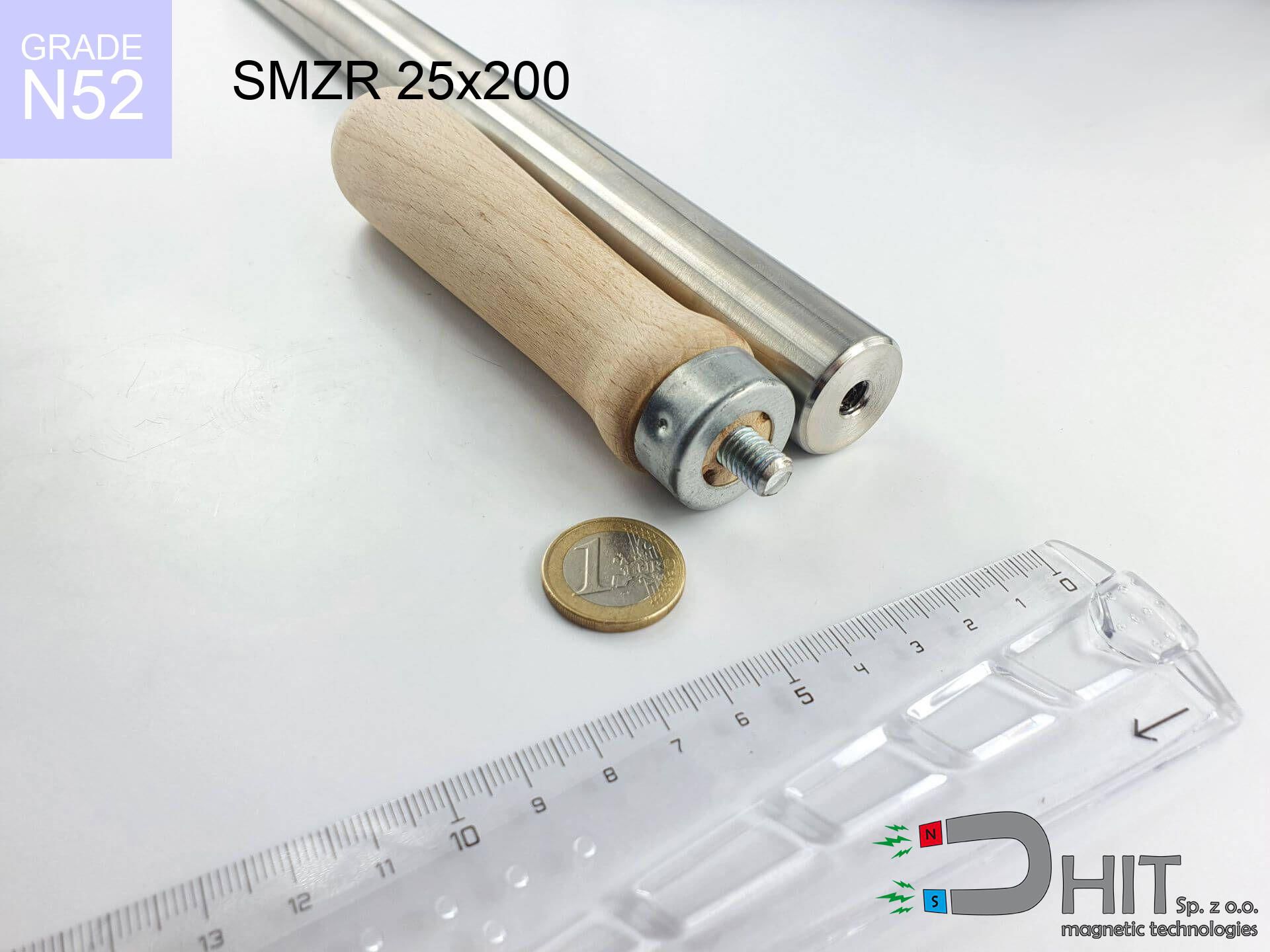
SMZR 25x200 / N52 - magnetic separator with handle
magnetic separator with handle
Catalog no 140444
GTIN/EAN: 5906301813507
- Diameter Ø
- 25 mm [±1 mm]
- Height
- 200 mm [±1 mm]
- Weight
- 0.01 g
- Magnetic Flux
- ~ 8 500 Gauss [±5%]
How we measure these parameters — certificates and measurements
500.00 zł net / pcs
615.00 zł with VAT (23% VAT) / pcs
450.00 zł net was the lowest price in the last 30 days
bulk discounts:
Need more?Frequently asked questions
How do I choose a separator for fine contamination and check availability?
Where can I order a separator for a production line, and what should I check?
How can I verify a separator's declared magnetic parameters before purchase?
Can a magnetic beam withstand continuous work on a production line?
What roller design is suitable for a dusty environment?
How do I choose the size of a hand-held separator?
What is a hand-held separator for, and how is it different from a built-in rod?
Which separator type suits a small production plant?
Call us now
+48 888 99 98 98
alternatively let us know using
contact form
the contact section.
Specifications and structure of a neodymium magnet can be estimated using our
power calculator.
Order by 14:00 and we’ll ship today!
Technical - SMZR 25x200 / N52 - magnetic separator with handle
Specification / characteristics - SMZR 25x200 / N52 - magnetic separator with handle
| properties | values |
|---|---|
| Cat. no. | 140444 |
| GTIN/EAN | 5906301813507 |
| Production/Distribution | Dhit sp. z o.o. |
| Country of origin | Poland / China / Germany |
| Customs code | 85059029 |
| Diameter Ø | 25 mm [±1 mm] |
| Height | 200 mm [±1 mm] |
| Weight | 0.01 g |
| Material Type | Stainless steel AISI 304 / A2 |
| Magnetic Flux | ~ 8 500 Gauss [±5%] |
| Size/Mount Quantity | M8x2 |
| Polarity | circumferential - 7 poles |
| Casing Tube Thickness | 1 mm |
| Manufacturing Tolerance | ±1 mm |
Magnetic properties of material N52
| properties | values | units |
|---|---|---|
| Remanence Br ? | 14.2-14.7 | kGs |
| Remanence Br ? | 1420-1470 | mT |
| Coercivity bHc ? | 10.8-12.5 | kOe |
| Coercivity bHc ? | 860-995 | kA/m |
| Intrinsic coercivity iHc | ≥ 12 | kOe |
| Intrinsic coercivity iHc | ≥ 955 | kA/m |
| Energy product BHmax ? | 48-53 | BH max MGOe |
| Energy product BHmax ? | 380-422 | BH max KJ/m |
| Maximum working temperature ? | ≤ 60 | °C |
Physical properties of sintered neodymium magnets Nd2Fe14B at 20°C
| properties | values | units |
|---|---|---|
| Vickers hardness | ≥550 | Hv |
| Density | ≥7.4 | g/cm3 |
| Curie Temperature TC | 310 | °C |
| Curie Temperature TF | 590 | °F |
| Specific resistance | 150 | μΩ⋅cm |
| Bending strength | 250 | MPa |
| Compressive strength | 1000~1100 | MPa |
| Thermal expansion parallel (∥) to orientation (M) | (3-4) x 10-6 | °C-1 |
| Thermal expansion perpendicular (⊥) to orientation (M) | -(1-3) x 10-6 | °C-1 |
| Young's modulus | 1.7 x 10⁴ | kg/mm² |
Table 1: Rod construction
SMZR 25x200 / N52
| Parameter | Value | Description / Unit |
|---|---|---|
| Diameter (Ø) | 25 | mm |
| Total length | 200 | mm (L) |
| Active length | 180 | mm |
| Section count | 7 | modules |
| Dead zone | 20 | mm (Blaszka 2mm + Gwint 18mm) |
| Weight (est.) | ~746 | g |
| Active area | 141 | cm² (Area) |
| Housing material | AISI 304 | 1.4301 (Inox) |
| Surface finish | Ra < 0.8 µm | Polished |
| Temp. class | 60°C | N52 |
| Force loss (at max °C) | -8.6% | Reversible loss (physics) |
| Force (calculated) | 18.1 | kg (theor.) |
| Induction (surface) | ~8 500 | Gauss (Max) |
Chart 2: Field profile (7 sections)
Chart 3: Temperature performance
Elemental analysis
| iron (Fe) | 64% – 68% |
| neodymium (Nd) | 29% – 32% |
| boron (B) | 1.1% – 1.2% |
| dysprosium (Dy) | 0.5% – 2.0% |
| coating (Ni-Cu-Ni) | < 0.05% |
Sustainability
| recyclability (EoL) | 100% |
| recycled raw materials | ~10% (pre-cons) |
| carbon footprint | low / zredukowany |
| waste code (EWC) | 16 02 16 |
Check out more products

![UMP 75x25 [M10x3] GW F200 GOLD Lina / N42 - search holder](https://cdn3.dhit.pl/graphics/products/ump-75x25-m10x3-gw-f200-gold-lina-buh.jpg "UMP 75x25 [M10x3] GW F200 GOLD Lina / N42 - search holder")
Strengths as well as weaknesses of Nd2Fe14B magnets.
Pros
- They retain full power for around 10 years – the drop is just ~1% (in theory),
- Magnets very well defend themselves against loss of magnetization caused by foreign field sources,
- The use of an refined coating of noble metals (nickel, gold, silver) causes the element to have aesthetics,
- Neodymium magnets generate maximum magnetic induction on a contact point, which ensures high operational effectiveness,
- Through (adequate) combination of ingredients, they can achieve high thermal strength, enabling operation at temperatures approaching 230°C and above...
- Thanks to flexibility in constructing and the ability to customize to specific needs,
- Fundamental importance in modern technologies – they are utilized in hard drives, drive modules, medical equipment, also multitasking production systems.
- Relatively small size with high pulling force – neodymium magnets offer strong magnetic field in compact dimensions, which enables their usage in small systems
Disadvantages
- They are fragile upon heavy impacts. To avoid cracks, it is worth protecting magnets in a protective case. Such protection not only protects the magnet but also increases its resistance to damage
- Do not exceed this material temperature limit: 60°C. Overheating may permanently weaken the magnet.
- Magnets exposed to a humid environment can rust. Therefore when using outdoors, we suggest using waterproof magnets made of rubber, plastic or other material resistant to moisture
- We recommend cover - magnetic mechanism, due to difficulties in creating nuts inside the magnet and complicated forms.
- Possible danger to health – tiny shards of magnets are risky, when accidentally swallowed, which gains importance in the context of child health protection. Furthermore, tiny parts of these products can be problematic in diagnostics medical after entering the body.
- Due to neodymium price, their price exceeds standard values,
Lifting parameters
Maximum lifting capacity of the magnet – what contributes to it?
- on a block made of structural steel, effectively closing the magnetic flux
- possessing a thickness of minimum 10 mm to avoid saturation
- with an ground touching surface
- with direct contact (without coatings)
- under axial force direction (90-degree angle)
- at conditions approx. 20°C
Practical lifting capacity: influencing factors
- Distance (betwixt the magnet and the metal), because even a very small clearance (e.g. 0.5 mm) results in a reduction in force by up to 50% (this also applies to paint, rust or debris).
- Loading method – declared lifting capacity refers to detachment vertically. When slipping, the magnet holds much less (typically approx. 20-30% of nominal force).
- Plate thickness – insufficiently thick sheet causes magnetic saturation, causing part of the flux to be lost into the air.
- Material composition – different alloys reacts the same. Alloy additives worsen the attraction effect.
- Plate texture – smooth surfaces ensure maximum contact, which increases force. Rough surfaces weaken the grip.
- Temperature influence – high temperature reduces magnetic field. Too high temperature can permanently damage the magnet.
Lifting capacity was determined with the use of a steel plate with a smooth surface of optimal thickness (min. 20 mm), under perpendicular detachment force, however under shearing force the load capacity is reduced by as much as 5 times. In addition, even a minimal clearance between the magnet’s surface and the plate lowers the lifting capacity.
Precautions when working with NdFeB magnets
Mechanical processing
Machining of neodymium magnets poses a fire risk. Neodymium dust oxidizes rapidly with oxygen and is hard to extinguish.
Physical harm
Large magnets can crush fingers in a fraction of a second. Never place your hand betwixt two strong magnets.
Warning for allergy sufferers
It is widely known that nickel (the usual finish) is a strong allergen. For allergy sufferers, refrain from direct skin contact and select versions in plastic housing.
Magnets are brittle
Watch out for shards. Magnets can explode upon violent connection, launching shards into the air. Eye protection is mandatory.
Do not give to children
Strictly store magnets away from children. Choking hazard is significant, and the effects of magnets connecting inside the body are very dangerous.
Magnetic media
Do not bring magnets close to a wallet, computer, or TV. The magnetism can irreversibly ruin these devices and wipe information from cards.
Handling rules
Be careful. Neodymium magnets attract from a distance and snap with massive power, often faster than you can react.
Thermal limits
Watch the temperature. Heating the magnet above 80 degrees Celsius will destroy its magnetic structure and pulling force.
Impact on smartphones
A strong magnetic field disrupts the operation of compasses in phones and GPS navigation. Maintain magnets near a smartphone to prevent damaging the sensors.
Implant safety
Medical warning: Strong magnets can deactivate heart devices and defibrillators. Stay away if you have electronic implants.
Tabela kosztu i czasu dostawy
Płatność przed wysyłką:

GLS kurier
Przesyłka będzie u Ciebie za 2-3 dni
14.99 ZŁ

InPost Paczkomaty 24/7
Przesyłka będzie u Ciebie za 1-2 dni
12.30 ZŁ
Płatność przy odbiorze (pobranie):
GLS kurier
Przesyłka będzie u Ciebie za 1-2 dni
23.00 ZŁ