

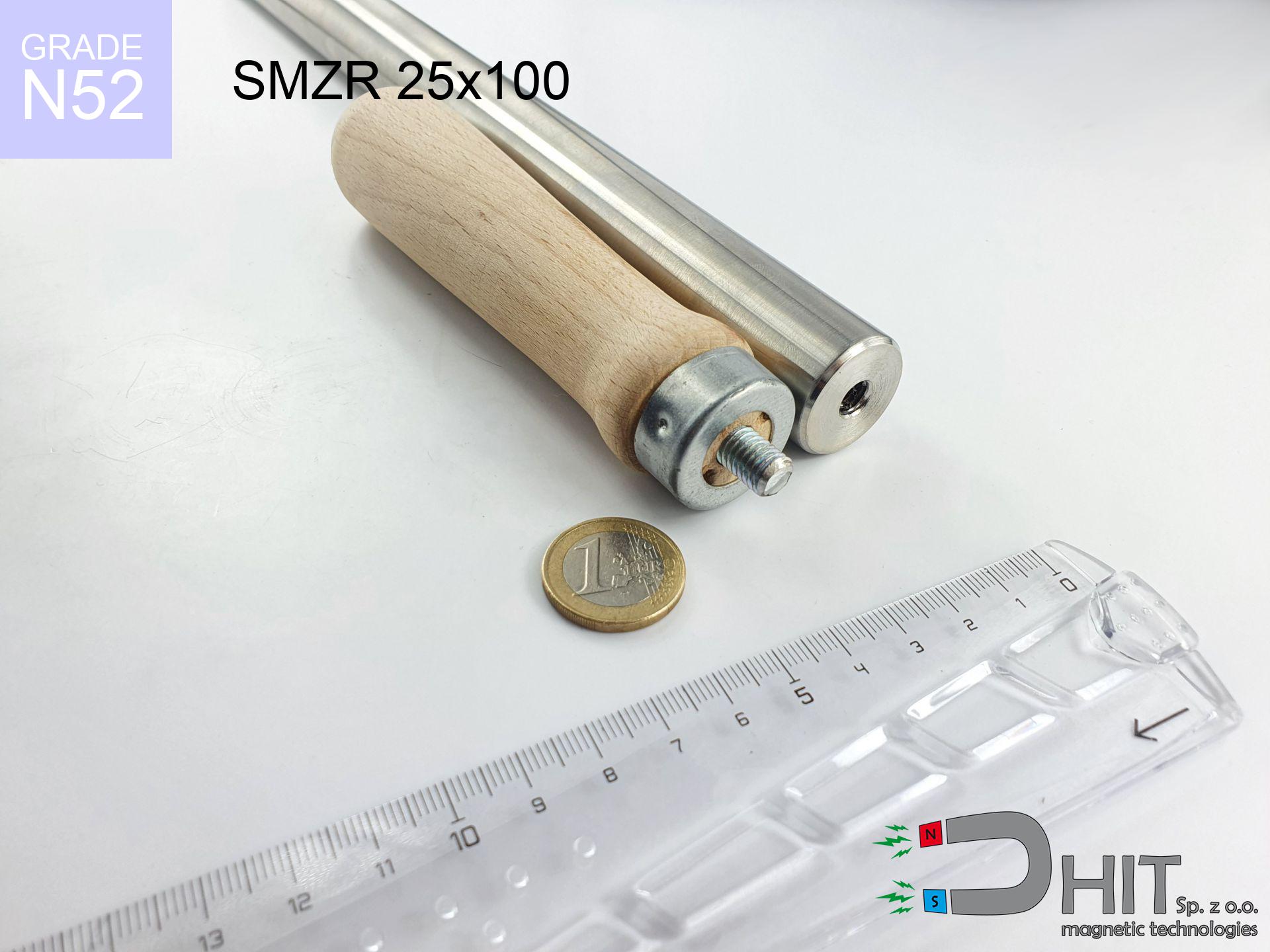
SMZR 25x100 / N52 - magnetic separator with handle
magnetic separator with handle
Catalog no 140232
GTIN/EAN: 5906301813408
- Diameter Ø
- 25 mm [±1 mm]
- Height
- 100 mm [±1 mm]
- Weight
- 440 g
- Magnetic Flux
- ~ 8 500 Gauss [±5%]
How we measure these parameters — certificates and measurements
350.00 zł net / pcs
430.50 zł with VAT (23% VAT) / pcs
250.00 zł net was the lowest price in the last 30 days
bulk discounts:
Need more?Frequently asked questions
How do I choose a separator for fine contamination and check availability?
Where can I order a separator for a production line, and what should I check?
How can I verify a separator's declared magnetic parameters before purchase?
Can a magnetic beam withstand continuous work on a production line?
What roller design is suitable for a dusty environment?
How do I choose the size of a hand-held separator?
What is a hand-held separator for, and how is it different from a built-in rod?
Which separator type suits a small production plant?
Call us now
+48 888 99 98 98
alternatively let us know using
contact form
the contact section.
Specifications and structure of a neodymium magnet can be estimated using our
power calculator.
Order by 14:00 and we’ll ship today!
Physical properties - SMZR 25x100 / N52 - magnetic separator with handle
Specification / characteristics - SMZR 25x100 / N52 - magnetic separator with handle
| properties | values |
|---|---|
| Cat. no. | 140232 |
| GTIN/EAN | 5906301813408 |
| Production/Distribution | Dhit sp. z o.o. |
| Country of origin | Poland / China / Germany |
| Customs code | 85059029 |
| Diameter Ø | 25 mm [±1 mm] |
| Height | 100 mm [±1 mm] |
| Weight | 440 g |
| Material Type | Stainless steel AISI 304 / A2 |
| Magnetic Flux | ~ 8 500 Gauss [±5%] |
| Size/Mount Quantity | M8x2 |
| Polarity | circumferential - 3 poles |
| Casing Tube Thickness | 1 mm |
| Manufacturing Tolerance | ±1 mm |
Magnetic properties of material N52
| properties | values | units |
|---|---|---|
| Remanence Br ? | 14.2-14.7 | kGs |
| Remanence Br ? | 1420-1470 | mT |
| Coercivity bHc ? | 10.8-12.5 | kOe |
| Coercivity bHc ? | 860-995 | kA/m |
| Intrinsic coercivity iHc | ≥ 12 | kOe |
| Intrinsic coercivity iHc | ≥ 955 | kA/m |
| Energy product BHmax ? | 48-53 | BH max MGOe |
| Energy product BHmax ? | 380-422 | BH max KJ/m |
| Maximum working temperature ? | ≤ 60 | °C |
Physical properties of sintered neodymium magnets Nd2Fe14B at 20°C
| properties | values | units |
|---|---|---|
| Vickers hardness | ≥550 | Hv |
| Density | ≥7.4 | g/cm3 |
| Curie Temperature TC | 310 | °C |
| Curie Temperature TF | 590 | °F |
| Specific resistance | 150 | μΩ⋅cm |
| Bending strength | 250 | MPa |
| Compressive strength | 1000~1100 | MPa |
| Thermal expansion parallel (∥) to orientation (M) | (3-4) x 10-6 | °C-1 |
| Thermal expansion perpendicular (⊥) to orientation (M) | -(1-3) x 10-6 | °C-1 |
| Young's modulus | 1.7 x 10⁴ | kg/mm² |
Table 1: Rod construction
SMZR 25x100 / N52
| Parameter | Value | Description / Unit |
|---|---|---|
| Diameter (Ø) | 25 | mm |
| Total length | 100 | mm (L) |
| Active length | 80 | mm |
| Section count | 3 | modules |
| Dead zone | 20 | mm (Blaszka 2mm + Gwint 18mm) |
| Weight (est.) | ~373 | g |
| Active area | 63 | cm² (Area) |
| Housing material | AISI 304 | 1.4301 (Inox) |
| Surface finish | Ra < 0.8 µm | Polished |
| Temp. class | 60°C | N52 |
| Force loss (at max °C) | -8.6% | Reversible loss (physics) |
| Force (calculated) | 18.1 | kg (theor.) |
| Induction (surface) | ~8 500 | Gauss (Max) |
Chart 2: Field profile (3 sections)
Chart 3: Temperature performance
Chemical composition
| iron (Fe) | 64% – 68% |
| neodymium (Nd) | 29% – 32% |
| boron (B) | 1.1% – 1.2% |
| dysprosium (Dy) | 0.5% – 2.0% |
| coating (Ni-Cu-Ni) | < 0.05% |
Ecology and recycling (GPSR)
| recyclability (EoL) | 100% |
| recycled raw materials | ~10% (pre-cons) |
| carbon footprint | low / zredukowany |
| waste code (EWC) | 16 02 16 |
View also products


![UMH 20x7x35 [M4] / N38 - magnetic holder with hook](https://cdn3.dhit.pl/graphics/products/umh-20x7x35-m4-hiz.jpg "UMH 20x7x35 [M4] / N38 - magnetic holder with hook")
Pros and cons of neodymium magnets.
Pros
- They have stable power, and over more than ten years their performance decreases symbolically – ~1% (in testing),
- They are extremely resistant to demagnetization induced by external magnetic fields,
- A magnet with a shiny nickel surface has an effective appearance,
- Magnets have maximum magnetic induction on the surface,
- Made from properly selected components, these magnets show impressive resistance to high heat, enabling them to function (depending on their shape) at temperatures up to 230°C and above...
- Possibility of precise machining and adjusting to individual applications,
- Fundamental importance in advanced technology sectors – they are utilized in mass storage devices, drive modules, medical equipment, as well as industrial machines.
- Relatively small size with high pulling force – neodymium magnets offer high power in compact dimensions, which enables their usage in compact constructions
Weaknesses
- They are prone to damage upon heavy impacts. To avoid cracks, it is worth protecting magnets in a protective case. Such protection not only protects the magnet but also improves its resistance to damage
- Do not exceed this material temperature limit: 60°C. Overheating may permanently weaken the magnet.
- When exposed to humidity, magnets start to rust. To use them in conditions outside, it is recommended to use protective magnets, such as magnets in rubber or plastics, which prevent oxidation and corrosion.
- Limited ability of making threads in the magnet and complicated shapes - recommended is casing - magnet mounting.
- Potential hazard to health – tiny shards of magnets pose a threat, if swallowed, which is particularly important in the context of child safety. Furthermore, small elements of these magnets can complicate diagnosis medical after entering the body.
- High unit price – neodymium magnets are more expensive than other types of magnets (e.g. ferrite), which hinders application in large quantities
Lifting parameters
Highest magnetic holding force – what contributes to it?
- using a sheet made of high-permeability steel, acting as a magnetic yoke
- possessing a massiveness of at least 10 mm to ensure full flux closure
- with an ground contact surface
- without the slightest insulating layer between the magnet and steel
- during detachment in a direction vertical to the plane
- in temp. approx. 20°C
What influences lifting capacity in practice
- Clearance – the presence of foreign body (paint, tape, air) acts as an insulator, which lowers power rapidly (even by 50% at 0.5 mm).
- Force direction – remember that the magnet holds strongest perpendicularly. Under shear forces, the holding force drops drastically, often to levels of 20-30% of the maximum value.
- Metal thickness – thin material does not allow full use of the magnet. Magnetic flux penetrates through instead of converting into lifting capacity.
- Steel grade – the best choice is high-permeability steel. Stainless steels may attract less.
- Surface condition – ground elements guarantee perfect abutment, which improves field saturation. Rough surfaces reduce efficiency.
- Temperature – temperature increase results in weakening of force. It is worth remembering the thermal limit for a given model.
Lifting capacity was assessed with the use of a polished steel plate of optimal thickness (min. 20 mm), under perpendicular detachment force, however under shearing force the holding force is lower. Moreover, even a minimal clearance between the magnet and the plate decreases the lifting capacity.
Safe handling of neodymium magnets
Keep away from computers
Avoid bringing magnets near a wallet, laptop, or screen. The magnetic field can permanently damage these devices and erase data from cards.
Conscious usage
Before starting, read the rules. Sudden snapping can break the magnet or injure your hand. Think ahead.
Flammability
Dust generated during grinding of magnets is combustible. Avoid drilling into magnets unless you are an expert.
Allergy Warning
Medical facts indicate that nickel (standard magnet coating) is a common allergen. If you have an allergy, refrain from direct skin contact or select versions in plastic housing.
Threat to navigation
GPS units and smartphones are highly susceptible to magnetism. Direct contact with a powerful NdFeB magnet can ruin the internal compass in your phone.
Material brittleness
Despite metallic appearance, neodymium is brittle and not impact-resistant. Do not hit, as the magnet may shatter into hazardous fragments.
Choking Hazard
Strictly keep magnets out of reach of children. Choking hazard is high, and the effects of magnets connecting inside the body are life-threatening.
Life threat
Medical warning: Neodymium magnets can deactivate pacemakers and defibrillators. Do not approach if you have electronic implants.
Do not overheat magnets
Keep cool. NdFeB magnets are sensitive to heat. If you need operation above 80°C, ask us about special high-temperature series (H, SH, UH).
Pinching danger
Mind your fingers. Two powerful magnets will join immediately with a force of several hundred kilograms, crushing anything in their path. Be careful!
Tabela kosztu i czasu dostawy
Płatność przed wysyłką:

GLS kurier
Przesyłka będzie u Ciebie za 2-3 dni
14.99 ZŁ

InPost Paczkomaty 24/7
Przesyłka będzie u Ciebie za 1-2 dni
12.30 ZŁ
Płatność przy odbiorze (pobranie):
GLS kurier
Przesyłka będzie u Ciebie za 1-2 dni
23.00 ZŁ