


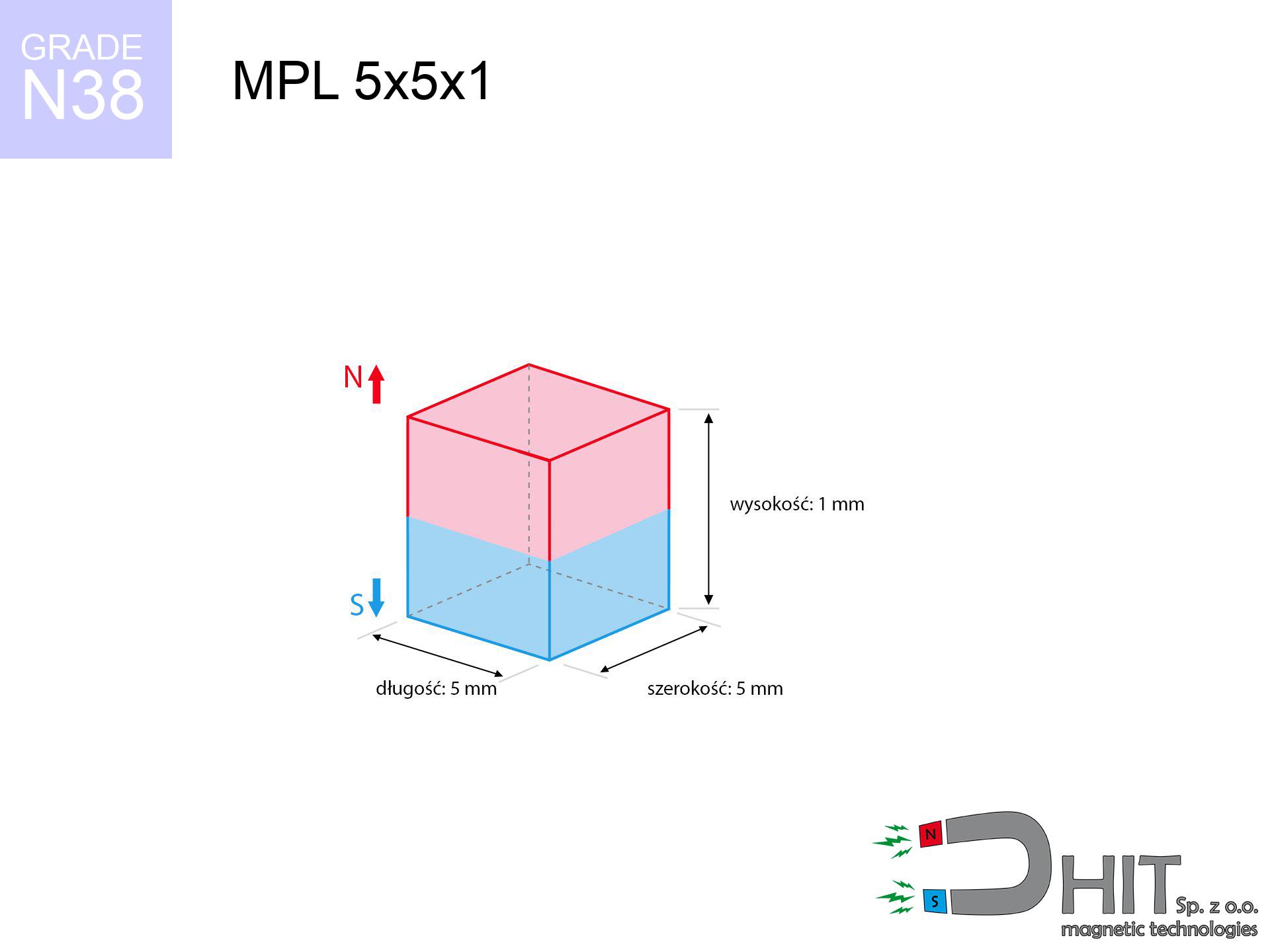
MPL 5x5x1 / N38 - lamellar magnet
lamellar magnet
Catalog no 020170
GTIN/EAN: 5906301811763
- length
- 5 mm [±0,1 mm]
- Width
- 5 mm [±0,1 mm]
- Height
- 1 mm [±0,1 mm]
- Weight
- 0.19 g
- Magnetization Direction
- ↑ axial
- Coating
- [NiCuNi] Nickel
How we measure these parameters — certificates and measurements
0.1500 zł net / pcs
0.1845 zł with VAT (23% VAT) / pcs
bulk discounts:
Need more?Frequently asked questions
What pull rating should I choose for a workshop block magnet?
Are block neodymium magnets available in more durable versions?
How should I choose block magnets for mounting a structure?
Engineering report for this magnet
Full PDF analysis: pull and shear force, effect of distance, temperature and plate thickness, safety distances and the demagnetization curve.
Call us now
+48 888 99 98 98
alternatively let us know using
contact form
the contact section.
Specifications and structure of a neodymium magnet can be estimated using our
power calculator.
Order by 14:00 and we’ll ship today!
Technical specification of the product - MPL 5x5x1 / N38 - lamellar magnet
Specification / characteristics - MPL 5x5x1 / N38 - lamellar magnet
| properties | values |
|---|---|
| Cat. no. | 020170 |
| GTIN/EAN | 5906301811763 |
| Production/Distribution | Dhit sp. z o.o. |
| Country of origin | Poland / China / Germany |
| Customs code | 85059029 |
| length | 5 mm [±0,1 mm] |
| Width | 5 mm [±0,1 mm] |
| Height | 1 mm [±0,1 mm] |
| Weight | 0.19 g |
| Magnetization Direction | ↑ axial |
| Load capacity ~ ? | 0.34 kg / 3.30 N |
| Magnetic Induction ~ ? | 209.53 mT / 2095 Gs |
| Coating | [NiCuNi] Nickel |
| Manufacturing Tolerance | ±0.1 mm |
Magnetic properties of material N38
| properties | values | units |
|---|---|---|
| Remanence Br ? | 12.2-12.6 | kGs |
| Remanence Br ? | 1220-1260 | mT |
| Coercivity bHc ? | 10.8-11.5 | kOe |
| Coercivity bHc ? | 860-915 | kA/m |
| Intrinsic coercivity iHc | ≥ 12 | kOe |
| Intrinsic coercivity iHc | ≥ 955 | kA/m |
| Energy product BHmax ? | 36-38 | BH max MGOe |
| Energy product BHmax ? | 287-303 | BH max KJ/m |
| Maximum working temperature ? | ≤ 80 | °C |
Physical properties of sintered neodymium magnets Nd2Fe14B at 20°C
| properties | values | units |
|---|---|---|
| Vickers hardness | ≥550 | Hv |
| Density | ≥7.4 | g/cm3 |
| Curie Temperature TC | 310 | °C |
| Curie Temperature TF | 590 | °F |
| Specific resistance | 150 | μΩ⋅cm |
| Bending strength | 250 | MPa |
| Compressive strength | 1000~1100 | MPa |
| Thermal expansion parallel (∥) to orientation (M) | (3-4) x 10-6 | °C-1 |
| Thermal expansion perpendicular (⊥) to orientation (M) | -(1-3) x 10-6 | °C-1 |
| Young's modulus | 1.7 x 10⁴ | kg/mm² |
Engineering modeling of the magnet - report
The following information represent the direct effect of a mathematical calculation. Values rely on algorithms for the class Nd2Fe14B. Actual parameters might slightly deviate from the simulation results. Use these calculations as a reference point for designers.
Table 1: Static pull force (force vs distance) - power drop
MPL 5x5x1 / N38
| Distance (mm) | Induction (Gauss) / mT | Pull Force (kg/lbs/g/N) | Risk Status |
|---|---|---|---|
| 0 mm |
2094 Gs
209.4 mT
|
0.34 kg / 0.75 pounds
340.0 g / 3.3 N
|
weak grip |
| 1 mm |
1514 Gs
151.4 mT
|
0.18 kg / 0.39 pounds
177.8 g / 1.7 N
|
weak grip |
| 2 mm |
922 Gs
92.2 mT
|
0.07 kg / 0.15 pounds
65.9 g / 0.6 N
|
weak grip |
| 3 mm |
543 Gs
54.3 mT
|
0.02 kg / 0.05 pounds
22.9 g / 0.2 N
|
weak grip |
| 5 mm |
209 Gs
20.9 mT
|
0.00 kg / 0.01 pounds
3.4 g / 0.0 N
|
weak grip |
| 10 mm |
38 Gs
3.8 mT
|
0.00 kg / 0.00 pounds
0.1 g / 0.0 N
|
weak grip |
| 15 mm |
13 Gs
1.3 mT
|
0.00 kg / 0.00 pounds
0.0 g / 0.0 N
|
weak grip |
| 20 mm |
6 Gs
0.6 mT
|
0.00 kg / 0.00 pounds
0.0 g / 0.0 N
|
weak grip |
| 30 mm |
2 Gs
0.2 mT
|
0.00 kg / 0.00 pounds
0.0 g / 0.0 N
|
weak grip |
| 50 mm |
0 Gs
0.0 mT
|
0.00 kg / 0.00 pounds
0.0 g / 0.0 N
|
weak grip |
Table 2: Shear capacity (vertical surface)
MPL 5x5x1 / N38
| Distance (mm) | Friction coefficient | Pull Force (kg/lbs/g/N) |
|---|---|---|
| 0 mm | Stal (~0.2) |
0.07 kg / 0.15 pounds
68.0 g / 0.7 N
|
| 1 mm | Stal (~0.2) |
0.04 kg / 0.08 pounds
36.0 g / 0.4 N
|
| 2 mm | Stal (~0.2) |
0.01 kg / 0.03 pounds
14.0 g / 0.1 N
|
| 3 mm | Stal (~0.2) |
0.00 kg / 0.01 pounds
4.0 g / 0.0 N
|
| 5 mm | Stal (~0.2) |
0.00 kg / 0.00 pounds
0.0 g / 0.0 N
|
| 10 mm | Stal (~0.2) |
0.00 kg / 0.00 pounds
0.0 g / 0.0 N
|
| 15 mm | Stal (~0.2) |
0.00 kg / 0.00 pounds
0.0 g / 0.0 N
|
| 20 mm | Stal (~0.2) |
0.00 kg / 0.00 pounds
0.0 g / 0.0 N
|
| 30 mm | Stal (~0.2) |
0.00 kg / 0.00 pounds
0.0 g / 0.0 N
|
| 50 mm | Stal (~0.2) |
0.00 kg / 0.00 pounds
0.0 g / 0.0 N
|
Table 3: Wall mounting (shearing) - vertical pull
MPL 5x5x1 / N38
| Surface type | Friction coefficient / % Mocy | Max load (kg/lbs/g/N) |
|---|---|---|
| Raw steel |
µ = 0.3
30% Nominalnej Siły
|
0.10 kg / 0.22 pounds
102.0 g / 1.0 N
|
| Painted steel (standard) |
µ = 0.2
20% Nominalnej Siły
|
0.07 kg / 0.15 pounds
68.0 g / 0.7 N
|
| Oily/slippery steel |
µ = 0.1
10% Nominalnej Siły
|
0.03 kg / 0.07 pounds
34.0 g / 0.3 N
|
| Magnet with anti-slip rubber |
µ = 0.5
50% Nominalnej Siły
|
0.17 kg / 0.37 pounds
170.0 g / 1.7 N
|
Table 4: Material efficiency (saturation) - sheet metal selection
MPL 5x5x1 / N38
| Steel thickness (mm) | % power | Real pull force (kg/lbs/g/N) |
|---|---|---|
| 0.5 mm |
|
0.03 kg / 0.07 pounds
34.0 g / 0.3 N
|
| 1 mm |
|
0.09 kg / 0.19 pounds
85.0 g / 0.8 N
|
| 2 mm |
|
0.17 kg / 0.37 pounds
170.0 g / 1.7 N
|
| 3 mm |
|
0.26 kg / 0.56 pounds
255.0 g / 2.5 N
|
| 5 mm |
|
0.34 kg / 0.75 pounds
340.0 g / 3.3 N
|
| 10 mm |
|
0.34 kg / 0.75 pounds
340.0 g / 3.3 N
|
| 11 mm |
|
0.34 kg / 0.75 pounds
340.0 g / 3.3 N
|
| 12 mm |
|
0.34 kg / 0.75 pounds
340.0 g / 3.3 N
|
Table 5: Thermal stability (stability) - power drop
MPL 5x5x1 / N38
| Ambient temp. (°C) | Power loss | Remaining pull (kg/lbs/g/N) | Status |
|---|---|---|---|
| 20 °C | 0.0% |
0.34 kg / 0.75 pounds
340.0 g / 3.3 N
|
OK |
| 40 °C | -2.2% |
0.33 kg / 0.73 pounds
332.5 g / 3.3 N
|
OK |
| 60 °C | -4.4% |
0.33 kg / 0.72 pounds
325.0 g / 3.2 N
|
|
| 80 °C | -6.6% |
0.32 kg / 0.70 pounds
317.6 g / 3.1 N
|
|
| 100 °C | -28.8% |
0.24 kg / 0.53 pounds
242.1 g / 2.4 N
|
Table 6: Two magnets (repulsion) - forces in the system
MPL 5x5x1 / N38
| Gap (mm) | Attraction (kg/lbs) (N-S) | Lateral Force (kg/lbs/g/N) | Repulsion (kg/lbs) (N-N) |
|---|---|---|---|
| 0 mm |
0.68 kg / 1.49 pounds
3 601 Gs
|
0.10 kg / 0.22 pounds
101 g / 1.0 N
|
N/A |
| 1 mm |
0.52 kg / 1.15 pounds
3 682 Gs
|
0.08 kg / 0.17 pounds
78 g / 0.8 N
|
0.47 kg / 1.04 pounds
~0 Gs
|
| 2 mm |
0.35 kg / 0.78 pounds
3 028 Gs
|
0.05 kg / 0.12 pounds
53 g / 0.5 N
|
0.32 kg / 0.70 pounds
~0 Gs
|
| 3 mm |
0.22 kg / 0.48 pounds
2 388 Gs
|
0.03 kg / 0.07 pounds
33 g / 0.3 N
|
0.20 kg / 0.44 pounds
~0 Gs
|
| 5 mm |
0.08 kg / 0.17 pounds
1 413 Gs
|
0.01 kg / 0.03 pounds
12 g / 0.1 N
|
0.07 kg / 0.15 pounds
~0 Gs
|
| 10 mm |
0.01 kg / 0.01 pounds
417 Gs
|
0.00 kg / 0.00 pounds
1 g / 0.0 N
|
0.00 kg / 0.00 pounds
~0 Gs
|
| 20 mm |
0.00 kg / 0.00 pounds
77 Gs
|
0.00 kg / 0.00 pounds
0 g / 0.0 N
|
0.00 kg / 0.00 pounds
~0 Gs
|
| 50 mm |
0.00 kg / 0.00 pounds
6 Gs
|
0.00 kg / 0.00 pounds
0 g / 0.0 N
|
0.00 kg / 0.00 pounds
~0 Gs
|
| 60 mm |
0.00 kg / 0.00 pounds
3 Gs
|
0.00 kg / 0.00 pounds
0 g / 0.0 N
|
0.00 kg / 0.00 pounds
~0 Gs
|
| 70 mm |
0.00 kg / 0.00 pounds
2 Gs
|
0.00 kg / 0.00 pounds
0 g / 0.0 N
|
0.00 kg / 0.00 pounds
~0 Gs
|
| 80 mm |
0.00 kg / 0.00 pounds
1 Gs
|
0.00 kg / 0.00 pounds
0 g / 0.0 N
|
0.00 kg / 0.00 pounds
~0 Gs
|
| 90 mm |
0.00 kg / 0.00 pounds
1 Gs
|
0.00 kg / 0.00 pounds
0 g / 0.0 N
|
0.00 kg / 0.00 pounds
~0 Gs
|
| 100 mm |
0.00 kg / 0.00 pounds
1 Gs
|
0.00 kg / 0.00 pounds
0 g / 0.0 N
|
0.00 kg / 0.00 pounds
~0 Gs
|
Table 7: Protective zones (implants) - precautionary measures
MPL 5x5x1 / N38
| Object / Device | Limit (Gauss) / mT | Safe distance |
|---|---|---|
| Pacemaker | 5 Gs (0.5 mT) | 2.5 cm |
| Hearing aid | 10 Gs (1.0 mT) | 2.0 cm |
| Timepiece | 20 Gs (2.0 mT) | 1.5 cm |
| Phone / Smartphone | 40 Gs (4.0 mT) | 1.0 cm |
| Car key | 50 Gs (5.0 mT) | 1.0 cm |
| Payment card | 400 Gs (40.0 mT) | 0.5 cm |
| HDD hard drive | 600 Gs (60.0 mT) | 0.5 cm |
Table 8: Impact energy (cracking risk) - warning
MPL 5x5x1 / N38
| Start from (mm) | Speed (km/h) | Energy (J) | Predicted outcome |
|---|---|---|---|
| 10 mm |
24.38 km/h
(6.77 m/s)
|
0.00 J | |
| 30 mm |
24.38 km/h
(6.77 m/s)
|
0.00 J | |
| 50 mm |
24.34 km/h
(6.76 m/s)
|
0.00 J | |
| 100 mm |
24.39 km/h
(6.77 m/s)
|
0.00 J |
Table 9: Corrosion resistance
MPL 5x5x1 / N38
| Technical parameter | Value / Description |
|---|---|
| Coating type | [NiCuNi] Nickel |
| Layer structure | Nickel - Copper - Nickel |
| Layer thickness | 10-20 µm |
| Salt spray test (SST) ? | 24 h |
| Recommended environment | Indoors only (dry) |
Table 10: Construction data (Flux)
MPL 5x5x1 / N38
| Parameter | Value | SI Unit / Description |
|---|---|---|
| Magnetic Flux | 615 Mx | 6.2 µWb |
| Pc Coefficient | 0.26 | Low (Flat) |
Table 11: Hydrostatics and buoyancy
MPL 5x5x1 / N38
| Environment | Effective steel pull | Effect |
|---|---|---|
| Air (land) | 0.34 kg | Standard |
| Water (riverbed) |
0.39 kg
(+0.05 kg buoyancy gain)
|
+14.5% |
1. Wall mount (shear)
*Note: On a vertical surface, the magnet retains merely a fraction of its perpendicular strength.
2. Steel saturation
*Thin metal sheet (e.g. computer case) severely limits the holding force.
3. Thermal stability
N38: the maximum material working temperature is 80°C. Permitted conditions also depend on the shape and magnetic circuit.
4. Demagnetization curve and operating point (B-H)
chart generated for the permeance coefficient Pc (Permeance Coefficient) = 0.26
This simulation demonstrates the magnetic stability of the selected magnet under specific geometric conditions. The solid red line represents the demagnetization curve (material potential), while the dashed blue line is the load line based on the magnet's geometry. The Pc (Permeance Coefficient), also known as the load line slope, is a dimensionless value that describes the relationship between the magnet's shape and its magnetic stability. The intersection of these two lines (the black dot) is the operating point — it determines the actual magnetic flux density generated by the magnet in this specific configuration. A higher Pc value means the magnet is more 'slender' (tall relative to its area), resulting in a higher operating point and better resistance to irreversible demagnetization caused by external fields or temperature. A value of 0.42 is relatively low (typical for flat magnets), meaning the operating point is closer to the 'knee' of the curve — caution is advised when operating at temperatures near the maximum limit to avoid strength loss.
Material specification
| iron (Fe) | 64% – 68% |
| neodymium (Nd) | 29% – 32% |
| boron (B) | 1.1% – 1.2% |
| dysprosium (Dy) | 0.5% – 2.0% |
| coating (Ni-Cu-Ni) | < 0.05% |
Ecology and recycling (GPSR)
| recyclability (EoL) | 100% |
| recycled raw materials | ~10% (pre-cons) |
| carbon footprint | low / zredukowany |
| waste code (EWC) | 16 02 16 |
See more offers
![SM 32x375 [2xM8] / N52 - magnetic separator](https://cdn3.dhit.pl/graphics/products/sm-32x375-2xm8-mif.jpg "SM 32x375 [2xM8] / N52 - magnetic separator")
Strengths as well as weaknesses of neodymium magnets.
Strengths
- They virtually do not lose power, because even after ten years the decline in efficiency is only ~1% (according to literature),
- Magnets very well resist against demagnetization caused by foreign field sources,
- In other words, due to the shiny surface of silver, the element is aesthetically pleasing,
- Magnetic induction on the working part of the magnet turns out to be strong,
- Due to their durability and thermal resistance, neodymium magnets can operate (depending on the shape) even at high temperatures reaching 230°C or more...
- Due to the option of accurate shaping and adaptation to individualized needs, neodymium magnets can be manufactured in a broad palette of forms and dimensions, which increases their versatility,
- Huge importance in future technologies – they are utilized in HDD drives, motor assemblies, medical devices, also complex engineering applications.
- Relatively small size with high pulling force – neodymium magnets offer strong magnetic field in tiny dimensions, which allows their use in miniature devices
Weaknesses
- At very strong impacts they can crack, therefore we recommend placing them in strong housings. A metal housing provides additional protection against damage, as well as increases the magnet's durability.
- Do not exceed this material temperature limit: 80°C. Overheating may permanently weaken the magnet.
- Magnets exposed to a humid environment can corrode. Therefore when using outdoors, we advise using water-impermeable magnets made of rubber, plastic or other material resistant to moisture
- Due to limitations in creating threads and complex shapes in magnets, we propose using a housing - magnetic holder.
- Possible danger related to microscopic parts of magnets pose a threat, if swallowed, which becomes key in the context of child safety. Furthermore, small elements of these devices can complicate diagnosis medical when they are in the body.
- With mass production the cost of neodymium magnets is a challenge,
Lifting parameters
Maximum holding power of the magnet – what affects it?
- with the use of a yoke made of special test steel, ensuring maximum field concentration
- with a cross-section no less than 10 mm
- characterized by smoothness
- without any insulating layer between the magnet and steel
- for force acting at a right angle (pull-off, not shear)
- in stable room temperature
Key elements affecting lifting force
- Space between surfaces – even a fraction of a millimeter of distance (caused e.g. by veneer or unevenness) diminishes the magnet efficiency, often by half at just 0.5 mm.
- Angle of force application – highest force is available only during pulling at a 90° angle. The shear force of the magnet along the plate is standardly many times smaller (approx. 1/5 of the lifting capacity).
- Steel thickness – too thin steel causes magnetic saturation, causing part of the power to be escaped to the other side.
- Material type – the best choice is high-permeability steel. Hardened steels may attract less.
- Surface quality – the smoother and more polished the plate, the larger the contact zone and stronger the hold. Unevenness creates an air distance.
- Temperature – temperature increase results in weakening of force. It is worth remembering the thermal limit for a given model.
Holding force was checked on a smooth steel plate of 20 mm thickness, when a perpendicular force was applied, whereas under shearing force the load capacity is reduced by as much as fivefold. Moreover, even a minimal clearance between the magnet’s surface and the plate reduces the load capacity.
Precautions when working with NdFeB magnets
Handling rules
Before starting, read the rules. Uncontrolled attraction can break the magnet or hurt your hand. Be predictive.
Avoid contact if allergic
Allergy Notice: The Ni-Cu-Ni coating consists of nickel. If skin irritation happens, cease working with magnets and wear gloves.
ICD Warning
Warning for patients: Powerful magnets disrupt electronics. Maintain at least 30 cm distance or ask another person to work with the magnets.
Fire warning
Powder generated during cutting of magnets is self-igniting. Avoid drilling into magnets unless you are an expert.
Danger to the youngest
Strictly store magnets out of reach of children. Choking hazard is high, and the consequences of magnets connecting inside the body are fatal.
Finger safety
Pinching hazard: The attraction force is so immense that it can result in blood blisters, pinching, and even bone fractures. Protective gloves are recommended.
Precision electronics
A strong magnetic field interferes with the functioning of compasses in smartphones and GPS navigation. Maintain magnets near a device to prevent breaking the sensors.
Magnet fragility
Protect your eyes. Magnets can explode upon uncontrolled impact, ejecting shards into the air. Wear goggles.
Maximum temperature
Regular neodymium magnets (grade N) lose magnetization when the temperature exceeds 80°C. This process is irreversible.
Protect data
Intense magnetic fields can corrupt files on payment cards, HDDs, and storage devices. Keep a distance of at least 10 cm.
Tabela kosztu i czasu dostawy
Płatność przed wysyłką:

GLS kurier
Przesyłka będzie u Ciebie za 2-3 dni
14.99 ZŁ

InPost Paczkomaty 24/7
Przesyłka będzie u Ciebie za 1-2 dni
12.30 ZŁ
Płatność przy odbiorze (pobranie):
GLS kurier
Przesyłka będzie u Ciebie za 1-2 dni
23.00 ZŁ