

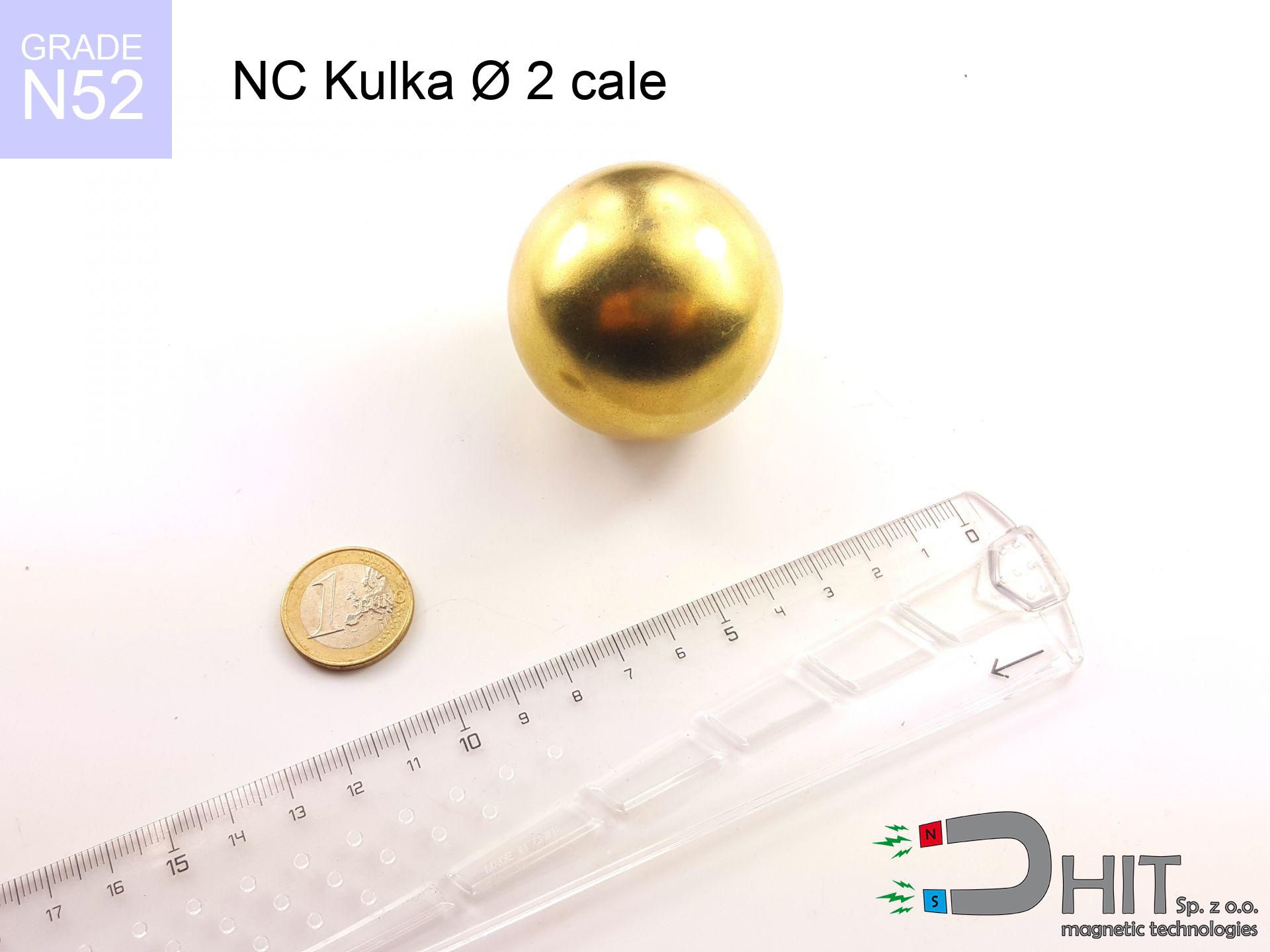
NC kulka fi 2 cale / N52 - neocube
neocube
Catalog no 120453
GTIN/EAN: 5906301812692
- Weight
- 1098 g
- Magnetization Direction
- ↑ axial
- Coating
- [Gold] Gold
How we measure these parameters — certificates and measurements
975.61 zł net / pcs
1200.00 zł with VAT (23% VAT) / pcs
bulk discounts:
Need more?Frequently asked questions
Are magnets in educational construction sets safe for children?
Which NeoCube set is the most durable?
How can I distinguish an original NeoCube set from a poor-quality substitute?
Guides from the knowledge base
Call us now
+48 888 99 98 98
alternatively let us know using
contact form
the contact section.
Specifications and structure of a neodymium magnet can be estimated using our
power calculator.
Order by 14:00 and we’ll ship today!
Technical - NC kulka fi 2 cale / N52 - neocube
Specification / characteristics - NC kulka fi 2 cale / N52 - neocube
| properties | values |
|---|---|
| Cat. no. | 120453 |
| GTIN/EAN | 5906301812692 |
| Production/Distribution | Dhit sp. z o.o. |
| Country of origin | Poland / China / Germany |
| Customs code | 85059029 |
| Weight | 1098 g |
| Magnetization Direction | ↑ axial |
| Coating | [Gold] Gold |
| Manufacturing Tolerance | ±1 mm |
Magnetic properties of material N52
| properties | values | units |
|---|---|---|
| Remanence Br ? | 14.2-14.7 | kGs |
| Remanence Br ? | 1420-1470 | mT |
| Coercivity bHc ? | 10.8-12.5 | kOe |
| Coercivity bHc ? | 860-995 | kA/m |
| Intrinsic coercivity iHc | ≥ 12 | kOe |
| Intrinsic coercivity iHc | ≥ 955 | kA/m |
| Energy product BHmax ? | 48-53 | BH max MGOe |
| Energy product BHmax ? | 380-422 | BH max KJ/m |
| Maximum working temperature ? | ≤ 60 | °C |
Physical properties of sintered neodymium magnets Nd2Fe14B at 20°C
| properties | values | units |
|---|---|---|
| Vickers hardness | ≥550 | Hv |
| Density | ≥7.4 | g/cm3 |
| Curie Temperature TC | 310 | °C |
| Curie Temperature TF | 590 | °F |
| Specific resistance | 150 | μΩ⋅cm |
| Bending strength | 250 | MPa |
| Compressive strength | 1000~1100 | MPa |
| Thermal expansion parallel (∥) to orientation (M) | (3-4) x 10-6 | °C-1 |
| Thermal expansion perpendicular (⊥) to orientation (M) | -(1-3) x 10-6 | °C-1 |
| Young's modulus | 1.7 x 10⁴ | kg/mm² |
Chemical composition
| iron (Fe) | 64% – 68% |
| neodymium (Nd) | 29% – 32% |
| boron (B) | 1.1% – 1.2% |
| dysprosium (Dy) | 0.5% – 2.0% |
| coating (Ni-Cu-Ni) | < 0.05% |
Ecology and recycling (GPSR)
| recyclability (EoL) | 100% |
| recycled raw materials | ~10% (pre-cons) |
| carbon footprint | low / zredukowany |
| waste code (EWC) | 16 02 16 |
Check out more offers
![UMGZ 75x34x18 [M10] GZ / N38 - magnetic holder external thread](https://cdn3.dhit.pl/graphics/products/umgw-75x34x18-m10-gz-xid.jpg "UMGZ 75x34x18 [M10] GZ / N38 - magnetic holder external thread")

![UMGZ 32x18x8 [M6] GZ / N38 - magnetic holder external thread](https://cdn3.dhit.pl/graphics/products/um-32x18x8-m6-gz-jix.jpg "UMGZ 32x18x8 [M6] GZ / N38 - magnetic holder external thread")
Strengths as well as weaknesses of Nd2Fe14B magnets.
Strengths
- Their magnetic field is durable, and after approximately 10 years it drops only by ~1% (according to research),
- Magnets very well protect themselves against loss of magnetization caused by foreign field sources,
- A magnet with a metallic silver surface has better aesthetics,
- Magnets exhibit extremely high magnetic induction on the working surface,
- Made from properly selected components, these magnets show impressive resistance to high heat, enabling them to function (depending on their form) at temperatures up to 230°C and above...
- Thanks to flexibility in designing and the capacity to customize to complex applications,
- Universal use in innovative solutions – they serve a role in computer drives, electric motors, medical devices, also complex engineering applications.
- Relatively small size with high pulling force – neodymium magnets offer impressive pulling force in compact dimensions, which enables their usage in small systems
Disadvantages
- To avoid cracks upon strong impacts, we recommend using special steel housings. Such a solution secures the magnet and simultaneously improves its durability.
- Do not exceed this material temperature limit: 60°C. Overheating may permanently weaken the magnet.
- When exposed to humidity, magnets usually rust. For applications outside, it is recommended to use protective magnets, such as those in rubber or plastics, which prevent oxidation and corrosion.
- Limited possibility of producing nuts in the magnet and complex forms - recommended is a housing - magnetic holder.
- Possible danger related to microscopic parts of magnets pose a threat, if swallowed, which is particularly important in the context of child health protection. Furthermore, small elements of these products are able to be problematic in diagnostics medical after entering the body.
- Due to expensive raw materials, their price is relatively high,
Holding force characteristics
Maximum holding power of the magnet – what it depends on?
- on a block made of mild steel, effectively closing the magnetic field
- with a thickness no less than 10 mm
- with a surface free of scratches
- under conditions of no distance (metal-to-metal)
- for force acting at a right angle (pull-off, not shear)
- at temperature room level
Lifting capacity in real conditions – factors
- Air gap (between the magnet and the plate), because even a microscopic clearance (e.g. 0.5 mm) results in a reduction in lifting capacity by up to 50% (this also applies to paint, rust or dirt).
- Force direction – declared lifting capacity refers to detachment vertically. When applying parallel force, the magnet holds significantly lower power (often approx. 20-30% of maximum force).
- Wall thickness – thin material does not allow full use of the magnet. Part of the magnetic field passes through the material instead of generating force.
- Plate material – mild steel attracts best. Alloy admixtures reduce magnetic properties and holding force.
- Surface structure – the more even the plate, the better the adhesion and higher the lifting capacity. Unevenness acts like micro-gaps.
- Operating temperature – neodymium magnets have a negative temperature coefficient. When it is hot they lose power, and in frost gain strength (up to a certain limit).
Lifting capacity was assessed with the use of a steel plate with a smooth surface of suitable thickness (min. 20 mm), under perpendicular pulling force, however under parallel forces the holding force is lower. Additionally, even a minimal clearance between the magnet’s surface and the plate reduces the load capacity.
H&S for magnets
Danger to pacemakers
Life threat: Strong magnets can turn off pacemakers and defibrillators. Do not approach if you have medical devices.
Data carriers
Powerful magnetic fields can destroy records on payment cards, HDDs, and storage devices. Stay away of at least 10 cm.
Nickel allergy
Warning for allergy sufferers: The Ni-Cu-Ni coating contains nickel. If skin irritation occurs, cease handling magnets and use protective gear.
Do not drill into magnets
Drilling and cutting of NdFeB material carries a risk of fire risk. Magnetic powder reacts violently with oxygen and is hard to extinguish.
Demagnetization risk
Monitor thermal conditions. Exposing the magnet above 80 degrees Celsius will destroy its properties and strength.
Phone sensors
Be aware: rare earth magnets generate a field that interferes with precision electronics. Maintain a safe distance from your phone, tablet, and GPS.
Caution required
Handle magnets with awareness. Their huge power can surprise even experienced users. Plan your moves and respect their power.
Keep away from children
Always store magnets out of reach of children. Choking hazard is significant, and the consequences of magnets clamping inside the body are very dangerous.
Crushing force
Watch your fingers. Two large magnets will snap together instantly with a force of massive weight, crushing anything in their path. Exercise extreme caution!
Shattering risk
NdFeB magnets are sintered ceramics, which means they are fragile like glass. Collision of two magnets will cause them breaking into shards.
Tabela kosztu i czasu dostawy
Płatność przed wysyłką:

GLS kurier
Przesyłka będzie u Ciebie za 2-3 dni
14.99 ZŁ

InPost Paczkomaty 24/7
Przesyłka będzie u Ciebie za 1-2 dni
12.30 ZŁ
Płatność przy odbiorze (pobranie):
GLS kurier
Przesyłka będzie u Ciebie za 1-2 dni
23.00 ZŁ