

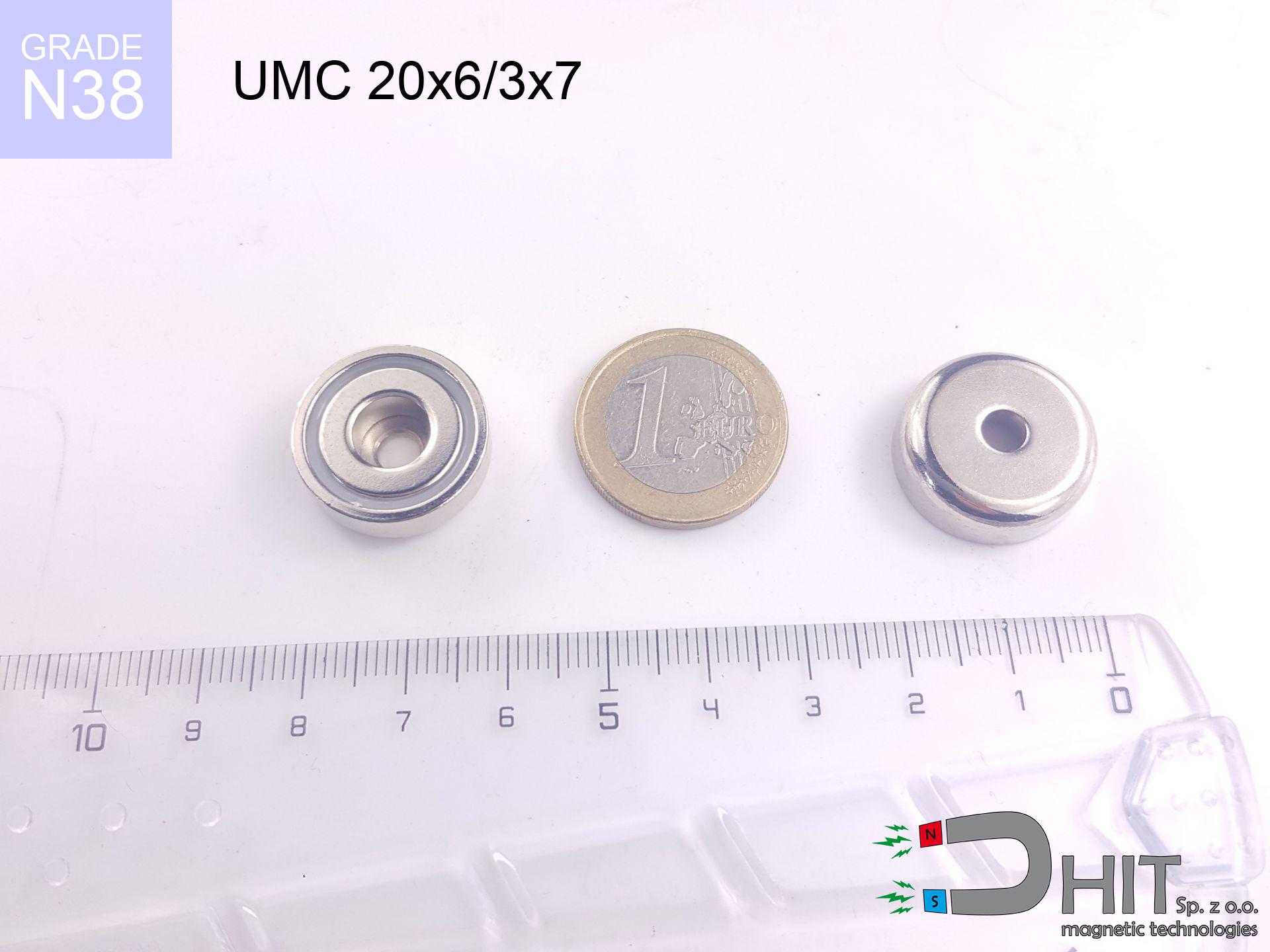
UMC 20x6/3x7 / N38 - cylindrical magnetic holder
cylindrical magnetic holder
Catalog no 320407
GTIN/EAN: 5906301814634
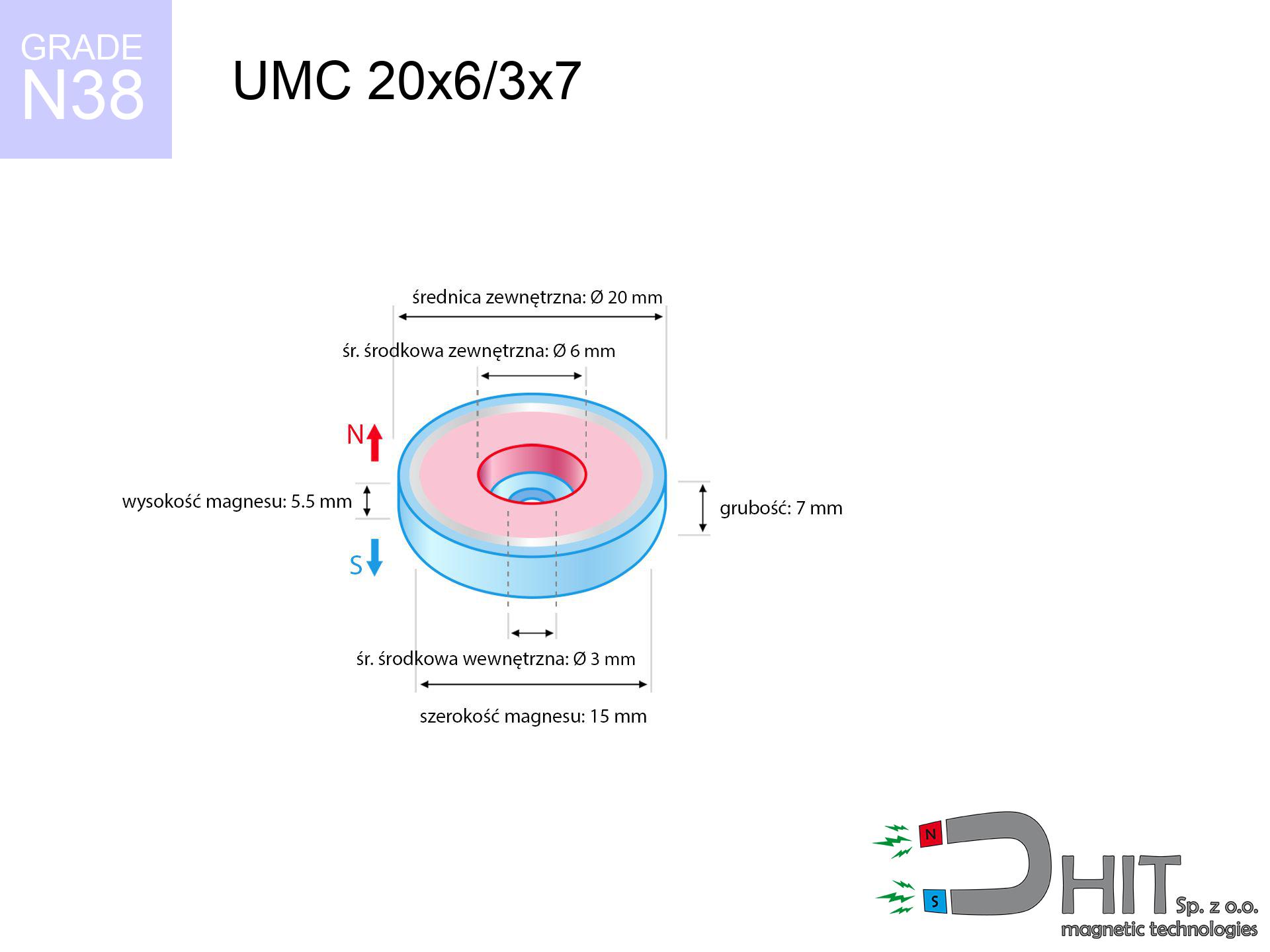
- Diameter
- 20 mm [±1 mm]
- internal diameter Ø
- 6/3 mm [±1 mm]
- Height
- 7 mm [±1 mm]
- Weight
- 12 g
- Magnetization Direction
- ↑ axial
- Coating
- [NiCuNi] Nickel
How we measure these parameters — certificates and measurements
5.68 zł net / pcs
6.99 zł with VAT (23% VAT) / pcs
bulk discounts:
Need more?Frequently asked questions
Which magnetic holder is suitable for moving metal parts in a workshop?
How do I choose a holder for hanging a heavy item and check its real grip?
Which magnetic holders can be used outdoors?
How should I choose a strong threaded holder for field work?
Call us now
+48 888 99 98 98
alternatively let us know using
contact form
the contact section.
Specifications and structure of a neodymium magnet can be estimated using our
power calculator.
Order by 14:00 and we’ll ship today!
Technical specification of the product - UMC 20x6/3x7 / N38 - cylindrical magnetic holder
Specification / characteristics - UMC 20x6/3x7 / N38 - cylindrical magnetic holder
| properties | values |
|---|---|
| Cat. no. | 320407 |
| GTIN/EAN | 5906301814634 |
| Production/Distribution | Dhit sp. z o.o. |
| Country of origin | Poland / China / Germany |
| Customs code | 85059029 |
| Diameter | 20 mm [±1 mm] |
| internal diameter Ø | 6/3 mm [±1 mm] |
| Height | 7 mm [±1 mm] |
| Weight | 12 g |
| Magnetization Direction | ↑ axial |
| Load capacity ~ ? | 6.00 kg / 58.84 N |
| Coating | [NiCuNi] Nickel |
| Manufacturing Tolerance | ±1 mm |
Magnetic properties of material N38
| properties | values | units |
|---|---|---|
| Remanence Br ? | 12.2-12.6 | kGs |
| Remanence Br ? | 1220-1260 | mT |
| Coercivity bHc ? | 10.8-11.5 | kOe |
| Coercivity bHc ? | 860-915 | kA/m |
| Intrinsic coercivity iHc | ≥ 12 | kOe |
| Intrinsic coercivity iHc | ≥ 955 | kA/m |
| Energy product BHmax ? | 36-38 | BH max MGOe |
| Energy product BHmax ? | 287-303 | BH max KJ/m |
| Maximum working temperature ? | ≤ 80 | °C |
Physical properties of sintered neodymium magnets Nd2Fe14B at 20°C
| properties | values | units |
|---|---|---|
| Vickers hardness | ≥550 | Hv |
| Density | ≥7.4 | g/cm3 |
| Curie Temperature TC | 310 | °C |
| Curie Temperature TF | 590 | °F |
| Specific resistance | 150 | μΩ⋅cm |
| Bending strength | 250 | MPa |
| Compressive strength | 1000~1100 | MPa |
| Thermal expansion parallel (∥) to orientation (M) | (3-4) x 10-6 | °C-1 |
| Thermal expansion perpendicular (⊥) to orientation (M) | -(1-3) x 10-6 | °C-1 |
| Young's modulus | 1.7 x 10⁴ | kg/mm² |
Material specification
| iron (Fe) | 64% – 68% |
| neodymium (Nd) | 29% – 32% |
| boron (B) | 1.1% – 1.2% |
| dysprosium (Dy) | 0.5% – 2.0% |
| coating (Ni-Cu-Ni) | < 0.05% |
Ecology and recycling (GPSR)
| recyclability (EoL) | 100% |
| recycled raw materials | ~10% (pre-cons) |
| carbon footprint | low / zredukowany |
| waste code (EWC) | 16 02 16 |
Other products
![SM 32x325 [2xM8] / N42 - magnetic separator](https://cdn3.dhit.pl/graphics/products/sm-32x325-2xm8-fog.jpg "SM 32x325 [2xM8] / N42 - magnetic separator")

![UMP 67x28 [M8+M10] GW F120 Lina / N38 - search holder](https://cdn3.dhit.pl/graphics/products/ump-67x28-m8+m10-gw-f-120+-lina-xiw.jpg "UMP 67x28 [M8+M10] GW F120 Lina / N38 - search holder")
Strengths and weaknesses of rare earth magnets.
Pros
- They have constant strength, and over nearly 10 years their performance decreases symbolically – ~1% (according to theory),
- They show high resistance to demagnetization induced by external magnetic fields,
- The use of an aesthetic coating of noble metals (nickel, gold, silver) causes the element to present itself better,
- Neodymium magnets create maximum magnetic induction on a contact point, which ensures high operational effectiveness,
- Made from properly selected components, these magnets show impressive resistance to high heat, enabling them to function (depending on their form) at temperatures up to 230°C and above...
- Thanks to the ability of flexible forming and customization to individualized solutions, NdFeB magnets can be produced in a broad palette of forms and dimensions, which amplifies use scope,
- Wide application in future technologies – they are used in magnetic memories, drive modules, diagnostic systems, also modern systems.
- Relatively small size with high pulling force – neodymium magnets offer high power in small dimensions, which enables their usage in small systems
Weaknesses
- At strong impacts they can break, therefore we recommend placing them in steel cases. A metal housing provides additional protection against damage and increases the magnet's durability.
- Do not exceed this material temperature limit: 80°C. Overheating may permanently weaken the magnet.
- They oxidize in a humid environment - during use outdoors we suggest using waterproof magnets e.g. in rubber, plastic
- We recommend cover - magnetic holder, due to difficulties in creating threads inside the magnet and complicated shapes.
- Possible danger related to microscopic parts of magnets are risky, if swallowed, which is particularly important in the aspect of protecting the youngest. Furthermore, small elements of these products can complicate diagnosis medical after entering the body.
- With mass production the cost of neodymium magnets is a challenge,
Pull force analysis
Optimal lifting capacity of a neodymium magnet – what contributes to it?
- using a plate made of mild steel, serving as a magnetic yoke
- possessing a thickness of min. 10 mm to avoid saturation
- characterized by smoothness
- under conditions of ideal adhesion (metal-to-metal)
- during detachment in a direction vertical to the plane
- in stable room temperature
Determinants of practical lifting force of a magnet
- Distance – the presence of foreign body (rust, tape, air) acts as an insulator, which reduces capacity rapidly (even by 50% at 0.5 mm).
- Force direction – remember that the magnet has greatest strength perpendicularly. Under shear forces, the holding force drops drastically, often to levels of 20-30% of the maximum value.
- Plate thickness – insufficiently thick plate causes magnetic saturation, causing part of the flux to be escaped into the air.
- Chemical composition of the base – mild steel attracts best. Higher carbon content reduce magnetic permeability and lifting capacity.
- Surface condition – ground elements ensure maximum contact, which increases field saturation. Uneven metal reduce efficiency.
- Temperature – heating the magnet causes a temporary drop of force. Check the thermal limit for a given model.
Lifting capacity testing was carried out on plates with a smooth surface of suitable thickness, under perpendicular forces, however under attempts to slide the magnet the load capacity is reduced by as much as 75%. Moreover, even a slight gap between the magnet and the plate reduces the load capacity.
Precautions when working with neodymium magnets
Flammability
Powder generated during cutting of magnets is combustible. Do not drill into magnets unless you are an expert.
Choking Hazard
Only for adults. Tiny parts pose a choking risk, causing serious injuries. Keep away from children and animals.
Threat to navigation
Remember: rare earth magnets generate a field that interferes with sensitive sensors. Keep a separation from your phone, device, and navigation systems.
Warning for allergy sufferers
Allergy Notice: The nickel-copper-nickel coating contains nickel. If an allergic reaction appears, cease working with magnets and use protective gear.
Material brittleness
NdFeB magnets are sintered ceramics, meaning they are prone to chipping. Clashing of two magnets leads to them cracking into small pieces.
Serious injuries
Protect your hands. Two large magnets will join immediately with a force of massive weight, destroying everything in their path. Be careful!
Handling rules
Be careful. Neodymium magnets attract from a distance and snap with massive power, often quicker than you can move away.
Cards and drives
Avoid bringing magnets near a purse, computer, or TV. The magnetism can permanently damage these devices and erase data from cards.
Heat warning
Standard neodymium magnets (N-type) lose magnetization when the temperature goes above 80°C. Damage is permanent.
Life threat
Warning for patients: Strong magnetic fields disrupt medical devices. Keep at least 30 cm distance or request help to work with the magnets.
Tabela kosztu i czasu dostawy
Płatność przed wysyłką:

GLS kurier
Przesyłka będzie u Ciebie za 2-3 dni
14.99 ZŁ

InPost Paczkomaty 24/7
Przesyłka będzie u Ciebie za 1-2 dni
12.30 ZŁ
Płatność przy odbiorze (pobranie):
GLS kurier
Przesyłka będzie u Ciebie za 1-2 dni
23.00 ZŁ