

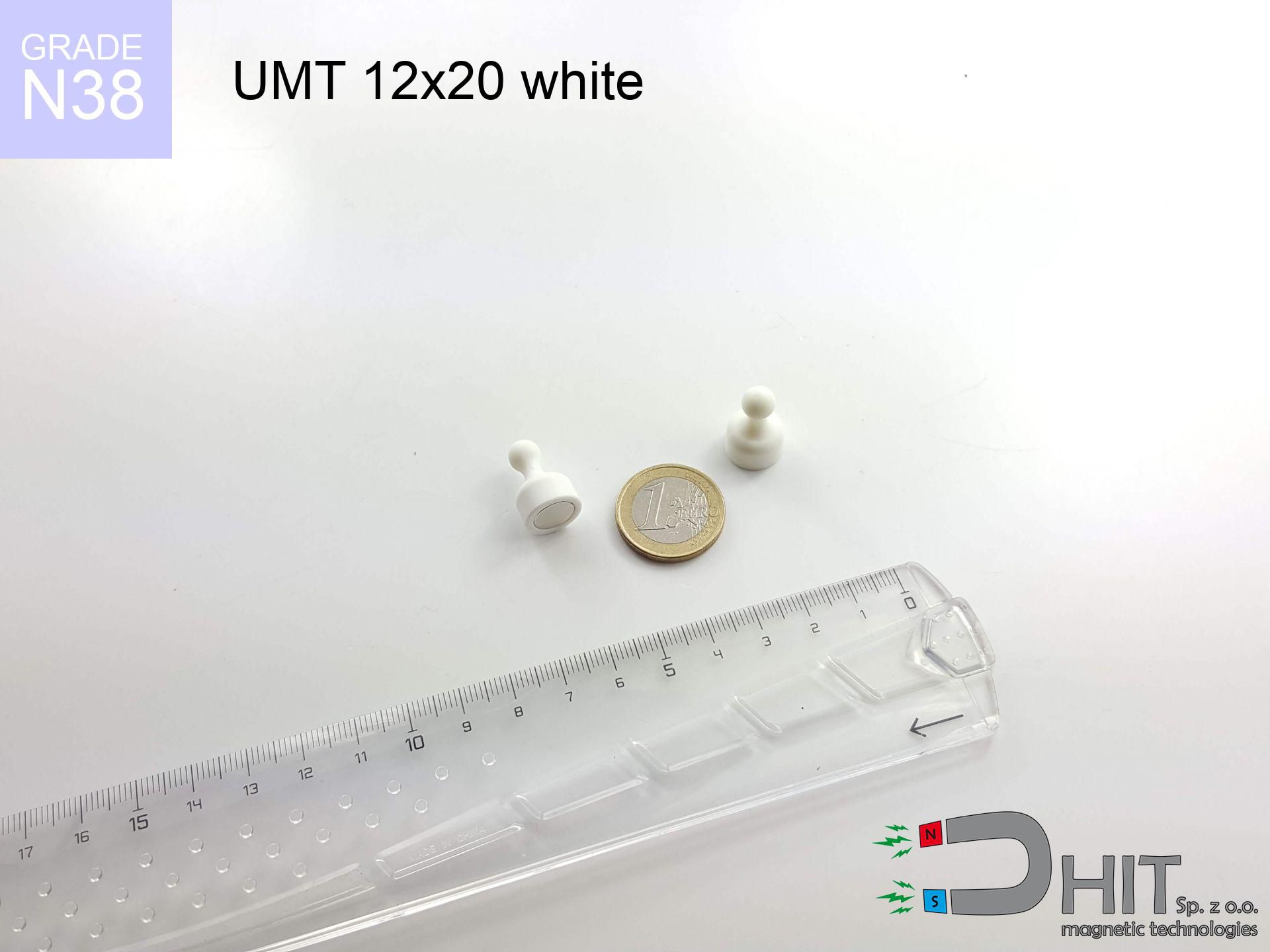
UMT 12x20 white / N38 - board holder
board holder
Catalog no 230265
GTIN/EAN: 5906301814283
- Diameter Ø
- 12 mm [±1 mm]
- Height
- 20 mm [±1 mm]
- Weight
- 3.5 g
- Coating
- [NiCuNi] Nickel
How we measure these parameters — certificates and measurements
1.540 zł net / pcs
1.894 zł with VAT (23% VAT) / pcs
bulk discounts:
Need more?Frequently asked questions
How many sheets of paper will one magnetic pin hold?
Will a magnetic pin stick to any board - whiteboard, glass, cork?
Will the magnet leave a mark or scratch the board or the fridge?
What is the difference between the 12x20 and 20x25 sizes, and which one suits an office?
Are magnetic pins suitable for large-format maps and plans?
Call us now
+48 888 99 98 98
alternatively let us know using
contact form
the contact section.
Specifications and structure of a neodymium magnet can be estimated using our
power calculator.
Order by 14:00 and we’ll ship today!
Technical of the product - UMT 12x20 white / N38 - board holder
Specification / characteristics - UMT 12x20 white / N38 - board holder
| properties | values |
|---|---|
| Cat. no. | 230265 |
| GTIN/EAN | 5906301814283 |
| Production/Distribution | Dhit sp. z o.o. |
| Country of origin | Poland / China / Germany |
| Customs code | 85059029 |
| Diameter Ø | 12 mm [±1 mm] |
| Height | 20 mm [±1 mm] |
| Weight | 3.5 g |
| Coating | [NiCuNi] Nickel |
| Manufacturing Tolerance | ±1 mm |
Magnetic properties of material N38
| properties | values | units |
|---|---|---|
| Remanence Br ? | 12.2-12.6 | kGs |
| Remanence Br ? | 1220-1260 | mT |
| Coercivity bHc ? | 10.8-11.5 | kOe |
| Coercivity bHc ? | 860-915 | kA/m |
| Intrinsic coercivity iHc | ≥ 12 | kOe |
| Intrinsic coercivity iHc | ≥ 955 | kA/m |
| Energy product BHmax ? | 36-38 | BH max MGOe |
| Energy product BHmax ? | 287-303 | BH max KJ/m |
| Maximum working temperature ? | ≤ 80 | °C |
Physical properties of sintered neodymium magnets Nd2Fe14B at 20°C
| properties | values | units |
|---|---|---|
| Vickers hardness | ≥550 | Hv |
| Density | ≥7.4 | g/cm3 |
| Curie Temperature TC | 310 | °C |
| Curie Temperature TF | 590 | °F |
| Specific resistance | 150 | μΩ⋅cm |
| Bending strength | 250 | MPa |
| Compressive strength | 1000~1100 | MPa |
| Thermal expansion parallel (∥) to orientation (M) | (3-4) x 10-6 | °C-1 |
| Thermal expansion perpendicular (⊥) to orientation (M) | -(1-3) x 10-6 | °C-1 |
| Young's modulus | 1.7 x 10⁴ | kg/mm² |
Material specification
| iron (Fe) | 64% – 68% |
| neodymium (Nd) | 29% – 32% |
| boron (B) | 1.1% – 1.2% |
| dysprosium (Dy) | 0.5% – 2.0% |
| coating (Ni-Cu-Ni) | < 0.05% |
Ecology and recycling (GPSR)
| recyclability (EoL) | 100% |
| recycled raw materials | ~10% (pre-cons) |
| carbon footprint | low / zredukowany |
| waste code (EWC) | 16 02 16 |
View also products
![HH 36x7.5 [M6] / N38 - through hole magnetic holder](https://cdn3.dhit.pl/graphics/products/hh-36x7.5-m6-bez.jpg "HH 36x7.5 [M6] / N38 - through hole magnetic holder")

Advantages as well as disadvantages of Nd2Fe14B magnets.
Benefits
- They do not lose magnetism, even over around ten years – the reduction in lifting capacity is only ~1% (theoretically),
- Neodymium magnets are distinguished by highly resistant to loss of magnetic properties caused by magnetic disturbances,
- The use of an aesthetic finish of noble metals (nickel, gold, silver) causes the element to have aesthetics,
- Neodymium magnets achieve maximum magnetic induction on a small area, which increases force concentration,
- Through (adequate) combination of ingredients, they can achieve high thermal strength, enabling operation at temperatures approaching 230°C and above...
- Due to the potential of flexible molding and adaptation to custom solutions, neodymium magnets can be produced in a variety of forms and dimensions, which makes them more universal,
- Universal use in innovative solutions – they serve a role in computer drives, electric motors, medical devices, and multitasking production systems.
- Relatively small size with high pulling force – neodymium magnets offer impressive pulling force in tiny dimensions, which makes them useful in small systems
Disadvantages
- Brittleness is one of their disadvantages. Upon intense impact they can fracture. We recommend keeping them in a steel housing, which not only secures them against impacts but also raises their durability
- Do not exceed this material temperature limit: 80°C. Overheating may permanently weaken the magnet.
- Due to the susceptibility of magnets to corrosion in a humid environment, we suggest using waterproof magnets made of rubber, plastic or other material immune to moisture, when using outdoors
- Limited ability of creating nuts in the magnet and complicated forms - recommended is cover - mounting mechanism.
- Potential hazard resulting from small fragments of magnets can be dangerous, if swallowed, which is particularly important in the context of child safety. It is also worth noting that tiny parts of these devices can be problematic in diagnostics medical in case of swallowing.
- With large orders the cost of neodymium magnets can be a barrier,
Pull force analysis
Best holding force of the magnet in ideal parameters – what contributes to it?
- on a base made of structural steel, optimally conducting the magnetic field
- possessing a thickness of at least 10 mm to avoid saturation
- with an ground contact surface
- with total lack of distance (no paint)
- during detachment in a direction perpendicular to the mounting surface
- at ambient temperature approx. 20 degrees Celsius
Practical lifting capacity: influencing factors
- Distance – the presence of foreign body (rust, tape, air) interrupts the magnetic circuit, which lowers power rapidly (even by 50% at 0.5 mm).
- Force direction – note that the magnet holds strongest perpendicularly. Under sliding down, the holding force drops significantly, often to levels of 20-30% of the maximum value.
- Element thickness – for full efficiency, the steel must be adequately massive. Thin sheet restricts the attraction force (the magnet "punches through" it).
- Metal type – not every steel reacts the same. High carbon content weaken the attraction effect.
- Surface quality – the more even the surface, the better the adhesion and higher the lifting capacity. Roughness acts like micro-gaps.
- Thermal conditions – neodymium magnets have a sensitivity to temperature. At higher temperatures they lose power, and at low temperatures they can be stronger (up to a certain limit).
Lifting capacity testing was conducted on plates with a smooth surface of suitable thickness, under perpendicular forces, in contrast under parallel forces the holding force is lower. Additionally, even a minimal clearance between the magnet’s surface and the plate decreases the holding force.
Precautions when working with neodymium magnets
Crushing force
Danger of trauma: The pulling power is so immense that it can cause hematomas, crushing, and broken bones. Use thick gloves.
Respect the power
Handle magnets consciously. Their powerful strength can shock even professionals. Plan your moves and do not underestimate their force.
Sensitization to coating
Some people have a contact allergy to nickel, which is the common plating for NdFeB magnets. Prolonged contact can result in an allergic reaction. We strongly advise wear protective gloves.
Precision electronics
Be aware: rare earth magnets generate a field that disrupts precision electronics. Keep a separation from your mobile, device, and navigation systems.
Eye protection
Protect your eyes. Magnets can fracture upon violent connection, launching sharp fragments into the air. Eye protection is mandatory.
Medical implants
Warning for patients: Powerful magnets disrupt medical devices. Keep minimum 30 cm distance or request help to handle the magnets.
Keep away from children
Neodymium magnets are not intended for children. Swallowing multiple magnets can lead to them connecting inside the digestive tract, which poses a critical condition and requires immediate surgery.
Threat to electronics
Avoid bringing magnets near a purse, laptop, or screen. The magnetism can irreversibly ruin these devices and erase data from cards.
Permanent damage
Keep cool. NdFeB magnets are sensitive to heat. If you require operation above 80°C, look for special high-temperature series (H, SH, UH).
Fire warning
Dust produced during cutting of magnets is flammable. Do not drill into magnets without proper cooling and knowledge.
Tabela kosztu i czasu dostawy
Płatność przed wysyłką:

GLS kurier
Przesyłka będzie u Ciebie za 2-3 dni
14.99 ZŁ

InPost Paczkomaty 24/7
Przesyłka będzie u Ciebie za 1-2 dni
12.30 ZŁ
Płatność przy odbiorze (pobranie):
GLS kurier
Przesyłka będzie u Ciebie za 1-2 dni
23.00 ZŁ