

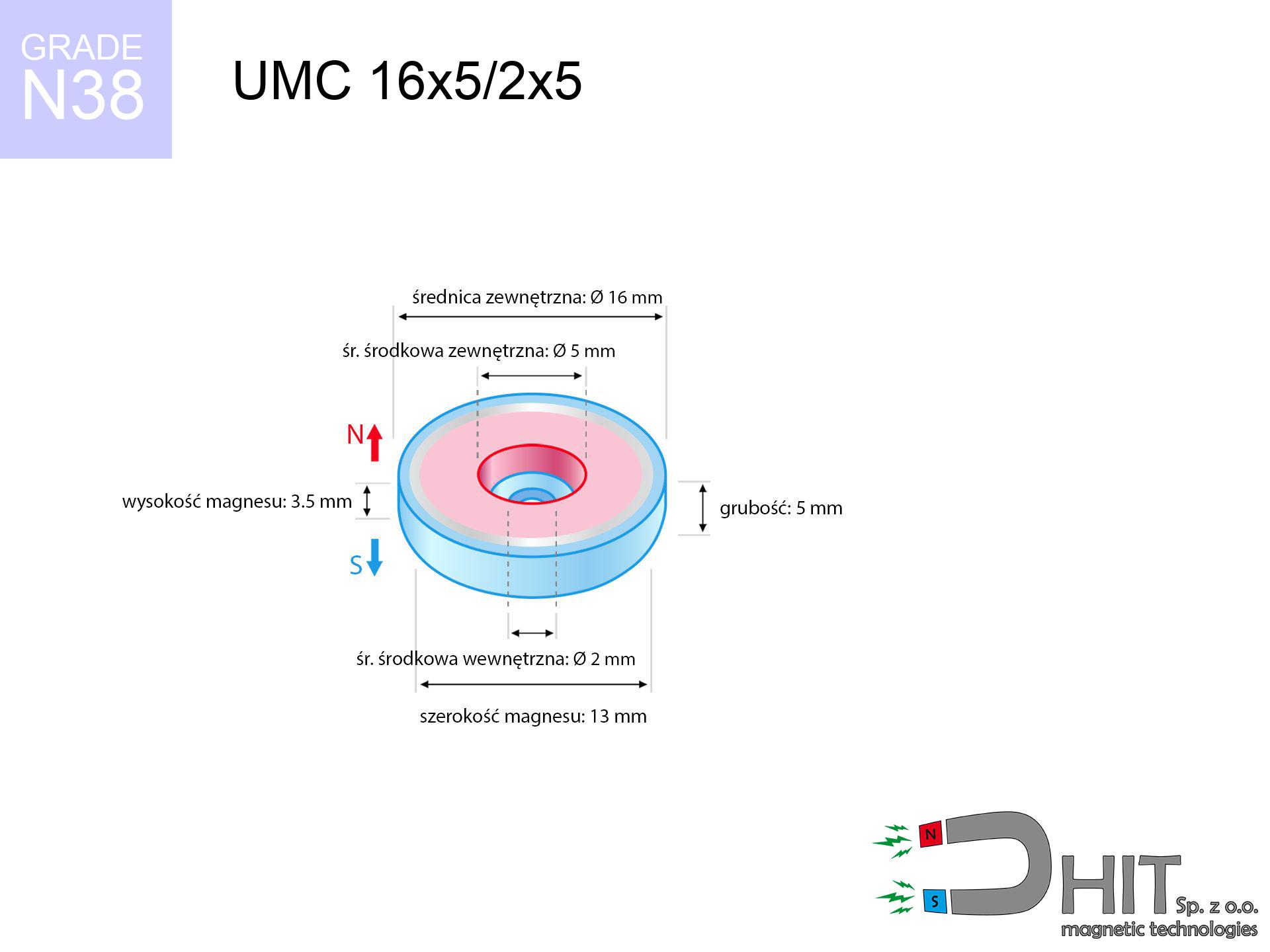
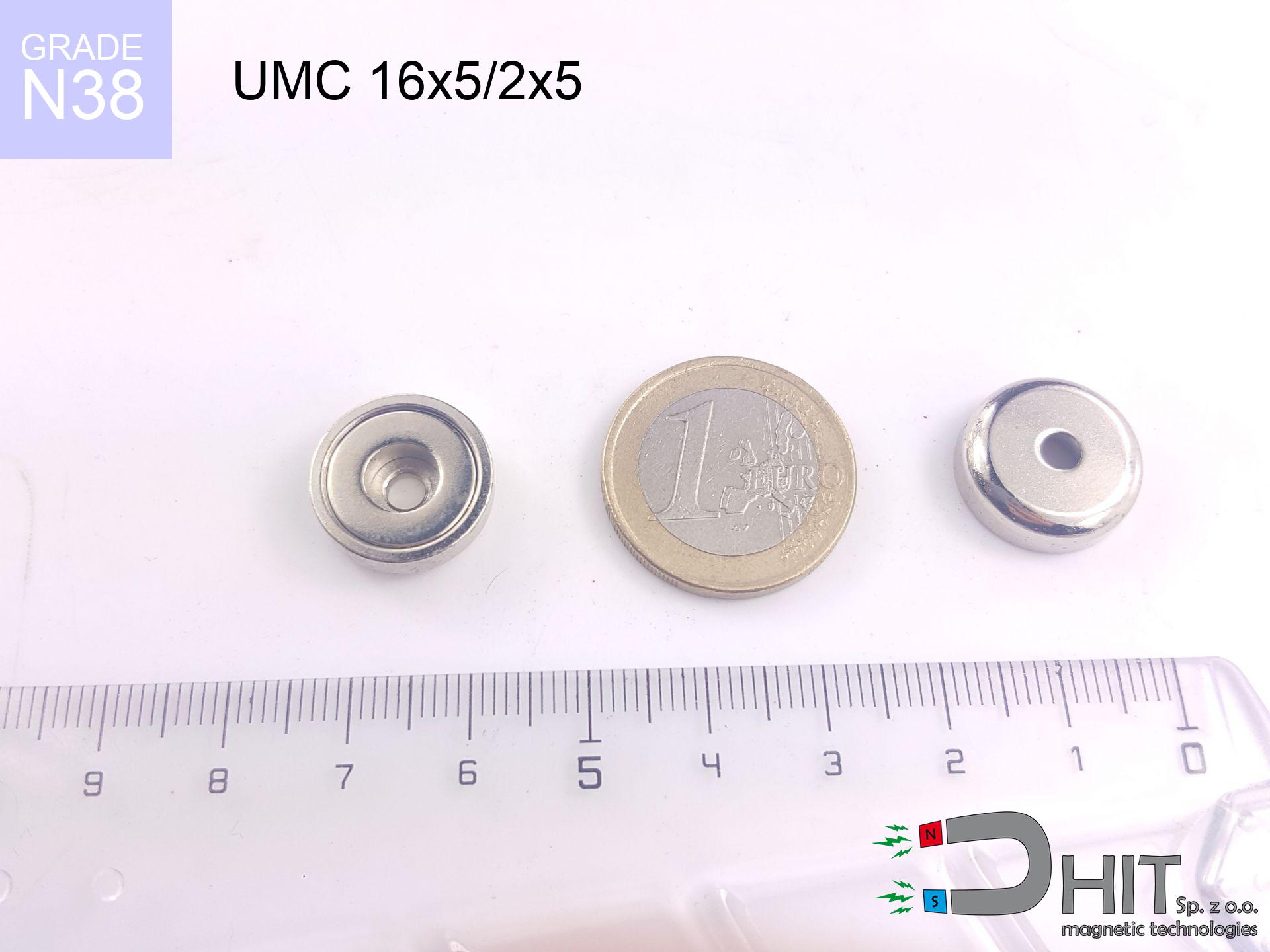
UMC 16x5/2x5 / N38 - cylindrical magnetic holder
cylindrical magnetic holder
Catalog no 320406
GTIN/EAN: 5906301814627
- Diameter
- 16 mm [±1 mm]
- internal diameter Ø
- 5/2 mm [±1 mm]
- Height
- 5 mm [±1 mm]
- Weight
- 5.5 g
- Magnetization Direction
- ↑ axial
- Coating
- [NiCuNi] Nickel
How we measure these parameters — certificates and measurements
2.71 zł net / pcs
3.33 zł with VAT (23% VAT) / pcs
bulk discounts:
Need more?Frequently asked questions
Which magnetic holder is suitable for moving metal parts in a workshop?
How do I choose a holder for hanging a heavy item and check its real grip?
Which magnetic holders can be used outdoors?
How should I choose a strong threaded holder for field work?
Call us now
+48 888 99 98 98
alternatively let us know using
contact form
the contact section.
Specifications and structure of a neodymium magnet can be estimated using our
power calculator.
Order by 14:00 and we’ll ship today!
Technical data of the product - UMC 16x5/2x5 / N38 - cylindrical magnetic holder
Specification / characteristics - UMC 16x5/2x5 / N38 - cylindrical magnetic holder
| properties | values |
|---|---|
| Cat. no. | 320406 |
| GTIN/EAN | 5906301814627 |
| Production/Distribution | Dhit sp. z o.o. |
| Country of origin | Poland / China / Germany |
| Customs code | 85059029 |
| Diameter | 16 mm [±1 mm] |
| internal diameter Ø | 5/2 mm [±1 mm] |
| Height | 5 mm [±1 mm] |
| Weight | 5.5 g |
| Magnetization Direction | ↑ axial |
| Load capacity ~ ? | 4.00 kg / 39.23 N |
| Coating | [NiCuNi] Nickel |
| Manufacturing Tolerance | ±1 mm |
Magnetic properties of material N38
| properties | values | units |
|---|---|---|
| Remanence Br ? | 12.2-12.6 | kGs |
| Remanence Br ? | 1220-1260 | mT |
| Coercivity bHc ? | 10.8-11.5 | kOe |
| Coercivity bHc ? | 860-915 | kA/m |
| Intrinsic coercivity iHc | ≥ 12 | kOe |
| Intrinsic coercivity iHc | ≥ 955 | kA/m |
| Energy product BHmax ? | 36-38 | BH max MGOe |
| Energy product BHmax ? | 287-303 | BH max KJ/m |
| Maximum working temperature ? | ≤ 80 | °C |
Physical properties of sintered neodymium magnets Nd2Fe14B at 20°C
| properties | values | units |
|---|---|---|
| Vickers hardness | ≥550 | Hv |
| Density | ≥7.4 | g/cm3 |
| Curie Temperature TC | 310 | °C |
| Curie Temperature TF | 590 | °F |
| Specific resistance | 150 | μΩ⋅cm |
| Bending strength | 250 | MPa |
| Compressive strength | 1000~1100 | MPa |
| Thermal expansion parallel (∥) to orientation (M) | (3-4) x 10-6 | °C-1 |
| Thermal expansion perpendicular (⊥) to orientation (M) | -(1-3) x 10-6 | °C-1 |
| Young's modulus | 1.7 x 10⁴ | kg/mm² |
Chemical composition
| iron (Fe) | 64% – 68% |
| neodymium (Nd) | 29% – 32% |
| boron (B) | 1.1% – 1.2% |
| dysprosium (Dy) | 0.5% – 2.0% |
| coating (Ni-Cu-Ni) | < 0.05% |
Ecology and recycling (GPSR)
| recyclability (EoL) | 100% |
| recycled raw materials | ~10% (pre-cons) |
| carbon footprint | low / zredukowany |
| waste code (EWC) | 16 02 16 |
Other proposals

![SM 28x275 [2xM8] / N52 - magnetic separator](https://cdn3.dhit.pl/graphics/products/sm-28x275-2xm8-lum.jpg "SM 28x275 [2xM8] / N52 - magnetic separator")
Pros as well as cons of rare earth magnets.
Strengths
- They have stable power, and over more than 10 years their attraction force decreases symbolically – ~1% (according to theory),
- Magnets perfectly protect themselves against demagnetization caused by ambient magnetic noise,
- The use of an refined coating of noble metals (nickel, gold, silver) causes the element to have aesthetics,
- They feature high magnetic induction at the operating surface, making them more effective,
- Neodymium magnets are characterized by extremely high magnetic induction on the magnet surface and can work (depending on the shape) even at a temperature of 230°C or more...
- Thanks to freedom in designing and the ability to modify to individual projects,
- Fundamental importance in advanced technology sectors – they serve a role in hard drives, electromotive mechanisms, diagnostic systems, and complex engineering applications.
- Relatively small size with high pulling force – neodymium magnets offer strong magnetic field in tiny dimensions, which makes them useful in miniature devices
Cons
- To avoid cracks under impact, we recommend using special steel housings. Such a solution secures the magnet and simultaneously increases its durability.
- Do not exceed this material temperature limit: 80°C. Overheating may permanently weaken the magnet.
- When exposed to humidity, magnets usually rust. For applications outside, it is recommended to use protective magnets, such as those in rubber or plastics, which prevent oxidation and corrosion.
- Due to limitations in creating nuts and complicated forms in magnets, we propose using casing - magnetic holder.
- Potential hazard related to microscopic parts of magnets are risky, when accidentally swallowed, which gains importance in the context of child health protection. It is also worth noting that tiny parts of these devices can disrupt the diagnostic process medical when they are in the body.
- With large orders the cost of neodymium magnets can be a barrier,
Holding force characteristics
Magnetic strength at its maximum – what affects it?
- with the use of a yoke made of low-carbon steel, ensuring maximum field concentration
- whose transverse dimension is min. 10 mm
- with a surface cleaned and smooth
- without any clearance between the magnet and steel
- for force applied at a right angle (pull-off, not shear)
- at temperature room level
What influences lifting capacity in practice
- Gap (between the magnet and the plate), as even a very small distance (e.g. 0.5 mm) can cause a decrease in lifting capacity by up to 50% (this also applies to paint, rust or dirt).
- Force direction – note that the magnet holds strongest perpendicularly. Under shear forces, the holding force drops drastically, often to levels of 20-30% of the nominal value.
- Metal thickness – thin material does not allow full use of the magnet. Part of the magnetic field passes through the material instead of generating force.
- Steel grade – ideal substrate is pure iron steel. Hardened steels may generate lower lifting capacity.
- Surface finish – full contact is possible only on polished steel. Rough texture create air cushions, weakening the magnet.
- Thermal conditions – NdFeB sinters have a negative temperature coefficient. At higher temperatures they are weaker, and in frost gain strength (up to a certain limit).
Lifting capacity testing was performed on plates with a smooth surface of suitable thickness, under a perpendicular pulling force, however under parallel forces the holding force is lower. Moreover, even a minimal clearance between the magnet’s surface and the plate lowers the holding force.
Safe handling of NdFeB magnets
Bodily injuries
Large magnets can crush fingers in a fraction of a second. Do not place your hand between two strong magnets.
Magnets are brittle
Despite metallic appearance, neodymium is brittle and cannot withstand shocks. Avoid impacts, as the magnet may crumble into hazardous fragments.
Nickel coating and allergies
Warning for allergy sufferers: The Ni-Cu-Ni coating contains nickel. If an allergic reaction appears, cease working with magnets and wear gloves.
Fire warning
Powder generated during cutting of magnets is self-igniting. Do not drill into magnets unless you are an expert.
Permanent damage
Monitor thermal conditions. Exposing the magnet to high heat will ruin its magnetic structure and strength.
Keep away from computers
Equipment safety: Neodymium magnets can damage payment cards and delicate electronics (heart implants, hearing aids, mechanical watches).
Safe operation
Exercise caution. Neodymium magnets attract from a distance and snap with massive power, often faster than you can move away.
Warning for heart patients
For implant holders: Powerful magnets affect electronics. Maintain minimum 30 cm distance or request help to handle the magnets.
Threat to navigation
A strong magnetic field disrupts the operation of magnetometers in smartphones and GPS navigation. Do not bring magnets close to a smartphone to avoid damaging the sensors.
Swallowing risk
Product intended for adults. Small elements pose a choking risk, causing intestinal necrosis. Keep out of reach of kids and pets.
Tabela kosztu i czasu dostawy
Płatność przed wysyłką:

GLS kurier
Przesyłka będzie u Ciebie za 2-3 dni
14.99 ZŁ

InPost Paczkomaty 24/7
Przesyłka będzie u Ciebie za 1-2 dni
12.30 ZŁ
Płatność przy odbiorze (pobranie):
GLS kurier
Przesyłka będzie u Ciebie za 1-2 dni
23.00 ZŁ