

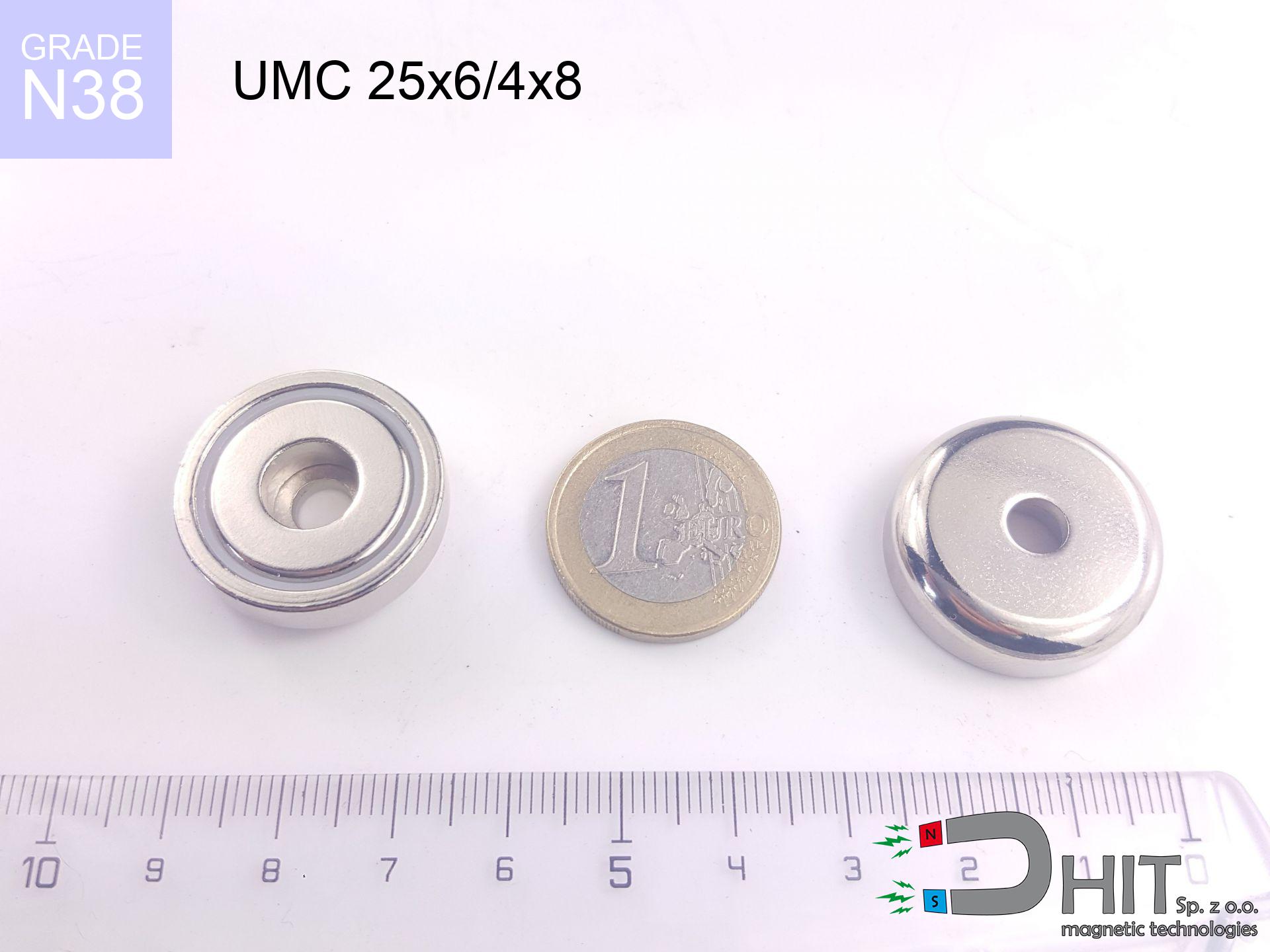
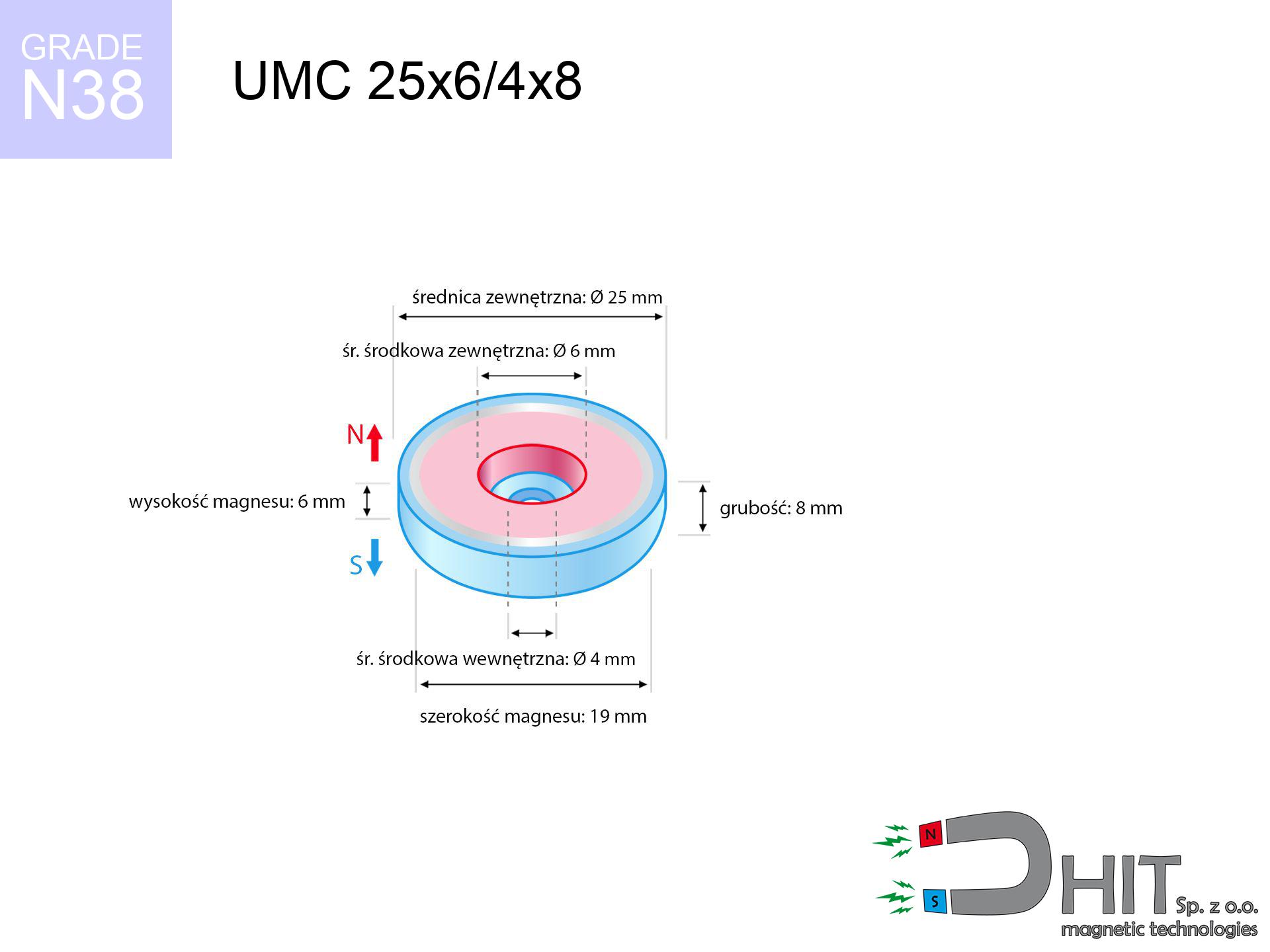
UMC 25x6/4x8 / N38 - cylindrical magnetic holder
cylindrical magnetic holder
Catalog no 320408
GTIN/EAN: 5906301814641
- Diameter
- 25 mm [±1 mm]
- internal diameter Ø
- 6/4 mm [±1 mm]
- Height
- 8 mm [±1 mm]
- Weight
- 21 g
- Magnetization Direction
- ↑ axial
- Coating
- [NiCuNi] Nickel
How we measure these parameters — certificates and measurements
9.51 zł net / pcs
11.70 zł with VAT (23% VAT) / pcs
bulk discounts:
Need more?Frequently asked questions
Which magnetic holder is suitable for moving metal parts in a workshop?
How do I choose a holder for hanging a heavy item and check its real grip?
Which magnetic holders can be used outdoors?
How should I choose a strong threaded holder for field work?
Call us now
+48 888 99 98 98
alternatively let us know using
contact form
the contact section.
Specifications and structure of a neodymium magnet can be estimated using our
power calculator.
Order by 14:00 and we’ll ship today!
Product card - UMC 25x6/4x8 / N38 - cylindrical magnetic holder
Specification / characteristics - UMC 25x6/4x8 / N38 - cylindrical magnetic holder
| properties | values |
|---|---|
| Cat. no. | 320408 |
| GTIN/EAN | 5906301814641 |
| Production/Distribution | Dhit sp. z o.o. |
| Country of origin | Poland / China / Germany |
| Customs code | 85059029 |
| Diameter | 25 mm [±1 mm] |
| internal diameter Ø | 6/4 mm [±1 mm] |
| Height | 8 mm [±1 mm] |
| Weight | 21 g |
| Magnetization Direction | ↑ axial |
| Load capacity ~ ? | 14.00 kg / 137.29 N |
| Coating | [NiCuNi] Nickel |
| Manufacturing Tolerance | ±1 mm |
Magnetic properties of material N38
| properties | values | units |
|---|---|---|
| Remanence Br ? | 12.2-12.6 | kGs |
| Remanence Br ? | 1220-1260 | mT |
| Coercivity bHc ? | 10.8-11.5 | kOe |
| Coercivity bHc ? | 860-915 | kA/m |
| Intrinsic coercivity iHc | ≥ 12 | kOe |
| Intrinsic coercivity iHc | ≥ 955 | kA/m |
| Energy product BHmax ? | 36-38 | BH max MGOe |
| Energy product BHmax ? | 287-303 | BH max KJ/m |
| Maximum working temperature ? | ≤ 80 | °C |
Physical properties of sintered neodymium magnets Nd2Fe14B at 20°C
| properties | values | units |
|---|---|---|
| Vickers hardness | ≥550 | Hv |
| Density | ≥7.4 | g/cm3 |
| Curie Temperature TC | 310 | °C |
| Curie Temperature TF | 590 | °F |
| Specific resistance | 150 | μΩ⋅cm |
| Bending strength | 250 | MPa |
| Compressive strength | 1000~1100 | MPa |
| Thermal expansion parallel (∥) to orientation (M) | (3-4) x 10-6 | °C-1 |
| Thermal expansion perpendicular (⊥) to orientation (M) | -(1-3) x 10-6 | °C-1 |
| Young's modulus | 1.7 x 10⁴ | kg/mm² |
Elemental analysis
| iron (Fe) | 64% – 68% |
| neodymium (Nd) | 29% – 32% |
| boron (B) | 1.1% – 1.2% |
| dysprosium (Dy) | 0.5% – 2.0% |
| coating (Ni-Cu-Ni) | < 0.05% |
Sustainability
| recyclability (EoL) | 100% |
| recycled raw materials | ~10% (pre-cons) |
| carbon footprint | low / zredukowany |
| waste code (EWC) | 16 02 16 |
Check out more products
![SM 25x150 [2xM8] / N42 - magnetic separator](https://cdn3.dhit.pl/graphics/products/sm-25x150-2xm8-cim.jpg "SM 25x150 [2xM8] / N42 - magnetic separator")
Strengths as well as weaknesses of neodymium magnets.
Pros
- Their strength is durable, and after around ten years it drops only by ~1% (according to research),
- They have excellent resistance to magnetic field loss due to external fields,
- A magnet with a smooth silver surface is more attractive,
- Magnetic induction on the working part of the magnet is impressive,
- Neodymium magnets are characterized by very high magnetic induction on the magnet surface and can function (depending on the form) even at a temperature of 230°C or more...
- Possibility of precise forming as well as adjusting to atypical applications,
- Huge importance in advanced technology sectors – they are commonly used in mass storage devices, electric motors, precision medical tools, also industrial machines.
- Thanks to efficiency per cm³, small magnets offer high operating force, in miniature format,
Disadvantages
- At very strong impacts they can break, therefore we advise placing them in steel cases. A metal housing provides additional protection against damage and increases the magnet's durability.
- Do not exceed this material temperature limit: 80°C. Overheating may permanently weaken the magnet.
- Magnets exposed to a humid environment can corrode. Therefore during using outdoors, we recommend using waterproof magnets made of rubber, plastic or other material resistant to moisture
- We suggest casing - magnetic mechanism, due to difficulties in creating nuts inside the magnet and complex forms.
- Possible danger related to microscopic parts of magnets are risky, when accidentally swallowed, which gains importance in the aspect of protecting the youngest. Additionally, small components of these magnets are able to be problematic in diagnostics medical when they are in the body.
- With mass production the cost of neodymium magnets is a challenge,
Holding force characteristics
Maximum holding power of the magnet – what affects it?
- on a base made of mild steel, effectively closing the magnetic field
- with a thickness no less than 10 mm
- characterized by lack of roughness
- with total lack of distance (without paint)
- during pulling in a direction vertical to the plane
- in neutral thermal conditions
Determinants of practical lifting force of a magnet
- Gap (between the magnet and the metal), as even a very small clearance (e.g. 0.5 mm) leads to a reduction in force by up to 50% (this also applies to paint, corrosion or debris).
- Pull-off angle – note that the magnet holds strongest perpendicularly. Under shear forces, the capacity drops drastically, often to levels of 20-30% of the nominal value.
- Element thickness – to utilize 100% power, the steel must be adequately massive. Paper-thin metal restricts the lifting capacity (the magnet "punches through" it).
- Steel grade – the best choice is pure iron steel. Stainless steels may have worse magnetic properties.
- Surface condition – ground elements guarantee perfect abutment, which increases force. Uneven metal weaken the grip.
- Operating temperature – neodymium magnets have a negative temperature coefficient. At higher temperatures they lose power, and at low temperatures gain strength (up to a certain limit).
Lifting capacity was determined using a polished steel plate of suitable thickness (min. 20 mm), under vertically applied force, whereas under shearing force the load capacity is reduced by as much as fivefold. Moreover, even a small distance between the magnet’s surface and the plate reduces the holding force.
Precautions when working with NdFeB magnets
Machining danger
Machining of NdFeB material carries a risk of fire risk. Neodymium dust reacts violently with oxygen and is difficult to extinguish.
Medical interference
For implant holders: Powerful magnets affect electronics. Keep minimum 30 cm distance or ask another person to handle the magnets.
Eye protection
NdFeB magnets are sintered ceramics, which means they are fragile like glass. Collision of two magnets will cause them shattering into shards.
Nickel allergy
Nickel alert: The Ni-Cu-Ni coating contains nickel. If skin irritation happens, cease handling magnets and use protective gear.
Pinching danger
Watch your fingers. Two large magnets will snap together instantly with a force of massive weight, crushing anything in their path. Be careful!
Heat warning
Do not overheat. NdFeB magnets are susceptible to temperature. If you require resistance above 80°C, ask us about special high-temperature series (H, SH, UH).
Precision electronics
A strong magnetic field disrupts the operation of magnetometers in phones and navigation systems. Maintain magnets close to a device to avoid breaking the sensors.
Do not underestimate power
Before use, read the rules. Sudden snapping can destroy the magnet or hurt your hand. Be predictive.
Keep away from computers
Avoid bringing magnets near a purse, laptop, or TV. The magnetism can permanently damage these devices and erase data from cards.
Keep away from children
Always keep magnets away from children. Choking hazard is significant, and the consequences of magnets clamping inside the body are fatal.
Tabela kosztu i czasu dostawy
Płatność przed wysyłką:

GLS kurier
Przesyłka będzie u Ciebie za 2-3 dni
14.99 ZŁ

InPost Paczkomaty 24/7
Przesyłka będzie u Ciebie za 1-2 dni
12.30 ZŁ
Płatność przy odbiorze (pobranie):
GLS kurier
Przesyłka będzie u Ciebie za 1-2 dni
23.00 ZŁ