

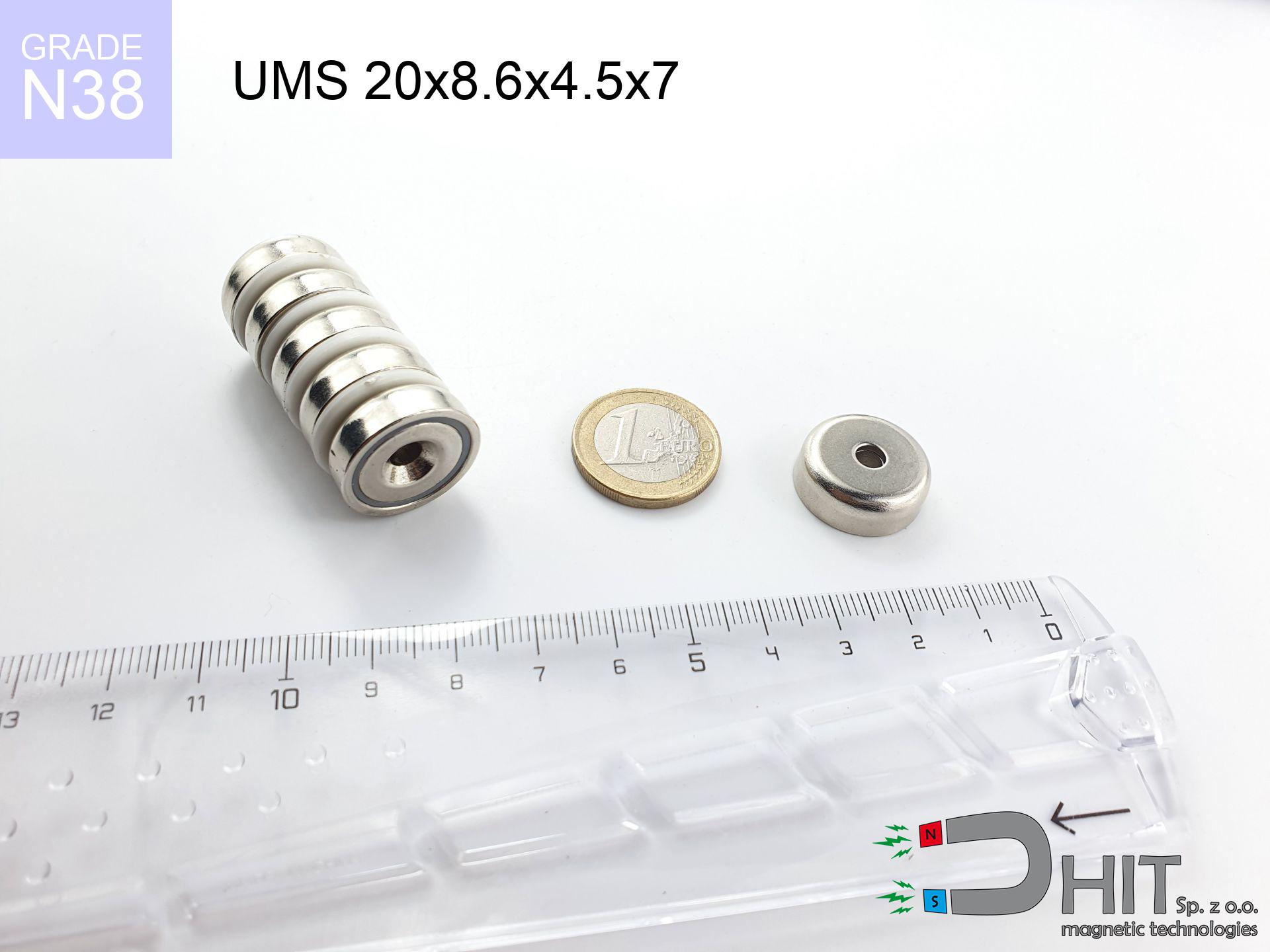
UMS 20x8.6x4.5x7 / N38 - conical magnetic holder
conical magnetic holder
Catalog no 220327
GTIN/EAN: 5906301814177
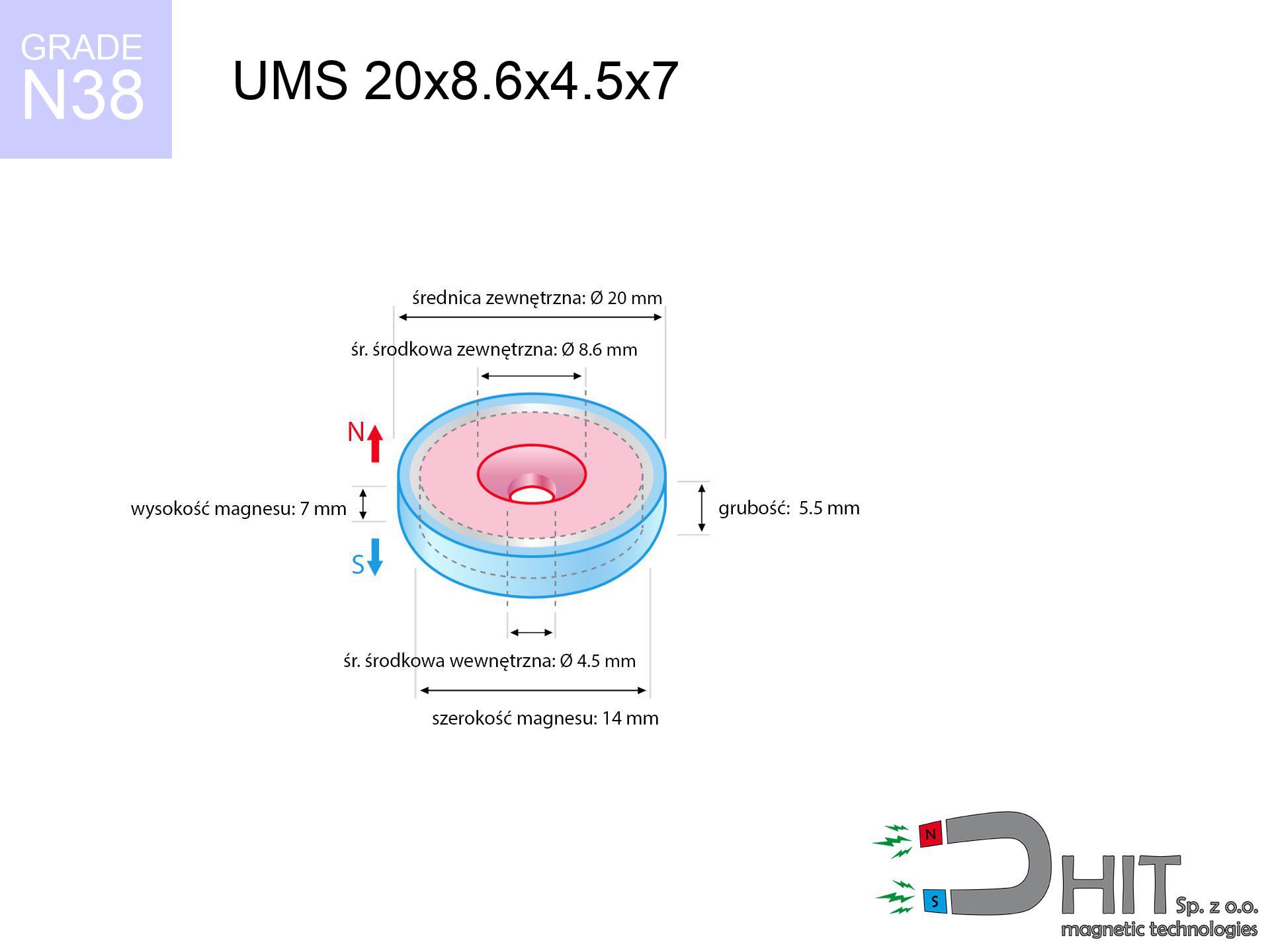
- Diameter Ø
- 20 mm [±1 mm]
- cone dimension Ø
- 8.6x4.5 mm [±1 mm]
- Height
- 7 mm [±1 mm]
- Weight
- 12 g
- Magnetization Direction
- ↑ axial
- Coating
- [NiCuNi] Nickel
How we measure these parameters — certificates and measurements
5.25 zł net / pcs
6.46 zł with VAT (23% VAT) / pcs
bulk discounts:
Need more?Frequently asked questions
Which magnetic holder is suitable for moving metal parts in a workshop?
How do I choose a holder for hanging a heavy item and check its real grip?
Which magnetic holders can be used outdoors?
How should I choose a strong threaded holder for field work?
Call us now
+48 888 99 98 98
alternatively let us know using
contact form
the contact section.
Specifications and structure of a neodymium magnet can be estimated using our
power calculator.
Order by 14:00 and we’ll ship today!
Technical of the product - UMS 20x8.6x4.5x7 / N38 - conical magnetic holder
Specification / characteristics - UMS 20x8.6x4.5x7 / N38 - conical magnetic holder
| properties | values |
|---|---|
| Cat. no. | 220327 |
| GTIN/EAN | 5906301814177 |
| Production/Distribution | Dhit sp. z o.o. |
| Country of origin | Poland / China / Germany |
| Customs code | 85059029 |
| Diameter Ø | 20 mm [±1 mm] |
| cone dimension Ø | 8.6x4.5 mm [±1 mm] |
| Height | 7 mm [±1 mm] |
| Weight | 12 g |
| Magnetization Direction | ↑ axial |
| Load capacity ~ ? | 6.00 kg / 58.84 N |
| Coating | [NiCuNi] Nickel |
| Manufacturing Tolerance | ±1 mm |
Magnetic properties of material N38
| properties | values | units |
|---|---|---|
| Remanence Br ? | 12.2-12.6 | kGs |
| Remanence Br ? | 1220-1260 | mT |
| Coercivity bHc ? | 10.8-11.5 | kOe |
| Coercivity bHc ? | 860-915 | kA/m |
| Intrinsic coercivity iHc | ≥ 12 | kOe |
| Intrinsic coercivity iHc | ≥ 955 | kA/m |
| Energy product BHmax ? | 36-38 | BH max MGOe |
| Energy product BHmax ? | 287-303 | BH max KJ/m |
| Maximum working temperature ? | ≤ 80 | °C |
Physical properties of sintered neodymium magnets Nd2Fe14B at 20°C
| properties | values | units |
|---|---|---|
| Vickers hardness | ≥550 | Hv |
| Density | ≥7.4 | g/cm3 |
| Curie Temperature TC | 310 | °C |
| Curie Temperature TF | 590 | °F |
| Specific resistance | 150 | μΩ⋅cm |
| Bending strength | 250 | MPa |
| Compressive strength | 1000~1100 | MPa |
| Thermal expansion parallel (∥) to orientation (M) | (3-4) x 10-6 | °C-1 |
| Thermal expansion perpendicular (⊥) to orientation (M) | -(1-3) x 10-6 | °C-1 |
| Young's modulus | 1.7 x 10⁴ | kg/mm² |
Material specification
| iron (Fe) | 64% – 68% |
| neodymium (Nd) | 29% – 32% |
| boron (B) | 1.1% – 1.2% |
| dysprosium (Dy) | 0.5% – 2.0% |
| coating (Ni-Cu-Ni) | < 0.05% |
Environmental data
| recyclability (EoL) | 100% |
| recycled raw materials | ~10% (pre-cons) |
| carbon footprint | low / zredukowany |
| waste code (EWC) | 16 02 16 |
Other offers
![UI 45x13x6 [C321] / N38 - badge holder](https://cdn3.dhit.pl/graphics/products/ui45x13x6-c321-jic.jpg "UI 45x13x6 [C321] / N38 - badge holder")
![UMGZ 60x30x15 [M10] GZ / N38 - magnetic holder external thread](https://cdn3.dhit.pl/graphics/products/umgw-60x30x15-m10-gz-bas.jpg "UMGZ 60x30x15 [M10] GZ / N38 - magnetic holder external thread")
Pros as well as cons of neodymium magnets.
Pros
- They have constant strength, and over around ten years their performance decreases symbolically – ~1% (in testing),
- Magnets perfectly resist against loss of magnetization caused by external fields,
- In other words, due to the reflective finish of silver, the element gains visual value,
- Magnetic induction on the surface of the magnet is strong,
- Through (appropriate) combination of ingredients, they can achieve high thermal resistance, enabling operation at temperatures reaching 230°C and above...
- Possibility of accurate forming and optimizing to atypical needs,
- Versatile presence in modern industrial fields – they find application in data components, electric drive systems, precision medical tools, also multitasking production systems.
- Thanks to their power density, small magnets offer high operating force, in miniature format,
Disadvantages
- They are fragile upon too strong impacts. To avoid cracks, it is worth securing magnets using a steel holder. Such protection not only shields the magnet but also increases its resistance to damage
- Do not exceed this material temperature limit: 80°C. Overheating may permanently weaken the magnet.
- Due to the susceptibility of magnets to corrosion in a humid environment, we suggest using waterproof magnets made of rubber, plastic or other material stable to moisture, in case of application outdoors
- Limited possibility of producing threads in the magnet and complex shapes - preferred is a housing - magnet mounting.
- Potential hazard resulting from small fragments of magnets can be dangerous, in case of ingestion, which becomes key in the aspect of protecting the youngest. It is also worth noting that small elements of these magnets can disrupt the diagnostic process medical when they are in the body.
- With budget limitations the cost of neodymium magnets can be a barrier,
Pull force analysis
Best holding force of the magnet in ideal parameters – what it depends on?
- using a plate made of high-permeability steel, serving as a ideal flux conductor
- whose transverse dimension equals approx. 10 mm
- with a plane perfectly flat
- under conditions of ideal adhesion (metal-to-metal)
- during pulling in a direction perpendicular to the mounting surface
- at conditions approx. 20°C
Determinants of lifting force in real conditions
- Space between surfaces – every millimeter of distance (caused e.g. by veneer or dirt) drastically reduces the pulling force, often by half at just 0.5 mm.
- Pull-off angle – remember that the magnet has greatest strength perpendicularly. Under sliding down, the holding force drops significantly, often to levels of 20-30% of the nominal value.
- Wall thickness – thin material does not allow full use of the magnet. Magnetic flux penetrates through instead of converting into lifting capacity.
- Plate material – mild steel attracts best. Alloy admixtures lower magnetic permeability and holding force.
- Smoothness – full contact is obtained only on polished steel. Any scratches and bumps create air cushions, reducing force.
- Thermal factor – high temperature weakens pulling force. Too high temperature can permanently demagnetize the magnet.
Lifting capacity testing was performed on plates with a smooth surface of suitable thickness, under perpendicular forces, however under attempts to slide the magnet the load capacity is reduced by as much as fivefold. Moreover, even a minimal clearance between the magnet and the plate reduces the holding force.
Safety rules for work with NdFeB magnets
Caution required
Before starting, check safety instructions. Sudden snapping can destroy the magnet or injure your hand. Be predictive.
Avoid contact if allergic
Medical facts indicate that the nickel plating (the usual finish) is a potent allergen. If your skin reacts to metals, refrain from touching magnets with bare hands or opt for coated magnets.
Do not give to children
Only for adults. Tiny parts pose a choking risk, leading to serious injuries. Store away from children and animals.
Bodily injuries
Watch your fingers. Two large magnets will join immediately with a force of massive weight, crushing anything in their path. Be careful!
Magnetic media
Do not bring magnets close to a purse, laptop, or screen. The magnetic field can irreversibly ruin these devices and wipe information from cards.
Fire warning
Machining of neodymium magnets carries a risk of fire hazard. Neodymium dust reacts violently with oxygen and is difficult to extinguish.
Magnetic interference
An intense magnetic field negatively affects the functioning of compasses in phones and navigation systems. Maintain magnets close to a device to avoid breaking the sensors.
ICD Warning
Warning for patients: Strong magnetic fields affect medical devices. Keep at least 30 cm distance or ask another person to work with the magnets.
Heat sensitivity
Monitor thermal conditions. Exposing the magnet to high heat will destroy its properties and strength.
Magnets are brittle
Neodymium magnets are sintered ceramics, which means they are prone to chipping. Collision of two magnets will cause them shattering into shards.
Tabela kosztu i czasu dostawy
Płatność przed wysyłką:

GLS kurier
Przesyłka będzie u Ciebie za 2-3 dni
14.99 ZŁ

InPost Paczkomaty 24/7
Przesyłka będzie u Ciebie za 1-2 dni
12.30 ZŁ
Płatność przy odbiorze (pobranie):
GLS kurier
Przesyłka będzie u Ciebie za 1-2 dni
23.00 ZŁ