

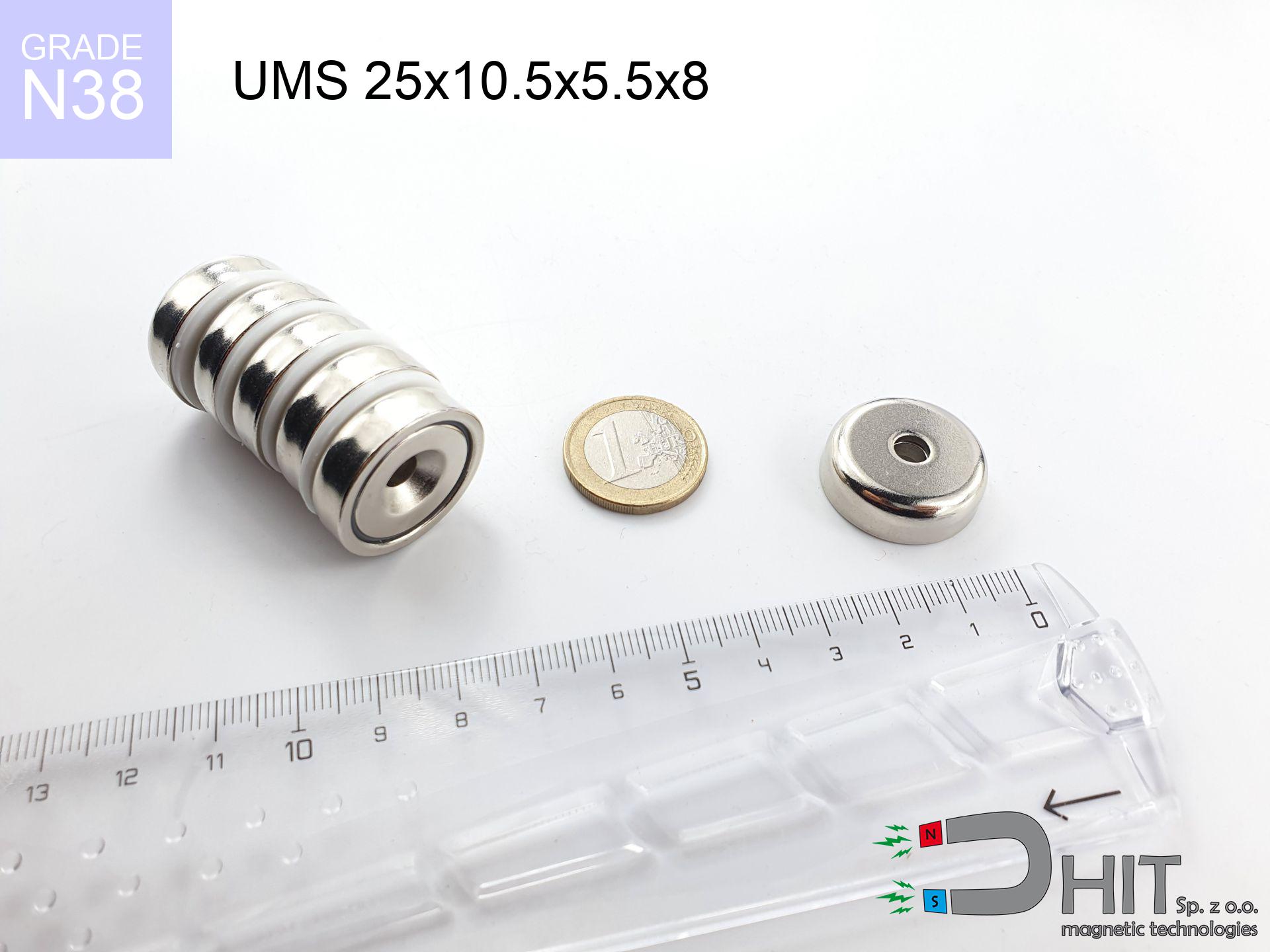
UMS 25x10.5x5.5x8 / N38 - conical magnetic holder
conical magnetic holder
Catalog no 220328
GTIN/EAN: 5906301814184
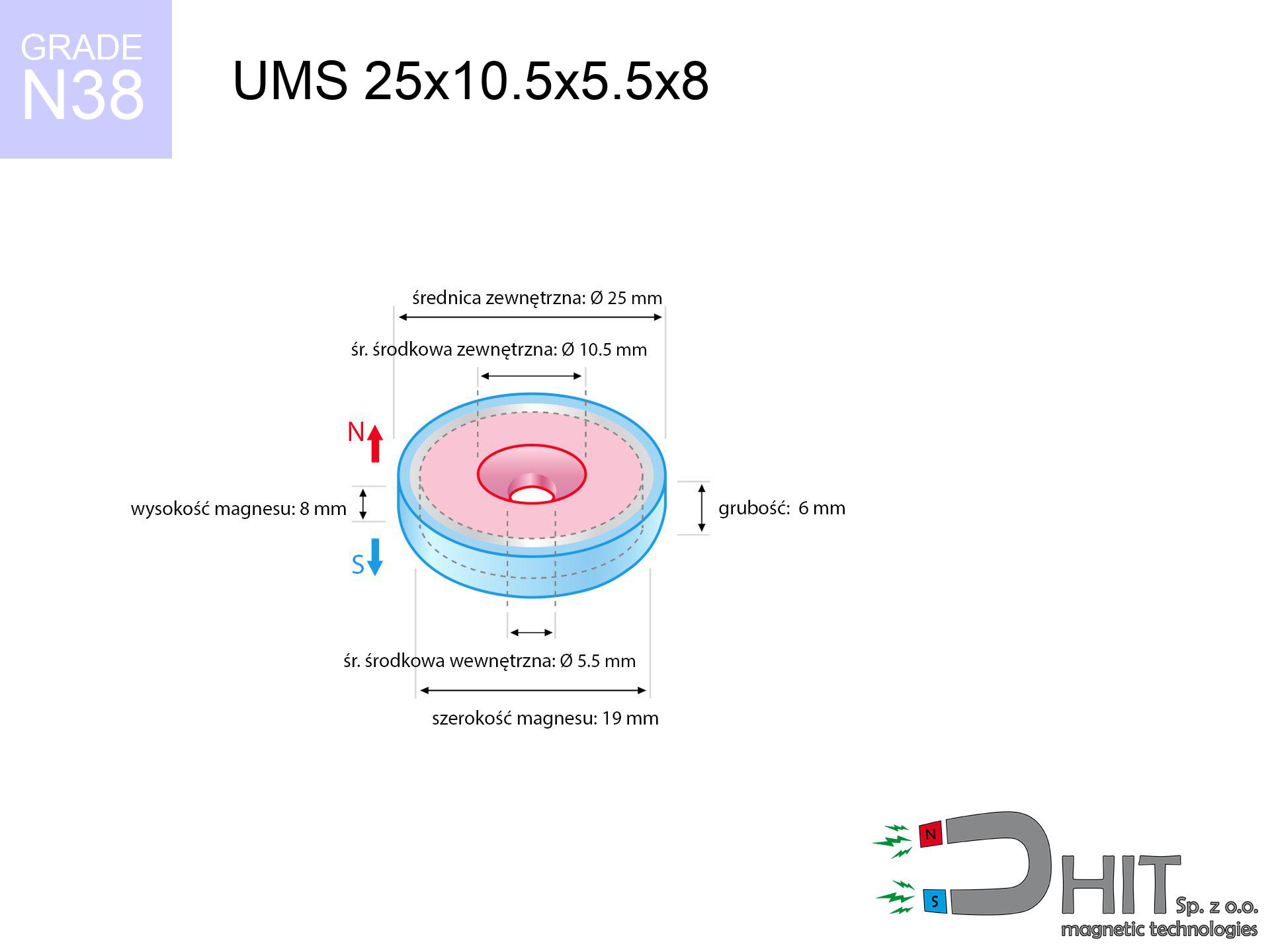
- Diameter Ø
- 25 mm [±1 mm]
- cone dimension Ø
- 10.5x5.5 mm [±1 mm]
- Height
- 8 mm [±1 mm]
- Weight
- 21 g
- Magnetization Direction
- ↑ axial
- Coating
- [NiCuNi] Nickel
How we measure these parameters — certificates and measurements
7.90 zł net / pcs
9.72 zł with VAT (23% VAT) / pcs
bulk discounts:
Need more?Frequently asked questions
Which magnetic holder is suitable for moving metal parts in a workshop?
How do I choose a holder for hanging a heavy item and check its real grip?
Which magnetic holders can be used outdoors?
How should I choose a strong threaded holder for field work?
Call us now
+48 888 99 98 98
alternatively let us know using
contact form
the contact section.
Specifications and structure of a neodymium magnet can be estimated using our
power calculator.
Order by 14:00 and we’ll ship today!
Physical properties - UMS 25x10.5x5.5x8 / N38 - conical magnetic holder
Specification / characteristics - UMS 25x10.5x5.5x8 / N38 - conical magnetic holder
| properties | values |
|---|---|
| Cat. no. | 220328 |
| GTIN/EAN | 5906301814184 |
| Production/Distribution | Dhit sp. z o.o. |
| Country of origin | Poland / China / Germany |
| Customs code | 85059029 |
| Diameter Ø | 25 mm [±1 mm] |
| cone dimension Ø | 10.5x5.5 mm [±1 mm] |
| Height | 8 mm [±1 mm] |
| Weight | 21 g |
| Magnetization Direction | ↑ axial |
| Load capacity ~ ? | 14.00 kg / 137.29 N |
| Coating | [NiCuNi] Nickel |
| Manufacturing Tolerance | ±1 mm |
Magnetic properties of material N38
| properties | values | units |
|---|---|---|
| Remanence Br ? | 12.2-12.6 | kGs |
| Remanence Br ? | 1220-1260 | mT |
| Coercivity bHc ? | 10.8-11.5 | kOe |
| Coercivity bHc ? | 860-915 | kA/m |
| Intrinsic coercivity iHc | ≥ 12 | kOe |
| Intrinsic coercivity iHc | ≥ 955 | kA/m |
| Energy product BHmax ? | 36-38 | BH max MGOe |
| Energy product BHmax ? | 287-303 | BH max KJ/m |
| Maximum working temperature ? | ≤ 80 | °C |
Physical properties of sintered neodymium magnets Nd2Fe14B at 20°C
| properties | values | units |
|---|---|---|
| Vickers hardness | ≥550 | Hv |
| Density | ≥7.4 | g/cm3 |
| Curie Temperature TC | 310 | °C |
| Curie Temperature TF | 590 | °F |
| Specific resistance | 150 | μΩ⋅cm |
| Bending strength | 250 | MPa |
| Compressive strength | 1000~1100 | MPa |
| Thermal expansion parallel (∥) to orientation (M) | (3-4) x 10-6 | °C-1 |
| Thermal expansion perpendicular (⊥) to orientation (M) | -(1-3) x 10-6 | °C-1 |
| Young's modulus | 1.7 x 10⁴ | kg/mm² |
Material specification
| iron (Fe) | 64% – 68% |
| neodymium (Nd) | 29% – 32% |
| boron (B) | 1.1% – 1.2% |
| dysprosium (Dy) | 0.5% – 2.0% |
| coating (Ni-Cu-Ni) | < 0.05% |
Sustainability
| recyclability (EoL) | 100% |
| recycled raw materials | ~10% (pre-cons) |
| carbon footprint | low / zredukowany |
| waste code (EWC) | 16 02 16 |
See more deals
![UMP 135x40 [M10+M12] GW F 600 kg / N38 - search holder](https://cdn3.dhit.pl/graphics/products/ump135x40-m10+m12-gw-f-600-kg-luz.jpg "UMP 135x40 [M10+M12] GW F 600 kg / N38 - search holder")
![MPL 40x10x4x2[7/3.5] / N38 - lamellar magnet](https://cdn3.dhit.pl/graphics/products/mpl40x10x4x27-3.5-suw.jpg "MPL 40x10x4x2[7/3.5] / N38 - lamellar magnet")
Strengths and weaknesses of Nd2Fe14B magnets.
Pros
- They do not lose magnetism, even over approximately ten years – the reduction in strength is only ~1% (according to tests),
- They show high resistance to demagnetization induced by external field influence,
- In other words, due to the reflective surface of silver, the element becomes visually attractive,
- Magnets exhibit exceptionally strong magnetic induction on the working surface,
- Made from properly selected components, these magnets show impressive resistance to high heat, enabling them to function (depending on their shape) at temperatures up to 230°C and above...
- Thanks to the ability of free forming and adaptation to specialized projects, NdFeB magnets can be modeled in a wide range of shapes and sizes, which expands the range of possible applications,
- Versatile presence in advanced technology sectors – they are utilized in computer drives, electromotive mechanisms, medical devices, also other advanced devices.
- Compactness – despite small sizes they generate large force, making them ideal for precision applications
Cons
- Brittleness is one of their disadvantages. Upon intense impact they can break. We advise keeping them in a special holder, which not only secures them against impacts but also raises their durability
- Do not exceed this material temperature limit: 80°C. Overheating may permanently weaken the magnet.
- They rust in a humid environment - during use outdoors we recommend using waterproof magnets e.g. in rubber, plastic
- We recommend cover - magnetic holder, due to difficulties in realizing threads inside the magnet and complex shapes.
- Potential hazard resulting from small fragments of magnets pose a threat, when accidentally swallowed, which is particularly important in the context of child safety. It is also worth noting that small components of these magnets can complicate diagnosis medical in case of swallowing.
- Due to expensive raw materials, their price is relatively high,
Pull force analysis
Highest magnetic holding force – what it depends on?
- on a plate made of mild steel, optimally conducting the magnetic flux
- possessing a thickness of min. 10 mm to avoid saturation
- with a surface perfectly flat
- with direct contact (no impurities)
- for force applied at a right angle (in the magnet axis)
- in neutral thermal conditions
Determinants of practical lifting force of a magnet
- Air gap (betwixt the magnet and the metal), because even a tiny distance (e.g. 0.5 mm) can cause a drastic drop in lifting capacity by up to 50% (this also applies to varnish, corrosion or debris).
- Force direction – catalog parameter refers to pulling vertically. When slipping, the magnet exhibits significantly lower power (typically approx. 20-30% of nominal force).
- Steel thickness – too thin steel causes magnetic saturation, causing part of the flux to be lost to the other side.
- Steel type – low-carbon steel attracts best. Alloy admixtures decrease magnetic permeability and holding force.
- Smoothness – full contact is obtained only on smooth steel. Rough texture create air cushions, reducing force.
- Thermal factor – hot environment reduces pulling force. Exceeding the limit temperature can permanently demagnetize the magnet.
Holding force was checked on the plate surface of 20 mm thickness, when a perpendicular force was applied, in contrast under shearing force the holding force is lower. In addition, even a small distance between the magnet’s surface and the plate reduces the holding force.
Safe handling of NdFeB magnets
Caution required
Use magnets with awareness. Their powerful strength can surprise even experienced users. Stay alert and respect their force.
Phone sensors
Navigation devices and mobile phones are highly susceptible to magnetism. Direct contact with a powerful NdFeB magnet can permanently damage the internal compass in your phone.
Mechanical processing
Combustion risk: Neodymium dust is explosive. Do not process magnets in home conditions as this risks ignition.
Pacemakers
Life threat: Neodymium magnets can deactivate heart devices and defibrillators. Do not approach if you have medical devices.
Choking Hazard
Neodymium magnets are not suitable for play. Eating multiple magnets can lead to them connecting inside the digestive tract, which poses a severe health hazard and necessitates urgent medical intervention.
Do not overheat magnets
Control the heat. Exposing the magnet to high heat will permanently weaken its properties and strength.
Metal Allergy
Nickel alert: The nickel-copper-nickel coating consists of nickel. If skin irritation occurs, immediately stop working with magnets and use protective gear.
Protect data
Do not bring magnets near a wallet, computer, or screen. The magnetic field can destroy these devices and wipe information from cards.
Shattering risk
Neodymium magnets are sintered ceramics, meaning they are prone to chipping. Collision of two magnets leads to them shattering into small pieces.
Serious injuries
Danger of trauma: The pulling power is so immense that it can cause blood blisters, crushing, and broken bones. Protective gloves are recommended.
Tabela kosztu i czasu dostawy
Płatność przed wysyłką:

GLS kurier
Przesyłka będzie u Ciebie za 2-3 dni
14.99 ZŁ

InPost Paczkomaty 24/7
Przesyłka będzie u Ciebie za 1-2 dni
12.30 ZŁ
Płatność przy odbiorze (pobranie):
GLS kurier
Przesyłka będzie u Ciebie za 1-2 dni
23.00 ZŁ