

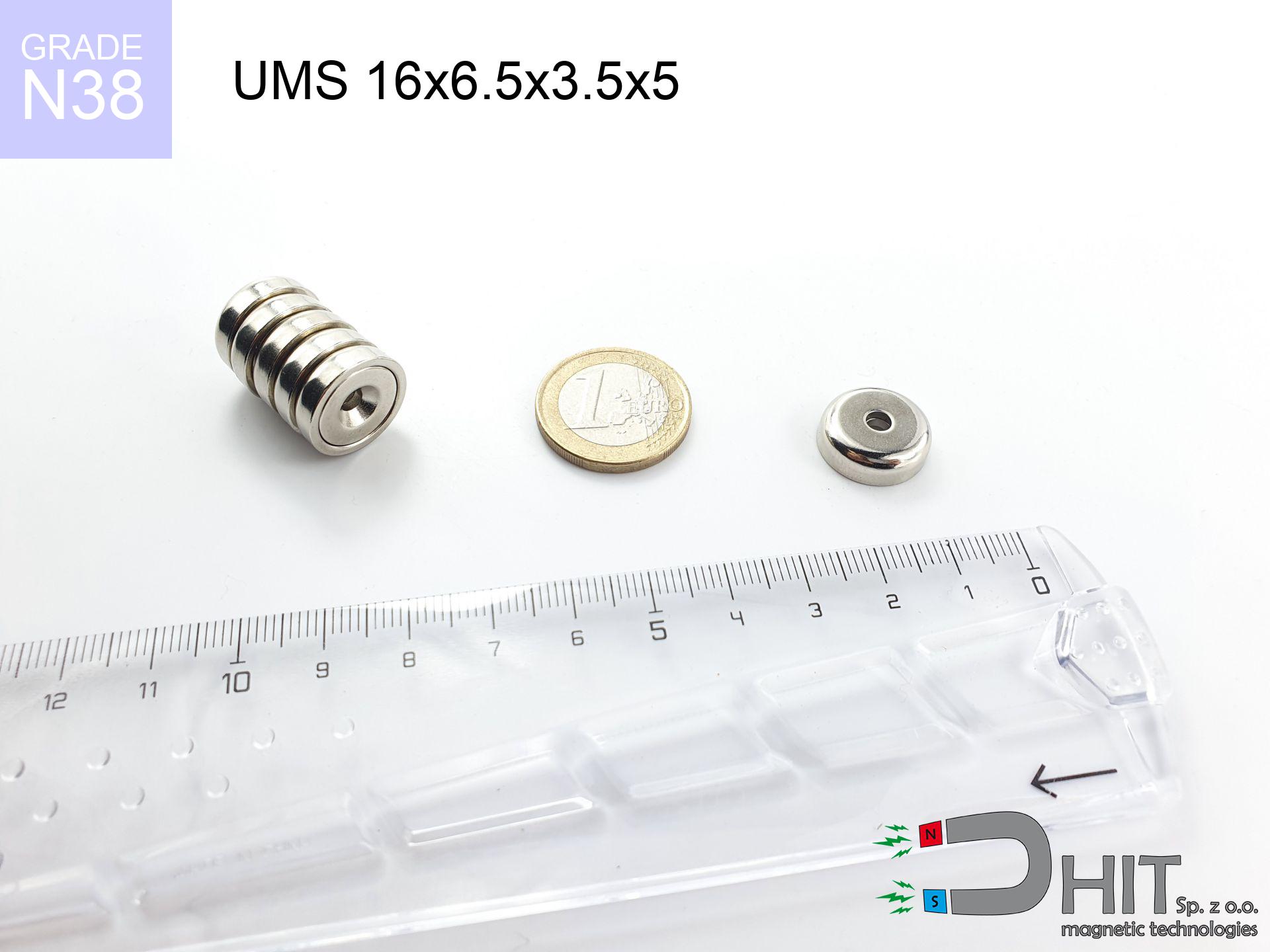
UMS 16x6.5x3.5x5 / N38 - conical magnetic holder
conical magnetic holder
Catalog no 220326
GTIN/EAN: 5906301814160
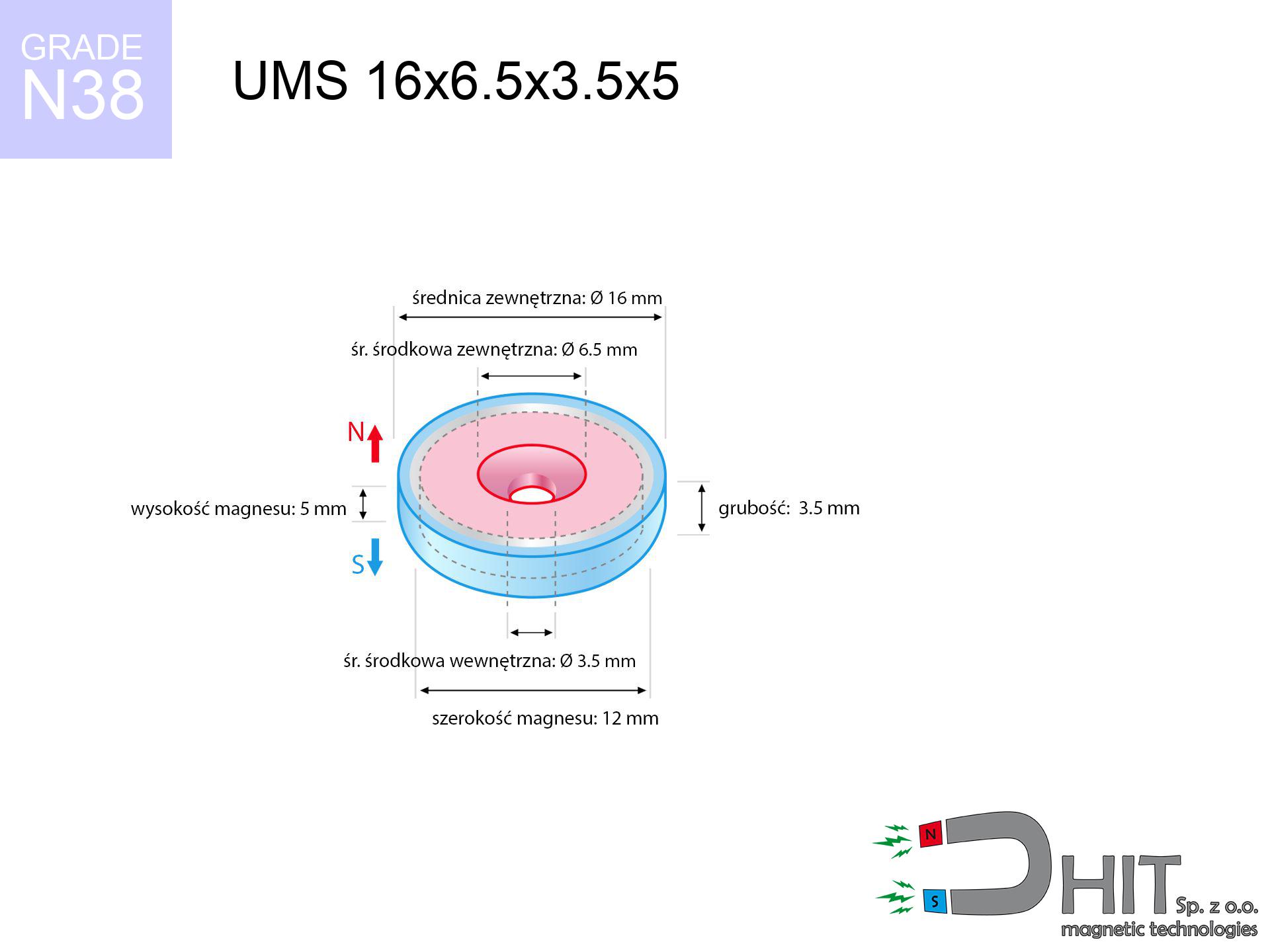
- Diameter Ø
- 16 mm [±1 mm]
- cone dimension Ø
- 6.5x3.5 mm [±1 mm]
- Height
- 5 mm [±1 mm]
- Weight
- 5.5 g
- Magnetization Direction
- ↑ axial
- Coating
- [NiCuNi] Nickel
How we measure these parameters — certificates and measurements
3.64 zł net / pcs
4.48 zł with VAT (23% VAT) / pcs
bulk discounts:
Need more?Frequently asked questions
Which magnetic holder is suitable for moving metal parts in a workshop?
How do I choose a holder for hanging a heavy item and check its real grip?
Which magnetic holders can be used outdoors?
How should I choose a strong threaded holder for field work?
Call us now
+48 888 99 98 98
alternatively let us know using
contact form
the contact section.
Specifications and structure of a neodymium magnet can be estimated using our
power calculator.
Order by 14:00 and we’ll ship today!
Technical of the product - UMS 16x6.5x3.5x5 / N38 - conical magnetic holder
Specification / characteristics - UMS 16x6.5x3.5x5 / N38 - conical magnetic holder
| properties | values |
|---|---|
| Cat. no. | 220326 |
| GTIN/EAN | 5906301814160 |
| Production/Distribution | Dhit sp. z o.o. |
| Country of origin | Poland / China / Germany |
| Customs code | 85059029 |
| Diameter Ø | 16 mm [±1 mm] |
| cone dimension Ø | 6.5x3.5 mm [±1 mm] |
| Height | 5 mm [±1 mm] |
| Weight | 5.5 g |
| Magnetization Direction | ↑ axial |
| Load capacity ~ ? | 5.00 kg / 49.03 N |
| Coating | [NiCuNi] Nickel |
| Manufacturing Tolerance | ±1 mm |
Magnetic properties of material N38
| properties | values | units |
|---|---|---|
| Remanence Br ? | 12.2-12.6 | kGs |
| Remanence Br ? | 1220-1260 | mT |
| Coercivity bHc ? | 10.8-11.5 | kOe |
| Coercivity bHc ? | 860-915 | kA/m |
| Intrinsic coercivity iHc | ≥ 12 | kOe |
| Intrinsic coercivity iHc | ≥ 955 | kA/m |
| Energy product BHmax ? | 36-38 | BH max MGOe |
| Energy product BHmax ? | 287-303 | BH max KJ/m |
| Maximum working temperature ? | ≤ 80 | °C |
Physical properties of sintered neodymium magnets Nd2Fe14B at 20°C
| properties | values | units |
|---|---|---|
| Vickers hardness | ≥550 | Hv |
| Density | ≥7.4 | g/cm3 |
| Curie Temperature TC | 310 | °C |
| Curie Temperature TF | 590 | °F |
| Specific resistance | 150 | μΩ⋅cm |
| Bending strength | 250 | MPa |
| Compressive strength | 1000~1100 | MPa |
| Thermal expansion parallel (∥) to orientation (M) | (3-4) x 10-6 | °C-1 |
| Thermal expansion perpendicular (⊥) to orientation (M) | -(1-3) x 10-6 | °C-1 |
| Young's modulus | 1.7 x 10⁴ | kg/mm² |
Material specification
| iron (Fe) | 64% – 68% |
| neodymium (Nd) | 29% – 32% |
| boron (B) | 1.1% – 1.2% |
| dysprosium (Dy) | 0.5% – 2.0% |
| coating (Ni-Cu-Ni) | < 0.05% |
Environmental data
| recyclability (EoL) | 100% |
| recycled raw materials | ~10% (pre-cons) |
| carbon footprint | low / zredukowany |
| waste code (EWC) | 16 02 16 |
Other products


![UMP 135x40 [M10+M12] GW F600 Lina / N38 - search holder](https://cdn3.dhit.pl/graphics/products/ump-135x40-m10+m12-gw-f600-+lina-sej.jpg "UMP 135x40 [M10+M12] GW F600 Lina / N38 - search holder")
![SM 32x100 [2xM8] / N42 - magnetic separator](https://cdn3.dhit.pl/graphics/products/sm-32x100-2xm8-cox.jpg "SM 32x100 [2xM8] / N42 - magnetic separator")
Pros and cons of rare earth magnets.
Pros
- They retain magnetic properties for nearly 10 years – the drop is just ~1% (based on simulations),
- Magnets very well resist against loss of magnetization caused by foreign field sources,
- The use of an refined finish of noble metals (nickel, gold, silver) causes the element to look better,
- The surface of neodymium magnets generates a unique magnetic field – this is a distinguishing feature,
- Made from properly selected components, these magnets show impressive resistance to high heat, enabling them to function (depending on their form) at temperatures up to 230°C and above...
- Thanks to freedom in shaping and the ability to modify to individual projects,
- Universal use in modern industrial fields – they serve a role in HDD drives, brushless drives, advanced medical instruments, and modern systems.
- Compactness – despite small sizes they generate large force, making them ideal for precision applications
Weaknesses
- They are prone to damage upon heavy impacts. To avoid cracks, it is worth securing magnets in a protective case. Such protection not only protects the magnet but also improves its resistance to damage
- Do not exceed this material temperature limit: 80°C. Overheating may permanently weaken the magnet.
- When exposed to humidity, magnets start to rust. To use them in conditions outside, it is recommended to use protective magnets, such as magnets in rubber or plastics, which secure oxidation as well as corrosion.
- Due to limitations in realizing nuts and complex forms in magnets, we propose using a housing - magnetic mount.
- Potential hazard to health – tiny shards of magnets are risky, if swallowed, which gains importance in the context of child health protection. Additionally, tiny parts of these devices are able to be problematic in diagnostics medical when they are in the body.
- Due to neodymium price, their price is relatively high,
Holding force characteristics
Detachment force of the magnet in optimal conditions – what it depends on?
- using a base made of high-permeability steel, serving as a circuit closing element
- possessing a thickness of min. 10 mm to ensure full flux closure
- characterized by even structure
- with zero gap (no paint)
- for force acting at a right angle (in the magnet axis)
- at temperature approx. 20 degrees Celsius
Lifting capacity in practice – influencing factors
- Distance – the presence of foreign body (paint, tape, gap) acts as an insulator, which reduces capacity rapidly (even by 50% at 0.5 mm).
- Force direction – declared lifting capacity refers to detachment vertically. When attempting to slide, the magnet holds significantly lower power (typically approx. 20-30% of nominal force).
- Plate thickness – too thin plate does not close the flux, causing part of the power to be lost to the other side.
- Plate material – low-carbon steel gives the best results. Alloy admixtures reduce magnetic permeability and holding force.
- Surface quality – the smoother and more polished the surface, the better the adhesion and higher the lifting capacity. Roughness creates an air distance.
- Operating temperature – neodymium magnets have a negative temperature coefficient. At higher temperatures they lose power, and at low temperatures gain strength (up to a certain limit).
Lifting capacity was assessed using a steel plate with a smooth surface of suitable thickness (min. 20 mm), under perpendicular detachment force, however under attempts to slide the magnet the lifting capacity is smaller. In addition, even a small distance between the magnet and the plate lowers the load capacity.
Warnings
Do not underestimate power
Be careful. Neodymium magnets act from a distance and snap with huge force, often quicker than you can react.
Compass and GPS
Be aware: rare earth magnets generate a field that confuses sensitive sensors. Keep a safe distance from your phone, device, and navigation systems.
Life threat
Health Alert: Strong magnets can turn off pacemakers and defibrillators. Do not approach if you have medical devices.
Flammability
Dust generated during cutting of magnets is self-igniting. Avoid drilling into magnets unless you are an expert.
Demagnetization risk
Avoid heat. NdFeB magnets are sensitive to heat. If you require resistance above 80°C, look for special high-temperature series (H, SH, UH).
Eye protection
Despite the nickel coating, neodymium is delicate and not impact-resistant. Avoid impacts, as the magnet may shatter into sharp, dangerous pieces.
Product not for children
Only for adults. Small elements can be swallowed, leading to intestinal necrosis. Store out of reach of children and animals.
Hand protection
Risk of injury: The pulling power is so immense that it can cause blood blisters, crushing, and broken bones. Protective gloves are recommended.
Allergy Warning
It is widely known that the nickel plating (the usual finish) is a strong allergen. If you have an allergy, avoid direct skin contact or choose coated magnets.
Protect data
Powerful magnetic fields can destroy records on payment cards, hard drives, and other magnetic media. Keep a distance of at least 10 cm.
Tabela kosztu i czasu dostawy
Płatność przed wysyłką:

GLS kurier
Przesyłka będzie u Ciebie za 2-3 dni
14.99 ZŁ

InPost Paczkomaty 24/7
Przesyłka będzie u Ciebie za 1-2 dni
12.30 ZŁ
Płatność przy odbiorze (pobranie):
GLS kurier
Przesyłka będzie u Ciebie za 1-2 dni
23.00 ZŁ