

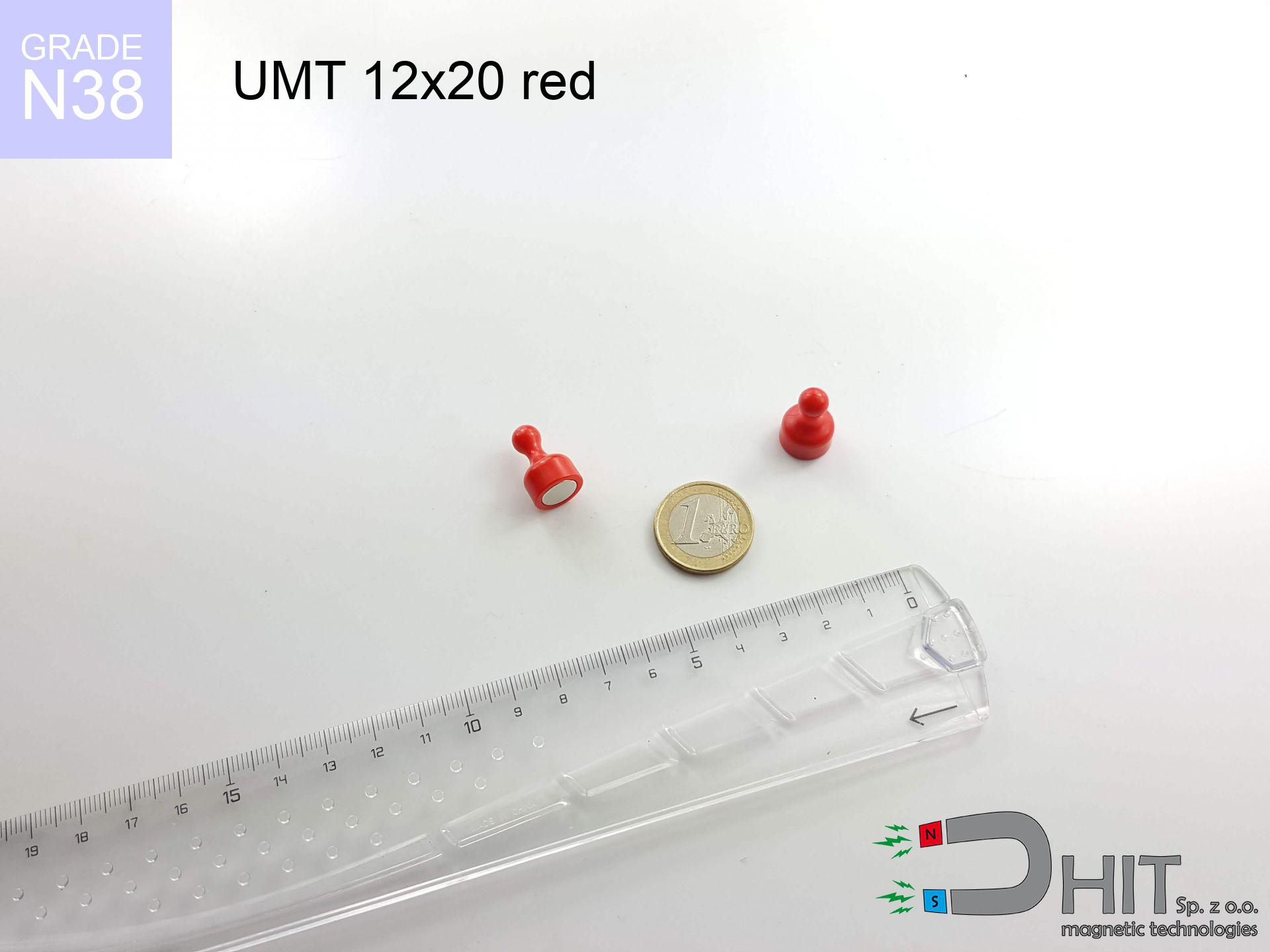
UMT 12x20 red / N38 - board holder
board holder
Catalog no 230278
GTIN/EAN: 5906301814306
- Diameter Ø
- 12 mm [±1 mm]
- Height
- 20 mm [±1 mm]
- Weight
- 3.5 g
- Coating
- [NiCuNi] Nickel
How we measure these parameters — certificates and measurements
1.540 zł net / pcs
1.894 zł with VAT (23% VAT) / pcs
bulk discounts:
Need more?Frequently asked questions
How many sheets of paper will one magnetic pin hold?
Will a magnetic pin stick to any board - whiteboard, glass, cork?
Will the magnet leave a mark or scratch the board or the fridge?
What is the difference between the 12x20 and 20x25 sizes, and which one suits an office?
Are magnetic pins suitable for large-format maps and plans?
Call us now
+48 888 99 98 98
alternatively let us know using
contact form
the contact section.
Specifications and structure of a neodymium magnet can be estimated using our
power calculator.
Order by 14:00 and we’ll ship today!
Technical of the product - UMT 12x20 red / N38 - board holder
Specification / characteristics - UMT 12x20 red / N38 - board holder
| properties | values |
|---|---|
| Cat. no. | 230278 |
| GTIN/EAN | 5906301814306 |
| Production/Distribution | Dhit sp. z o.o. |
| Country of origin | Poland / China / Germany |
| Customs code | 85059029 |
| Diameter Ø | 12 mm [±1 mm] |
| Height | 20 mm [±1 mm] |
| Weight | 3.5 g |
| Coating | [NiCuNi] Nickel |
| Manufacturing Tolerance | ±1 mm |
Magnetic properties of material N38
| properties | values | units |
|---|---|---|
| Remanence Br ? | 12.2-12.6 | kGs |
| Remanence Br ? | 1220-1260 | mT |
| Coercivity bHc ? | 10.8-11.5 | kOe |
| Coercivity bHc ? | 860-915 | kA/m |
| Intrinsic coercivity iHc | ≥ 12 | kOe |
| Intrinsic coercivity iHc | ≥ 955 | kA/m |
| Energy product BHmax ? | 36-38 | BH max MGOe |
| Energy product BHmax ? | 287-303 | BH max KJ/m |
| Maximum working temperature ? | ≤ 80 | °C |
Physical properties of sintered neodymium magnets Nd2Fe14B at 20°C
| properties | values | units |
|---|---|---|
| Vickers hardness | ≥550 | Hv |
| Density | ≥7.4 | g/cm3 |
| Curie Temperature TC | 310 | °C |
| Curie Temperature TF | 590 | °F |
| Specific resistance | 150 | μΩ⋅cm |
| Bending strength | 250 | MPa |
| Compressive strength | 1000~1100 | MPa |
| Thermal expansion parallel (∥) to orientation (M) | (3-4) x 10-6 | °C-1 |
| Thermal expansion perpendicular (⊥) to orientation (M) | -(1-3) x 10-6 | °C-1 |
| Young's modulus | 1.7 x 10⁴ | kg/mm² |
Elemental analysis
| iron (Fe) | 64% – 68% |
| neodymium (Nd) | 29% – 32% |
| boron (B) | 1.1% – 1.2% |
| dysprosium (Dy) | 0.5% – 2.0% |
| coating (Ni-Cu-Ni) | < 0.05% |
Environmental data
| recyclability (EoL) | 100% |
| recycled raw materials | ~10% (pre-cons) |
| carbon footprint | low / zredukowany |
| waste code (EWC) | 16 02 16 |
Other deals
![HH 32x7.8 [M5] / N38 - through hole magnetic holder](https://cdn3.dhit.pl/graphics/products/hh-32x7.8-m5-war.jpg "HH 32x7.8 [M5] / N38 - through hole magnetic holder")


Advantages and disadvantages of rare earth magnets.
Pros
- They do not lose magnetism, even after approximately 10 years – the decrease in power is only ~1% (based on measurements),
- They feature excellent resistance to magnetic field loss when exposed to external fields,
- By applying a smooth layer of gold, the element gains an nice look,
- Magnetic induction on the top side of the magnet turns out to be extremely intense,
- Neodymium magnets are characterized by very high magnetic induction on the magnet surface and are able to act (depending on the form) even at a temperature of 230°C or more...
- Possibility of custom machining as well as optimizing to individual needs,
- Significant place in high-tech industry – they are utilized in mass storage devices, electric motors, diagnostic systems, as well as complex engineering applications.
- Thanks to concentrated force, small magnets offer high operating force, with minimal size,
Disadvantages
- Susceptibility to cracking is one of their disadvantages. Upon strong impact they can fracture. We advise keeping them in a steel housing, which not only protects them against impacts but also increases their durability
- Do not exceed this material temperature limit: 80°C. Overheating may permanently weaken the magnet.
- Magnets exposed to a humid environment can corrode. Therefore when using outdoors, we advise using water-impermeable magnets made of rubber, plastic or other material protecting against moisture
- Limited ability of creating threads in the magnet and complicated shapes - recommended is casing - magnet mounting.
- Health risk resulting from small fragments of magnets can be dangerous, when accidentally swallowed, which becomes key in the aspect of protecting the youngest. Furthermore, small elements of these magnets can be problematic in diagnostics medical in case of swallowing.
- High unit price – neodymium magnets cost more than other types of magnets (e.g. ferrite), which increases costs of application in large quantities
Holding force characteristics
Optimal lifting capacity of a neodymium magnet – what affects it?
- on a plate made of structural steel, perfectly concentrating the magnetic field
- possessing a massiveness of minimum 10 mm to avoid saturation
- with an ideally smooth touching surface
- with direct contact (without impurities)
- under perpendicular force vector (90-degree angle)
- at temperature approx. 20 degrees Celsius
Practical aspects of lifting capacity – factors
- Gap between magnet and steel – every millimeter of separation (caused e.g. by varnish or dirt) significantly weakens the magnet efficiency, often by half at just 0.5 mm.
- Force direction – remember that the magnet has greatest strength perpendicularly. Under shear forces, the capacity drops drastically, often to levels of 20-30% of the nominal value.
- Base massiveness – insufficiently thick sheet does not accept the full field, causing part of the power to be lost into the air.
- Chemical composition of the base – mild steel attracts best. Alloy steels reduce magnetic permeability and lifting capacity.
- Surface finish – full contact is obtained only on polished steel. Any scratches and bumps create air cushions, reducing force.
- Thermal factor – hot environment weakens magnetic field. Too high temperature can permanently damage the magnet.
Lifting capacity testing was conducted on a smooth plate of suitable thickness, under perpendicular forces, however under parallel forces the holding force is lower. Additionally, even a slight gap between the magnet’s surface and the plate decreases the load capacity.
Warnings
Handling guide
Use magnets consciously. Their powerful strength can surprise even experienced users. Plan your moves and do not underestimate their power.
Safe distance
Avoid bringing magnets near a wallet, computer, or TV. The magnetism can destroy these devices and erase data from cards.
Medical implants
Medical warning: Neodymium magnets can deactivate pacemakers and defibrillators. Do not approach if you have medical devices.
Swallowing risk
Strictly keep magnets out of reach of children. Choking hazard is high, and the consequences of magnets connecting inside the body are very dangerous.
Nickel coating and allergies
Allergy Notice: The Ni-Cu-Ni coating contains nickel. If skin irritation occurs, cease working with magnets and use protective gear.
Phone sensors
A strong magnetic field interferes with the functioning of magnetometers in phones and navigation systems. Keep magnets close to a smartphone to avoid damaging the sensors.
Physical harm
Large magnets can smash fingers instantly. Under no circumstances place your hand betwixt two attracting surfaces.
Combustion hazard
Machining of NdFeB material carries a risk of fire risk. Magnetic powder reacts violently with oxygen and is hard to extinguish.
Fragile material
Watch out for shards. Magnets can explode upon uncontrolled impact, launching shards into the air. Wear goggles.
Operating temperature
Watch the temperature. Heating the magnet above 80 degrees Celsius will permanently weaken its properties and pulling force.
Tabela kosztu i czasu dostawy
Płatność przed wysyłką:

GLS kurier
Przesyłka będzie u Ciebie za 2-3 dni
14.99 ZŁ

InPost Paczkomaty 24/7
Przesyłka będzie u Ciebie za 1-2 dni
12.30 ZŁ
Płatność przy odbiorze (pobranie):
GLS kurier
Przesyłka będzie u Ciebie za 1-2 dni
23.00 ZŁ