

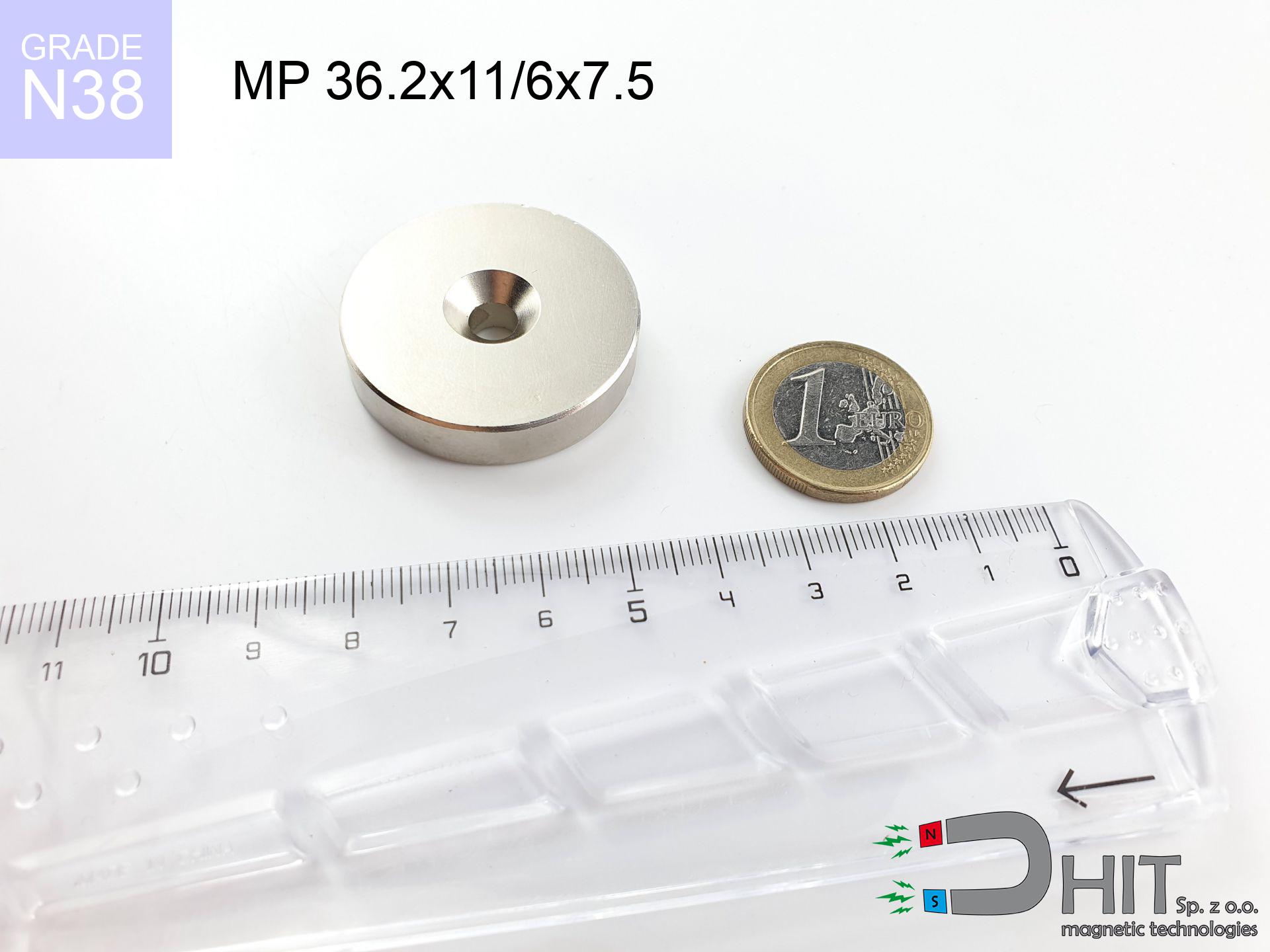
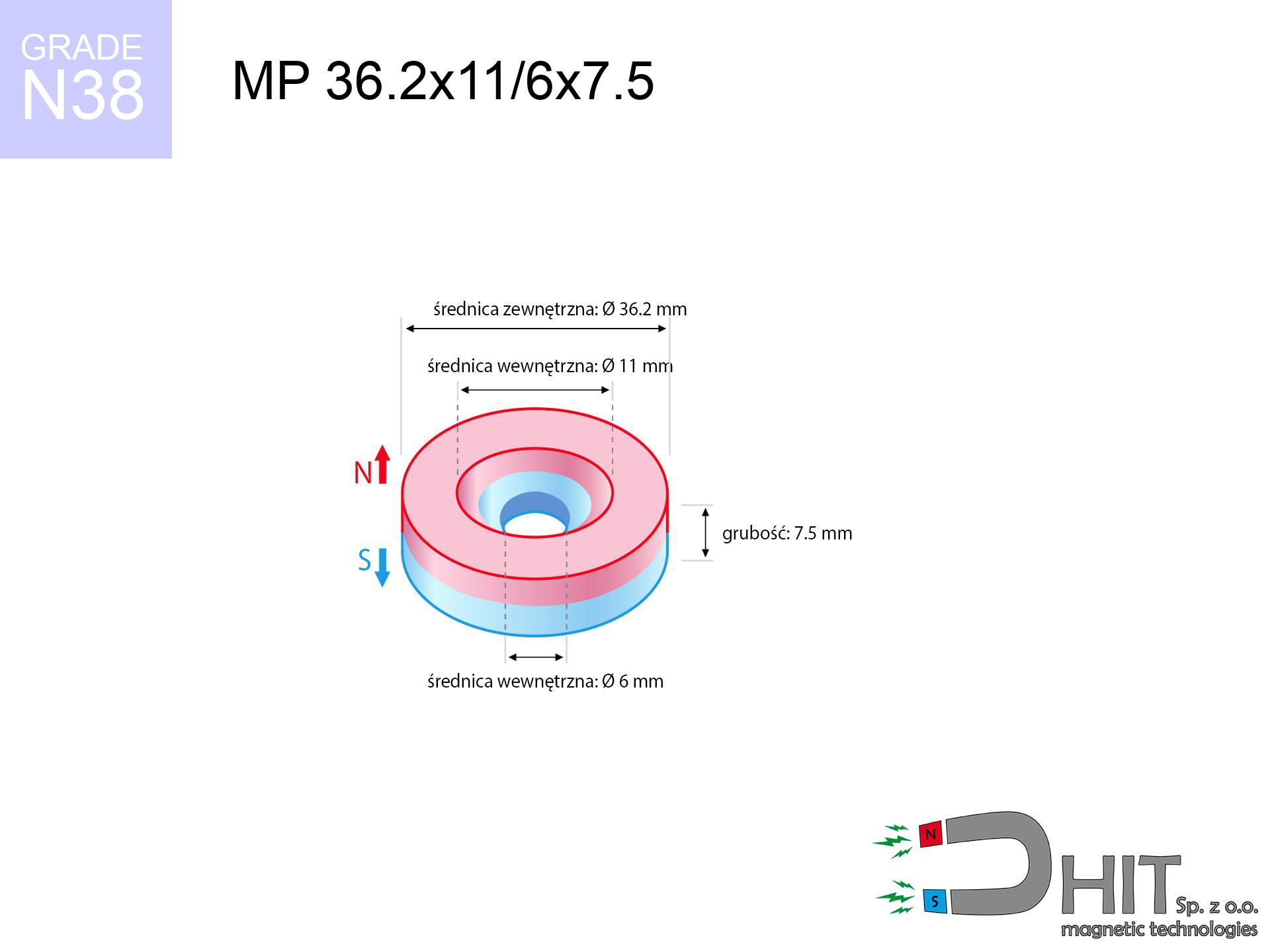
MP 36.2x11/6x7.5 / N38 - ring magnet
ring magnet
Catalog no 030248
GTIN/EAN: 5906301812241
- Diameter
- 36.2 mm [±0,1 mm]
- internal diameter Ø
- 11/6 mm [±0,1 mm]
- Height
- 7.5 mm [±0,1 mm]
- Weight
- 56.3 g
- Magnetization Direction
- ↑ axial
- Coating
- [NiCuNi] Nickel
How we measure these parameters — certificates and measurements
28.46 zł net / pcs
35.01 zł with VAT (23% VAT) / pcs
bulk discounts:
Need more?Frequently asked questions
Where can I compare prices of ring magnets for mounting in Poland?
Are ring magnets resistant to damage?
Which ring magnet is suitable for an outdoor structure?
Where can I check the available sizes of neodymium ring magnets?
Engineering report for this magnet
Full PDF analysis: pull and shear force, effect of distance, temperature and plate thickness, safety distances and the demagnetization curve.
Call us now
+48 888 99 98 98
alternatively let us know using
contact form
the contact section.
Specifications and structure of a neodymium magnet can be estimated using our
power calculator.
Order by 14:00 and we’ll ship today!
Technical details - MP 36.2x11/6x7.5 / N38 - ring magnet
Specification / characteristics - MP 36.2x11/6x7.5 / N38 - ring magnet
| properties | values |
|---|---|
| Cat. no. | 030248 |
| GTIN/EAN | 5906301812241 |
| Production/Distribution | Dhit sp. z o.o. |
| Country of origin | Poland / China / Germany |
| Customs code | 85059029 |
| Diameter | 36.2 mm [±0,1 mm] |
| internal diameter Ø | 11/6 mm [±0,1 mm] |
| Height | 7.5 mm [±0,1 mm] |
| Weight | 56.3 g |
| Magnetization Direction | ↑ axial |
| Load capacity ~ ? | 17.12 kg / 167.95 N |
| Magnetic Induction ~ ? | 237.29 mT / 2373 Gs |
| Coating | [NiCuNi] Nickel |
| Manufacturing Tolerance | ±0.1 mm |
Magnetic properties of material N38
| properties | values | units |
|---|---|---|
| Remanence Br ? | 12.2-12.6 | kGs |
| Remanence Br ? | 1220-1260 | mT |
| Coercivity bHc ? | 10.8-11.5 | kOe |
| Coercivity bHc ? | 860-915 | kA/m |
| Intrinsic coercivity iHc | ≥ 12 | kOe |
| Intrinsic coercivity iHc | ≥ 955 | kA/m |
| Energy product BHmax ? | 36-38 | BH max MGOe |
| Energy product BHmax ? | 287-303 | BH max KJ/m |
| Maximum working temperature ? | ≤ 80 | °C |
Physical properties of sintered neodymium magnets Nd2Fe14B at 20°C
| properties | values | units |
|---|---|---|
| Vickers hardness | ≥550 | Hv |
| Density | ≥7.4 | g/cm3 |
| Curie Temperature TC | 310 | °C |
| Curie Temperature TF | 590 | °F |
| Specific resistance | 150 | μΩ⋅cm |
| Bending strength | 250 | MPa |
| Compressive strength | 1000~1100 | MPa |
| Thermal expansion parallel (∥) to orientation (M) | (3-4) x 10-6 | °C-1 |
| Thermal expansion perpendicular (⊥) to orientation (M) | -(1-3) x 10-6 | °C-1 |
| Young's modulus | 1.7 x 10⁴ | kg/mm² |
Physical modeling of the assembly - technical parameters
Presented information are the outcome of a physical calculation. Values are based on models for the material Nd2Fe14B. Actual performance might slightly differ. Treat these data as a supplementary guide during assembly planning.
Table 1: Static force (pull vs distance) - power drop
MP 36.2x11/6x7.5 / N38
| Distance (mm) | Induction (Gauss) / mT | Pull Force (kg/lbs/g/N) | Risk Status |
|---|---|---|---|
| 0 mm |
2059 Gs
205.9 mT
|
17.12 kg / 37.74 LBS
17120.0 g / 167.9 N
|
crushing |
| 1 mm |
1997 Gs
199.7 mT
|
16.11 kg / 35.52 LBS
16110.1 g / 158.0 N
|
crushing |
| 2 mm |
1923 Gs
192.3 mT
|
14.93 kg / 32.91 LBS
14925.7 g / 146.4 N
|
crushing |
| 3 mm |
1838 Gs
183.8 mT
|
13.64 kg / 30.06 LBS
13636.4 g / 133.8 N
|
crushing |
| 5 mm |
1648 Gs
164.8 mT
|
10.97 kg / 24.18 LBS
10968.0 g / 107.6 N
|
crushing |
| 10 mm |
1161 Gs
116.1 mT
|
5.44 kg / 12.00 LBS
5444.8 g / 53.4 N
|
strong |
| 15 mm |
775 Gs
77.5 mT
|
2.43 kg / 5.35 LBS
2427.5 g / 23.8 N
|
strong |
| 20 mm |
515 Gs
51.5 mT
|
1.07 kg / 2.36 LBS
1071.1 g / 10.5 N
|
safe |
| 30 mm |
242 Gs
24.2 mT
|
0.24 kg / 0.52 LBS
236.8 g / 2.3 N
|
safe |
| 50 mm |
73 Gs
7.3 mT
|
0.02 kg / 0.05 LBS
21.8 g / 0.2 N
|
safe |
Table 2: Vertical capacity (vertical surface)
MP 36.2x11/6x7.5 / N38
| Distance (mm) | Friction coefficient | Pull Force (kg/lbs/g/N) |
|---|---|---|
| 0 mm | Stal (~0.2) |
3.42 kg / 7.55 LBS
3424.0 g / 33.6 N
|
| 1 mm | Stal (~0.2) |
3.22 kg / 7.10 LBS
3222.0 g / 31.6 N
|
| 2 mm | Stal (~0.2) |
2.99 kg / 6.58 LBS
2986.0 g / 29.3 N
|
| 3 mm | Stal (~0.2) |
2.73 kg / 6.01 LBS
2728.0 g / 26.8 N
|
| 5 mm | Stal (~0.2) |
2.19 kg / 4.84 LBS
2194.0 g / 21.5 N
|
| 10 mm | Stal (~0.2) |
1.09 kg / 2.40 LBS
1088.0 g / 10.7 N
|
| 15 mm | Stal (~0.2) |
0.49 kg / 1.07 LBS
486.0 g / 4.8 N
|
| 20 mm | Stal (~0.2) |
0.21 kg / 0.47 LBS
214.0 g / 2.1 N
|
| 30 mm | Stal (~0.2) |
0.05 kg / 0.11 LBS
48.0 g / 0.5 N
|
| 50 mm | Stal (~0.2) |
0.00 kg / 0.01 LBS
4.0 g / 0.0 N
|
Table 3: Vertical assembly (sliding) - vertical pull
MP 36.2x11/6x7.5 / N38
| Surface type | Friction coefficient / % Mocy | Max load (kg/lbs/g/N) |
|---|---|---|
| Raw steel |
µ = 0.3
30% Nominalnej Siły
|
5.14 kg / 11.32 LBS
5136.0 g / 50.4 N
|
| Painted steel (standard) |
µ = 0.2
20% Nominalnej Siły
|
3.42 kg / 7.55 LBS
3424.0 g / 33.6 N
|
| Oily/slippery steel |
µ = 0.1
10% Nominalnej Siły
|
1.71 kg / 3.77 LBS
1712.0 g / 16.8 N
|
| Magnet with anti-slip rubber |
µ = 0.5
50% Nominalnej Siły
|
8.56 kg / 18.87 LBS
8560.0 g / 84.0 N
|
Table 4: Steel thickness (saturation) - power losses
MP 36.2x11/6x7.5 / N38
| Steel thickness (mm) | % power | Real pull force (kg/lbs/g/N) |
|---|---|---|
| 0.5 mm |
|
0.86 kg / 1.89 LBS
856.0 g / 8.4 N
|
| 1 mm |
|
2.14 kg / 4.72 LBS
2140.0 g / 21.0 N
|
| 2 mm |
|
4.28 kg / 9.44 LBS
4280.0 g / 42.0 N
|
| 3 mm |
|
6.42 kg / 14.15 LBS
6420.0 g / 63.0 N
|
| 5 mm |
|
10.70 kg / 23.59 LBS
10700.0 g / 105.0 N
|
| 10 mm |
|
17.12 kg / 37.74 LBS
17120.0 g / 167.9 N
|
| 11 mm |
|
17.12 kg / 37.74 LBS
17120.0 g / 167.9 N
|
| 12 mm |
|
17.12 kg / 37.74 LBS
17120.0 g / 167.9 N
|
Table 5: Thermal stability (material behavior) - thermal limit
MP 36.2x11/6x7.5 / N38
| Ambient temp. (°C) | Power loss | Remaining pull (kg/lbs/g/N) | Status |
|---|---|---|---|
| 20 °C | 0.0% |
17.12 kg / 37.74 LBS
17120.0 g / 167.9 N
|
OK |
| 40 °C | -2.2% |
16.74 kg / 36.91 LBS
16743.4 g / 164.3 N
|
OK |
| 60 °C | -4.4% |
16.37 kg / 36.08 LBS
16366.7 g / 160.6 N
|
|
| 80 °C | -6.6% |
15.99 kg / 35.25 LBS
15990.1 g / 156.9 N
|
|
| 100 °C | -28.8% |
12.19 kg / 26.87 LBS
12189.4 g / 119.6 N
|
Table 6: Magnet-Magnet interaction (repulsion) - forces in the system
MP 36.2x11/6x7.5 / N38
| Gap (mm) | Attraction (kg/lbs) (N-S) | Shear Force (kg/lbs/g/N) | Repulsion (kg/lbs) (N-N) |
|---|---|---|---|
| 0 mm |
22.24 kg / 49.03 LBS
3 569 Gs
|
3.34 kg / 7.35 LBS
3336 g / 32.7 N
|
N/A |
| 1 mm |
21.62 kg / 47.67 LBS
4 061 Gs
|
3.24 kg / 7.15 LBS
3243 g / 31.8 N
|
19.46 kg / 42.90 LBS
~0 Gs
|
| 2 mm |
20.93 kg / 46.14 LBS
3 995 Gs
|
3.14 kg / 6.92 LBS
3139 g / 30.8 N
|
18.84 kg / 41.52 LBS
~0 Gs
|
| 3 mm |
20.18 kg / 44.49 LBS
3 923 Gs
|
3.03 kg / 6.67 LBS
3027 g / 29.7 N
|
18.16 kg / 40.04 LBS
~0 Gs
|
| 5 mm |
18.56 kg / 40.93 LBS
3 763 Gs
|
2.78 kg / 6.14 LBS
2785 g / 27.3 N
|
16.71 kg / 36.83 LBS
~0 Gs
|
| 10 mm |
14.25 kg / 31.41 LBS
3 296 Gs
|
2.14 kg / 4.71 LBS
2137 g / 21.0 N
|
12.82 kg / 28.27 LBS
~0 Gs
|
| 20 mm |
7.07 kg / 15.59 LBS
2 322 Gs
|
1.06 kg / 2.34 LBS
1061 g / 10.4 N
|
6.37 kg / 14.03 LBS
~0 Gs
|
| 50 mm |
0.64 kg / 1.40 LBS
697 Gs
|
0.10 kg / 0.21 LBS
96 g / 0.9 N
|
0.57 kg / 1.26 LBS
~0 Gs
|
| 60 mm |
0.31 kg / 0.68 LBS
484 Gs
|
0.05 kg / 0.10 LBS
46 g / 0.5 N
|
0.28 kg / 0.61 LBS
~0 Gs
|
| 70 mm |
0.16 kg / 0.35 LBS
346 Gs
|
0.02 kg / 0.05 LBS
24 g / 0.2 N
|
0.14 kg / 0.31 LBS
~0 Gs
|
| 80 mm |
0.08 kg / 0.19 LBS
254 Gs
|
0.01 kg / 0.03 LBS
13 g / 0.1 N
|
0.08 kg / 0.17 LBS
~0 Gs
|
| 90 mm |
0.05 kg / 0.11 LBS
191 Gs
|
0.01 kg / 0.02 LBS
7 g / 0.1 N
|
0.04 kg / 0.10 LBS
~0 Gs
|
| 100 mm |
0.03 kg / 0.06 LBS
147 Gs
|
0.00 kg / 0.01 LBS
4 g / 0.0 N
|
0.03 kg / 0.06 LBS
~0 Gs
|
Table 7: Protective zones (electronics) - warnings
MP 36.2x11/6x7.5 / N38
| Object / Device | Limit (Gauss) / mT | Safe distance |
|---|---|---|
| Pacemaker | 5 Gs (0.5 mT) | 13.5 cm |
| Hearing aid | 10 Gs (1.0 mT) | 10.5 cm |
| Timepiece | 20 Gs (2.0 mT) | 8.5 cm |
| Mobile device | 40 Gs (4.0 mT) | 6.5 cm |
| Car key | 50 Gs (5.0 mT) | 6.0 cm |
| Payment card | 400 Gs (40.0 mT) | 2.5 cm |
| HDD hard drive | 600 Gs (60.0 mT) | 2.0 cm |
Table 8: Dynamics (cracking risk) - warning
MP 36.2x11/6x7.5 / N38
| Start from (mm) | Speed (km/h) | Energy (J) | Predicted outcome |
|---|---|---|---|
| 10 mm |
22.40 km/h
(6.22 m/s)
|
1.09 J | |
| 30 mm |
25.46 km/h
(7.07 m/s)
|
1.41 J | |
| 50 mm |
25.61 km/h
(7.11 m/s)
|
1.42 J | |
| 100 mm |
25.63 km/h
(7.12 m/s)
|
1.43 J |
Table 9: Coating parameters (durability)
MP 36.2x11/6x7.5 / N38
| Technical parameter | Value / Description |
|---|---|
| Coating type | [NiCuNi] Nickel |
| Layer structure | Nickel - Copper - Nickel |
| Layer thickness | 10-20 µm |
| Salt spray test (SST) ? | 24 h |
| Recommended environment | Indoors only (dry) |
Table 10: Construction data (Pc)
MP 36.2x11/6x7.5 / N38
| Parameter | Value | SI Unit / Description |
|---|---|---|
| Magnetic Flux | 21 038 Mx | 210.4 µWb |
| Pc Coefficient | 0.26 | Low (Flat) |
Table 11: Underwater work (magnet fishing)
MP 36.2x11/6x7.5 / N38
| Environment | Effective steel pull | Effect |
|---|---|---|
| Air (land) | 17.12 kg | Standard |
| Water (riverbed) |
19.60 kg
(+2.48 kg buoyancy gain)
|
+14.5% |
1. Wall mount (shear)
*Note: On a vertical wall, the magnet holds merely approx. 20-30% of its max power.
2. Steel thickness impact
*Thin steel (e.g. 0.5mm PC case) significantly limits the holding force.
3. Power loss vs temp
N38: the maximum material working temperature is 80°C. Permitted conditions also depend on the shape and magnetic circuit.
4. Demagnetization curve and operating point (B-H)
chart generated for the permeance coefficient Pc (Permeance Coefficient) = 0.26
This simulation demonstrates the magnetic stability of the selected magnet under specific geometric conditions. The solid red line represents the demagnetization curve (material potential), while the dashed blue line is the load line based on the magnet's geometry. The Pc (Permeance Coefficient), also known as the load line slope, is a dimensionless value that describes the relationship between the magnet's shape and its magnetic stability. The intersection of these two lines (the black dot) is the operating point — it determines the actual magnetic flux density generated by the magnet in this specific configuration. A higher Pc value means the magnet is more 'slender' (tall relative to its area), resulting in a higher operating point and better resistance to irreversible demagnetization caused by external fields or temperature. A value of 0.42 is relatively low (typical for flat magnets), meaning the operating point is closer to the 'knee' of the curve — caution is advised when operating at temperatures near the maximum limit to avoid strength loss.
Chemical composition
| iron (Fe) | 64% – 68% |
| neodymium (Nd) | 29% – 32% |
| boron (B) | 1.1% – 1.2% |
| dysprosium (Dy) | 0.5% – 2.0% |
| coating (Ni-Cu-Ni) | < 0.05% |
Environmental data
| recyclability (EoL) | 100% |
| recycled raw materials | ~10% (pre-cons) |
| carbon footprint | low / zredukowany |
| waste code (EWC) | 16 02 16 |
Other deals

![SM 25x275 [2xM8] / N42 - magnetic separator](https://cdn3.dhit.pl/graphics/products/sm-25x275-2xm8-boc.jpg "SM 25x275 [2xM8] / N42 - magnetic separator")
Pros and cons of neodymium magnets.
Benefits
- They virtually do not lose power, because even after ten years the decline in efficiency is only ~1% (in laboratory conditions),
- Magnets effectively defend themselves against demagnetization caused by ambient magnetic noise,
- By using a smooth coating of silver, the element acquires an proper look,
- The surface of neodymium magnets generates a intense magnetic field – this is a distinguishing feature,
- Due to their durability and thermal resistance, neodymium magnets can operate (depending on the form) even at high temperatures reaching 230°C or more...
- Thanks to freedom in shaping and the ability to customize to individual projects,
- Fundamental importance in advanced technology sectors – they find application in computer drives, motor assemblies, advanced medical instruments, also multitasking production systems.
- Compactness – despite small sizes they provide effective action, making them ideal for precision applications
Limitations
- They are fragile upon too strong impacts. To avoid cracks, it is worth protecting magnets using a steel holder. Such protection not only shields the magnet but also increases its resistance to damage
- Do not exceed this material temperature limit: 80°C. Overheating may permanently weaken the magnet.
- Magnets exposed to a humid environment can corrode. Therefore during using outdoors, we advise using waterproof magnets made of rubber, plastic or other material protecting against moisture
- Limited ability of creating nuts in the magnet and complicated forms - preferred is a housing - mounting mechanism.
- Possible danger resulting from small fragments of magnets are risky, if swallowed, which is particularly important in the context of child health protection. Additionally, tiny parts of these products can disrupt the diagnostic process medical in case of swallowing.
- With budget limitations the cost of neodymium magnets is a challenge,
Pull force analysis
Optimal lifting capacity of a neodymium magnet – what it depends on?
- with the use of a sheet made of special test steel, ensuring full magnetic saturation
- with a cross-section minimum 10 mm
- with a surface perfectly flat
- without the slightest insulating layer between the magnet and steel
- under perpendicular force direction (90-degree angle)
- in neutral thermal conditions
Determinants of practical lifting force of a magnet
- Distance – existence of any layer (rust, tape, air) interrupts the magnetic circuit, which lowers power rapidly (even by 50% at 0.5 mm).
- Force direction – note that the magnet has greatest strength perpendicularly. Under sliding down, the capacity drops significantly, often to levels of 20-30% of the maximum value.
- Metal thickness – thin material does not allow full use of the magnet. Magnetic flux passes through the material instead of generating force.
- Material type – the best choice is pure iron steel. Cast iron may have worse magnetic properties.
- Base smoothness – the smoother and more polished the surface, the better the adhesion and stronger the hold. Roughness creates an air distance.
- Temperature – heating the magnet results in weakening of force. Check the maximum operating temperature for a given model.
Lifting capacity testing was conducted on plates with a smooth surface of suitable thickness, under perpendicular forces, however under attempts to slide the magnet the lifting capacity is smaller. Additionally, even a small distance between the magnet and the plate decreases the holding force.
Precautions when working with neodymium magnets
GPS and phone interference
Remember: neodymium magnets generate a field that disrupts precision electronics. Keep a separation from your mobile, device, and navigation systems.
Power loss in heat
Do not overheat. Neodymium magnets are susceptible to temperature. If you require operation above 80°C, look for HT versions (H, SH, UH).
Crushing force
Mind your fingers. Two powerful magnets will snap together immediately with a force of several hundred kilograms, destroying everything in their path. Be careful!
Skin irritation risks
Medical facts indicate that nickel (standard magnet coating) is a strong allergen. If you have an allergy, refrain from direct skin contact or select coated magnets.
Mechanical processing
Dust generated during grinding of magnets is self-igniting. Do not drill into magnets unless you are an expert.
Danger to pacemakers
For implant holders: Powerful magnets disrupt electronics. Keep minimum 30 cm distance or ask another person to handle the magnets.
Keep away from children
Absolutely keep magnets away from children. Choking hazard is significant, and the consequences of magnets connecting inside the body are life-threatening.
Eye protection
Despite the nickel coating, the material is brittle and not impact-resistant. Avoid impacts, as the magnet may shatter into sharp, dangerous pieces.
Safe operation
Exercise caution. Rare earth magnets act from a distance and connect with massive power, often faster than you can move away.
Electronic devices
Powerful magnetic fields can destroy records on credit cards, hard drives, and other magnetic media. Stay away of min. 10 cm.
Tabela kosztu i czasu dostawy
Płatność przed wysyłką:

GLS kurier
Przesyłka będzie u Ciebie za 2-3 dni
14.99 ZŁ

InPost Paczkomaty 24/7
Przesyłka będzie u Ciebie za 1-2 dni
12.30 ZŁ
Płatność przy odbiorze (pobranie):
GLS kurier
Przesyłka będzie u Ciebie za 1-2 dni
23.00 ZŁ