

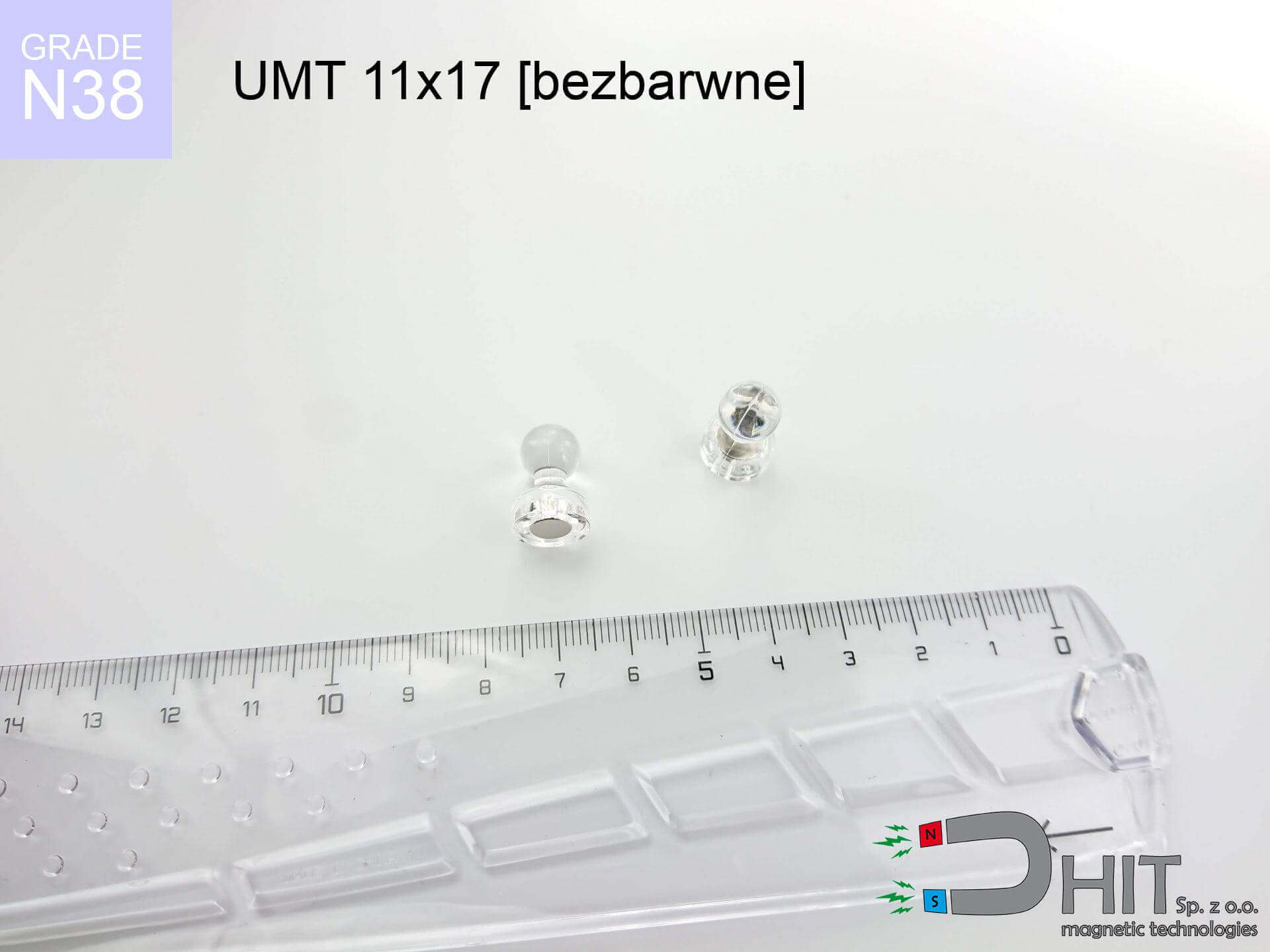
UMT 11x17 colorless / N38 - board holder
board holder
Catalog no 230266
GTIN/EAN: 5906301814290
- Diameter Ø
- 11 mm [±1 mm]
- Height
- 17 mm [±1 mm]
- Weight
- 3 g
- Coating
- [NiCuNi] Nickel
How we measure these parameters — certificates and measurements
1.250 zł net / pcs
1.538 zł with VAT (23% VAT) / pcs
bulk discounts:
Need more?Frequently asked questions
How many sheets of paper will one magnetic pin hold?
Will a magnetic pin stick to any board - whiteboard, glass, cork?
Will the magnet leave a mark or scratch the board or the fridge?
What is the difference between the 12x20 and 20x25 sizes, and which one suits an office?
Are magnetic pins suitable for large-format maps and plans?
Call us now
+48 888 99 98 98
alternatively let us know using
contact form
the contact section.
Specifications and structure of a neodymium magnet can be estimated using our
power calculator.
Order by 14:00 and we’ll ship today!
Technical specification of the product - UMT 11x17 colorless / N38 - board holder
Specification / characteristics - UMT 11x17 colorless / N38 - board holder
| properties | values |
|---|---|
| Cat. no. | 230266 |
| GTIN/EAN | 5906301814290 |
| Production/Distribution | Dhit sp. z o.o. |
| Country of origin | Poland / China / Germany |
| Customs code | 85059029 |
| Diameter Ø | 11 mm [±1 mm] |
| Height | 17 mm [±1 mm] |
| Weight | 3 g |
| Coating | [NiCuNi] Nickel |
| Manufacturing Tolerance | ±1 mm |
Magnetic properties of material N38
| properties | values | units |
|---|---|---|
| Remanence Br ? | 12.2-12.6 | kGs |
| Remanence Br ? | 1220-1260 | mT |
| Coercivity bHc ? | 10.8-11.5 | kOe |
| Coercivity bHc ? | 860-915 | kA/m |
| Intrinsic coercivity iHc | ≥ 12 | kOe |
| Intrinsic coercivity iHc | ≥ 955 | kA/m |
| Energy product BHmax ? | 36-38 | BH max MGOe |
| Energy product BHmax ? | 287-303 | BH max KJ/m |
| Maximum working temperature ? | ≤ 80 | °C |
Physical properties of sintered neodymium magnets Nd2Fe14B at 20°C
| properties | values | units |
|---|---|---|
| Vickers hardness | ≥550 | Hv |
| Density | ≥7.4 | g/cm3 |
| Curie Temperature TC | 310 | °C |
| Curie Temperature TF | 590 | °F |
| Specific resistance | 150 | μΩ⋅cm |
| Bending strength | 250 | MPa |
| Compressive strength | 1000~1100 | MPa |
| Thermal expansion parallel (∥) to orientation (M) | (3-4) x 10-6 | °C-1 |
| Thermal expansion perpendicular (⊥) to orientation (M) | -(1-3) x 10-6 | °C-1 |
| Young's modulus | 1.7 x 10⁴ | kg/mm² |
Material specification
| iron (Fe) | 64% – 68% |
| neodymium (Nd) | 29% – 32% |
| boron (B) | 1.1% – 1.2% |
| dysprosium (Dy) | 0.5% – 2.0% |
| coating (Ni-Cu-Ni) | < 0.05% |
Ecology and recycling (GPSR)
| recyclability (EoL) | 100% |
| recycled raw materials | ~10% (pre-cons) |
| carbon footprint | low / zredukowany |
| waste code (EWC) | 16 02 16 |
Check out more proposals
![SM 32x300 [2xM8] / N52 - magnetic separator](https://cdn3.dhit.pl/graphics/products/sm-32x300-2xm8-luf.jpg "SM 32x300 [2xM8] / N52 - magnetic separator")
![SM 25x250 [2xM8] / N42 - magnetic separator](https://cdn3.dhit.pl/graphics/products/sm-25x250-2xm8-ker.jpg "SM 25x250 [2xM8] / N42 - magnetic separator")

Advantages and disadvantages of Nd2Fe14B magnets.
Pros
- They retain attractive force for around ten years – the drop is just ~1% (according to analyses),
- They are noted for resistance to demagnetization induced by external disturbances,
- In other words, due to the aesthetic layer of silver, the element becomes visually attractive,
- Magnets are distinguished by impressive magnetic induction on the outer layer,
- Thanks to resistance to high temperature, they are capable of working (depending on the shape) even at temperatures up to 230°C and higher...
- Thanks to versatility in forming and the ability to modify to client solutions,
- Significant place in modern technologies – they are commonly used in HDD drives, brushless drives, precision medical tools, also modern systems.
- Thanks to concentrated force, small magnets offer high operating force, occupying minimum space,
Weaknesses
- They are fragile upon too strong impacts. To avoid cracks, it is worth securing magnets in special housings. Such protection not only shields the magnet but also improves its resistance to damage
- Do not exceed this material temperature limit: 80°C. Overheating may permanently weaken the magnet.
- Due to the susceptibility of magnets to corrosion in a humid environment, we advise using waterproof magnets made of rubber, plastic or other material immune to moisture, in case of application outdoors
- Limited possibility of making nuts in the magnet and complex forms - preferred is a housing - mounting mechanism.
- Possible danger to health – tiny shards of magnets can be dangerous, if swallowed, which is particularly important in the context of child health protection. It is also worth noting that small elements of these magnets are able to be problematic in diagnostics medical in case of swallowing.
- Due to neodymium price, their price exceeds standard values,
Holding force characteristics
Maximum lifting force for a neodymium magnet – what affects it?
- using a plate made of high-permeability steel, acting as a magnetic yoke
- with a thickness minimum 10 mm
- with a plane free of scratches
- under conditions of no distance (surface-to-surface)
- under axial application of breakaway force (90-degree angle)
- in temp. approx. 20°C
Determinants of practical lifting force of a magnet
- Space between magnet and steel – even a fraction of a millimeter of distance (caused e.g. by veneer or unevenness) diminishes the magnet efficiency, often by half at just 0.5 mm.
- Force direction – catalog parameter refers to pulling vertically. When slipping, the magnet exhibits much less (typically approx. 20-30% of maximum force).
- Base massiveness – too thin sheet does not accept the full field, causing part of the power to be lost to the other side.
- Steel grade – the best choice is pure iron steel. Stainless steels may attract less.
- Surface quality – the smoother and more polished the surface, the larger the contact zone and stronger the hold. Roughness creates an air distance.
- Temperature influence – high temperature reduces magnetic field. Too high temperature can permanently demagnetize the magnet.
Lifting capacity testing was carried out on plates with a smooth surface of optimal thickness, under perpendicular forces, in contrast under parallel forces the lifting capacity is smaller. Additionally, even a slight gap between the magnet and the plate decreases the lifting capacity.
Warnings
Immense force
Before use, read the rules. Sudden snapping can break the magnet or injure your hand. Be predictive.
Operating temperature
Control the heat. Exposing the magnet to high heat will ruin its magnetic structure and pulling force.
Pacemakers
Warning for patients: Strong magnetic fields affect electronics. Keep minimum 30 cm distance or ask another person to handle the magnets.
Fire warning
Dust created during machining of magnets is combustible. Avoid drilling into magnets without proper cooling and knowledge.
Magnets are brittle
Despite the nickel coating, neodymium is delicate and not impact-resistant. Avoid impacts, as the magnet may shatter into hazardous fragments.
This is not a toy
Absolutely store magnets away from children. Ingestion danger is significant, and the consequences of magnets clamping inside the body are life-threatening.
Safe distance
Avoid bringing magnets close to a purse, laptop, or screen. The magnetism can permanently damage these devices and erase data from cards.
Finger safety
Big blocks can break fingers instantly. Do not put your hand betwixt two strong magnets.
GPS Danger
A powerful magnetic field disrupts the operation of magnetometers in phones and GPS navigation. Keep magnets near a device to prevent breaking the sensors.
Avoid contact if allergic
Warning for allergy sufferers: The Ni-Cu-Ni coating contains nickel. If skin irritation occurs, cease handling magnets and wear gloves.
Tabela kosztu i czasu dostawy
Płatność przed wysyłką:

GLS kurier
Przesyłka będzie u Ciebie za 2-3 dni
14.99 ZŁ

InPost Paczkomaty 24/7
Przesyłka będzie u Ciebie za 1-2 dni
12.30 ZŁ
Płatność przy odbiorze (pobranie):
GLS kurier
Przesyłka będzie u Ciebie za 1-2 dni
23.00 ZŁ