


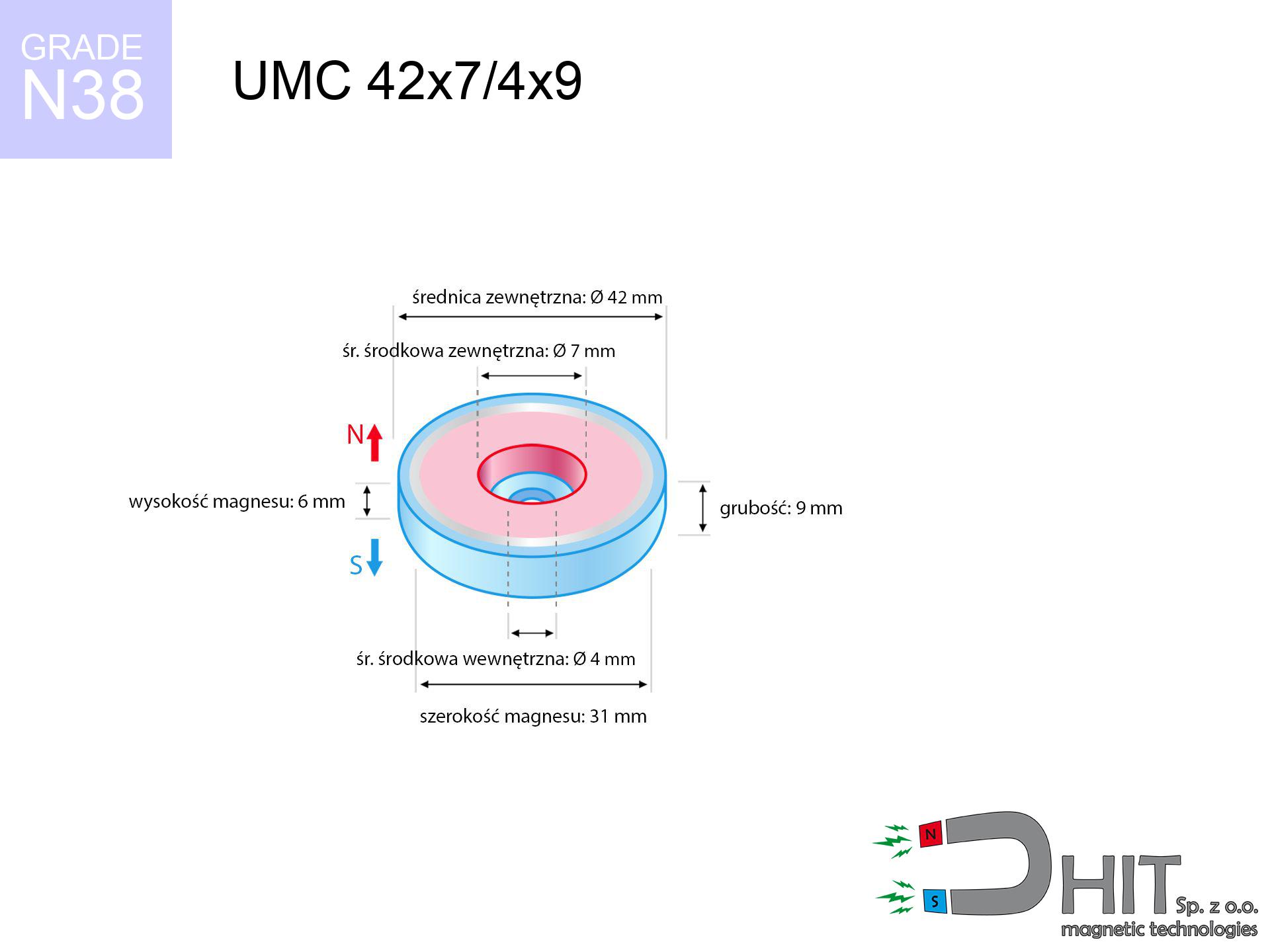
UMC 42x7/4x9 / N38 - cylindrical magnetic holder
cylindrical magnetic holder
Catalog no 320411
GTIN/EAN: 5906301814672
- Diameter
- 42 mm [±1 mm]
- internal diameter Ø
- 7/4 mm [±1 mm]
- Height
- 9 mm [±1 mm]
- Weight
- 72 g
- Magnetization Direction
- ↑ axial
- Coating
- [NiCuNi] Nickel
How we measure these parameters — certificates and measurements
24.38 zł net / pcs
29.99 zł with VAT (23% VAT) / pcs
bulk discounts:
Need more?Frequently asked questions
Which magnetic holder is suitable for moving metal parts in a workshop?
How do I choose a holder for hanging a heavy item and check its real grip?
Which magnetic holders can be used outdoors?
How should I choose a strong threaded holder for field work?
Call us now
+48 888 99 98 98
alternatively let us know using
contact form
the contact section.
Specifications and structure of a neodymium magnet can be estimated using our
power calculator.
Order by 14:00 and we’ll ship today!
Product card - UMC 42x7/4x9 / N38 - cylindrical magnetic holder
Specification / characteristics - UMC 42x7/4x9 / N38 - cylindrical magnetic holder
| properties | values |
|---|---|
| Cat. no. | 320411 |
| GTIN/EAN | 5906301814672 |
| Production/Distribution | Dhit sp. z o.o. |
| Country of origin | Poland / China / Germany |
| Customs code | 85059029 |
| Diameter | 42 mm [±1 mm] |
| internal diameter Ø | 7/4 mm [±1 mm] |
| Height | 9 mm [±1 mm] |
| Weight | 72 g |
| Magnetization Direction | ↑ axial |
| Load capacity ~ ? | 32.00 kg / 313.81 N |
| Coating | [NiCuNi] Nickel |
| Manufacturing Tolerance | ±1 mm |
Magnetic properties of material N38
| properties | values | units |
|---|---|---|
| Remanence Br ? | 12.2-12.6 | kGs |
| Remanence Br ? | 1220-1260 | mT |
| Coercivity bHc ? | 10.8-11.5 | kOe |
| Coercivity bHc ? | 860-915 | kA/m |
| Intrinsic coercivity iHc | ≥ 12 | kOe |
| Intrinsic coercivity iHc | ≥ 955 | kA/m |
| Energy product BHmax ? | 36-38 | BH max MGOe |
| Energy product BHmax ? | 287-303 | BH max KJ/m |
| Maximum working temperature ? | ≤ 80 | °C |
Physical properties of sintered neodymium magnets Nd2Fe14B at 20°C
| properties | values | units |
|---|---|---|
| Vickers hardness | ≥550 | Hv |
| Density | ≥7.4 | g/cm3 |
| Curie Temperature TC | 310 | °C |
| Curie Temperature TF | 590 | °F |
| Specific resistance | 150 | μΩ⋅cm |
| Bending strength | 250 | MPa |
| Compressive strength | 1000~1100 | MPa |
| Thermal expansion parallel (∥) to orientation (M) | (3-4) x 10-6 | °C-1 |
| Thermal expansion perpendicular (⊥) to orientation (M) | -(1-3) x 10-6 | °C-1 |
| Young's modulus | 1.7 x 10⁴ | kg/mm² |
Material specification
| iron (Fe) | 64% – 68% |
| neodymium (Nd) | 29% – 32% |
| boron (B) | 1.1% – 1.2% |
| dysprosium (Dy) | 0.5% – 2.0% |
| coating (Ni-Cu-Ni) | < 0.05% |
Ecology and recycling (GPSR)
| recyclability (EoL) | 100% |
| recycled raw materials | ~10% (pre-cons) |
| carbon footprint | low / zredukowany |
| waste code (EWC) | 16 02 16 |
Other deals
![UMH 32x8x46 [M6] / N38 - magnetic holder with hook](https://cdn3.dhit.pl/graphics/products/umh-32x8x46-m6-xov.jpg "UMH 32x8x46 [M6] / N38 - magnetic holder with hook")
![AM szekla [M10] - magnetic accessories](https://cdn3.dhit.pl/graphics/products/am-szekla-m10-zeh.jpg "AM szekla [M10] - magnetic accessories")
Strengths and weaknesses of Nd2Fe14B magnets.
Advantages
- Their strength is maintained, and after around 10 years it decreases only by ~1% (theoretically),
- They retain their magnetic properties even under strong external field,
- By using a decorative layer of silver, the element acquires an modern look,
- Magnetic induction on the top side of the magnet is exceptional,
- Due to their durability and thermal resistance, neodymium magnets are capable of operate (depending on the shape) even at high temperatures reaching 230°C or more...
- Considering the potential of precise forming and adaptation to unique projects, magnetic components can be modeled in a wide range of forms and dimensions, which makes them more universal,
- Universal use in innovative solutions – they are commonly used in HDD drives, brushless drives, precision medical tools, and other advanced devices.
- Thanks to efficiency per cm³, small magnets offer high operating force, with minimal size,
Limitations
- Brittleness is one of their disadvantages. Upon strong impact they can break. We advise keeping them in a strong case, which not only protects them against impacts but also increases their durability
- Do not exceed this material temperature limit: 80°C. Overheating may permanently weaken the magnet.
- They rust in a humid environment - during use outdoors we recommend using waterproof magnets e.g. in rubber, plastic
- Due to limitations in realizing threads and complex shapes in magnets, we recommend using casing - magnetic holder.
- Health risk related to microscopic parts of magnets can be dangerous, if swallowed, which is particularly important in the context of child safety. Furthermore, small components of these products are able to be problematic in diagnostics medical in case of swallowing.
- Due to complex production process, their price exceeds standard values,
Pull force analysis
Maximum lifting capacity of the magnet – what contributes to it?
- with the contact of a sheet made of low-carbon steel, ensuring maximum field concentration
- with a thickness no less than 10 mm
- characterized by lack of roughness
- under conditions of no distance (metal-to-metal)
- under vertical force direction (90-degree angle)
- in stable room temperature
Lifting capacity in real conditions – factors
- Clearance – existence of any layer (rust, tape, gap) interrupts the magnetic circuit, which reduces capacity steeply (even by 50% at 0.5 mm).
- Pull-off angle – remember that the magnet has greatest strength perpendicularly. Under shear forces, the capacity drops drastically, often to levels of 20-30% of the nominal value.
- Substrate thickness – to utilize 100% power, the steel must be sufficiently thick. Paper-thin metal limits the lifting capacity (the magnet "punches through" it).
- Plate material – mild steel attracts best. Alloy admixtures reduce magnetic permeability and holding force.
- Surface finish – ideal contact is obtained only on polished steel. Any scratches and bumps reduce the real contact area, weakening the magnet.
- Thermal factor – hot environment weakens magnetic field. Too high temperature can permanently demagnetize the magnet.
Holding force was measured on the plate surface of 20 mm thickness, when a perpendicular force was applied, in contrast under attempts to slide the magnet the load capacity is reduced by as much as 75%. Additionally, even a minimal clearance between the magnet’s surface and the plate reduces the load capacity.
Precautions when working with NdFeB magnets
Demagnetization risk
Control the heat. Heating the magnet to high heat will permanently weaken its magnetic structure and pulling force.
Product not for children
Only for adults. Small elements pose a choking risk, causing serious injuries. Keep out of reach of children and animals.
Bodily injuries
Risk of injury: The attraction force is so immense that it can result in hematomas, pinching, and even bone fractures. Protective gloves are recommended.
Immense force
Be careful. Neodymium magnets act from a distance and snap with huge force, often faster than you can move away.
Mechanical processing
Dust generated during machining of magnets is self-igniting. Do not drill into magnets without proper cooling and knowledge.
Threat to navigation
An intense magnetic field interferes with the functioning of magnetometers in smartphones and GPS navigation. Maintain magnets close to a smartphone to avoid damaging the sensors.
Life threat
Individuals with a heart stimulator should maintain an absolute distance from magnets. The magnetic field can interfere with the functioning of the implant.
Safe distance
Avoid bringing magnets near a wallet, computer, or screen. The magnetism can irreversibly ruin these devices and erase data from cards.
Avoid contact if allergic
Nickel alert: The nickel-copper-nickel coating contains nickel. If an allergic reaction happens, cease handling magnets and use protective gear.
Eye protection
Despite the nickel coating, the material is brittle and cannot withstand shocks. Avoid impacts, as the magnet may crumble into hazardous fragments.
Tabela kosztu i czasu dostawy
Płatność przed wysyłką:

GLS kurier
Przesyłka będzie u Ciebie za 2-3 dni
14.99 ZŁ

InPost Paczkomaty 24/7
Przesyłka będzie u Ciebie za 1-2 dni
12.30 ZŁ
Płatność przy odbiorze (pobranie):
GLS kurier
Przesyłka będzie u Ciebie za 1-2 dni
23.00 ZŁ