

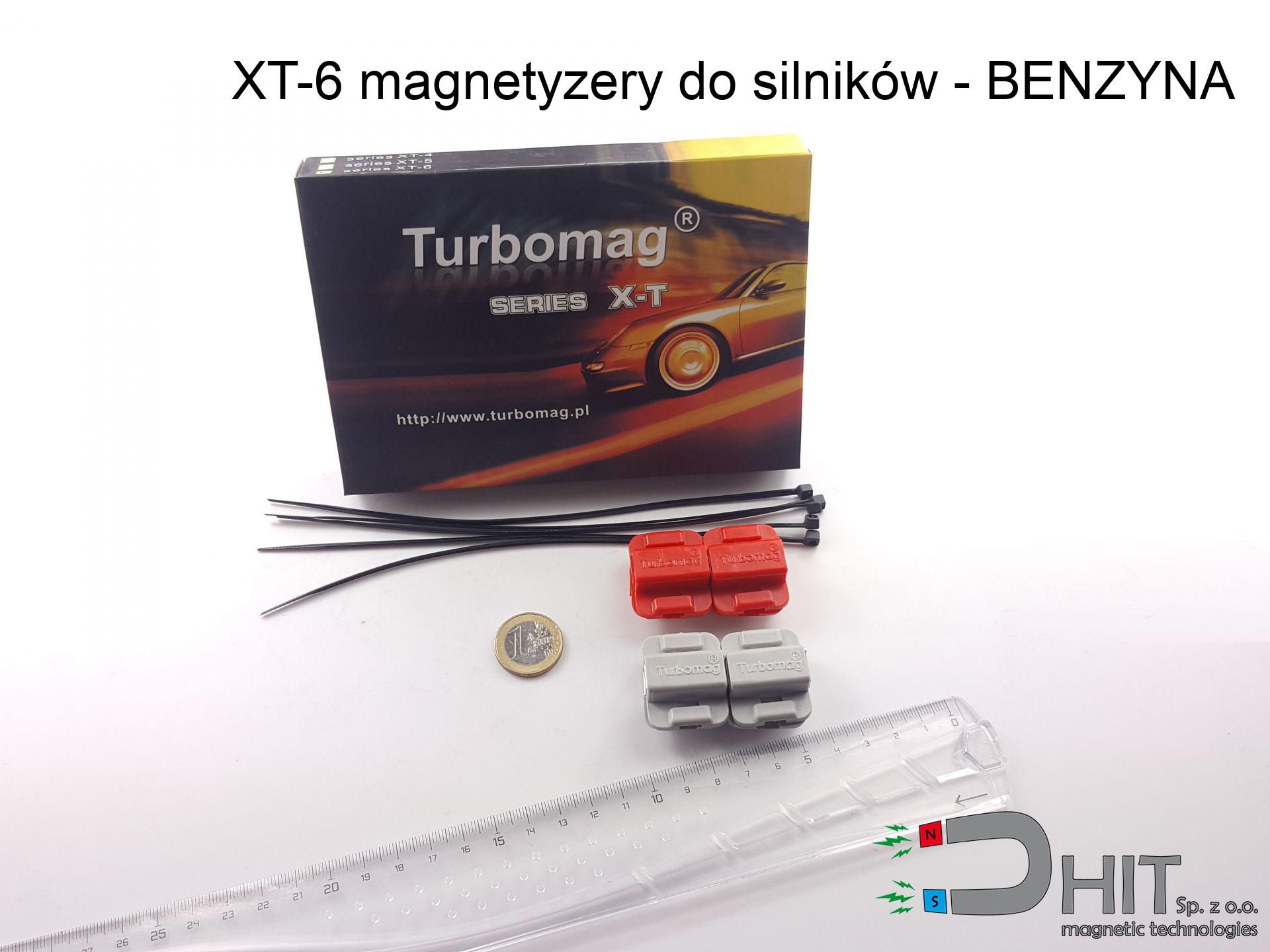
XT-6 magnetyzery do silników - BENZYNA + POWIETRZE - XT-6 magnetizer
XT-6 magnetizer
Catalog no 070243
GTIN/EAN: 5906301812432
77.23 zł net / pcs
94.99 zł with VAT (23% VAT) / pcs
bulk discounts:
Need more?Frequently asked questions
Which Turbomag® model should I choose?
Is a magnetizer used to capture metal swarf?
How do I match a model to an installation?
Where is a magnetizer fitted?
What are the fastening parts made of?
What operating temperature is allowed?
Guides from the knowledge base
Call us now
+48 888 99 98 98
alternatively let us know using
contact form
the contact section.
Specifications and structure of a neodymium magnet can be estimated using our
power calculator.
Order by 14:00 and we’ll ship today!
Technical details - XT-6 magnetyzery do silników - BENZYNA + POWIETRZE - XT-6 magnetizer
Specification / characteristics - XT-6 magnetyzery do silników - BENZYNA + POWIETRZE - XT-6 magnetizer
| properties | values |
|---|---|
| Cat. no. | 070243 |
| GTIN/EAN | 5906301812432 |
| Production/Distribution | Dhit sp. z o.o. |
| Country of origin | Poland / China / Germany |
| Customs code | 85059029 |
| Weight | 152 g |
| Manufacturing Tolerance | ±1 mm |
Physical properties of sintered neodymium magnets Nd2Fe14B at 20°C
| properties | values | units |
|---|---|---|
| Vickers hardness | ≥550 | Hv |
| Density | ≥7.4 | g/cm3 |
| Curie Temperature TC | 310 | °C |
| Curie Temperature TF | 590 | °F |
| Specific resistance | 150 | μΩ⋅cm |
| Bending strength | 250 | MPa |
| Compressive strength | 1000~1100 | MPa |
| Thermal expansion parallel (∥) to orientation (M) | (3-4) x 10-6 | °C-1 |
| Thermal expansion perpendicular (⊥) to orientation (M) | -(1-3) x 10-6 | °C-1 |
| Young's modulus | 1.7 x 10⁴ | kg/mm² |
Chemical composition
| iron (Fe) | 64% – 68% |
| neodymium (Nd) | 29% – 32% |
| boron (B) | 1.1% – 1.2% |
| dysprosium (Dy) | 0.5% – 2.0% |
| coating (Ni-Cu-Ni) | < 0.05% |
Ecology and recycling (GPSR)
| recyclability (EoL) | 100% |
| recycled raw materials | ~10% (pre-cons) |
| carbon footprint | low / zredukowany |
| waste code (EWC) | 16 02 16 |
Other deals

![UMGW 75x33x18 [M10] GW / N38 - magnetic holder internal thread](https://cdn3.dhit.pl/graphics/products/umgw-75x33x18-m10-gw-cak.jpg "UMGW 75x33x18 [M10] GW / N38 - magnetic holder internal thread")
Strengths as well as weaknesses of rare earth magnets.
Benefits
- They retain magnetic properties for around 10 years – the drop is just ~1% (in theory),
- Magnets perfectly defend themselves against demagnetization caused by ambient magnetic noise,
- A magnet with a metallic silver surface has an effective appearance,
- Neodymium magnets create maximum magnetic induction on a contact point, which allows for strong attraction,
- Thanks to resistance to high temperature, they can operate (depending on the form) even at temperatures up to 230°C and higher...
- Possibility of exact shaping and optimizing to concrete requirements,
- Fundamental importance in high-tech industry – they find application in magnetic memories, brushless drives, precision medical tools, as well as complex engineering applications.
- Compactness – despite small sizes they offer powerful magnetic field, making them ideal for precision applications
Disadvantages
- They are fragile upon too strong impacts. To avoid cracks, it is worth securing magnets in a protective case. Such protection not only shields the magnet but also increases its resistance to damage
- Heat sensitivity: observe the temperature specified for this product. Overheating may permanently weaken the magnet.
- When exposed to humidity, magnets usually rust. To use them in conditions outside, it is recommended to use protective magnets, such as magnets in rubber or plastics, which prevent oxidation and corrosion.
- Limited possibility of creating threads in the magnet and complex shapes - preferred is cover - magnet mounting.
- Potential hazard to health – tiny shards of magnets are risky, in case of ingestion, which is particularly important in the aspect of protecting the youngest. Furthermore, small components of these devices are able to complicate diagnosis medical in case of swallowing.
- With budget limitations the cost of neodymium magnets can be a barrier,
Lifting parameters
Breakaway strength of the magnet in ideal conditions – what contributes to it?
- on a block made of mild steel, effectively closing the magnetic flux
- possessing a massiveness of min. 10 mm to ensure full flux closure
- with a surface free of scratches
- with total lack of distance (without coatings)
- under axial force direction (90-degree angle)
- in neutral thermal conditions
What influences lifting capacity in practice
- Gap between magnet and steel – every millimeter of separation (caused e.g. by varnish or dirt) diminishes the pulling force, often by half at just 0.5 mm.
- Pull-off angle – remember that the magnet has greatest strength perpendicularly. Under shear forces, the holding force drops drastically, often to levels of 20-30% of the nominal value.
- Wall thickness – thin material does not allow full use of the magnet. Part of the magnetic field penetrates through instead of converting into lifting capacity.
- Plate material – mild steel attracts best. Higher carbon content reduce magnetic properties and holding force.
- Plate texture – smooth surfaces guarantee perfect abutment, which increases field saturation. Uneven metal weaken the grip.
- Thermal environment – temperature increase results in weakening of induction. Check the maximum operating temperature for a given model.
Lifting capacity was measured with the use of a steel plate with a smooth surface of suitable thickness (min. 20 mm), under perpendicular pulling force, however under parallel forces the load capacity is reduced by as much as fivefold. In addition, even a minimal clearance between the magnet and the plate decreases the lifting capacity.
Safe handling of neodymium magnets
Precision electronics
Navigation devices and mobile phones are extremely susceptible to magnetic fields. Close proximity with a strong magnet can decalibrate the sensors in your phone.
Dust explosion hazard
Combustion risk: Neodymium dust is explosive. Avoid machining magnets in home conditions as this risks ignition.
Allergic reactions
Certain individuals suffer from a hypersensitivity to Ni, which is the typical protective layer for neodymium magnets. Prolonged contact might lead to a rash. We recommend use safety gloves.
Material brittleness
Despite the nickel coating, neodymium is brittle and not impact-resistant. Do not hit, as the magnet may crumble into sharp, dangerous pieces.
Pinching danger
Pinching hazard: The pulling power is so great that it can result in hematomas, crushing, and even bone fractures. Use thick gloves.
Cards and drives
Data protection: Strong magnets can damage payment cards and sensitive devices (heart implants, hearing aids, timepieces).
Demagnetization risk
Control the heat. Exposing the magnet above 80 degrees Celsius will ruin its properties and strength.
Do not give to children
Adult use only. Tiny parts can be swallowed, causing intestinal necrosis. Store away from kids and pets.
Pacemakers
Individuals with a heart stimulator should maintain an large gap from magnets. The magnetism can interfere with the operation of the implant.
Caution required
Use magnets with awareness. Their huge power can surprise even experienced users. Plan your moves and respect their power.
Tabela kosztu i czasu dostawy
Płatność przed wysyłką:

GLS kurier
Przesyłka będzie u Ciebie za 2-3 dni
14.99 ZŁ

InPost Paczkomaty 24/7
Przesyłka będzie u Ciebie za 1-2 dni
12.30 ZŁ
Płatność przy odbiorze (pobranie):
GLS kurier
Przesyłka będzie u Ciebie za 1-2 dni
23.00 ZŁ