

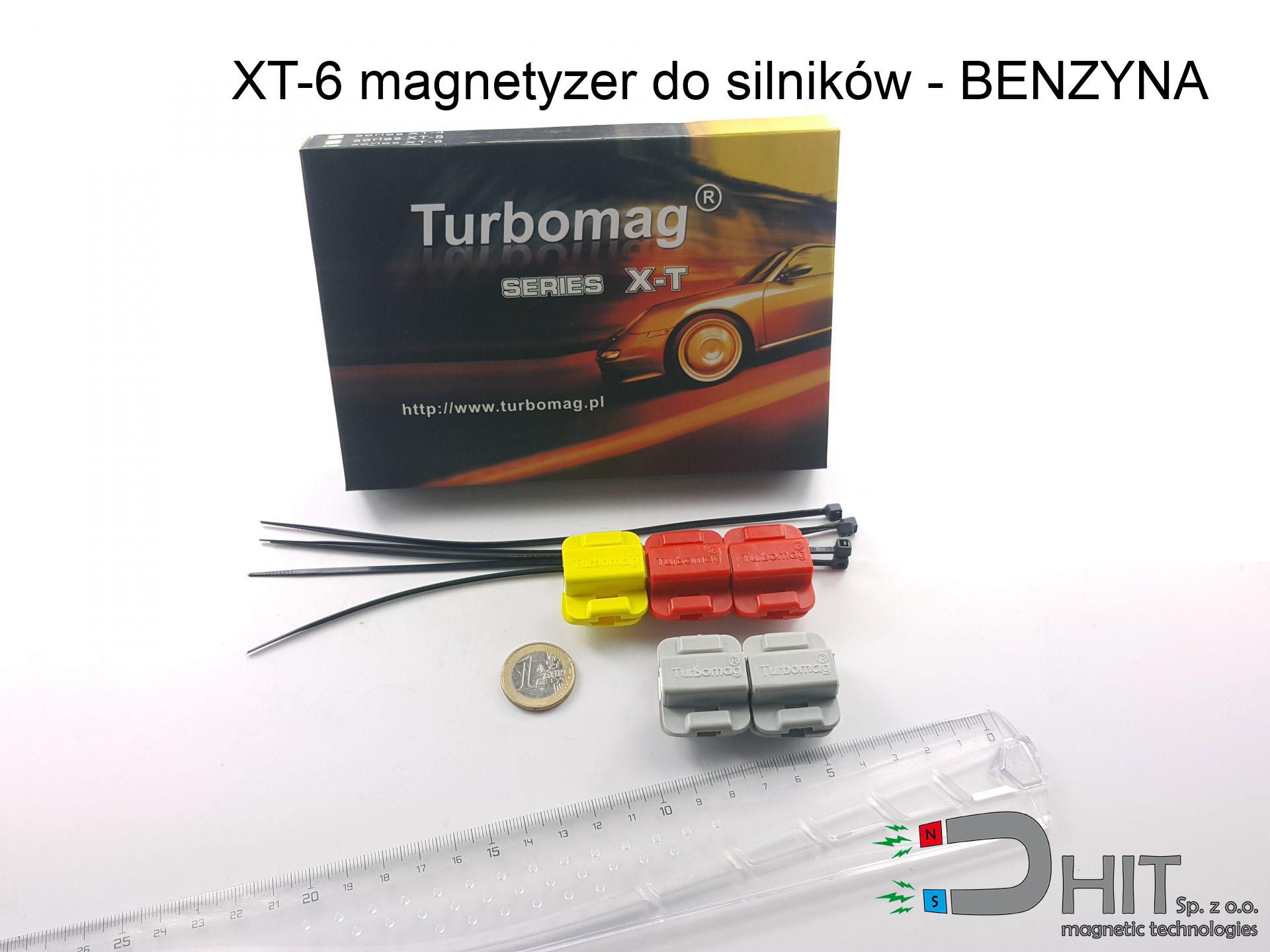
XT-6 magnetyzer do silników - BENZYNA + olej - XT-6 magnetizer
XT-6 magnetizer
Catalog no 070244
GTIN/EAN: 5906301812449
77.23 zł net / pcs
94.99 zł with VAT (23% VAT) / pcs
bulk discounts:
Need more?Frequently asked questions
Which Turbomag® model should I choose?
Is a magnetizer used to capture metal swarf?
How do I match a model to an installation?
Where is a magnetizer fitted?
What are the fastening parts made of?
What operating temperature is allowed?
Guides from the knowledge base
Call us now
+48 888 99 98 98
alternatively let us know using
contact form
the contact section.
Specifications and structure of a neodymium magnet can be estimated using our
power calculator.
Order by 14:00 and we’ll ship today!
Technical of the product - XT-6 magnetyzer do silników - BENZYNA + olej - XT-6 magnetizer
Specification / characteristics - XT-6 magnetyzer do silników - BENZYNA + olej - XT-6 magnetizer
| properties | values |
|---|---|
| Cat. no. | 070244 |
| GTIN/EAN | 5906301812449 |
| Production/Distribution | Dhit sp. z o.o. |
| Country of origin | Poland / China / Germany |
| Customs code | 85059029 |
| Weight | 152 g |
| Manufacturing Tolerance | ±1 mm |
Physical properties of sintered neodymium magnets Nd2Fe14B at 20°C
| properties | values | units |
|---|---|---|
| Vickers hardness | ≥550 | Hv |
| Density | ≥7.4 | g/cm3 |
| Curie Temperature TC | 310 | °C |
| Curie Temperature TF | 590 | °F |
| Specific resistance | 150 | μΩ⋅cm |
| Bending strength | 250 | MPa |
| Compressive strength | 1000~1100 | MPa |
| Thermal expansion parallel (∥) to orientation (M) | (3-4) x 10-6 | °C-1 |
| Thermal expansion perpendicular (⊥) to orientation (M) | -(1-3) x 10-6 | °C-1 |
| Young's modulus | 1.7 x 10⁴ | kg/mm² |
Elemental analysis
| iron (Fe) | 64% – 68% |
| neodymium (Nd) | 29% – 32% |
| boron (B) | 1.1% – 1.2% |
| dysprosium (Dy) | 0.5% – 2.0% |
| coating (Ni-Cu-Ni) | < 0.05% |
Environmental data
| recyclability (EoL) | 100% |
| recycled raw materials | ~10% (pre-cons) |
| carbon footprint | low / zredukowany |
| waste code (EWC) | 16 02 16 |
View also offers
![HH 16x5.3 [M3] / N38 - through hole magnetic holder](https://cdn3.dhit.pl/graphics/products/hh-16x5.3-m3-sud.jpg "HH 16x5.3 [M3] / N38 - through hole magnetic holder")

![SM 32x425 [2xM8] / N42 - magnetic separator](https://cdn3.dhit.pl/graphics/products/sm-32x425-2xm8-woj.jpg "SM 32x425 [2xM8] / N42 - magnetic separator")
![SM 25x375 [2xM8] / N42 - magnetic separator](https://cdn3.dhit.pl/graphics/products/sm-25x375-2xm8-feg.jpg "SM 25x375 [2xM8] / N42 - magnetic separator")
Pros and cons of rare earth magnets.
Strengths
- They have stable power, and over nearly 10 years their attraction force decreases symbolically – ~1% (in testing),
- They do not lose their magnetic properties even under external field action,
- In other words, due to the reflective layer of silver, the element becomes visually attractive,
- The surface of neodymium magnets generates a powerful magnetic field – this is a key feature,
- Due to their durability and thermal resistance, neodymium magnets are capable of operate (depending on the form) even at high temperatures reaching 230°C or more...
- Possibility of exact creating as well as adapting to concrete requirements,
- Key role in electronics industry – they are used in magnetic memories, brushless drives, medical equipment, and industrial machines.
- Thanks to concentrated force, small magnets offer high operating force, with minimal size,
Disadvantages
- Susceptibility to cracking is one of their disadvantages. Upon intense impact they can break. We recommend keeping them in a strong case, which not only protects them against impacts but also increases their durability
- Heat sensitivity: observe the temperature specified for this product. Overheating may permanently weaken the magnet.
- Magnets exposed to a humid environment can rust. Therefore while using outdoors, we suggest using water-impermeable magnets made of rubber, plastic or other material resistant to moisture
- Due to limitations in realizing nuts and complex forms in magnets, we propose using casing - magnetic mount.
- Health risk to health – tiny shards of magnets are risky, when accidentally swallowed, which gains importance in the aspect of protecting the youngest. Additionally, tiny parts of these magnets are able to complicate diagnosis medical in case of swallowing.
- High unit price – neodymium magnets have a higher price than other types of magnets (e.g. ferrite), which increases costs of application in large quantities
Lifting parameters
Breakaway strength of the magnet in ideal conditions – what affects it?
- using a base made of high-permeability steel, serving as a ideal flux conductor
- whose transverse dimension equals approx. 10 mm
- with a surface cleaned and smooth
- with total lack of distance (no impurities)
- during detachment in a direction perpendicular to the mounting surface
- at standard ambient temperature
Magnet lifting force in use – key factors
- Gap (betwixt the magnet and the plate), as even a tiny clearance (e.g. 0.5 mm) results in a decrease in force by up to 50% (this also applies to varnish, rust or dirt).
- Direction of force – maximum parameter is available only during perpendicular pulling. The force required to slide of the magnet along the surface is standardly many times lower (approx. 1/5 of the lifting capacity).
- Substrate thickness – for full efficiency, the steel must be sufficiently thick. Paper-thin metal limits the attraction force (the magnet "punches through" it).
- Material composition – different alloys reacts the same. Alloy additives weaken the attraction effect.
- Surface structure – the smoother and more polished the surface, the larger the contact zone and higher the lifting capacity. Roughness creates an air distance.
- Thermal environment – temperature increase results in weakening of force. Check the thermal limit for a given model.
Lifting capacity testing was conducted on plates with a smooth surface of optimal thickness, under a perpendicular pulling force, however under shearing force the lifting capacity is smaller. Additionally, even a slight gap between the magnet and the plate reduces the load capacity.
H&S for magnets
ICD Warning
Health Alert: Neodymium magnets can turn off heart devices and defibrillators. Stay away if you have electronic implants.
Permanent damage
Keep cool. Neodymium magnets are susceptible to temperature. If you require resistance above 80°C, inquire about HT versions (H, SH, UH).
Powerful field
Handle magnets consciously. Their powerful strength can surprise even professionals. Stay alert and respect their force.
Phone sensors
A strong magnetic field disrupts the operation of compasses in phones and GPS navigation. Do not bring magnets near a smartphone to prevent damaging the sensors.
Magnetic media
Very strong magnetic fields can erase data on payment cards, hard drives, and storage devices. Keep a distance of min. 10 cm.
Bone fractures
Pinching hazard: The attraction force is so immense that it can cause hematomas, pinching, and even bone fractures. Use thick gloves.
Avoid contact if allergic
Studies show that the nickel plating (the usual finish) is a strong allergen. For allergy sufferers, refrain from touching magnets with bare hands or choose versions in plastic housing.
Product not for children
Neodymium magnets are not suitable for play. Eating several magnets may result in them connecting inside the digestive tract, which poses a direct threat to life and requires urgent medical intervention.
Shattering risk
Neodymium magnets are ceramic materials, meaning they are prone to chipping. Collision of two magnets leads to them cracking into small pieces.
Machining danger
Fire warning: Rare earth powder is highly flammable. Avoid machining magnets in home conditions as this risks ignition.
Tabela kosztu i czasu dostawy
Płatność przed wysyłką:

GLS kurier
Przesyłka będzie u Ciebie za 2-3 dni
14.99 ZŁ

InPost Paczkomaty 24/7
Przesyłka będzie u Ciebie za 1-2 dni
12.30 ZŁ
Płatność przy odbiorze (pobranie):
GLS kurier
Przesyłka będzie u Ciebie za 1-2 dni
23.00 ZŁ