

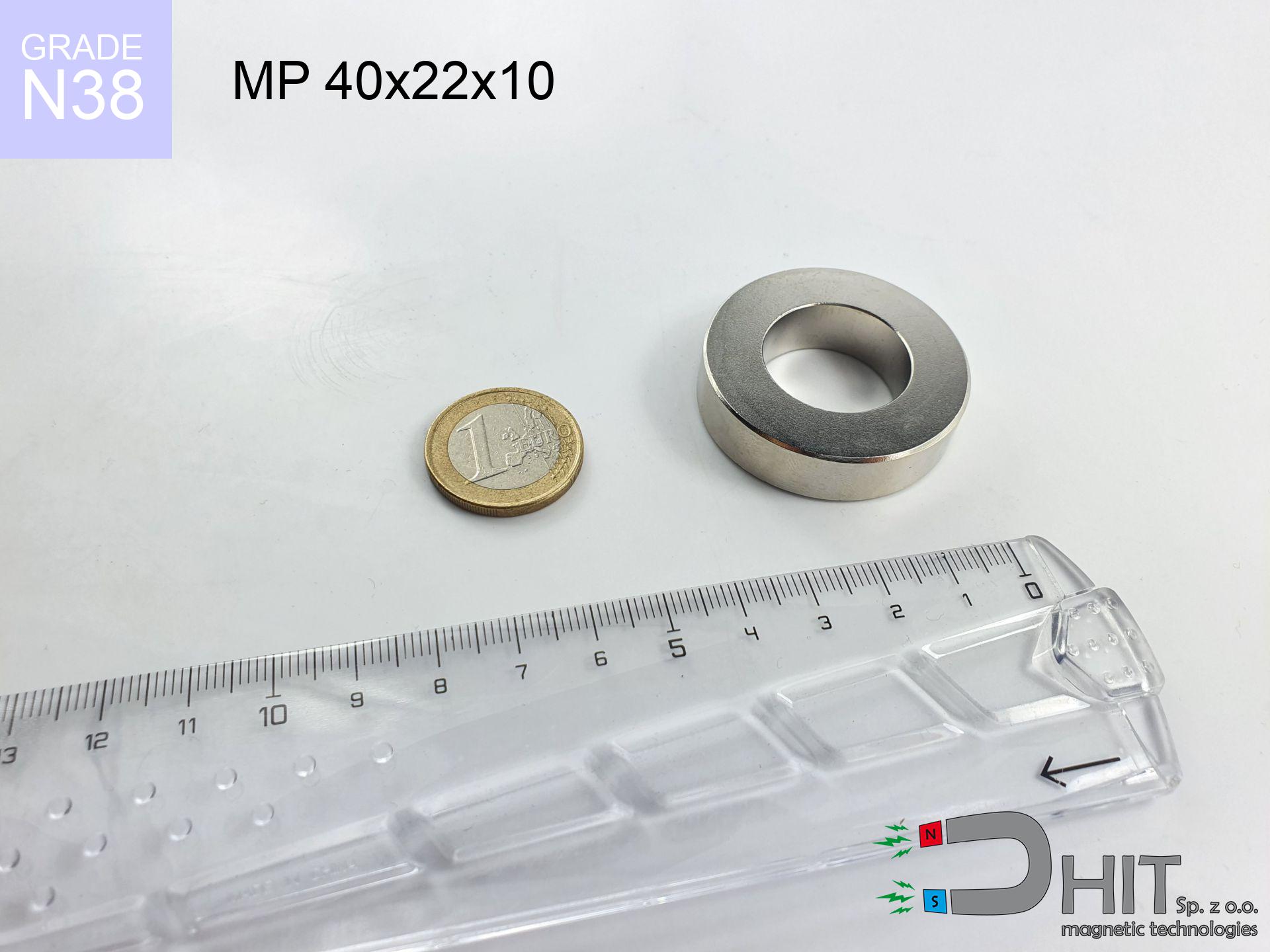
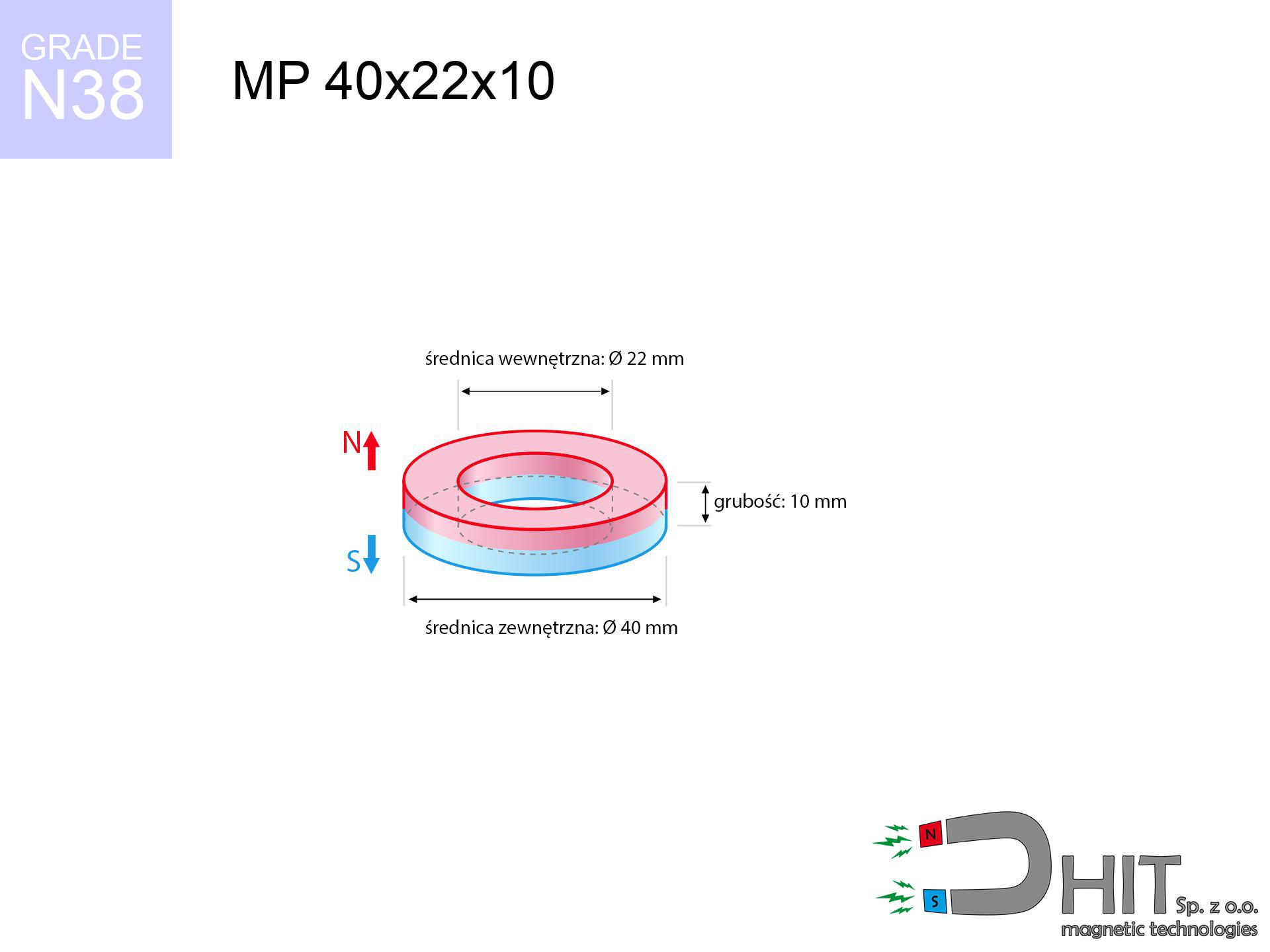
MP 40x22x10 / N38 - ring magnet
ring magnet
Catalog no 030344
GTIN/EAN: 5906301812296
- Diameter
- 40 mm [±0,1 mm]
- internal diameter Ø
- 22 mm [±0,1 mm]
- Height
- 10 mm [±0,1 mm]
- Weight
- 65.74 g
- Magnetization Direction
- ↑ axial
- Coating
- [NiCuNi] Nickel
How we measure these parameters — certificates and measurements
33.00 zł net / pcs
40.59 zł with VAT (23% VAT) / pcs
bulk discounts:
Need more?Frequently asked questions
Where can I compare prices of ring magnets for mounting in Poland?
Are ring magnets resistant to damage?
Which ring magnet is suitable for an outdoor structure?
Where can I check the available sizes of neodymium ring magnets?
Engineering report for this magnet
Full PDF analysis: pull and shear force, effect of distance, temperature and plate thickness, safety distances and the demagnetization curve.
Call us now
+48 888 99 98 98
alternatively let us know using
contact form
the contact section.
Specifications and structure of a neodymium magnet can be estimated using our
power calculator.
Order by 14:00 and we’ll ship today!
Physical properties - MP 40x22x10 / N38 - ring magnet
Specification / characteristics - MP 40x22x10 / N38 - ring magnet
| properties | values |
|---|---|
| Cat. no. | 030344 |
| GTIN/EAN | 5906301812296 |
| Production/Distribution | Dhit sp. z o.o. |
| Country of origin | Poland / China / Germany |
| Customs code | 85059029 |
| Diameter | 40 mm [±0,1 mm] |
| internal diameter Ø | 22 mm [±0,1 mm] |
| Height | 10 mm [±0,1 mm] |
| Weight | 65.74 g |
| Magnetization Direction | ↑ axial |
| Load capacity ~ ? | 19.34 kg / 189.71 N |
| Magnetic Induction ~ ? | 277.22 mT / 2772 Gs |
| Coating | [NiCuNi] Nickel |
| Manufacturing Tolerance | ±0.1 mm |
Magnetic properties of material N38
| properties | values | units |
|---|---|---|
| Remanence Br ? | 12.2-12.6 | kGs |
| Remanence Br ? | 1220-1260 | mT |
| Coercivity bHc ? | 10.8-11.5 | kOe |
| Coercivity bHc ? | 860-915 | kA/m |
| Intrinsic coercivity iHc | ≥ 12 | kOe |
| Intrinsic coercivity iHc | ≥ 955 | kA/m |
| Energy product BHmax ? | 36-38 | BH max MGOe |
| Energy product BHmax ? | 287-303 | BH max KJ/m |
| Maximum working temperature ? | ≤ 80 | °C |
Physical properties of sintered neodymium magnets Nd2Fe14B at 20°C
| properties | values | units |
|---|---|---|
| Vickers hardness | ≥550 | Hv |
| Density | ≥7.4 | g/cm3 |
| Curie Temperature TC | 310 | °C |
| Curie Temperature TF | 590 | °F |
| Specific resistance | 150 | μΩ⋅cm |
| Bending strength | 250 | MPa |
| Compressive strength | 1000~1100 | MPa |
| Thermal expansion parallel (∥) to orientation (M) | (3-4) x 10-6 | °C-1 |
| Thermal expansion perpendicular (⊥) to orientation (M) | -(1-3) x 10-6 | °C-1 |
| Young's modulus | 1.7 x 10⁴ | kg/mm² |
Engineering simulation of the product - report
The following data constitute the outcome of a mathematical simulation. Values rely on models for the class Nd2Fe14B. Real-world parameters may deviate from the simulation results. Use these data as a reference point when designing systems.
Table 1: Static force (pull vs distance) - characteristics
MP 40x22x10 / N38
| Distance (mm) | Induction (Gauss) / mT | Pull Force (kg/lbs/g/N) | Risk Status |
|---|---|---|---|
| 0 mm |
5269 Gs
526.9 mT
|
19.34 kg / 42.64 lbs
19340.0 g / 189.7 N
|
crushing |
| 1 mm |
5005 Gs
500.5 mT
|
17.46 kg / 38.48 lbs
17455.9 g / 171.2 N
|
crushing |
| 2 mm |
4739 Gs
473.9 mT
|
15.65 kg / 34.50 lbs
15647.5 g / 153.5 N
|
crushing |
| 3 mm |
4475 Gs
447.5 mT
|
13.95 kg / 30.75 lbs
13950.0 g / 136.8 N
|
crushing |
| 5 mm |
3960 Gs
396.0 mT
|
10.93 kg / 24.09 lbs
10927.7 g / 107.2 N
|
crushing |
| 10 mm |
2832 Gs
283.2 mT
|
5.59 kg / 12.32 lbs
5589.2 g / 54.8 N
|
warning |
| 15 mm |
1990 Gs
199.0 mT
|
2.76 kg / 6.09 lbs
2760.5 g / 27.1 N
|
warning |
| 20 mm |
1407 Gs
140.7 mT
|
1.38 kg / 3.04 lbs
1379.2 g / 13.5 N
|
safe |
| 30 mm |
745 Gs
74.5 mT
|
0.39 kg / 0.85 lbs
386.2 g / 3.8 N
|
safe |
| 50 mm |
268 Gs
26.8 mT
|
0.05 kg / 0.11 lbs
50.1 g / 0.5 N
|
safe |
Table 2: Sliding load (wall)
MP 40x22x10 / N38
| Distance (mm) | Friction coefficient | Pull Force (kg/lbs/g/N) |
|---|---|---|
| 0 mm | Stal (~0.2) |
3.87 kg / 8.53 lbs
3868.0 g / 37.9 N
|
| 1 mm | Stal (~0.2) |
3.49 kg / 7.70 lbs
3492.0 g / 34.3 N
|
| 2 mm | Stal (~0.2) |
3.13 kg / 6.90 lbs
3130.0 g / 30.7 N
|
| 3 mm | Stal (~0.2) |
2.79 kg / 6.15 lbs
2790.0 g / 27.4 N
|
| 5 mm | Stal (~0.2) |
2.19 kg / 4.82 lbs
2186.0 g / 21.4 N
|
| 10 mm | Stal (~0.2) |
1.12 kg / 2.46 lbs
1118.0 g / 11.0 N
|
| 15 mm | Stal (~0.2) |
0.55 kg / 1.22 lbs
552.0 g / 5.4 N
|
| 20 mm | Stal (~0.2) |
0.28 kg / 0.61 lbs
276.0 g / 2.7 N
|
| 30 mm | Stal (~0.2) |
0.08 kg / 0.17 lbs
78.0 g / 0.8 N
|
| 50 mm | Stal (~0.2) |
0.01 kg / 0.02 lbs
10.0 g / 0.1 N
|
Table 3: Vertical assembly (sliding) - vertical pull
MP 40x22x10 / N38
| Surface type | Friction coefficient / % Mocy | Max load (kg/lbs/g/N) |
|---|---|---|
| Raw steel |
µ = 0.3
30% Nominalnej Siły
|
5.80 kg / 12.79 lbs
5802.0 g / 56.9 N
|
| Painted steel (standard) |
µ = 0.2
20% Nominalnej Siły
|
3.87 kg / 8.53 lbs
3868.0 g / 37.9 N
|
| Oily/slippery steel |
µ = 0.1
10% Nominalnej Siły
|
1.93 kg / 4.26 lbs
1934.0 g / 19.0 N
|
| Magnet with anti-slip rubber |
µ = 0.5
50% Nominalnej Siły
|
9.67 kg / 21.32 lbs
9670.0 g / 94.9 N
|
Table 4: Steel thickness (substrate influence) - sheet metal selection
MP 40x22x10 / N38
| Steel thickness (mm) | % power | Real pull force (kg/lbs/g/N) |
|---|---|---|
| 0.5 mm |
|
0.97 kg / 2.13 lbs
967.0 g / 9.5 N
|
| 1 mm |
|
2.42 kg / 5.33 lbs
2417.5 g / 23.7 N
|
| 2 mm |
|
4.84 kg / 10.66 lbs
4835.0 g / 47.4 N
|
| 3 mm |
|
7.25 kg / 15.99 lbs
7252.5 g / 71.1 N
|
| 5 mm |
|
12.09 kg / 26.65 lbs
12087.5 g / 118.6 N
|
| 10 mm |
|
19.34 kg / 42.64 lbs
19340.0 g / 189.7 N
|
| 11 mm |
|
19.34 kg / 42.64 lbs
19340.0 g / 189.7 N
|
| 12 mm |
|
19.34 kg / 42.64 lbs
19340.0 g / 189.7 N
|
Table 5: Thermal stability (material behavior) - thermal limit
MP 40x22x10 / N38
| Ambient temp. (°C) | Power loss | Remaining pull (kg/lbs/g/N) | Status |
|---|---|---|---|
| 20 °C | 0.0% |
19.34 kg / 42.64 lbs
19340.0 g / 189.7 N
|
OK |
| 40 °C | -2.2% |
18.91 kg / 41.70 lbs
18914.5 g / 185.6 N
|
OK |
| 60 °C | -4.4% |
18.49 kg / 40.76 lbs
18489.0 g / 181.4 N
|
OK |
| 80 °C | -6.6% |
18.06 kg / 39.82 lbs
18063.6 g / 177.2 N
|
|
| 100 °C | -28.8% |
13.77 kg / 30.36 lbs
13770.1 g / 135.1 N
|
Table 6: Two magnets (attraction) - field collision
MP 40x22x10 / N38
| Gap (mm) | Attraction (kg/lbs) (N-S) | Shear Force (kg/lbs/g/N) | Repulsion (kg/lbs) (N-N) |
|---|---|---|---|
| 0 mm |
171.37 kg / 377.80 lbs
5 920 Gs
|
25.71 kg / 56.67 lbs
25705 g / 252.2 N
|
N/A |
| 1 mm |
163.01 kg / 359.38 lbs
10 277 Gs
|
24.45 kg / 53.91 lbs
24452 g / 239.9 N
|
146.71 kg / 323.44 lbs
~0 Gs
|
| 2 mm |
154.67 kg / 341.00 lbs
10 011 Gs
|
23.20 kg / 51.15 lbs
23201 g / 227.6 N
|
139.21 kg / 306.90 lbs
~0 Gs
|
| 3 mm |
146.55 kg / 323.08 lbs
9 744 Gs
|
21.98 kg / 48.46 lbs
21982 g / 215.6 N
|
131.89 kg / 290.77 lbs
~0 Gs
|
| 5 mm |
131.00 kg / 288.81 lbs
9 213 Gs
|
19.65 kg / 43.32 lbs
19650 g / 192.8 N
|
117.90 kg / 259.92 lbs
~0 Gs
|
| 10 mm |
96.83 kg / 213.47 lbs
7 921 Gs
|
14.52 kg / 32.02 lbs
14524 g / 142.5 N
|
87.15 kg / 192.12 lbs
~0 Gs
|
| 20 mm |
49.53 kg / 109.18 lbs
5 665 Gs
|
7.43 kg / 16.38 lbs
7429 g / 72.9 N
|
44.57 kg / 98.27 lbs
~0 Gs
|
| 50 mm |
6.33 kg / 13.95 lbs
2 025 Gs
|
0.95 kg / 2.09 lbs
949 g / 9.3 N
|
5.69 kg / 12.55 lbs
~0 Gs
|
| 60 mm |
3.42 kg / 7.55 lbs
1 489 Gs
|
0.51 kg / 1.13 lbs
513 g / 5.0 N
|
3.08 kg / 6.79 lbs
~0 Gs
|
| 70 mm |
1.94 kg / 4.27 lbs
1 120 Gs
|
0.29 kg / 0.64 lbs
290 g / 2.8 N
|
1.74 kg / 3.84 lbs
~0 Gs
|
| 80 mm |
1.14 kg / 2.52 lbs
860 Gs
|
0.17 kg / 0.38 lbs
171 g / 1.7 N
|
1.03 kg / 2.27 lbs
~0 Gs
|
| 90 mm |
0.70 kg / 1.54 lbs
673 Gs
|
0.10 kg / 0.23 lbs
105 g / 1.0 N
|
0.63 kg / 1.39 lbs
~0 Gs
|
| 100 mm |
0.44 kg / 0.98 lbs
536 Gs
|
0.07 kg / 0.15 lbs
67 g / 0.7 N
|
0.40 kg / 0.88 lbs
~0 Gs
|
Table 7: Protective zones (electronics) - precautionary measures
MP 40x22x10 / N38
| Object / Device | Limit (Gauss) / mT | Safe distance |
|---|---|---|
| Pacemaker | 5 Gs (0.5 mT) | 24.0 cm |
| Hearing aid | 10 Gs (1.0 mT) | 18.5 cm |
| Mechanical watch | 20 Gs (2.0 mT) | 14.5 cm |
| Mobile device | 40 Gs (4.0 mT) | 11.0 cm |
| Car key | 50 Gs (5.0 mT) | 10.5 cm |
| Payment card | 400 Gs (40.0 mT) | 4.5 cm |
| HDD hard drive | 600 Gs (60.0 mT) | 3.5 cm |
Table 8: Dynamics (kinetic energy) - warning
MP 40x22x10 / N38
| Start from (mm) | Speed (km/h) | Energy (J) | Predicted outcome |
|---|---|---|---|
| 10 mm |
21.05 km/h
(5.85 m/s)
|
1.12 J | |
| 30 mm |
24.27 km/h
(6.74 m/s)
|
1.49 J | |
| 50 mm |
24.52 km/h
(6.81 m/s)
|
1.52 J | |
| 100 mm |
24.57 km/h
(6.82 m/s)
|
1.53 J |
Table 9: Surface protection spec
MP 40x22x10 / N38
| Technical parameter | Value / Description |
|---|---|
| Coating type | [NiCuNi] Nickel |
| Layer structure | Nickel - Copper - Nickel |
| Layer thickness | 10-20 µm |
| Salt spray test (SST) ? | 24 h |
| Recommended environment | Indoors only (dry) |
Table 10: Electrical data (Pc)
MP 40x22x10 / N38
| Parameter | Value | SI Unit / Description |
|---|---|---|
| Magnetic Flux | 54 070 Mx | 540.7 µWb |
| Pc Coefficient | 0.81 | High (Stable) |
Table 11: Submerged application
MP 40x22x10 / N38
| Environment | Effective steel pull | Effect |
|---|---|---|
| Air (land) | 19.34 kg | Standard |
| Water (riverbed) |
22.14 kg
(+2.80 kg buoyancy gain)
|
+14.5% |
1. Vertical hold
*Note: On a vertical surface, the magnet holds merely a fraction of its max power.
2. Plate thickness effect
*Thin steel (e.g. 0.5mm PC case) significantly limits the holding force.
3. Heat tolerance
N38: the maximum material working temperature is 80°C. Permitted conditions also depend on the shape and magnetic circuit.
4. Demagnetization curve and operating point (B-H)
chart generated for the permeance coefficient Pc (Permeance Coefficient) = 0.81
The chart above illustrates the magnetic characteristics of the material within the second quadrant of the hysteresis loop. The solid red line represents the demagnetization curve (material potential), while the dashed blue line is the load line based on the magnet's geometry. The Pc (Permeance Coefficient), also known as the load line slope, is a dimensionless value that describes the relationship between the magnet's shape and its magnetic stability. The intersection of these two lines (the black dot) is the operating point — it determines the actual magnetic flux density generated by the magnet in this specific configuration. A higher Pc value means the magnet is more 'slender' (tall relative to its area), resulting in a higher operating point and better resistance to irreversible demagnetization caused by external fields or temperature. A value of 0.42 is relatively low (typical for flat magnets), meaning the operating point is closer to the 'knee' of the curve — caution is advised when operating at temperatures near the maximum limit to avoid strength loss.
Material specification
| iron (Fe) | 64% – 68% |
| neodymium (Nd) | 29% – 32% |
| boron (B) | 1.1% – 1.2% |
| dysprosium (Dy) | 0.5% – 2.0% |
| coating (Ni-Cu-Ni) | < 0.05% |
Environmental data
| recyclability (EoL) | 100% |
| recycled raw materials | ~10% (pre-cons) |
| carbon footprint | low / zredukowany |
| waste code (EWC) | 16 02 16 |
View more offers

![SM 28x175 [2xM8] / N52 - magnetic separator](https://cdn3.dhit.pl/graphics/products/sm-28x175-2xm8-bab.jpg "SM 28x175 [2xM8] / N52 - magnetic separator")

![SM 32x150 [2xM8] / N42 - magnetic separator](https://cdn3.dhit.pl/graphics/products/sm-32x150-2xm8-xus.jpg "SM 32x150 [2xM8] / N42 - magnetic separator")
Pros as well as cons of Nd2Fe14B magnets.
Pros
- They do not lose strength, even during around ten years – the decrease in lifting capacity is only ~1% (according to tests),
- They feature excellent resistance to magnetism drop due to external magnetic sources,
- In other words, due to the aesthetic surface of silver, the element gains a professional look,
- They show high magnetic induction at the operating surface, which affects their effectiveness,
- Thanks to resistance to high temperature, they are able to function (depending on the shape) even at temperatures up to 230°C and higher...
- In view of the possibility of precise forming and customization to unique needs, NdFeB magnets can be manufactured in a wide range of geometric configurations, which makes them more universal,
- Fundamental importance in modern industrial fields – they find application in computer drives, brushless drives, diagnostic systems, as well as other advanced devices.
- Compactness – despite small sizes they generate large force, making them ideal for precision applications
Limitations
- To avoid cracks upon strong impacts, we suggest using special steel holders. Such a solution protects the magnet and simultaneously increases its durability.
- Do not exceed this material temperature limit: 80°C. Overheating may permanently weaken the magnet.
- Due to the susceptibility of magnets to corrosion in a humid environment, we recommend using waterproof magnets made of rubber, plastic or other material stable to moisture, in case of application outdoors
- We recommend a housing - magnetic mount, due to difficulties in creating threads inside the magnet and complex shapes.
- Possible danger to health – tiny shards of magnets can be dangerous, when accidentally swallowed, which becomes key in the aspect of protecting the youngest. It is also worth noting that small components of these devices are able to be problematic in diagnostics medical after entering the body.
- High unit price – neodymium magnets have a higher price than other types of magnets (e.g. ferrite), which increases costs of application in large quantities
Holding force characteristics
Detachment force of the magnet in optimal conditions – what it depends on?
- with the use of a sheet made of low-carbon steel, ensuring full magnetic saturation
- with a thickness minimum 10 mm
- characterized by lack of roughness
- with zero gap (no impurities)
- during pulling in a direction vertical to the plane
- at ambient temperature approx. 20 degrees Celsius
Impact of factors on magnetic holding capacity in practice
- Space between magnet and steel – even a fraction of a millimeter of distance (caused e.g. by veneer or unevenness) drastically reduces the pulling force, often by half at just 0.5 mm.
- Force direction – declared lifting capacity refers to pulling vertically. When slipping, the magnet exhibits significantly lower power (typically approx. 20-30% of nominal force).
- Substrate thickness – to utilize 100% power, the steel must be sufficiently thick. Thin sheet restricts the attraction force (the magnet "punches through" it).
- Chemical composition of the base – low-carbon steel gives the best results. Alloy admixtures lower magnetic permeability and holding force.
- Plate texture – smooth surfaces guarantee perfect abutment, which improves field saturation. Rough surfaces reduce efficiency.
- Thermal environment – temperature increase results in weakening of force. Check the maximum operating temperature for a given model.
Holding force was tested on the plate surface of 20 mm thickness, when the force acted perpendicularly, whereas under attempts to slide the magnet the holding force is lower. Additionally, even a slight gap between the magnet’s surface and the plate lowers the lifting capacity.
Safe handling of neodymium magnets
Life threat
Medical warning: Neodymium magnets can turn off heart devices and defibrillators. Stay away if you have medical devices.
Permanent damage
Monitor thermal conditions. Exposing the magnet above 80 degrees Celsius will ruin its properties and strength.
Physical harm
Large magnets can crush fingers instantly. Do not put your hand between two attracting surfaces.
Immense force
Handle with care. Neodymium magnets act from a distance and connect with huge force, often quicker than you can move away.
Machining danger
Fire hazard: Neodymium dust is explosive. Avoid machining magnets without safety gear as this risks ignition.
Precision electronics
Navigation devices and mobile phones are highly susceptible to magnetism. Close proximity with a strong magnet can decalibrate the sensors in your phone.
Magnetic media
Do not bring magnets near a purse, laptop, or screen. The magnetic field can permanently damage these devices and wipe information from cards.
Allergic reactions
Some people experience a contact allergy to nickel, which is the standard coating for NdFeB magnets. Prolonged contact might lead to dermatitis. We recommend wear protective gloves.
Do not give to children
Strictly keep magnets away from children. Choking hazard is high, and the effects of magnets clamping inside the body are very dangerous.
Protective goggles
Despite metallic appearance, neodymium is delicate and not impact-resistant. Avoid impacts, as the magnet may shatter into sharp, dangerous pieces.
Tabela kosztu i czasu dostawy
Płatność przed wysyłką:

GLS kurier
Przesyłka będzie u Ciebie za 2-3 dni
14.99 ZŁ

InPost Paczkomaty 24/7
Przesyłka będzie u Ciebie za 1-2 dni
12.30 ZŁ
Płatność przy odbiorze (pobranie):
GLS kurier
Przesyłka będzie u Ciebie za 1-2 dni
23.00 ZŁ