

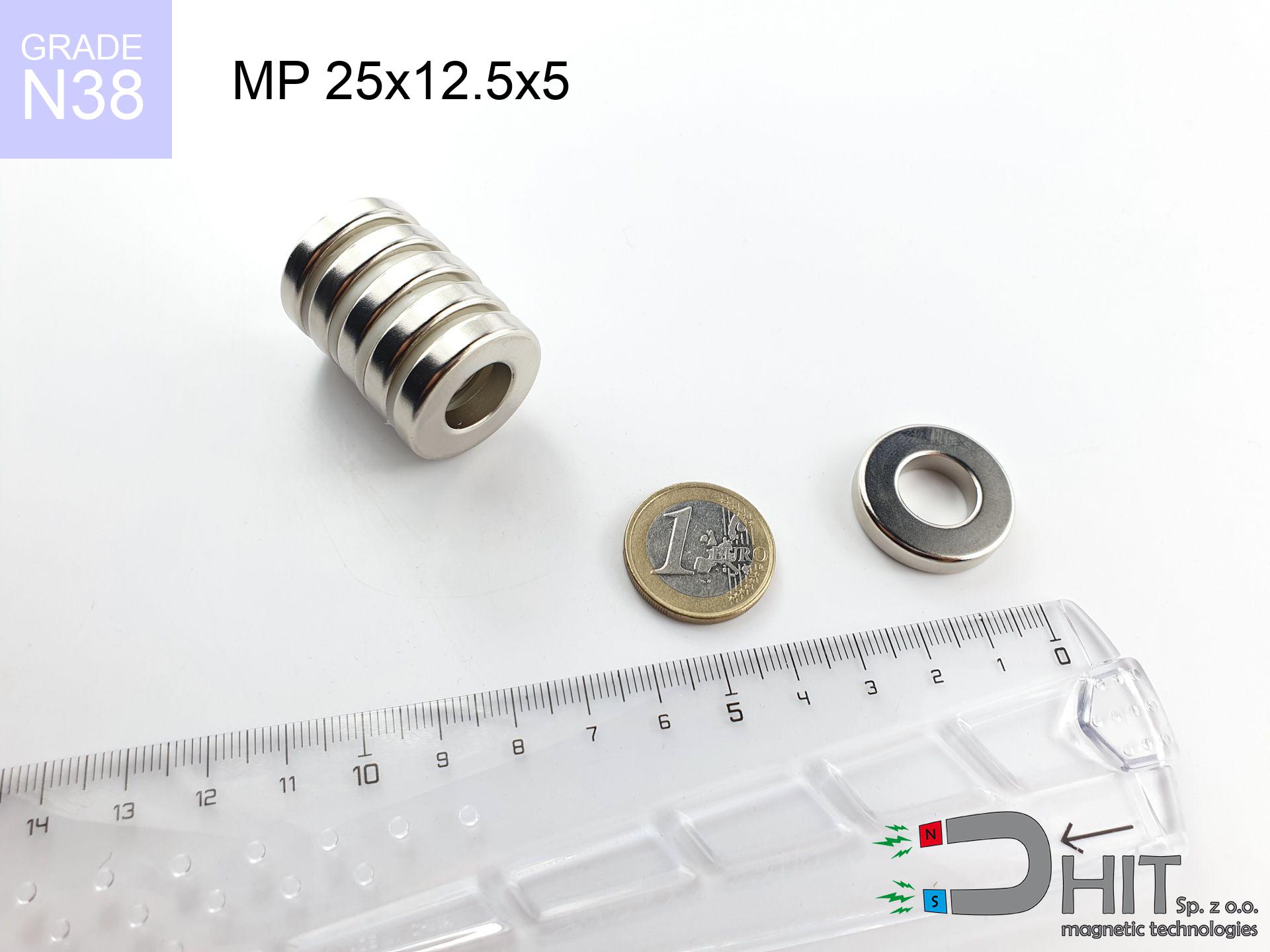
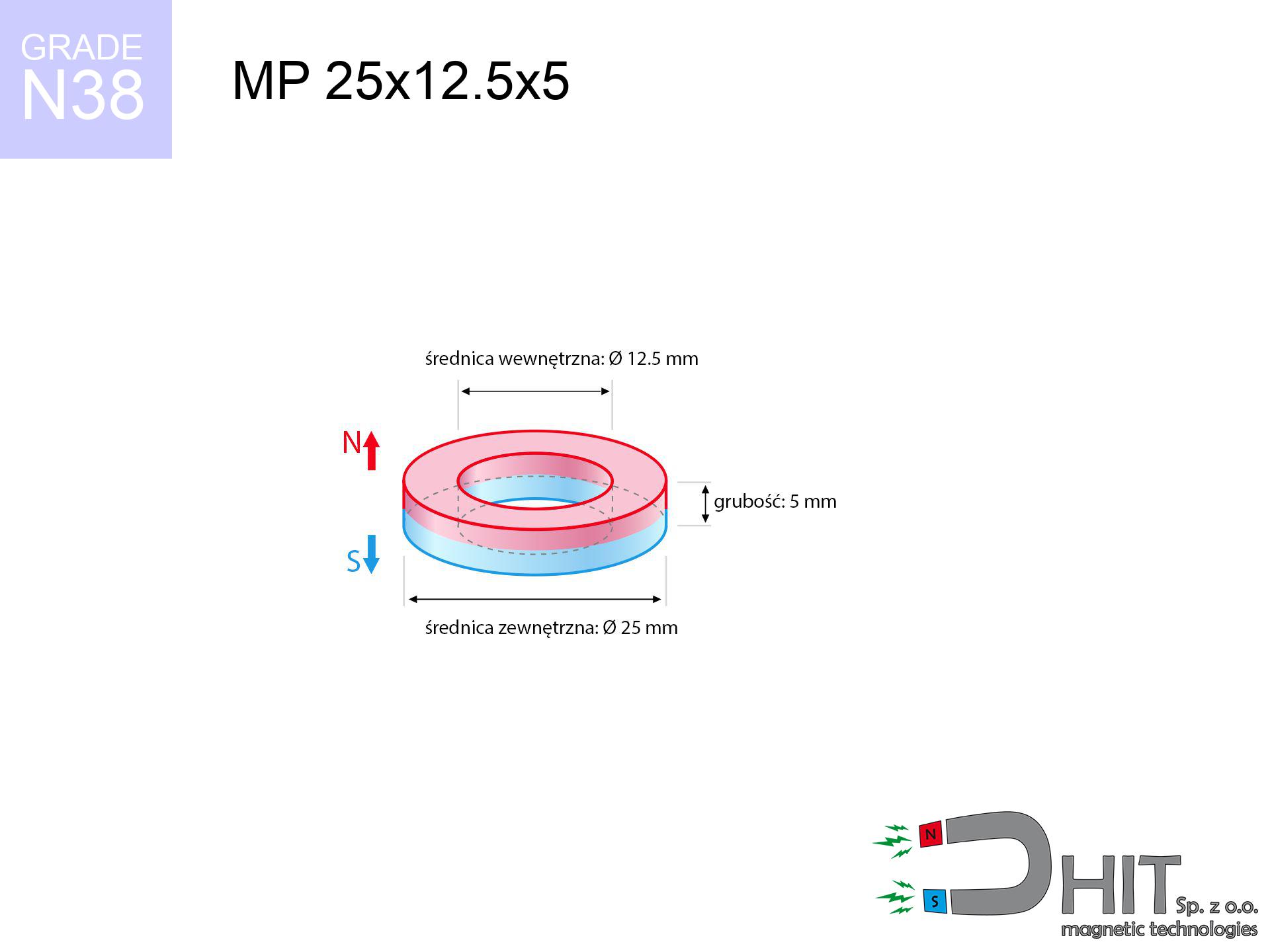
MP 25x12.5x5 / N38 - ring magnet
ring magnet
Catalog no 030342
GTIN/EAN: 5906301812289
- Diameter
- 25 mm [±0,1 mm]
- internal diameter Ø
- 12.5 mm [±0,1 mm]
- Height
- 5 mm [±0,1 mm]
- Weight
- 13.81 g
- Magnetization Direction
- ↑ axial
- Coating
- [NiCuNi] Nickel
How we measure these parameters — certificates and measurements
5.04 zł net / pcs
6.20 zł with VAT (23% VAT) / pcs
bulk discounts:
Need more?Frequently asked questions
Where can I compare prices of ring magnets for mounting in Poland?
Are ring magnets resistant to damage?
Which ring magnet is suitable for an outdoor structure?
Where can I check the available sizes of neodymium ring magnets?
Engineering report for this magnet
Full PDF analysis: pull and shear force, effect of distance, temperature and plate thickness, safety distances and the demagnetization curve.
Call us now
+48 888 99 98 98
alternatively let us know using
contact form
the contact section.
Specifications and structure of a neodymium magnet can be estimated using our
power calculator.
Order by 14:00 and we’ll ship today!
Technical data - MP 25x12.5x5 / N38 - ring magnet
Specification / characteristics - MP 25x12.5x5 / N38 - ring magnet
| properties | values |
|---|---|
| Cat. no. | 030342 |
| GTIN/EAN | 5906301812289 |
| Production/Distribution | Dhit sp. z o.o. |
| Country of origin | Poland / China / Germany |
| Customs code | 85059029 |
| Diameter | 25 mm [±0,1 mm] |
| internal diameter Ø | 12.5 mm [±0,1 mm] |
| Height | 5 mm [±0,1 mm] |
| Weight | 13.81 g |
| Magnetization Direction | ↑ axial |
| Load capacity ~ ? | 5.98 kg / 58.64 N |
| Magnetic Induction ~ ? | 230.20 mT / 2302 Gs |
| Coating | [NiCuNi] Nickel |
| Manufacturing Tolerance | ±0.1 mm |
Magnetic properties of material N38
| properties | values | units |
|---|---|---|
| Remanence Br ? | 12.2-12.6 | kGs |
| Remanence Br ? | 1220-1260 | mT |
| Coercivity bHc ? | 10.8-11.5 | kOe |
| Coercivity bHc ? | 860-915 | kA/m |
| Intrinsic coercivity iHc | ≥ 12 | kOe |
| Intrinsic coercivity iHc | ≥ 955 | kA/m |
| Energy product BHmax ? | 36-38 | BH max MGOe |
| Energy product BHmax ? | 287-303 | BH max KJ/m |
| Maximum working temperature ? | ≤ 80 | °C |
Physical properties of sintered neodymium magnets Nd2Fe14B at 20°C
| properties | values | units |
|---|---|---|
| Vickers hardness | ≥550 | Hv |
| Density | ≥7.4 | g/cm3 |
| Curie Temperature TC | 310 | °C |
| Curie Temperature TF | 590 | °F |
| Specific resistance | 150 | μΩ⋅cm |
| Bending strength | 250 | MPa |
| Compressive strength | 1000~1100 | MPa |
| Thermal expansion parallel (∥) to orientation (M) | (3-4) x 10-6 | °C-1 |
| Thermal expansion perpendicular (⊥) to orientation (M) | -(1-3) x 10-6 | °C-1 |
| Young's modulus | 1.7 x 10⁴ | kg/mm² |
Physical simulation of the assembly - data
The following data constitute the direct effect of a mathematical simulation. Results are based on models for the class Nd2Fe14B. Actual performance may differ from theoretical values. Use these data as a preliminary roadmap for designers.
Table 1: Static pull force (pull vs distance) - interaction chart
MP 25x12.5x5 / N38
| Distance (mm) | Induction (Gauss) / mT | Pull Force (kg/lbs/g/N) | Risk Status |
|---|---|---|---|
| 0 mm |
5777 Gs
577.7 mT
|
5.98 kg / 13.18 LBS
5980.0 g / 58.7 N
|
warning |
| 1 mm |
5310 Gs
531.0 mT
|
5.05 kg / 11.14 LBS
5051.8 g / 49.6 N
|
warning |
| 2 mm |
4846 Gs
484.6 mT
|
4.21 kg / 9.27 LBS
4206.8 g / 41.3 N
|
warning |
| 3 mm |
4397 Gs
439.7 mT
|
3.46 kg / 7.64 LBS
3464.5 g / 34.0 N
|
warning |
| 5 mm |
3576 Gs
357.6 mT
|
2.29 kg / 5.05 LBS
2291.1 g / 22.5 N
|
warning |
| 10 mm |
2073 Gs
207.3 mT
|
0.77 kg / 1.70 LBS
769.7 g / 7.6 N
|
weak grip |
| 15 mm |
1231 Gs
123.1 mT
|
0.27 kg / 0.60 LBS
271.6 g / 2.7 N
|
weak grip |
| 20 mm |
773 Gs
77.3 mT
|
0.11 kg / 0.24 LBS
106.9 g / 1.0 N
|
weak grip |
| 30 mm |
356 Gs
35.6 mT
|
0.02 kg / 0.05 LBS
22.7 g / 0.2 N
|
weak grip |
| 50 mm |
115 Gs
11.5 mT
|
0.00 kg / 0.01 LBS
2.4 g / 0.0 N
|
weak grip |
Table 2: Slippage load (vertical surface)
MP 25x12.5x5 / N38
| Distance (mm) | Friction coefficient | Pull Force (kg/lbs/g/N) |
|---|---|---|
| 0 mm | Stal (~0.2) |
1.20 kg / 2.64 LBS
1196.0 g / 11.7 N
|
| 1 mm | Stal (~0.2) |
1.01 kg / 2.23 LBS
1010.0 g / 9.9 N
|
| 2 mm | Stal (~0.2) |
0.84 kg / 1.86 LBS
842.0 g / 8.3 N
|
| 3 mm | Stal (~0.2) |
0.69 kg / 1.53 LBS
692.0 g / 6.8 N
|
| 5 mm | Stal (~0.2) |
0.46 kg / 1.01 LBS
458.0 g / 4.5 N
|
| 10 mm | Stal (~0.2) |
0.15 kg / 0.34 LBS
154.0 g / 1.5 N
|
| 15 mm | Stal (~0.2) |
0.05 kg / 0.12 LBS
54.0 g / 0.5 N
|
| 20 mm | Stal (~0.2) |
0.02 kg / 0.05 LBS
22.0 g / 0.2 N
|
| 30 mm | Stal (~0.2) |
0.00 kg / 0.01 LBS
4.0 g / 0.0 N
|
| 50 mm | Stal (~0.2) |
0.00 kg / 0.00 LBS
0.0 g / 0.0 N
|
Table 3: Wall mounting (shearing) - behavior on slippery surfaces
MP 25x12.5x5 / N38
| Surface type | Friction coefficient / % Mocy | Max load (kg/lbs/g/N) |
|---|---|---|
| Raw steel |
µ = 0.3
30% Nominalnej Siły
|
1.79 kg / 3.96 LBS
1794.0 g / 17.6 N
|
| Painted steel (standard) |
µ = 0.2
20% Nominalnej Siły
|
1.20 kg / 2.64 LBS
1196.0 g / 11.7 N
|
| Oily/slippery steel |
µ = 0.1
10% Nominalnej Siły
|
0.60 kg / 1.32 LBS
598.0 g / 5.9 N
|
| Magnet with anti-slip rubber |
µ = 0.5
50% Nominalnej Siły
|
2.99 kg / 6.59 LBS
2990.0 g / 29.3 N
|
Table 4: Material efficiency (substrate influence) - sheet metal selection
MP 25x12.5x5 / N38
| Steel thickness (mm) | % power | Real pull force (kg/lbs/g/N) |
|---|---|---|
| 0.5 mm |
|
0.60 kg / 1.32 LBS
598.0 g / 5.9 N
|
| 1 mm |
|
1.50 kg / 3.30 LBS
1495.0 g / 14.7 N
|
| 2 mm |
|
2.99 kg / 6.59 LBS
2990.0 g / 29.3 N
|
| 3 mm |
|
4.49 kg / 9.89 LBS
4485.0 g / 44.0 N
|
| 5 mm |
|
5.98 kg / 13.18 LBS
5980.0 g / 58.7 N
|
| 10 mm |
|
5.98 kg / 13.18 LBS
5980.0 g / 58.7 N
|
| 11 mm |
|
5.98 kg / 13.18 LBS
5980.0 g / 58.7 N
|
| 12 mm |
|
5.98 kg / 13.18 LBS
5980.0 g / 58.7 N
|
Table 5: Thermal stability (material behavior) - resistance threshold
MP 25x12.5x5 / N38
| Ambient temp. (°C) | Power loss | Remaining pull (kg/lbs/g/N) | Status |
|---|---|---|---|
| 20 °C | 0.0% |
5.98 kg / 13.18 LBS
5980.0 g / 58.7 N
|
OK |
| 40 °C | -2.2% |
5.85 kg / 12.89 LBS
5848.4 g / 57.4 N
|
OK |
| 60 °C | -4.4% |
5.72 kg / 12.60 LBS
5716.9 g / 56.1 N
|
OK |
| 80 °C | -6.6% |
5.59 kg / 12.31 LBS
5585.3 g / 54.8 N
|
|
| 100 °C | -28.8% |
4.26 kg / 9.39 LBS
4257.8 g / 41.8 N
|
Table 6: Two magnets (repulsion) - field range
MP 25x12.5x5 / N38
| Gap (mm) | Attraction (kg/lbs) (N-S) | Lateral Force (kg/lbs/g/N) | Repulsion (kg/lbs) (N-N) |
|---|---|---|---|
| 0 mm |
82.42 kg / 181.72 LBS
6 082 Gs
|
12.36 kg / 27.26 LBS
12364 g / 121.3 N
|
N/A |
| 1 mm |
75.95 kg / 167.44 LBS
11 091 Gs
|
11.39 kg / 25.12 LBS
11392 g / 111.8 N
|
68.35 kg / 150.69 LBS
~0 Gs
|
| 2 mm |
69.63 kg / 153.51 LBS
10 620 Gs
|
10.44 kg / 23.03 LBS
10445 g / 102.5 N
|
62.67 kg / 138.16 LBS
~0 Gs
|
| 3 mm |
63.64 kg / 140.29 LBS
10 153 Gs
|
9.55 kg / 21.04 LBS
9545 g / 93.6 N
|
57.27 kg / 126.26 LBS
~0 Gs
|
| 5 mm |
52.69 kg / 116.16 LBS
9 238 Gs
|
7.90 kg / 17.42 LBS
7903 g / 77.5 N
|
47.42 kg / 104.54 LBS
~0 Gs
|
| 10 mm |
31.58 kg / 69.62 LBS
7 152 Gs
|
4.74 kg / 10.44 LBS
4737 g / 46.5 N
|
28.42 kg / 62.66 LBS
~0 Gs
|
| 20 mm |
10.61 kg / 23.39 LBS
4 145 Gs
|
1.59 kg / 3.51 LBS
1591 g / 15.6 N
|
9.55 kg / 21.05 LBS
~0 Gs
|
| 50 mm |
0.65 kg / 1.43 LBS
1 024 Gs
|
0.10 kg / 0.21 LBS
97 g / 1.0 N
|
0.58 kg / 1.28 LBS
~0 Gs
|
| 60 mm |
0.31 kg / 0.69 LBS
712 Gs
|
0.05 kg / 0.10 LBS
47 g / 0.5 N
|
0.28 kg / 0.62 LBS
~0 Gs
|
| 70 mm |
0.16 kg / 0.36 LBS
514 Gs
|
0.02 kg / 0.05 LBS
24 g / 0.2 N
|
0.15 kg / 0.32 LBS
~0 Gs
|
| 80 mm |
0.09 kg / 0.20 LBS
383 Gs
|
0.01 kg / 0.03 LBS
14 g / 0.1 N
|
0.08 kg / 0.18 LBS
~0 Gs
|
| 90 mm |
0.05 kg / 0.12 LBS
293 Gs
|
0.01 kg / 0.02 LBS
8 g / 0.1 N
|
0.05 kg / 0.11 LBS
~0 Gs
|
| 100 mm |
0.03 kg / 0.07 LBS
230 Gs
|
0.00 kg / 0.01 LBS
5 g / 0.0 N
|
0.03 kg / 0.06 LBS
~0 Gs
|
Table 7: Safety (HSE) (implants) - warnings
MP 25x12.5x5 / N38
| Object / Device | Limit (Gauss) / mT | Safe distance |
|---|---|---|
| Pacemaker | 5 Gs (0.5 mT) | 17.0 cm |
| Hearing aid | 10 Gs (1.0 mT) | 13.5 cm |
| Timepiece | 20 Gs (2.0 mT) | 10.5 cm |
| Phone / Smartphone | 40 Gs (4.0 mT) | 8.0 cm |
| Remote | 50 Gs (5.0 mT) | 7.5 cm |
| Payment card | 400 Gs (40.0 mT) | 3.0 cm |
| HDD hard drive | 600 Gs (60.0 mT) | 2.5 cm |
Table 8: Impact energy (cracking risk) - collision effects
MP 25x12.5x5 / N38
| Start from (mm) | Speed (km/h) | Energy (J) | Predicted outcome |
|---|---|---|---|
| 10 mm |
22.15 km/h
(6.15 m/s)
|
0.26 J | |
| 30 mm |
23.66 km/h
(6.57 m/s)
|
0.30 J | |
| 50 mm |
23.73 km/h
(6.59 m/s)
|
0.30 J | |
| 100 mm |
23.74 km/h
(6.59 m/s)
|
0.30 J |
Table 9: Surface protection spec
MP 25x12.5x5 / N38
| Technical parameter | Value / Description |
|---|---|
| Coating type | [NiCuNi] Nickel |
| Layer structure | Nickel - Copper - Nickel |
| Layer thickness | 10-20 µm |
| Salt spray test (SST) ? | 24 h |
| Recommended environment | Indoors only (dry) |
Table 10: Construction data (Flux)
MP 25x12.5x5 / N38
| Parameter | Value | SI Unit / Description |
|---|---|---|
| Magnetic Flux | 24 536 Mx | 245.4 µWb |
| Pc Coefficient | 1.03 | High (Stable) |
Table 11: Submerged application
MP 25x12.5x5 / N38
| Environment | Effective steel pull | Effect |
|---|---|---|
| Air (land) | 5.98 kg | Standard |
| Water (riverbed) |
6.85 kg
(+0.87 kg buoyancy gain)
|
+14.5% |
1. Shear force
*Note: On a vertical wall, the magnet holds merely a fraction of its max power.
2. Efficiency vs thickness
*Thin metal sheet (e.g. computer case) severely weakens the holding force.
3. Heat tolerance
N38: the maximum material working temperature is 80°C. Permitted conditions also depend on the shape and magnetic circuit.
4. Demagnetization curve and operating point (B-H)
chart generated for the permeance coefficient Pc (Permeance Coefficient) = 1.03
This simulation demonstrates the magnetic stability of the selected magnet under specific geometric conditions. The solid red line represents the demagnetization curve (material potential), while the dashed blue line is the load line based on the magnet's geometry. The Pc (Permeance Coefficient), also known as the load line slope, is a dimensionless value that describes the relationship between the magnet's shape and its magnetic stability. The intersection of these two lines (the black dot) is the operating point — it determines the actual magnetic flux density generated by the magnet in this specific configuration. A higher Pc value means the magnet is more 'slender' (tall relative to its area), resulting in a higher operating point and better resistance to irreversible demagnetization caused by external fields or temperature. A value of 0.42 is relatively low (typical for flat magnets), meaning the operating point is closer to the 'knee' of the curve — caution is advised when operating at temperatures near the maximum limit to avoid strength loss.
Material specification
| iron (Fe) | 64% – 68% |
| neodymium (Nd) | 29% – 32% |
| boron (B) | 1.1% – 1.2% |
| dysprosium (Dy) | 0.5% – 2.0% |
| coating (Ni-Cu-Ni) | < 0.05% |
Sustainability
| recyclability (EoL) | 100% |
| recycled raw materials | ~10% (pre-cons) |
| carbon footprint | low / zredukowany |
| waste code (EWC) | 16 02 16 |
Other products


Strengths as well as weaknesses of rare earth magnets.
Pros
- They do not lose power, even during approximately ten years – the drop in strength is only ~1% (theoretically),
- They retain their magnetic properties even under close interference source,
- Thanks to the smooth finish, the layer of nickel, gold, or silver gives an professional appearance,
- Magnetic induction on the working layer of the magnet is very high,
- Thanks to resistance to high temperature, they can operate (depending on the shape) even at temperatures up to 230°C and higher...
- Possibility of custom forming as well as adjusting to complex applications,
- Fundamental importance in advanced technology sectors – they are used in magnetic memories, brushless drives, medical devices, also complex engineering applications.
- Compactness – despite small sizes they offer powerful magnetic field, making them ideal for precision applications
Cons
- Brittleness is one of their disadvantages. Upon strong impact they can fracture. We recommend keeping them in a strong case, which not only protects them against impacts but also increases their durability
- Do not exceed this material temperature limit: 80°C. Overheating may permanently weaken the magnet.
- They oxidize in a humid environment. For use outdoors we advise using waterproof magnets e.g. in rubber, plastic
- Due to limitations in creating threads and complicated shapes in magnets, we propose using a housing - magnetic holder.
- Possible danger to health – tiny shards of magnets are risky, if swallowed, which gains importance in the context of child health protection. Furthermore, small components of these magnets can be problematic in diagnostics medical in case of swallowing.
- Due to neodymium price, their price is higher than average,
Holding force characteristics
Detachment force of the magnet in optimal conditions – what contributes to it?
- with the contact of a sheet made of special test steel, guaranteeing full magnetic saturation
- whose transverse dimension reaches at least 10 mm
- characterized by smoothness
- under conditions of gap-free contact (surface-to-surface)
- for force acting at a right angle (in the magnet axis)
- in stable room temperature
What influences lifting capacity in practice
- Gap between magnet and steel – every millimeter of distance (caused e.g. by veneer or dirt) diminishes the magnet efficiency, often by half at just 0.5 mm.
- Loading method – declared lifting capacity refers to pulling vertically. When attempting to slide, the magnet exhibits significantly lower power (often approx. 20-30% of maximum force).
- Substrate thickness – to utilize 100% power, the steel must be sufficiently thick. Paper-thin metal restricts the attraction force (the magnet "punches through" it).
- Plate material – mild steel gives the best results. Alloy steels reduce magnetic permeability and lifting capacity.
- Surface finish – full contact is obtained only on polished steel. Any scratches and bumps create air cushions, reducing force.
- Temperature influence – hot environment weakens magnetic field. Too high temperature can permanently demagnetize the magnet.
Lifting capacity testing was performed on plates with a smooth surface of suitable thickness, under a perpendicular pulling force, whereas under parallel forces the holding force is lower. Moreover, even a minimal clearance between the magnet and the plate reduces the holding force.
H&S for magnets
Fire risk
Drilling and cutting of NdFeB material carries a risk of fire hazard. Magnetic powder reacts violently with oxygen and is difficult to extinguish.
Heat warning
Keep cool. Neodymium magnets are susceptible to temperature. If you need operation above 80°C, ask us about special high-temperature series (H, SH, UH).
Electronic hazard
Intense magnetic fields can erase data on credit cards, hard drives, and storage devices. Maintain a gap of at least 10 cm.
Allergic reactions
Studies show that nickel (standard magnet coating) is a potent allergen. If you have an allergy, refrain from direct skin contact and select coated magnets.
Life threat
People with a pacemaker have to keep an absolute distance from magnets. The magnetic field can stop the functioning of the life-saving device.
Bone fractures
Large magnets can break fingers in a fraction of a second. Do not put your hand betwixt two attracting surfaces.
Adults only
Product intended for adults. Small elements can be swallowed, causing severe trauma. Store out of reach of children and animals.
Conscious usage
Handle magnets consciously. Their huge power can shock even professionals. Stay alert and do not underestimate their force.
Compass and GPS
GPS units and mobile phones are highly susceptible to magnetic fields. Direct contact with a strong magnet can decalibrate the internal compass in your phone.
Eye protection
Beware of splinters. Magnets can fracture upon uncontrolled impact, ejecting shards into the air. Wear goggles.
Tabela kosztu i czasu dostawy
Płatność przed wysyłką:

GLS kurier
Przesyłka będzie u Ciebie za 2-3 dni
14.99 ZŁ

InPost Paczkomaty 24/7
Przesyłka będzie u Ciebie za 1-2 dni
12.30 ZŁ
Płatność przy odbiorze (pobranie):
GLS kurier
Przesyłka będzie u Ciebie za 1-2 dni
23.00 ZŁ