

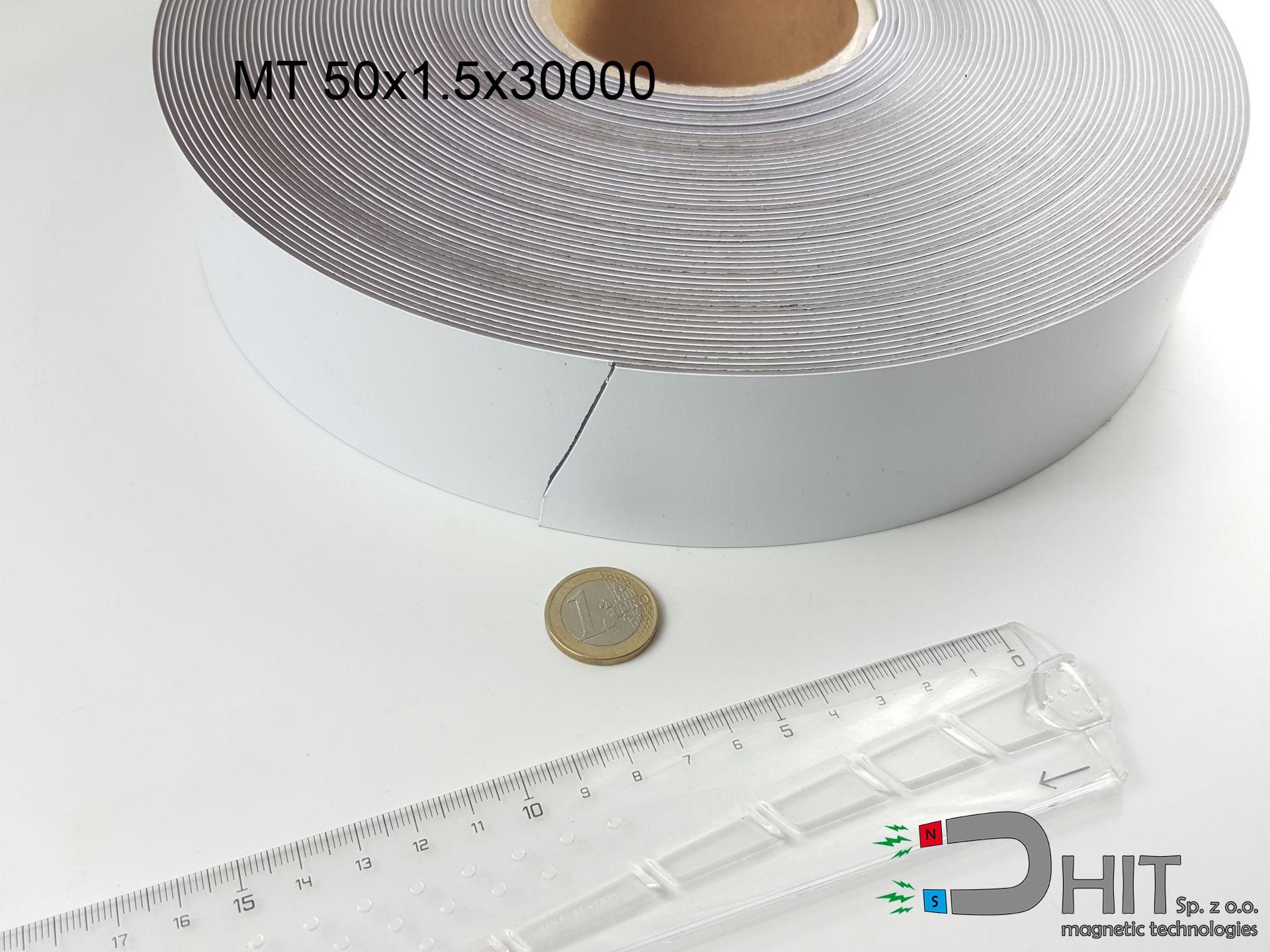
MT 50x1.5x30000 - magnetic tape
magnetic tape
Catalog no 380510
GTIN/EAN: 5906301815150
- length
- 50 mm [±1 mm]
- Width
- 1.5 mm [±1 mm]
- Height
- 30000 mm [±1 mm]
How we measure these parameters — certificates and measurements
210.00 zł net / pcs
258.30 zł with VAT (23% VAT) / pcs
bulk discounts:
Need more?Frequently asked questions
Where can I find accessories for mounting magnets?
Can I find a technical magnet with a documented pull rating?
Where can I find magnets for a higher operating temperature?
When does an N52 magnet make sense in demanding conditions?
Guides from the knowledge base
Call us now
+48 888 99 98 98
alternatively let us know using
contact form
the contact section.
Specifications and structure of a neodymium magnet can be estimated using our
power calculator.
Order by 14:00 and we’ll ship today!
Technical specification of the product - MT 50x1.5x30000 - magnetic tape
Specification / characteristics - MT 50x1.5x30000 - magnetic tape
| properties | values |
|---|---|
| Cat. no. | 380510 |
| GTIN/EAN | 5906301815150 |
| Production/Distribution | Dhit sp. z o.o. |
| Country of origin | Poland / China / Germany |
| Customs code | 85059029 |
| length | 50 mm [±1 mm] |
| Width | 1.5 mm [±1 mm] |
| Height | 30000 mm [±1 mm] |
| Manufacturing Tolerance | ±1 mm |
Physical properties of sintered neodymium magnets Nd2Fe14B at 20°C
| properties | values | units |
|---|---|---|
| Vickers hardness | ≥550 | Hv |
| Density | ≥7.4 | g/cm3 |
| Curie Temperature TC | 310 | °C |
| Curie Temperature TF | 590 | °F |
| Specific resistance | 150 | μΩ⋅cm |
| Bending strength | 250 | MPa |
| Compressive strength | 1000~1100 | MPa |
| Thermal expansion parallel (∥) to orientation (M) | (3-4) x 10-6 | °C-1 |
| Thermal expansion perpendicular (⊥) to orientation (M) | -(1-3) x 10-6 | °C-1 |
| Young's modulus | 1.7 x 10⁴ | kg/mm² |
Elemental analysis
| iron (Fe) | 64% – 68% |
| neodymium (Nd) | 29% – 32% |
| boron (B) | 1.1% – 1.2% |
| dysprosium (Dy) | 0.5% – 2.0% |
| coating (Ni-Cu-Ni) | < 0.05% |
Sustainability
| recyclability (EoL) | 100% |
| recycled raw materials | ~10% (pre-cons) |
| carbon footprint | low / zredukowany |
| waste code (EWC) | 16 02 16 |
Other products
![AM ucho małe [M8] - magnetic accessories](https://cdn3.dhit.pl/graphics/products/am-ucho-małe-m8-zud.jpg "AM ucho małe [M8] - magnetic accessories")

![SM 28x300 [2xM8] / N52 - magnetic separator](https://cdn3.dhit.pl/graphics/products/sm-28x300-2xm8-paw.jpg "SM 28x300 [2xM8] / N52 - magnetic separator")
![SM 32x300 [2xM8] / N52 - magnetic separator](https://cdn3.dhit.pl/graphics/products/sm-32x300-2xm8-luf.jpg "SM 32x300 [2xM8] / N52 - magnetic separator")
Pros as well as cons of rare earth magnets.
Pros
- They retain attractive force for nearly 10 years – the drop is just ~1% (based on simulations),
- Magnets perfectly protect themselves against demagnetization caused by ambient magnetic noise,
- A magnet with a metallic nickel surface looks better,
- They are known for high magnetic induction at the operating surface, which increases their power,
- Neodymium magnets are characterized by very high magnetic induction on the magnet surface and can work (depending on the form) even at a temperature of 230°C or more...
- Possibility of individual machining as well as adjusting to defined conditions,
- Huge importance in advanced technology sectors – they are used in magnetic memories, motor assemblies, medical devices, and technologically advanced constructions.
- Compactness – despite small sizes they generate large force, making them ideal for precision applications
Cons
- They are fragile upon too strong impacts. To avoid cracks, it is worth protecting magnets in a protective case. Such protection not only shields the magnet but also improves its resistance to damage
- Heat sensitivity: observe the temperature specified for this product. Overheating may permanently weaken the magnet.
- Due to the susceptibility of magnets to corrosion in a humid environment, we suggest using waterproof magnets made of rubber, plastic or other material immune to moisture, when using outdoors
- Due to limitations in creating threads and complicated shapes in magnets, we propose using a housing - magnetic holder.
- Health risk resulting from small fragments of magnets pose a threat, in case of ingestion, which is particularly important in the context of child health protection. Furthermore, small elements of these devices can disrupt the diagnostic process medical after entering the body.
- With large orders the cost of neodymium magnets is a challenge,
Pull force analysis
Maximum lifting force for a neodymium magnet – what it depends on?
- with the contact of a yoke made of special test steel, guaranteeing maximum field concentration
- possessing a massiveness of at least 10 mm to avoid saturation
- with an polished touching surface
- under conditions of gap-free contact (surface-to-surface)
- under perpendicular force direction (90-degree angle)
- at standard ambient temperature
What influences lifting capacity in practice
- Air gap (betwixt the magnet and the plate), because even a microscopic clearance (e.g. 0.5 mm) leads to a decrease in force by up to 50% (this also applies to paint, rust or dirt).
- Load vector – maximum parameter is reached only during pulling at a 90° angle. The shear force of the magnet along the plate is standardly several times smaller (approx. 1/5 of the lifting capacity).
- Substrate thickness – to utilize 100% power, the steel must be sufficiently thick. Paper-thin metal limits the lifting capacity (the magnet "punches through" it).
- Steel type – mild steel gives the best results. Higher carbon content decrease magnetic permeability and lifting capacity.
- Surface finish – full contact is obtained only on smooth steel. Any scratches and bumps create air cushions, reducing force.
- Thermal environment – heating the magnet causes a temporary drop of force. It is worth remembering the maximum operating temperature for a given model.
Holding force was measured on a smooth steel plate of 20 mm thickness, when a perpendicular force was applied, however under shearing force the holding force is lower. Moreover, even a slight gap between the magnet’s surface and the plate reduces the lifting capacity.
Safety rules for work with neodymium magnets
Swallowing risk
Product intended for adults. Small elements can be swallowed, causing severe trauma. Store out of reach of children and animals.
Heat warning
Regular neodymium magnets (N-type) undergo demagnetization when the temperature surpasses 80°C. Damage is permanent.
Threat to electronics
Do not bring magnets close to a wallet, computer, or TV. The magnetic field can permanently damage these devices and wipe information from cards.
Skin irritation risks
Allergy Notice: The Ni-Cu-Ni coating contains nickel. If an allergic reaction happens, cease working with magnets and wear gloves.
Hand protection
Big blocks can break fingers instantly. Do not place your hand betwixt two strong magnets.
Caution required
Be careful. Rare earth magnets attract from a long distance and snap with massive power, often faster than you can react.
Do not drill into magnets
Mechanical processing of NdFeB material carries a risk of fire risk. Magnetic powder reacts violently with oxygen and is hard to extinguish.
Protective goggles
Watch out for shards. Magnets can explode upon uncontrolled impact, launching shards into the air. We recommend safety glasses.
Impact on smartphones
GPS units and mobile phones are extremely susceptible to magnetic fields. Direct contact with a strong magnet can decalibrate the internal compass in your phone.
Implant safety
For implant holders: Powerful magnets affect electronics. Keep at least 30 cm distance or ask another person to work with the magnets.
Tabela kosztu i czasu dostawy
Płatność przed wysyłką:

GLS kurier
Przesyłka będzie u Ciebie za 2-3 dni
14.99 ZŁ

InPost Paczkomaty 24/7
Przesyłka będzie u Ciebie za 1-2 dni
12.30 ZŁ
Płatność przy odbiorze (pobranie):
GLS kurier
Przesyłka będzie u Ciebie za 1-2 dni
23.00 ZŁ