

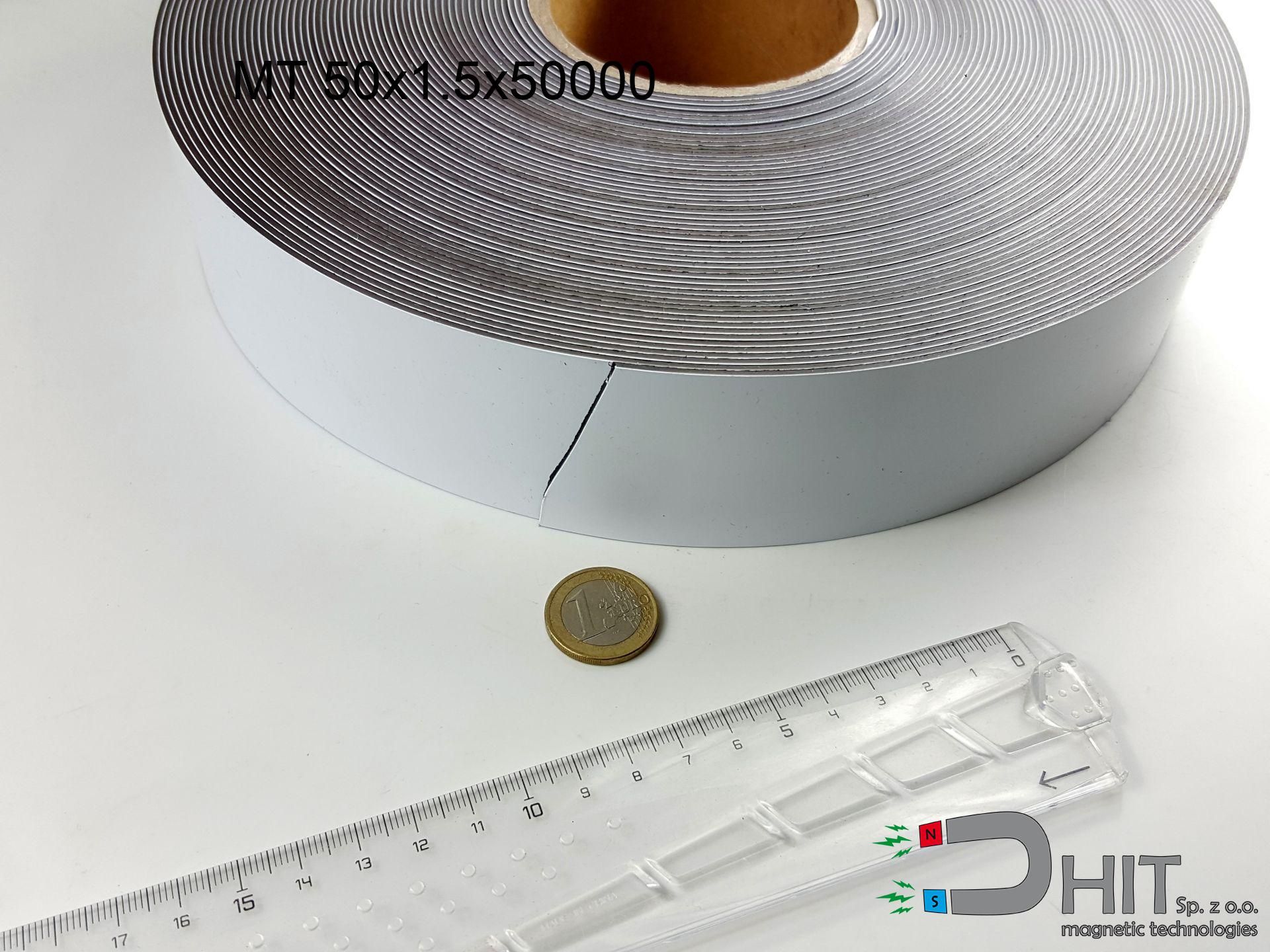
MT 50x1.5x50000 - magnetic tape
magnetic tape
Catalog no 380511
GTIN/EAN: 5906301815167
- length
- 50 mm [±1 mm]
- Width
- 1.5 mm [±1 mm]
- Height
- 50000 mm [±1 mm]
How we measure these parameters — certificates and measurements
350.00 zł net / pcs
430.50 zł with VAT (23% VAT) / pcs
bulk discounts:
Need more?Frequently asked questions
Where can I find accessories for mounting magnets?
Can I find a technical magnet with a documented pull rating?
Where can I find magnets for a higher operating temperature?
When does an N52 magnet make sense in demanding conditions?
Guides from the knowledge base
Call us now
+48 888 99 98 98
alternatively let us know using
contact form
the contact section.
Specifications and structure of a neodymium magnet can be estimated using our
power calculator.
Order by 14:00 and we’ll ship today!
Detailed specification - MT 50x1.5x50000 - magnetic tape
Specification / characteristics - MT 50x1.5x50000 - magnetic tape
| properties | values |
|---|---|
| Cat. no. | 380511 |
| GTIN/EAN | 5906301815167 |
| Production/Distribution | Dhit sp. z o.o. |
| Country of origin | Poland / China / Germany |
| Customs code | 85059029 |
| length | 50 mm [±1 mm] |
| Width | 1.5 mm [±1 mm] |
| Height | 50000 mm [±1 mm] |
| Manufacturing Tolerance | ±1 mm |
Physical properties of sintered neodymium magnets Nd2Fe14B at 20°C
| properties | values | units |
|---|---|---|
| Vickers hardness | ≥550 | Hv |
| Density | ≥7.4 | g/cm3 |
| Curie Temperature TC | 310 | °C |
| Curie Temperature TF | 590 | °F |
| Specific resistance | 150 | μΩ⋅cm |
| Bending strength | 250 | MPa |
| Compressive strength | 1000~1100 | MPa |
| Thermal expansion parallel (∥) to orientation (M) | (3-4) x 10-6 | °C-1 |
| Thermal expansion perpendicular (⊥) to orientation (M) | -(1-3) x 10-6 | °C-1 |
| Young's modulus | 1.7 x 10⁴ | kg/mm² |
Chemical composition
| iron (Fe) | 64% – 68% |
| neodymium (Nd) | 29% – 32% |
| boron (B) | 1.1% – 1.2% |
| dysprosium (Dy) | 0.5% – 2.0% |
| coating (Ni-Cu-Ni) | < 0.05% |
Ecology and recycling (GPSR)
| recyclability (EoL) | 100% |
| recycled raw materials | ~10% (pre-cons) |
| carbon footprint | low / zredukowany |
| waste code (EWC) | 16 02 16 |
View more products
![UMGZ 42x20x9 [M8] GZ / N38 - magnetic holder external thread](https://cdn3.dhit.pl/graphics/products/um-42x20x9-m8-gz-fof.jpg "UMGZ 42x20x9 [M8] GZ / N38 - magnetic holder external thread")
![UMP 75x25 [M10x3] GW F200 PLATINIUM Lina / N52 - search holder](https://cdn3.dhit.pl/graphics/products/ump-75x25-m10x3-gw-f200-platinium-lina-wiz.jpg "UMP 75x25 [M10x3] GW F200 PLATINIUM Lina / N52 - search holder")

Strengths as well as weaknesses of neodymium magnets.
Advantages
- They do not lose magnetism, even over around ten years – the reduction in strength is only ~1% (based on measurements),
- They do not lose their magnetic properties even under strong external field,
- A magnet with a metallic silver surface has an effective appearance,
- Magnets are characterized by maximum magnetic induction on the outer side,
- Through (adequate) combination of ingredients, they can achieve high thermal strength, enabling action at temperatures approaching 230°C and above...
- Thanks to modularity in designing and the ability to adapt to specific needs,
- Universal use in future technologies – they are commonly used in mass storage devices, electric drive systems, precision medical tools, as well as industrial machines.
- Thanks to their power density, small magnets offer high operating force, occupying minimum space,
Weaknesses
- To avoid cracks under impact, we recommend using special steel holders. Such a solution protects the magnet and simultaneously increases its durability.
- Heat sensitivity: observe the temperature specified for this product. Overheating may permanently weaken the magnet.
- They oxidize in a humid environment. For use outdoors we recommend using waterproof magnets e.g. in rubber, plastic
- We suggest a housing - magnetic mechanism, due to difficulties in realizing nuts inside the magnet and complicated forms.
- Potential hazard related to microscopic parts of magnets can be dangerous, in case of ingestion, which gains importance in the context of child health protection. Additionally, tiny parts of these products can disrupt the diagnostic process medical in case of swallowing.
- With mass production the cost of neodymium magnets is economically unviable,
Holding force characteristics
Highest magnetic holding force – what it depends on?
- on a plate made of structural steel, effectively closing the magnetic field
- possessing a thickness of at least 10 mm to ensure full flux closure
- with a surface cleaned and smooth
- with total lack of distance (no paint)
- during pulling in a direction perpendicular to the mounting surface
- at standard ambient temperature
Magnet lifting force in use – key factors
- Gap between surfaces – even a fraction of a millimeter of separation (caused e.g. by veneer or dirt) drastically reduces the magnet efficiency, often by half at just 0.5 mm.
- Direction of force – highest force is obtained only during perpendicular pulling. The shear force of the magnet along the surface is standardly many times lower (approx. 1/5 of the lifting capacity).
- Substrate thickness – to utilize 100% power, the steel must be sufficiently thick. Thin sheet limits the attraction force (the magnet "punches through" it).
- Material type – the best choice is pure iron steel. Stainless steels may generate lower lifting capacity.
- Smoothness – full contact is possible only on polished steel. Any scratches and bumps reduce the real contact area, weakening the magnet.
- Operating temperature – neodymium magnets have a sensitivity to temperature. When it is hot they lose power, and at low temperatures gain strength (up to a certain limit).
Lifting capacity was determined using a steel plate with a smooth surface of optimal thickness (min. 20 mm), under vertically applied force, whereas under attempts to slide the magnet the holding force is lower. In addition, even a small distance between the magnet and the plate reduces the holding force.
Safe handling of neodymium magnets
Cards and drives
Intense magnetic fields can destroy records on credit cards, HDDs, and other magnetic media. Stay away of min. 10 cm.
Fire warning
Fire warning: Rare earth powder is highly flammable. Avoid machining magnets without safety gear as this may cause fire.
Protective goggles
NdFeB magnets are ceramic materials, meaning they are fragile like glass. Collision of two magnets leads to them shattering into small pieces.
ICD Warning
Individuals with a ICD must maintain an large gap from magnets. The magnetic field can stop the functioning of the life-saving device.
Danger to the youngest
Adult use only. Tiny parts pose a choking risk, leading to intestinal necrosis. Keep away from children and animals.
Handling guide
Before use, check safety instructions. Sudden snapping can destroy the magnet or injure your hand. Think ahead.
Nickel allergy
Studies show that nickel (the usual finish) is a strong allergen. If you have an allergy, refrain from touching magnets with bare hands or opt for encased magnets.
Bone fractures
Large magnets can crush fingers instantly. Do not put your hand between two strong magnets.
Heat warning
Watch the temperature. Exposing the magnet to high heat will destroy its magnetic structure and pulling force.
Keep away from electronics
Remember: rare earth magnets generate a field that disrupts sensitive sensors. Maintain a separation from your mobile, tablet, and navigation systems.
Tabela kosztu i czasu dostawy
Płatność przed wysyłką:

GLS kurier
Przesyłka będzie u Ciebie za 2-3 dni
14.99 ZŁ

InPost Paczkomaty 24/7
Przesyłka będzie u Ciebie za 1-2 dni
12.30 ZŁ
Płatność przy odbiorze (pobranie):
GLS kurier
Przesyłka będzie u Ciebie za 1-2 dni
23.00 ZŁ