
![Magnetic name badge holder UI 45x13x5 [M301] / N38](https://cdn3.dhit.pl/graphics/banners/magnet.webp "Magnetic name badge holder UI 45x13x5 [M301] / N38")
![UI 45x13x5 [M301] / N38 - badge holder](https://cdn3.dhit.pl/graphics/products/ui45x13x5-m301-vud.jpg)
UI 45x13x5 [M301] / N38 - badge holder
badge holder
Catalog no 150208
GTIN/EAN: 5906301813552
- length
- 45 mm [±1 mm]
- Width
- 13 mm [±1 mm]
- Height
- 5 mm [±1 mm]
- Weight
- 0.14 g
How we measure these parameters — certificates and measurements
1.950 zł net / pcs
2.40 zł with VAT (23% VAT) / pcs
bulk discounts:
Need more?Frequently asked questions
What badge size fits these holders - will a standard 86x54 mm card work?
We already have lanyard or pin badges. Can they be converted to magnetic ones?
What should a staff badge show, and does it have to carry a surname?
Can the badge be swapped, for example on a change of role or for a conference?
Will the badge rotate, and is it readable from a distance at a counter or reception?
Pacemaker, hearing aid, contactless card - what about safety when wearing the badge?
We are ordering badges for a whole team. How many holders to count and what to order with them?
Call us now
+48 888 99 98 98
alternatively let us know using
contact form
the contact section.
Specifications and structure of a neodymium magnet can be estimated using our
power calculator.
Order by 14:00 and we’ll ship today!
Technical parameters of the product - UI 45x13x5 [M301] / N38 - badge holder
Specification / characteristics - UI 45x13x5 [M301] / N38 - badge holder
| properties | values |
|---|---|
| Cat. no. | 150208 |
| GTIN/EAN | 5906301813552 |
| Production/Distribution | Dhit sp. z o.o. |
| Country of origin | Poland / China / Germany |
| Customs code | 85059029 |
| length | 45 mm [±1 mm] |
| Width | 13 mm [±1 mm] |
| Height | 5 mm [±1 mm] |
| Weight | 0.14 g |
| Load capacity ~ ? | 1.10 kg / 10.79 N |
| Manufacturing Tolerance | ±1 mm |
Magnetic properties of material N38
| properties | values | units |
|---|---|---|
| Remanence Br ? | 12.2-12.6 | kGs |
| Remanence Br ? | 1220-1260 | mT |
| Coercivity bHc ? | 10.8-11.5 | kOe |
| Coercivity bHc ? | 860-915 | kA/m |
| Intrinsic coercivity iHc | ≥ 12 | kOe |
| Intrinsic coercivity iHc | ≥ 955 | kA/m |
| Energy product BHmax ? | 36-38 | BH max MGOe |
| Energy product BHmax ? | 287-303 | BH max KJ/m |
| Maximum working temperature ? | ≤ 80 | °C |
Physical properties of sintered neodymium magnets Nd2Fe14B at 20°C
| properties | values | units |
|---|---|---|
| Vickers hardness | ≥550 | Hv |
| Density | ≥7.4 | g/cm3 |
| Curie Temperature TC | 310 | °C |
| Curie Temperature TF | 590 | °F |
| Specific resistance | 150 | μΩ⋅cm |
| Bending strength | 250 | MPa |
| Compressive strength | 1000~1100 | MPa |
| Thermal expansion parallel (∥) to orientation (M) | (3-4) x 10-6 | °C-1 |
| Thermal expansion perpendicular (⊥) to orientation (M) | -(1-3) x 10-6 | °C-1 |
| Young's modulus | 1.7 x 10⁴ | kg/mm² |
Material specification
| iron (Fe) | 64% – 68% |
| neodymium (Nd) | 29% – 32% |
| boron (B) | 1.1% – 1.2% |
| dysprosium (Dy) | 0.5% – 2.0% |
| coating (Ni-Cu-Ni) | < 0.05% |
Sustainability
| recyclability (EoL) | 100% |
| recycled raw materials | ~10% (pre-cons) |
| carbon footprint | low / zredukowany |
| waste code (EWC) | 16 02 16 |
See more proposals
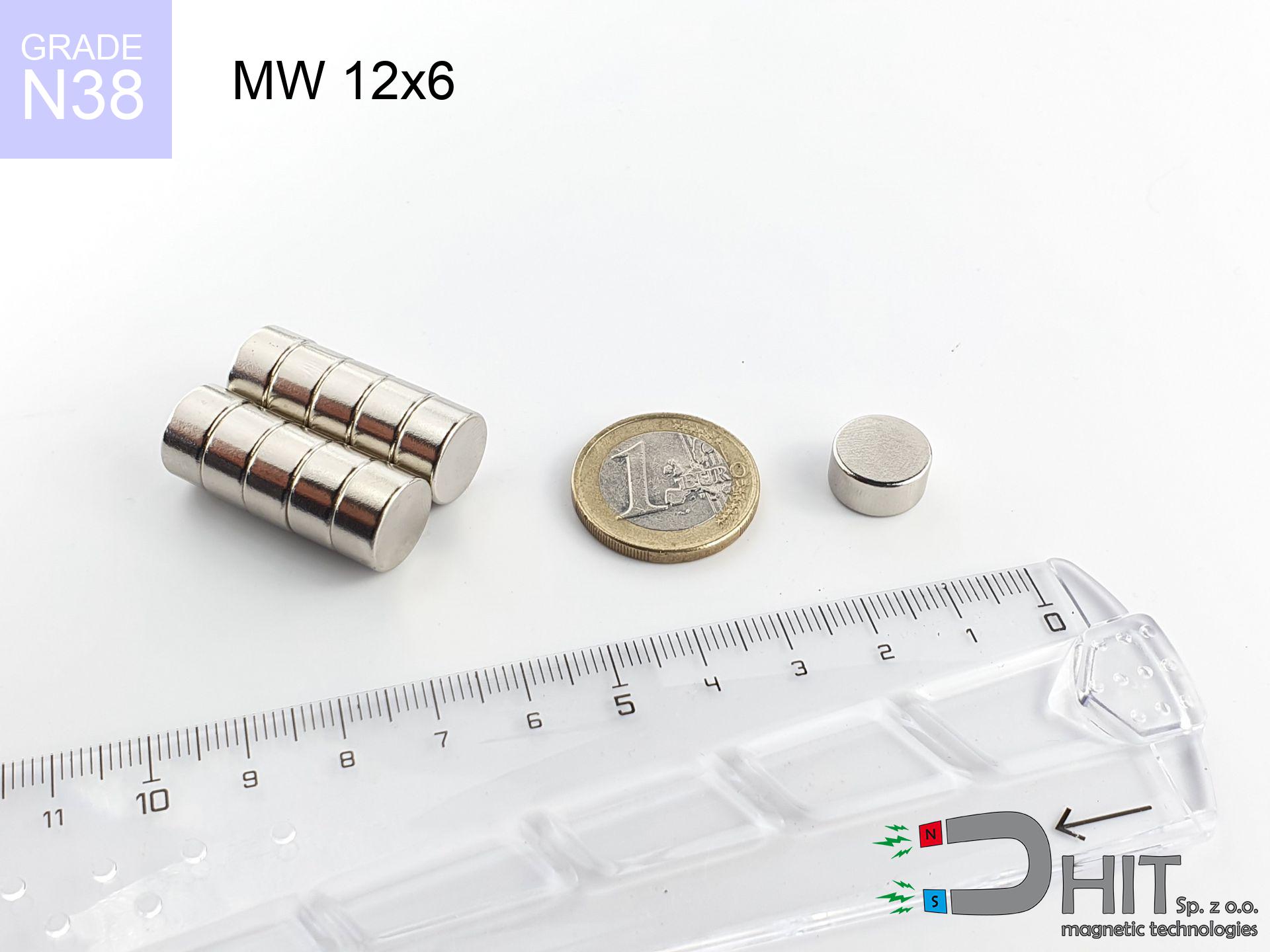

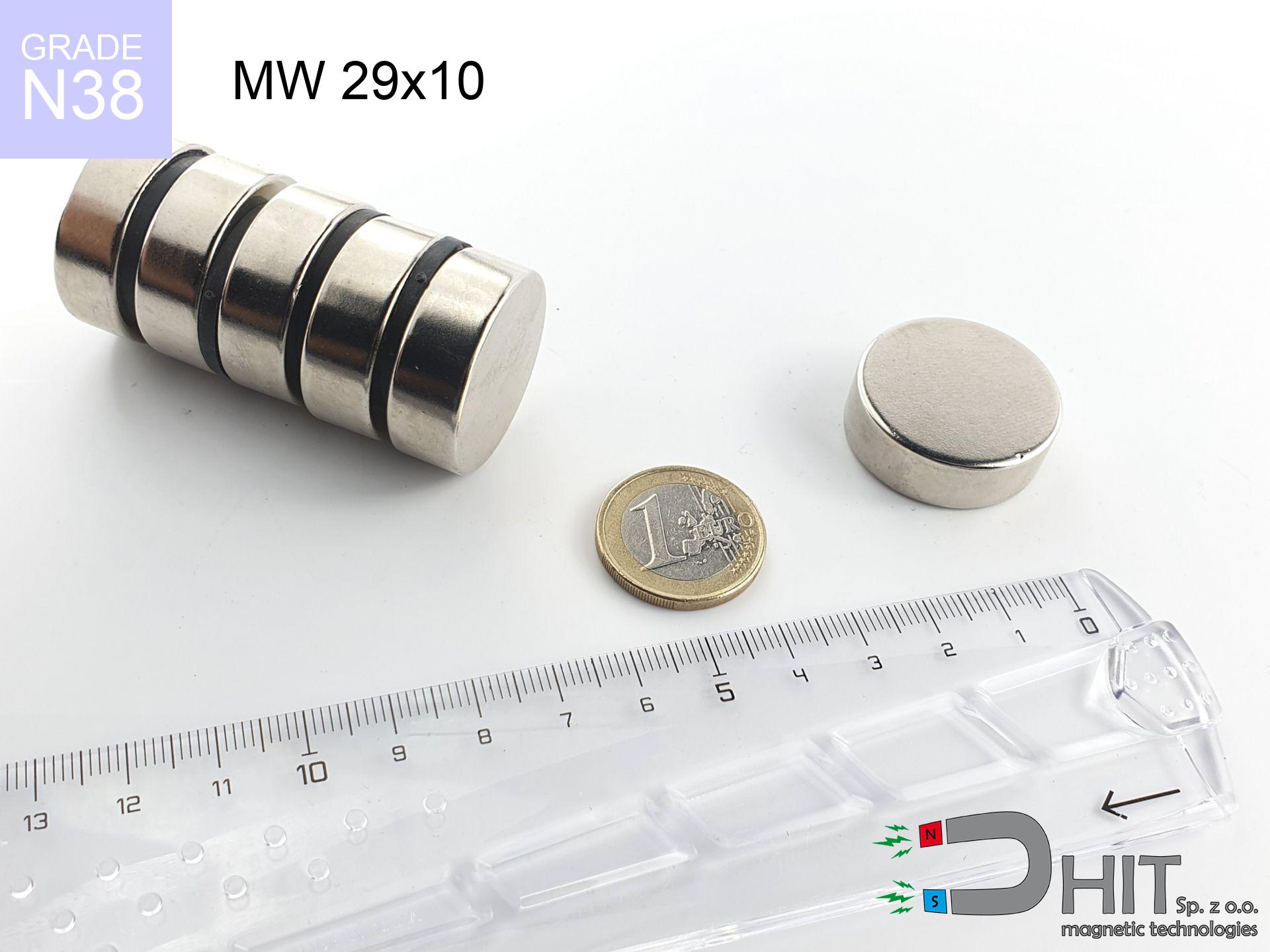

Pros and cons of Nd2Fe14B magnets.
Benefits
- Their strength is maintained, and after approximately 10 years it drops only by ~1% (according to research),
- They are noted for resistance to demagnetization induced by presence of other magnetic fields,
- In other words, due to the reflective finish of gold, the element becomes visually attractive,
- Magnetic induction on the surface of the magnet turns out to be strong,
- Neodymium magnets are characterized by extremely high magnetic induction on the magnet surface and are able to act (depending on the form) even at a temperature of 230°C or more...
- Possibility of individual modeling and adapting to complex requirements,
- Wide application in modern technologies – they are commonly used in hard drives, electric drive systems, medical devices, as well as industrial machines.
- Thanks to their power density, small magnets offer high operating force, in miniature format,
Cons
- Susceptibility to cracking is one of their disadvantages. Upon strong impact they can fracture. We advise keeping them in a strong case, which not only protects them against impacts but also increases their durability
- Do not exceed this material temperature limit: 80°C. Overheating may permanently weaken the magnet.
- They rust in a humid environment. For use outdoors we recommend using waterproof magnets e.g. in rubber, plastic
- Due to limitations in producing nuts and complex forms in magnets, we propose using a housing - magnetic mount.
- Health risk related to microscopic parts of magnets can be dangerous, if swallowed, which is particularly important in the aspect of protecting the youngest. Furthermore, small components of these devices are able to be problematic in diagnostics medical after entering the body.
- Higher cost of purchase is a significant factor to consider compared to ceramic magnets, especially in budget applications
Holding force characteristics
Breakaway strength of the magnet in ideal conditions – what affects it?
- on a plate made of mild steel, perfectly concentrating the magnetic flux
- with a thickness of at least 10 mm
- with a surface cleaned and smooth
- under conditions of ideal adhesion (surface-to-surface)
- for force acting at a right angle (pull-off, not shear)
- in stable room temperature
Lifting capacity in practice – influencing factors
- Distance – the presence of foreign body (rust, dirt, gap) acts as an insulator, which reduces capacity rapidly (even by 50% at 0.5 mm).
- Load vector – maximum parameter is available only during perpendicular pulling. The shear force of the magnet along the plate is usually several times smaller (approx. 1/5 of the lifting capacity).
- Wall thickness – thin material does not allow full use of the magnet. Magnetic flux penetrates through instead of generating force.
- Chemical composition of the base – mild steel gives the best results. Higher carbon content lower magnetic properties and holding force.
- Surface finish – ideal contact is possible only on smooth steel. Any scratches and bumps create air cushions, weakening the magnet.
- Thermal conditions – NdFeB sinters have a sensitivity to temperature. When it is hot they are weaker, and in frost gain strength (up to a certain limit).
Lifting capacity testing was conducted on a smooth plate of optimal thickness, under perpendicular forces, whereas under shearing force the lifting capacity is smaller. Moreover, even a small distance between the magnet and the plate lowers the lifting capacity.
H&S for magnets
Do not drill into magnets
Fire hazard: Rare earth powder is explosive. Do not process magnets without safety gear as this risks ignition.
Choking Hazard
Strictly store magnets out of reach of children. Risk of swallowing is significant, and the consequences of magnets clamping inside the body are tragic.
Permanent damage
Watch the temperature. Exposing the magnet above 80 degrees Celsius will ruin its magnetic structure and strength.
Health Danger
Health Alert: Neodymium magnets can turn off heart devices and defibrillators. Do not approach if you have electronic implants.
Compass and GPS
Remember: rare earth magnets generate a field that disrupts precision electronics. Keep a safe distance from your phone, device, and GPS.
Crushing risk
Big blocks can crush fingers instantly. Under no circumstances place your hand between two attracting surfaces.
Handling rules
Use magnets with awareness. Their immense force can surprise even experienced users. Be vigilant and respect their power.
Protective goggles
Despite metallic appearance, neodymium is brittle and cannot withstand shocks. Do not hit, as the magnet may shatter into sharp, dangerous pieces.
Protect data
Do not bring magnets close to a wallet, laptop, or TV. The magnetic field can destroy these devices and wipe information from cards.
Nickel allergy
Certain individuals experience a hypersensitivity to Ni, which is the standard coating for NdFeB magnets. Frequent touching might lead to a rash. It is best to use protective gloves.
Tabela kosztu i czasu dostawy
Płatność przed wysyłką:

GLS kurier
Przesyłka będzie u Ciebie za 2-3 dni
14.99 ZŁ

InPost Paczkomaty 24/7
Przesyłka będzie u Ciebie za 1-2 dni
12.30 ZŁ
Płatność przy odbiorze (pobranie):
GLS kurier
Przesyłka będzie u Ciebie za 1-2 dni
23.00 ZŁ