

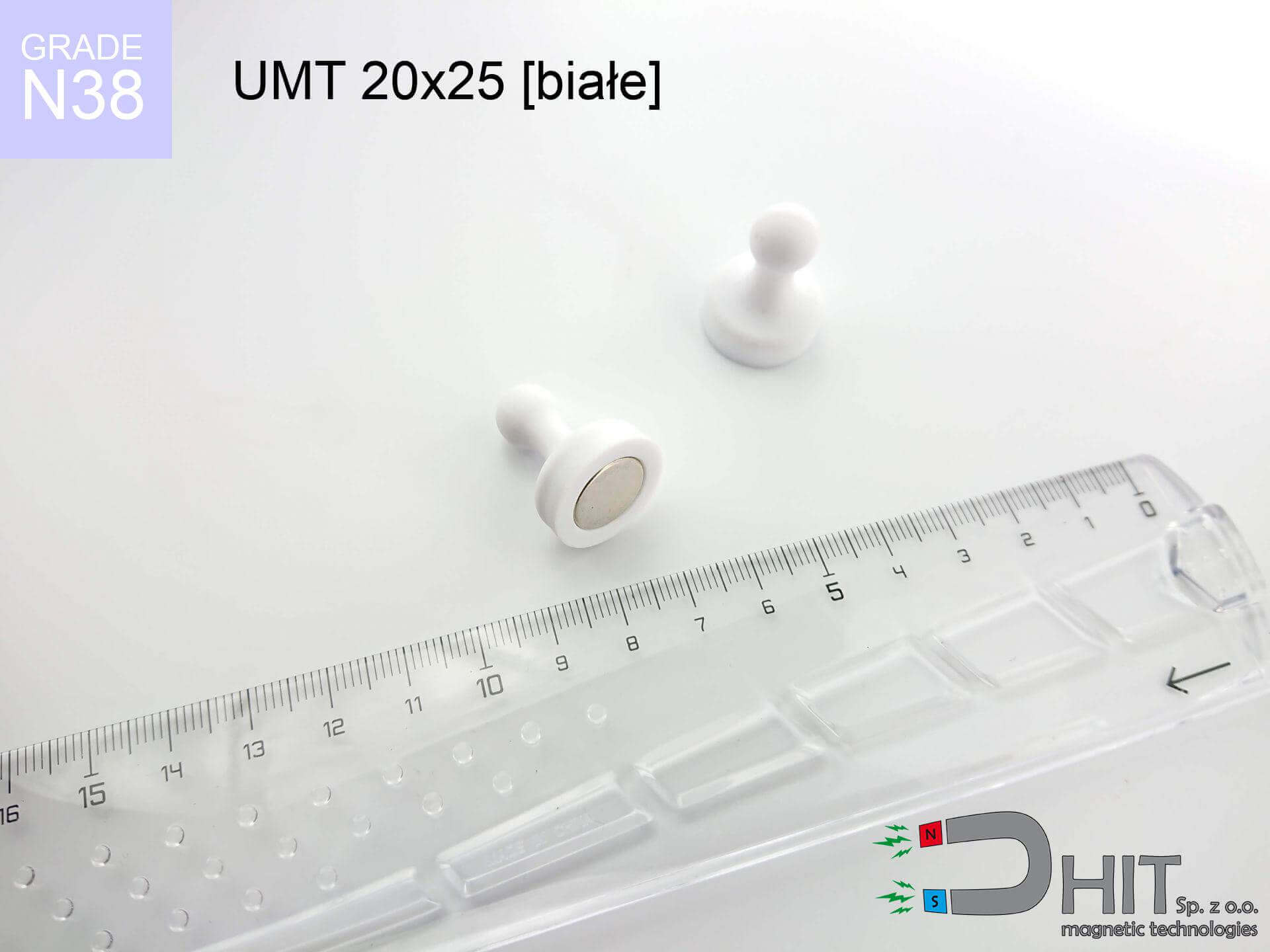
UMT 20x25 white / N38 - board holder
board holder
Catalog no 230262
GTIN/EAN: 5906301814252
- Diameter Ø
- 20 mm [±1 mm]
- Height
- 25 mm [±1 mm]
- Weight
- 7 g
- Coating
- [NiCuNi] Nickel
How we measure these parameters — certificates and measurements
2.84 zł net / pcs
3.49 zł with VAT (23% VAT) / pcs
bulk discounts:
Need more?Frequently asked questions
How many sheets of paper will one magnetic pin hold?
Will a magnetic pin stick to any board - whiteboard, glass, cork?
Will the magnet leave a mark or scratch the board or the fridge?
What is the difference between the 12x20 and 20x25 sizes, and which one suits an office?
Are magnetic pins suitable for large-format maps and plans?
Call us now
+48 888 99 98 98
alternatively let us know using
contact form
the contact section.
Specifications and structure of a neodymium magnet can be estimated using our
power calculator.
Order by 14:00 and we’ll ship today!
Physical properties - UMT 20x25 white / N38 - board holder
Specification / characteristics - UMT 20x25 white / N38 - board holder
| properties | values |
|---|---|
| Cat. no. | 230262 |
| GTIN/EAN | 5906301814252 |
| Production/Distribution | Dhit sp. z o.o. |
| Country of origin | Poland / China / Germany |
| Customs code | 85059029 |
| Diameter Ø | 20 mm [±1 mm] |
| Height | 25 mm [±1 mm] |
| Weight | 7 g |
| Coating | [NiCuNi] Nickel |
| Manufacturing Tolerance | ±1 mm |
Magnetic properties of material N38
| properties | values | units |
|---|---|---|
| Remanence Br ? | 12.2-12.6 | kGs |
| Remanence Br ? | 1220-1260 | mT |
| Coercivity bHc ? | 10.8-11.5 | kOe |
| Coercivity bHc ? | 860-915 | kA/m |
| Intrinsic coercivity iHc | ≥ 12 | kOe |
| Intrinsic coercivity iHc | ≥ 955 | kA/m |
| Energy product BHmax ? | 36-38 | BH max MGOe |
| Energy product BHmax ? | 287-303 | BH max KJ/m |
| Maximum working temperature ? | ≤ 80 | °C |
Physical properties of sintered neodymium magnets Nd2Fe14B at 20°C
| properties | values | units |
|---|---|---|
| Vickers hardness | ≥550 | Hv |
| Density | ≥7.4 | g/cm3 |
| Curie Temperature TC | 310 | °C |
| Curie Temperature TF | 590 | °F |
| Specific resistance | 150 | μΩ⋅cm |
| Bending strength | 250 | MPa |
| Compressive strength | 1000~1100 | MPa |
| Thermal expansion parallel (∥) to orientation (M) | (3-4) x 10-6 | °C-1 |
| Thermal expansion perpendicular (⊥) to orientation (M) | -(1-3) x 10-6 | °C-1 |
| Young's modulus | 1.7 x 10⁴ | kg/mm² |
Elemental analysis
| iron (Fe) | 64% – 68% |
| neodymium (Nd) | 29% – 32% |
| boron (B) | 1.1% – 1.2% |
| dysprosium (Dy) | 0.5% – 2.0% |
| coating (Ni-Cu-Ni) | < 0.05% |
Sustainability
| recyclability (EoL) | 100% |
| recycled raw materials | ~10% (pre-cons) |
| carbon footprint | low / zredukowany |
| waste code (EWC) | 16 02 16 |
See also deals

![SM 32x300 [2xM8] / N42 - magnetic separator](https://cdn3.dhit.pl/graphics/products/sm-32x300-2xm8-pel.jpg "SM 32x300 [2xM8] / N42 - magnetic separator")
![UMGZ 25x17x8 [M5] GZ / N38 - magnetic holder external thread](https://cdn3.dhit.pl/graphics/products/um-25x17x8-m5-gz-keb.jpg "UMGZ 25x17x8 [M5] GZ / N38 - magnetic holder external thread")
Strengths and weaknesses of neodymium magnets.
Strengths
- They have constant strength, and over around ten years their attraction force decreases symbolically – ~1% (in testing),
- They show high resistance to demagnetization induced by external magnetic fields,
- A magnet with a smooth gold surface has better aesthetics,
- They are known for high magnetic induction at the operating surface, which improves attraction properties,
- Neodymium magnets are characterized by extremely high magnetic induction on the magnet surface and are able to act (depending on the shape) even at a temperature of 230°C or more...
- Possibility of detailed shaping and adapting to defined conditions,
- Fundamental importance in future technologies – they are used in data components, electric drive systems, medical devices, as well as complex engineering applications.
- Relatively small size with high pulling force – neodymium magnets offer impressive pulling force in compact dimensions, which makes them useful in small systems
Limitations
- Brittleness is one of their disadvantages. Upon strong impact they can fracture. We advise keeping them in a special holder, which not only protects them against impacts but also increases their durability
- Do not exceed this material temperature limit: 80°C. Overheating may permanently weaken the magnet.
- When exposed to humidity, magnets usually rust. To use them in conditions outside, it is recommended to use protective magnets, such as those in rubber or plastics, which prevent oxidation and corrosion.
- Limited ability of producing threads in the magnet and complicated shapes - recommended is cover - magnetic holder.
- Health risk related to microscopic parts of magnets pose a threat, if swallowed, which is particularly important in the aspect of protecting the youngest. Additionally, small elements of these magnets are able to be problematic in diagnostics medical in case of swallowing.
- Due to complex production process, their price is relatively high,
Lifting parameters
Optimal lifting capacity of a neodymium magnet – what it depends on?
- using a sheet made of low-carbon steel, serving as a circuit closing element
- whose thickness is min. 10 mm
- with an ground touching surface
- without any air gap between the magnet and steel
- under vertical application of breakaway force (90-degree angle)
- at standard ambient temperature
Practical lifting capacity: influencing factors
- Distance (betwixt the magnet and the metal), because even a microscopic distance (e.g. 0.5 mm) results in a reduction in lifting capacity by up to 50% (this also applies to varnish, corrosion or debris).
- Force direction – remember that the magnet holds strongest perpendicularly. Under shear forces, the holding force drops drastically, often to levels of 20-30% of the maximum value.
- Metal thickness – thin material does not allow full use of the magnet. Magnetic flux penetrates through instead of converting into lifting capacity.
- Metal type – not every steel reacts the same. Alloy additives weaken the attraction effect.
- Base smoothness – the more even the surface, the better the adhesion and higher the lifting capacity. Unevenness acts like micro-gaps.
- Temperature influence – hot environment reduces magnetic field. Too high temperature can permanently demagnetize the magnet.
Lifting capacity testing was carried out on a smooth plate of optimal thickness, under perpendicular forces, however under parallel forces the holding force is lower. Moreover, even a small distance between the magnet and the plate decreases the load capacity.
Safe handling of NdFeB magnets
Conscious usage
Before use, check safety instructions. Uncontrolled attraction can break the magnet or injure your hand. Be predictive.
Machining danger
Fire warning: Rare earth powder is highly flammable. Do not process magnets without safety gear as this may cause fire.
Phone sensors
GPS units and smartphones are highly susceptible to magnetic fields. Direct contact with a powerful NdFeB magnet can decalibrate the sensors in your phone.
Heat sensitivity
Standard neodymium magnets (grade N) undergo demagnetization when the temperature goes above 80°C. This process is irreversible.
Keep away from children
NdFeB magnets are not toys. Eating several magnets can lead to them connecting inside the digestive tract, which poses a critical condition and requires immediate surgery.
Skin irritation risks
It is widely known that nickel (the usual finish) is a potent allergen. If your skin reacts to metals, avoid direct skin contact and choose encased magnets.
Medical interference
Individuals with a pacemaker have to maintain an safe separation from magnets. The magnetic field can interfere with the functioning of the implant.
Crushing risk
Big blocks can break fingers instantly. Do not put your hand between two attracting surfaces.
Shattering risk
NdFeB magnets are ceramic materials, meaning they are prone to chipping. Impact of two magnets leads to them breaking into small pieces.
Data carriers
Data protection: Neodymium magnets can ruin data carriers and sensitive devices (pacemakers, medical aids, timepieces).
Tabela kosztu i czasu dostawy
Płatność przed wysyłką:

GLS kurier
Przesyłka będzie u Ciebie za 2-3 dni
14.99 ZŁ

InPost Paczkomaty 24/7
Przesyłka będzie u Ciebie za 1-2 dni
12.30 ZŁ
Płatność przy odbiorze (pobranie):
GLS kurier
Przesyłka będzie u Ciebie za 1-2 dni
23.00 ZŁ