

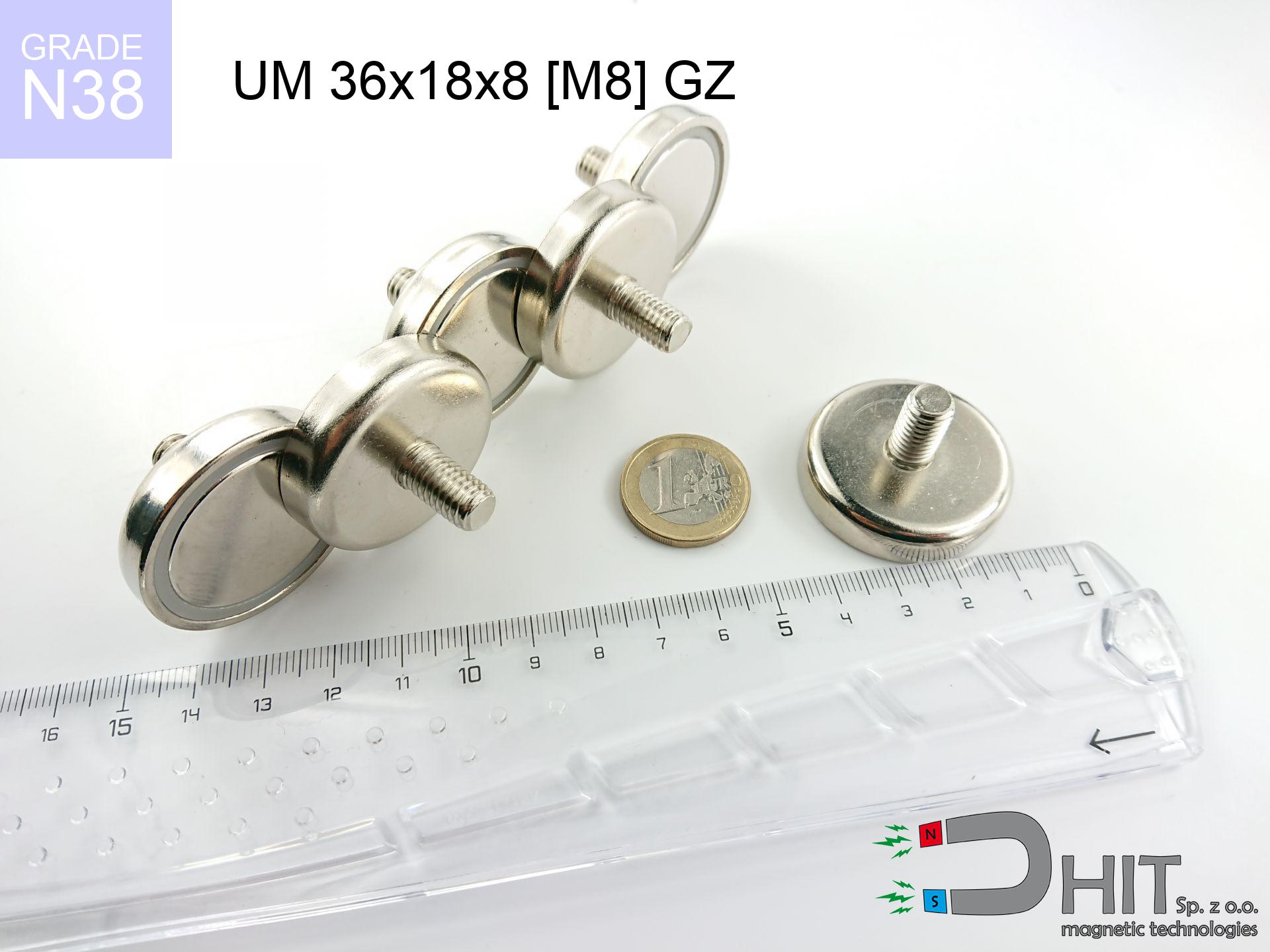
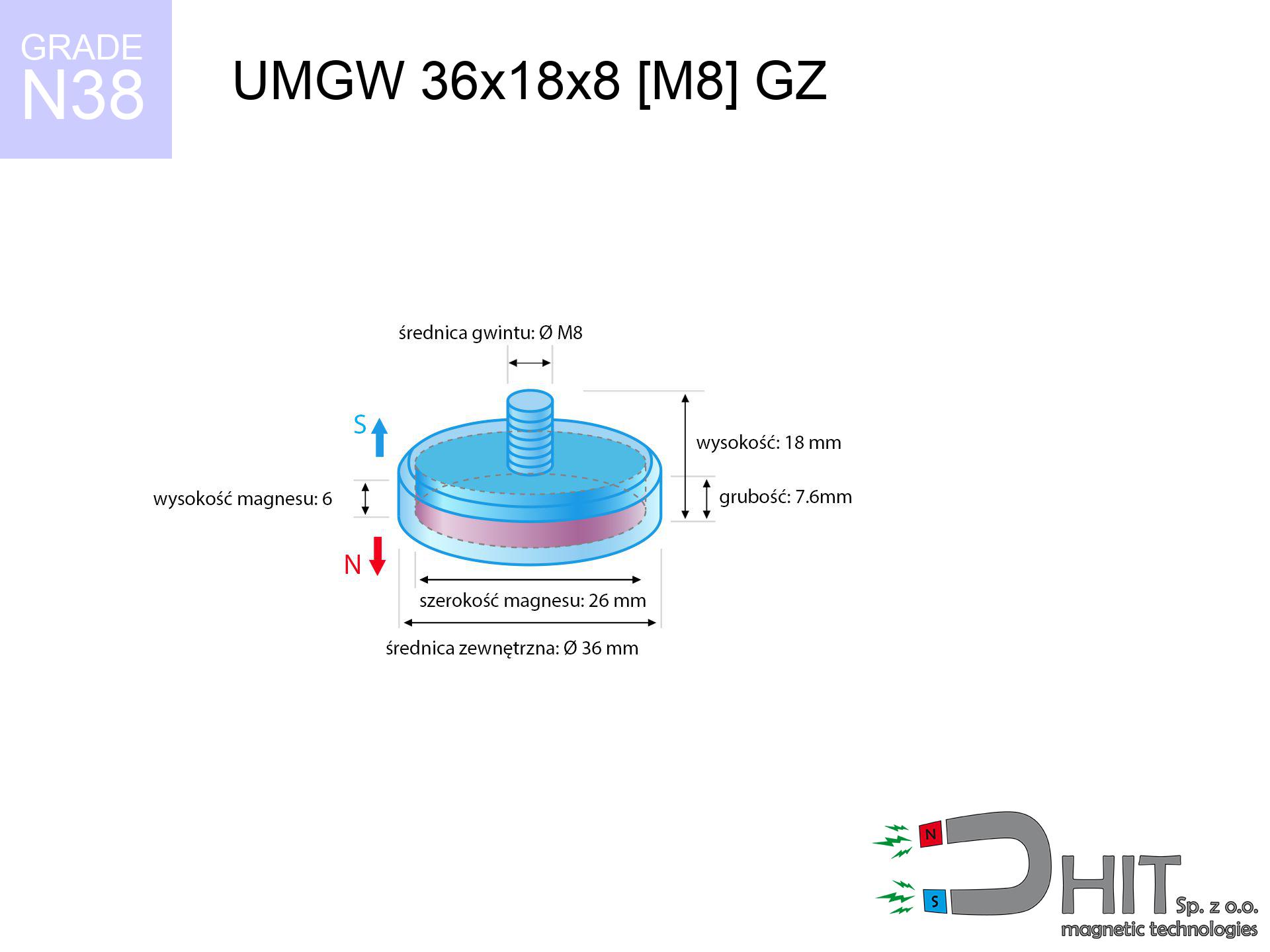
UMGZ 36x18x8 [M6] GZ / N38 - magnetic holder external thread
magnetic holder external thread
Catalog no 190325
GTIN/EAN: 5906301813842
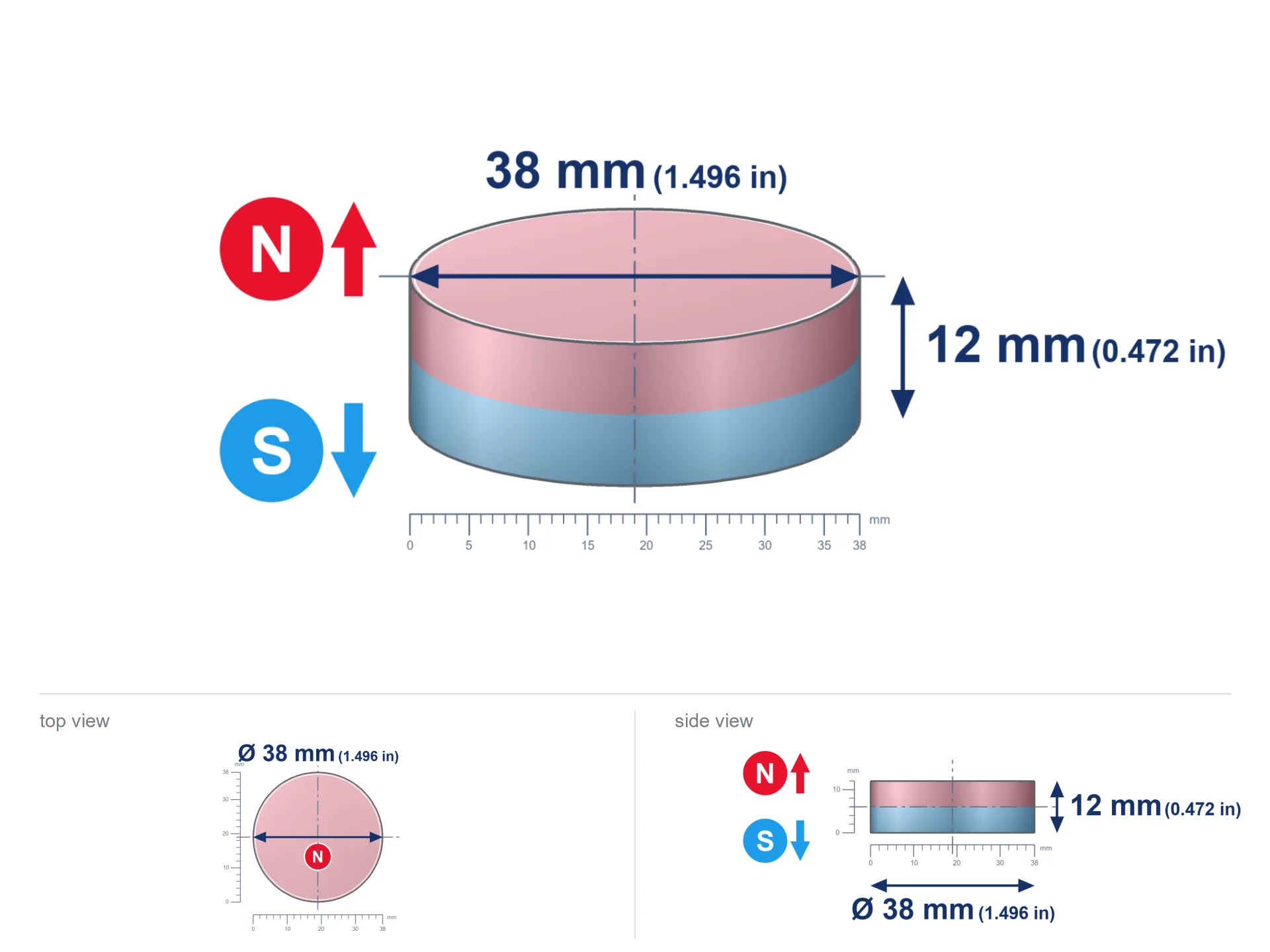
- Diameter Ø
- 36 mm [±1 mm]
- Height
- 18 mm [±1 mm]
- Height
- 8 mm [±1 mm]
- Weight
- 50 g
- Magnetization Direction
- ↑ axial
- Coating
- [NiCuNi] Nickel
How we measure these parameters — certificates and measurements
20.30 zł net / pcs
24.97 zł with VAT (23% VAT) / pcs
bulk discounts:
Need more?Frequently asked questions
Which magnetic holder is suitable for moving metal parts in a workshop?
How do I choose a holder for hanging a heavy item and check its real grip?
Which magnetic holders can be used outdoors?
How should I choose a strong threaded holder for field work?
Call us now
+48 888 99 98 98
alternatively let us know using
contact form
the contact section.
Specifications and structure of a neodymium magnet can be estimated using our
power calculator.
Order by 14:00 and we’ll ship today!
Technical - UMGZ 36x18x8 [M6] GZ / N38 - magnetic holder external thread
Specification / characteristics - UMGZ 36x18x8 [M6] GZ / N38 - magnetic holder external thread
| properties | values |
|---|---|
| Cat. no. | 190325 |
| GTIN/EAN | 5906301813842 |
| Distributor | Dhit sp. z o.o. |
| Country of origin | Poland / China / Germany |
| Customs code | 85059029 |
| Diameter Ø | 36 mm [±1 mm] |
| Height | 18 mm [±1 mm] |
| Height | 8 mm [±1 mm] |
| Weight | 50 g |
| Magnetization Direction | ↑ axial |
| Load capacity ~ ? | 40.00 kg / 392.27 N |
| Coating | [NiCuNi] Nickel |
| Manufacturing Tolerance | ±1 mm |
Magnetic properties of material N38
| properties | values | units |
|---|---|---|
| Remanence Br ? | 12.2-12.6 | kGs |
| Remanence Br ? | 1220-1260 | mT |
| Coercivity bHc ? | 10.8-11.5 | kOe |
| Coercivity bHc ? | 860-915 | kA/m |
| Intrinsic coercivity iHc | ≥ 12 | kOe |
| Intrinsic coercivity iHc | ≥ 955 | kA/m |
| Energy product BHmax ? | 36-38 | BH max MGOe |
| Energy product BHmax ? | 287-303 | BH max KJ/m |
| Maximum working temperature ? | ≤ 80 | °C |
Physical properties of sintered neodymium magnets Nd2Fe14B at 20°C
| properties | values | units |
|---|---|---|
| Vickers hardness | ≥550 | Hv |
| Density | ≥7.4 | g/cm3 |
| Curie Temperature TC | 310 | °C |
| Curie Temperature TF | 590 | °F |
| Specific resistance | 150 | μΩ⋅cm |
| Bending strength | 250 | MPa |
| Compressive strength | 1000~1100 | MPa |
| Thermal expansion parallel (∥) to orientation (M) | (3-4) x 10-6 | °C-1 |
| Thermal expansion perpendicular (⊥) to orientation (M) | -(1-3) x 10-6 | °C-1 |
| Young's modulus | 1.7 x 10⁴ | kg/mm² |
Elemental analysis
| iron (Fe) | 64% – 68% |
| neodymium (Nd) | 29% – 32% |
| boron (B) | 1.1% – 1.2% |
| dysprosium (Dy) | 0.5% – 2.0% |
| coating (Ni-Cu-Ni) | < 0.05% |
Sustainability
| recyclability (EoL) | 100% |
| recycled raw materials | ~10% (pre-cons) |
| carbon footprint | low / zredukowany |
| waste code (EWC) | 16 02 16 |
Check out more proposals

Pros and cons of Nd2Fe14B magnets.
Strengths
- They have stable power, and over nearly ten years their performance decreases symbolically – ~1% (in testing),
- They retain their magnetic properties even under external field action,
- A magnet with a metallic gold surface has better aesthetics,
- They are known for high magnetic induction at the operating surface, which increases their power,
- Neodymium magnets are characterized by extremely high magnetic induction on the magnet surface and can function (depending on the shape) even at a temperature of 230°C or more...
- Possibility of precise machining and adapting to complex applications,
- Universal use in modern technologies – they are commonly used in magnetic memories, electric drive systems, medical devices, also technologically advanced constructions.
- Thanks to concentrated force, small magnets offer high operating force, occupying minimum space,
Disadvantages
- Susceptibility to cracking is one of their disadvantages. Upon intense impact they can break. We advise keeping them in a steel housing, which not only protects them against impacts but also increases their durability
- Do not exceed this material temperature limit: 80°C. Overheating may permanently weaken the magnet.
- Magnets exposed to a humid environment can rust. Therefore when using outdoors, we advise using water-impermeable magnets made of rubber, plastic or other material protecting against moisture
- We suggest a housing - magnetic holder, due to difficulties in producing nuts inside the magnet and complicated forms.
- Health risk related to microscopic parts of magnets pose a threat, when accidentally swallowed, which is particularly important in the context of child health protection. It is also worth noting that tiny parts of these devices are able to complicate diagnosis medical after entering the body.
- Due to complex production process, their price is relatively high,
Pull force analysis
Maximum magnetic pulling force – what it depends on?
- on a base made of structural steel, optimally conducting the magnetic flux
- possessing a massiveness of min. 10 mm to ensure full flux closure
- characterized by even structure
- without the slightest air gap between the magnet and steel
- during pulling in a direction perpendicular to the mounting surface
- in temp. approx. 20°C
Practical lifting capacity: influencing factors
- Space between surfaces – every millimeter of separation (caused e.g. by veneer or dirt) diminishes the pulling force, often by half at just 0.5 mm.
- Direction of force – maximum parameter is obtained only during pulling at a 90° angle. The force required to slide of the magnet along the surface is typically several times lower (approx. 1/5 of the lifting capacity).
- Metal thickness – thin material does not allow full use of the magnet. Part of the magnetic field passes through the material instead of generating force.
- Material type – ideal substrate is high-permeability steel. Stainless steels may attract less.
- Surface structure – the smoother and more polished the surface, the larger the contact zone and stronger the hold. Roughness creates an air distance.
- Thermal environment – temperature increase results in weakening of induction. Check the thermal limit for a given model.
Lifting capacity testing was carried out on a smooth plate of optimal thickness, under a perpendicular pulling force, in contrast under attempts to slide the magnet the lifting capacity is smaller. Moreover, even a small distance between the magnet and the plate reduces the holding force.
Warnings
Life threat
Patients with a ICD have to keep an safe separation from magnets. The magnetism can disrupt the operation of the implant.
Do not drill into magnets
Mechanical processing of NdFeB material carries a risk of fire hazard. Magnetic powder reacts violently with oxygen and is hard to extinguish.
Magnet fragility
Despite the nickel coating, neodymium is brittle and not impact-resistant. Do not hit, as the magnet may crumble into hazardous fragments.
Heat warning
Do not exceed the maximum operating temperature stated in the specifications of the particular product. The limit depends on the material, geometry and operating arrangement; there is no single threshold for all neodymium magnets. Overheating can permanently weaken a magnet.
Safe operation
Use magnets with awareness. Their huge power can surprise even experienced users. Plan your moves and do not underestimate their force.
GPS and phone interference
An intense magnetic field negatively affects the operation of compasses in phones and navigation systems. Keep magnets close to a smartphone to avoid damaging the sensors.
This is not a toy
Neodymium magnets are not toys. Accidental ingestion of a few magnets can lead to them connecting inside the digestive tract, which constitutes a direct threat to life and necessitates urgent medical intervention.
Nickel allergy
Some people suffer from a sensitization to nickel, which is the standard coating for neodymium magnets. Prolonged contact can result in an allergic reaction. We suggest wear safety gloves.
Hand protection
Large magnets can break fingers in a fraction of a second. Never put your hand betwixt two attracting surfaces.
Threat to electronics
Very strong magnetic fields can corrupt files on credit cards, hard drives, and storage devices. Stay away of min. 10 cm.
Tabela kosztu i czasu dostawy
Płatność przed wysyłką:

GLS kurier
Przesyłka będzie u Ciebie za 2-3 dni
14.99 ZŁ

InPost Paczkomaty 24/7
Przesyłka będzie u Ciebie za 1-2 dni
12.30 ZŁ
Płatność przy odbiorze (pobranie):
GLS kurier
Przesyłka będzie u Ciebie za 1-2 dni
23.00 ZŁ