

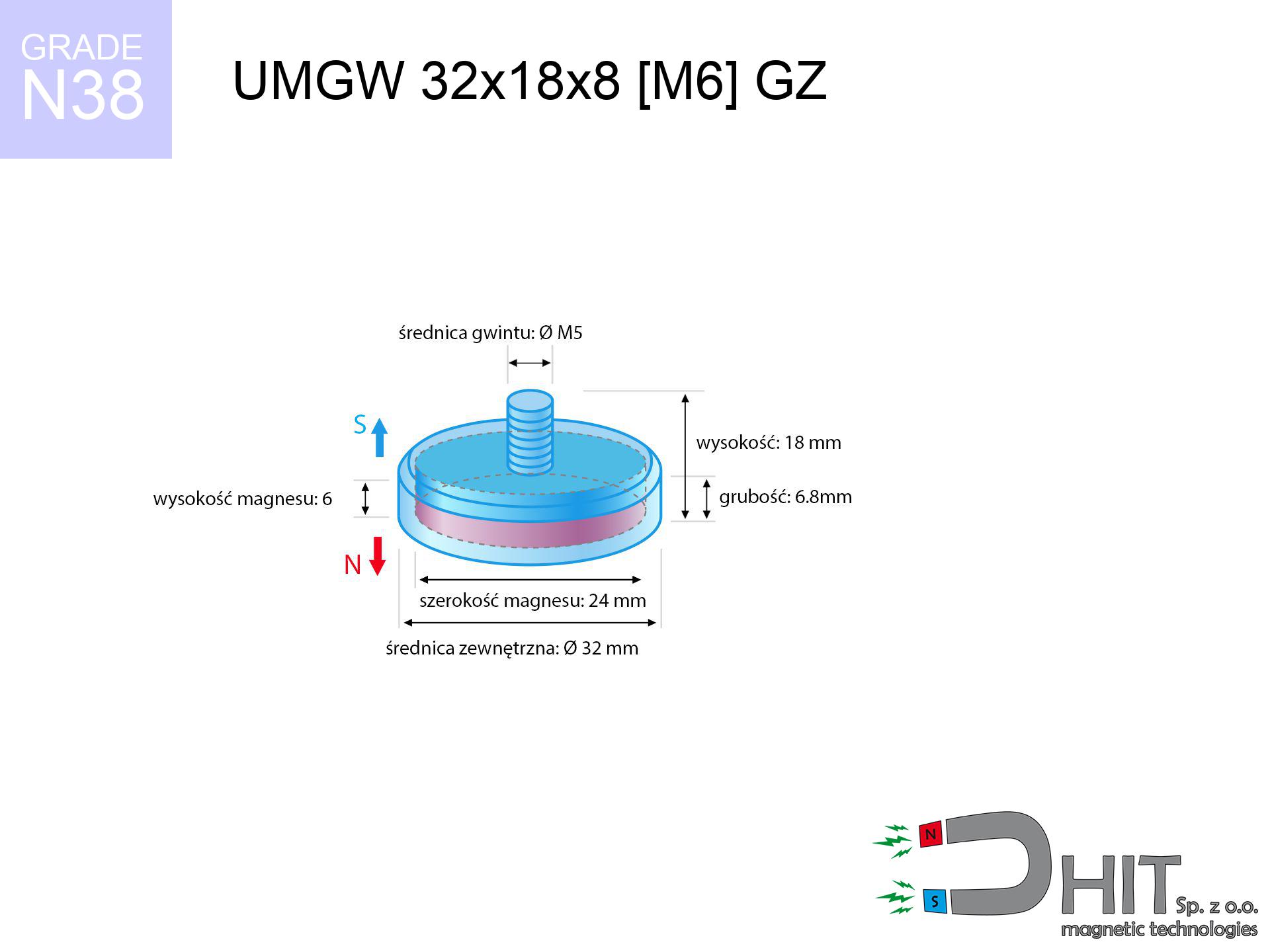
UMGZ 32x18x8 [M6] GZ / N38 - magnetic holder external thread
magnetic holder external thread
Catalog no 190324
GTIN/EAN: 5906301813835
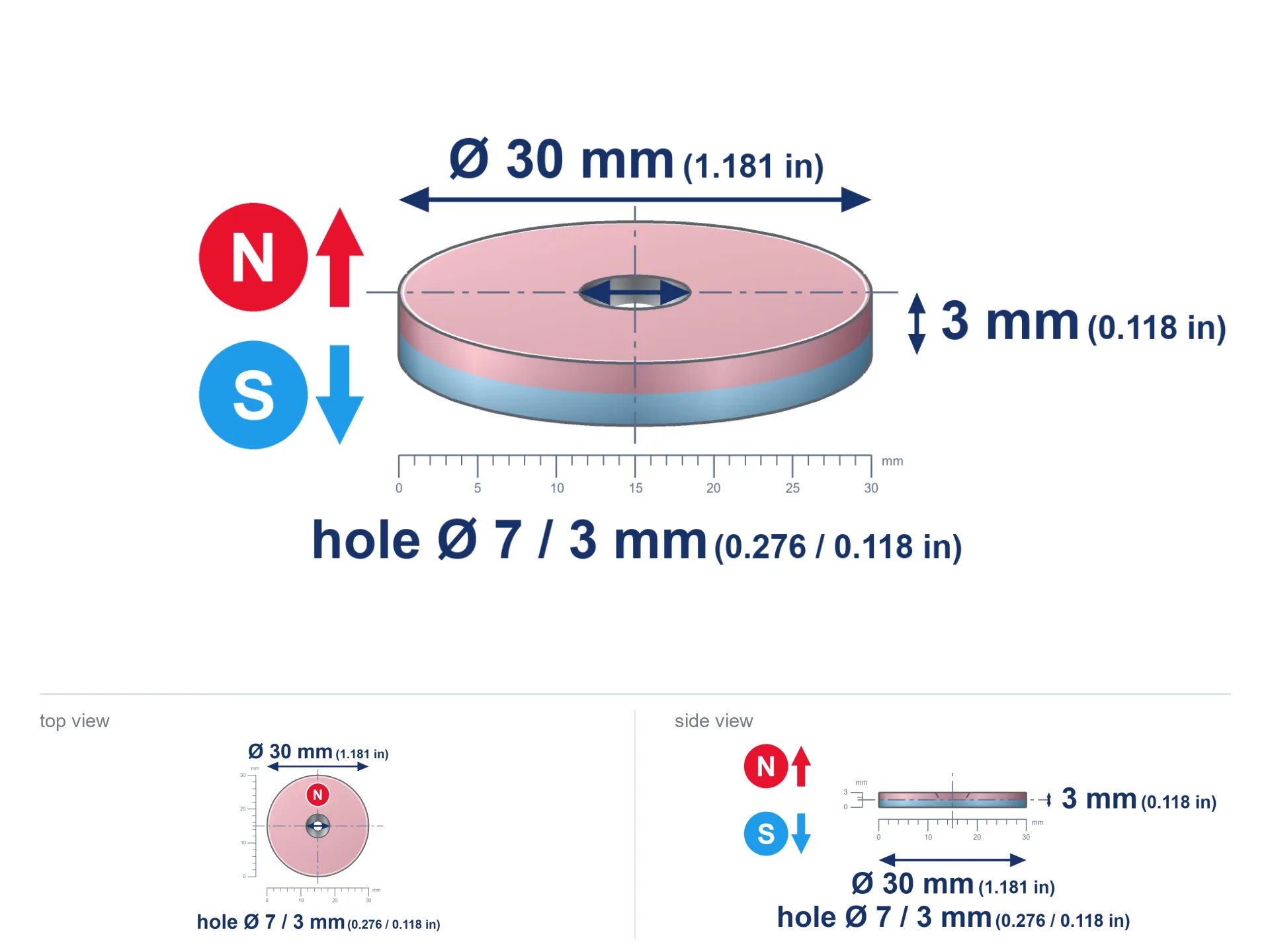
- Diameter Ø
- 32 mm [±1 mm]
- Height
- 18 mm [±1 mm]
- Height
- 8 mm [±1 mm]
- Weight
- 40 g
- Magnetization Direction
- ↑ axial
- Coating
- [NiCuNi] Nickel
How we measure these parameters — certificates and measurements
14.62 zł net / pcs
17.98 zł with VAT (23% VAT) / pcs
bulk discounts:
Need more?Frequently asked questions
Which magnetic holder is suitable for moving metal parts in a workshop?
How do I choose a holder for hanging a heavy item and check its real grip?
Which magnetic holders can be used outdoors?
How should I choose a strong threaded holder for field work?
Call us now
+48 888 99 98 98
alternatively let us know using
contact form
the contact section.
Specifications and structure of a neodymium magnet can be estimated using our
power calculator.
Order by 14:00 and we’ll ship today!
Technical data of the product - UMGZ 32x18x8 [M6] GZ / N38 - magnetic holder external thread
Specification / characteristics - UMGZ 32x18x8 [M6] GZ / N38 - magnetic holder external thread
| properties | values |
|---|---|
| Cat. no. | 190324 |
| GTIN/EAN | 5906301813835 |
| Distributor | Dhit sp. z o.o. |
| Country of origin | Poland / China / Germany |
| Customs code | 85059029 |
| Diameter Ø | 32 mm [±1 mm] |
| Height | 18 mm [±1 mm] |
| Height | 8 mm [±1 mm] |
| Weight | 40 g |
| Magnetization Direction | ↑ axial |
| Load capacity ~ ? | 34.00 kg / 333.43 N |
| Coating | [NiCuNi] Nickel |
| Manufacturing Tolerance | ±1 mm |
Magnetic properties of material N38
| properties | values | units |
|---|---|---|
| Remanence Br ? | 12.2-12.6 | kGs |
| Remanence Br ? | 1220-1260 | mT |
| Coercivity bHc ? | 10.8-11.5 | kOe |
| Coercivity bHc ? | 860-915 | kA/m |
| Intrinsic coercivity iHc | ≥ 12 | kOe |
| Intrinsic coercivity iHc | ≥ 955 | kA/m |
| Energy product BHmax ? | 36-38 | BH max MGOe |
| Energy product BHmax ? | 287-303 | BH max KJ/m |
| Maximum working temperature ? | ≤ 80 | °C |
Physical properties of sintered neodymium magnets Nd2Fe14B at 20°C
| properties | values | units |
|---|---|---|
| Vickers hardness | ≥550 | Hv |
| Density | ≥7.4 | g/cm3 |
| Curie Temperature TC | 310 | °C |
| Curie Temperature TF | 590 | °F |
| Specific resistance | 150 | μΩ⋅cm |
| Bending strength | 250 | MPa |
| Compressive strength | 1000~1100 | MPa |
| Thermal expansion parallel (∥) to orientation (M) | (3-4) x 10-6 | °C-1 |
| Thermal expansion perpendicular (⊥) to orientation (M) | -(1-3) x 10-6 | °C-1 |
| Young's modulus | 1.7 x 10⁴ | kg/mm² |
Chemical composition
| iron (Fe) | 64% – 68% |
| neodymium (Nd) | 29% – 32% |
| boron (B) | 1.1% – 1.2% |
| dysprosium (Dy) | 0.5% – 2.0% |
| coating (Ni-Cu-Ni) | < 0.05% |
Environmental data
| recyclability (EoL) | 100% |
| recycled raw materials | ~10% (pre-cons) |
| carbon footprint | low / zredukowany |
| waste code (EWC) | 16 02 16 |
View also deals
Strengths and weaknesses of rare earth magnets.
Strengths
- Their power is durable, and after approximately ten years it decreases only by ~1% (according to research),
- Magnets perfectly protect themselves against demagnetization caused by external fields,
- Thanks to the elegant finish, the plating of nickel, gold-plated, or silver-plated gives an visually attractive appearance,
- Magnets are characterized by excellent magnetic induction on the outer layer,
- Neodymium magnets are characterized by extremely high magnetic induction on the magnet surface and can work (depending on the form) even at a temperature of 230°C or more...
- Thanks to versatility in shaping and the ability to adapt to individual projects,
- Universal use in innovative solutions – they find application in HDD drives, electromotive mechanisms, advanced medical instruments, also technologically advanced constructions.
- Thanks to concentrated force, small magnets offer high operating force, in miniature format,
Weaknesses
- Susceptibility to cracking is one of their disadvantages. Upon strong impact they can fracture. We advise keeping them in a special holder, which not only protects them against impacts but also increases their durability
- Do not exceed this material temperature limit: 80°C. Overheating may permanently weaken the magnet.
- Magnets exposed to a humid environment can corrode. Therefore during using outdoors, we suggest using waterproof magnets made of rubber, plastic or other material protecting against moisture
- We recommend casing - magnetic mount, due to difficulties in realizing threads inside the magnet and complex shapes.
- Possible danger to health – tiny shards of magnets can be dangerous, if swallowed, which becomes key in the context of child safety. Furthermore, small elements of these devices can be problematic in diagnostics medical after entering the body.
- With mass production the cost of neodymium magnets is a challenge,
Pull force analysis
Maximum lifting capacity of the magnet – what contributes to it?
- on a plate made of mild steel, perfectly concentrating the magnetic field
- whose thickness equals approx. 10 mm
- with an ground touching surface
- without the slightest clearance between the magnet and steel
- under axial force vector (90-degree angle)
- at conditions approx. 20°C
Key elements affecting lifting force
- Gap between magnet and steel – even a fraction of a millimeter of separation (caused e.g. by veneer or dirt) drastically reduces the magnet efficiency, often by half at just 0.5 mm.
- Force direction – declared lifting capacity refers to detachment vertically. When attempting to slide, the magnet exhibits much less (often approx. 20-30% of maximum force).
- Wall thickness – the thinner the sheet, the weaker the hold. Part of the magnetic field passes through the material instead of generating force.
- Steel grade – the best choice is pure iron steel. Cast iron may attract less.
- Surface finish – full contact is obtained only on polished steel. Rough texture reduce the real contact area, weakening the magnet.
- Thermal factor – high temperature weakens pulling force. Too high temperature can permanently damage the magnet.
Holding force was tested on the plate surface of 20 mm thickness, when the force acted perpendicularly, however under attempts to slide the magnet the load capacity is reduced by as much as 75%. In addition, even a minimal clearance between the magnet’s surface and the plate reduces the load capacity.
Warnings
Danger to the youngest
NdFeB magnets are not suitable for play. Eating multiple magnets may result in them attracting across intestines, which poses a direct threat to life and necessitates immediate surgery.
Pinching danger
Large magnets can break fingers in a fraction of a second. Under no circumstances put your hand betwixt two strong magnets.
Dust is flammable
Powder produced during grinding of magnets is self-igniting. Do not drill into magnets without proper cooling and knowledge.
Fragile material
NdFeB magnets are ceramic materials, meaning they are prone to chipping. Collision of two magnets leads to them breaking into small pieces.
Electronic devices
Avoid bringing magnets near a purse, computer, or TV. The magnetic field can permanently damage these devices and erase data from cards.
Warning for heart patients
For implant holders: Powerful magnets disrupt medical devices. Keep at least 30 cm distance or request help to work with the magnets.
Handling rules
Before starting, check safety instructions. Uncontrolled attraction can destroy the magnet or hurt your hand. Be predictive.
Permanent damage
Do not exceed the maximum operating temperature stated in the specifications of the particular product. The limit depends on the material, geometry and operating arrangement; there is no single threshold for all neodymium magnets. Overheating can permanently weaken a magnet.
Precision electronics
A strong magnetic field interferes with the functioning of magnetometers in phones and GPS navigation. Do not bring magnets close to a smartphone to avoid damaging the sensors.
Allergic reactions
Medical facts indicate that the nickel plating (standard magnet coating) is a common allergen. If you have an allergy, refrain from touching magnets with bare hands or choose encased magnets.
Tabela kosztu i czasu dostawy
Płatność przed wysyłką:

GLS kurier
Przesyłka będzie u Ciebie za 2-3 dni
14.99 ZŁ

InPost Paczkomaty 24/7
Przesyłka będzie u Ciebie za 1-2 dni
12.30 ZŁ
Płatność przy odbiorze (pobranie):
GLS kurier
Przesyłka będzie u Ciebie za 1-2 dni
23.00 ZŁ