
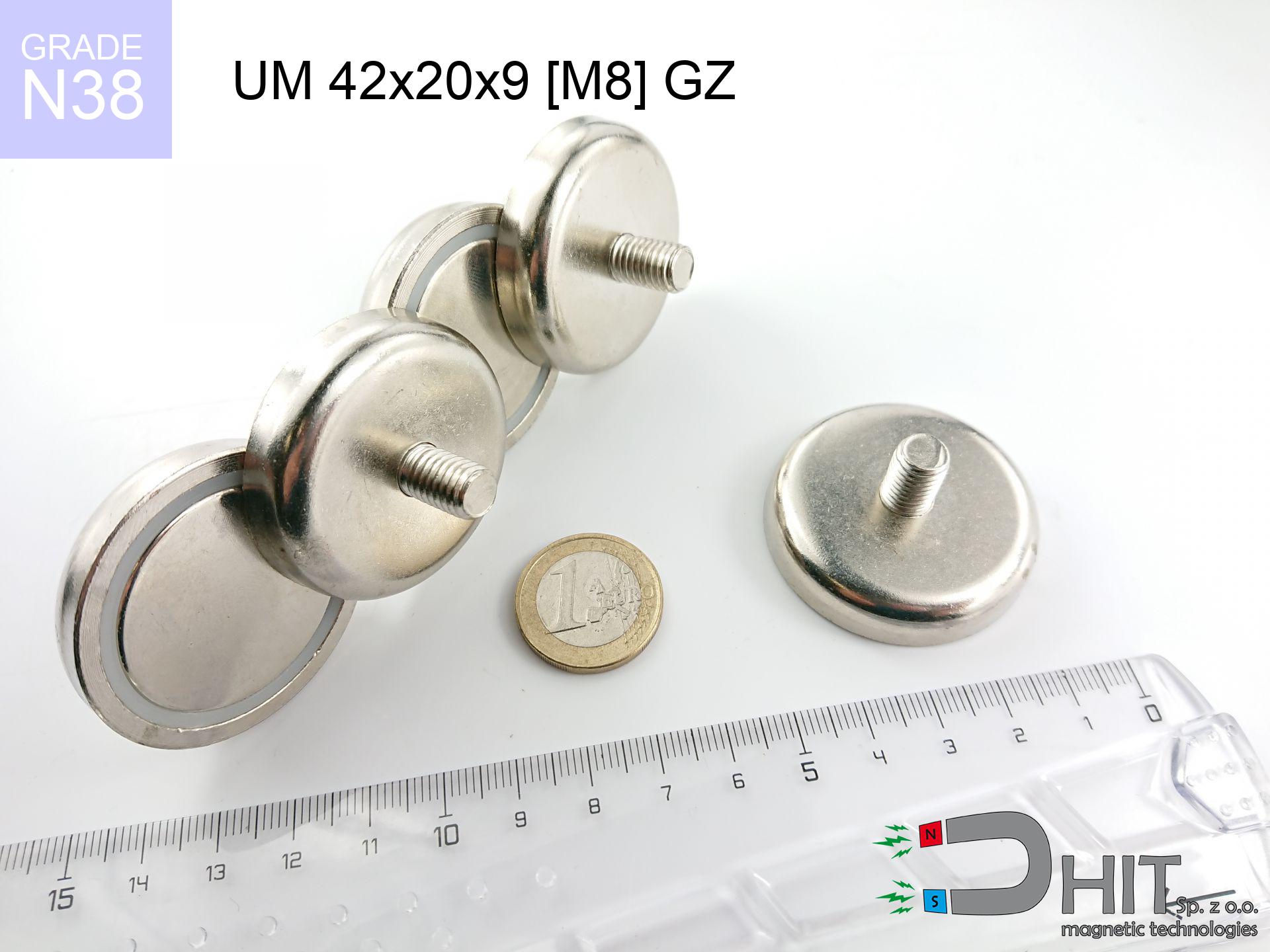
UMGZ 42x20x9 [M8] GZ / N38 - magnetic holder external thread
magnetic holder external thread
Catalog no 190332
GTIN/EAN: 5906301813859
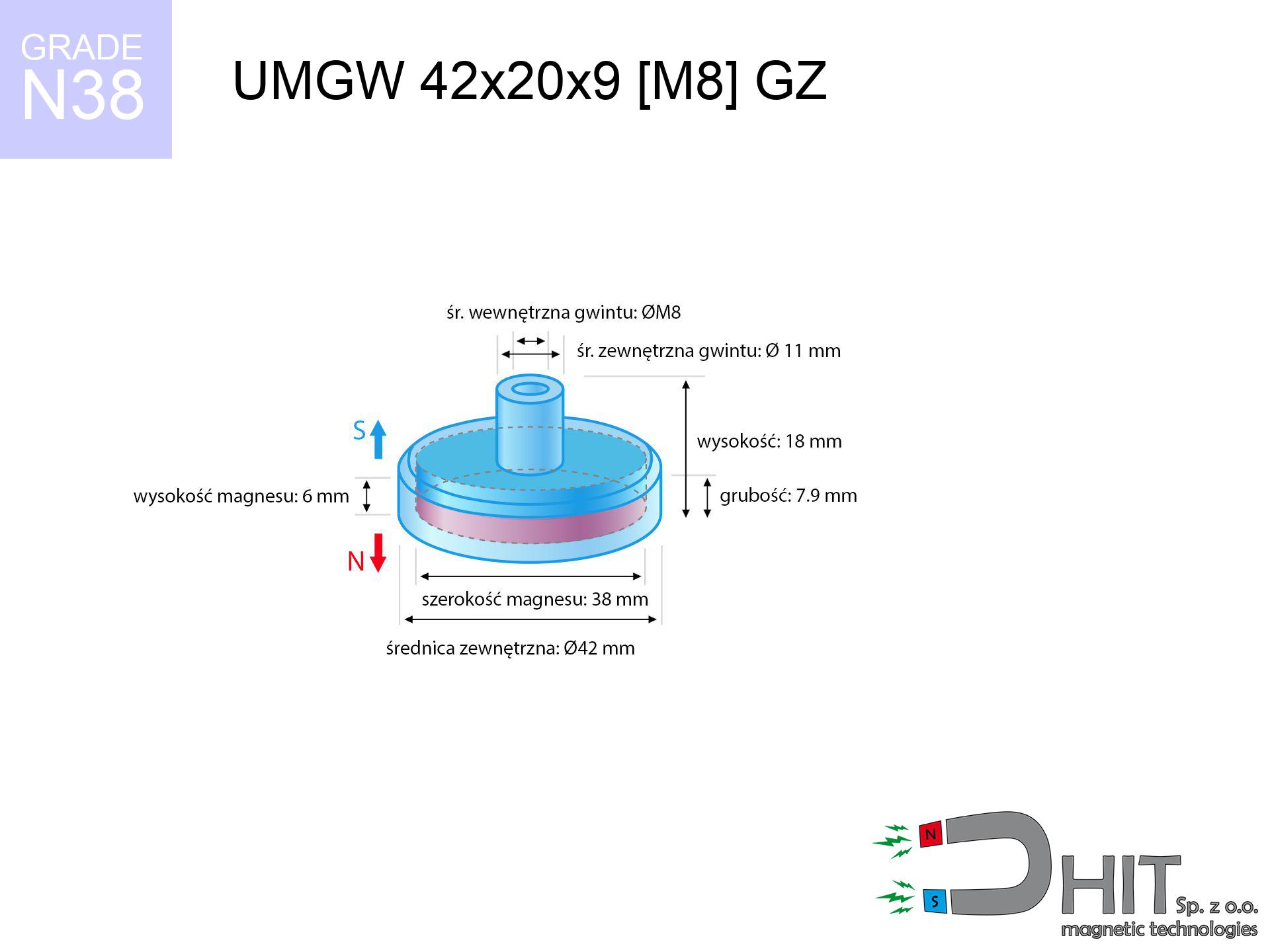
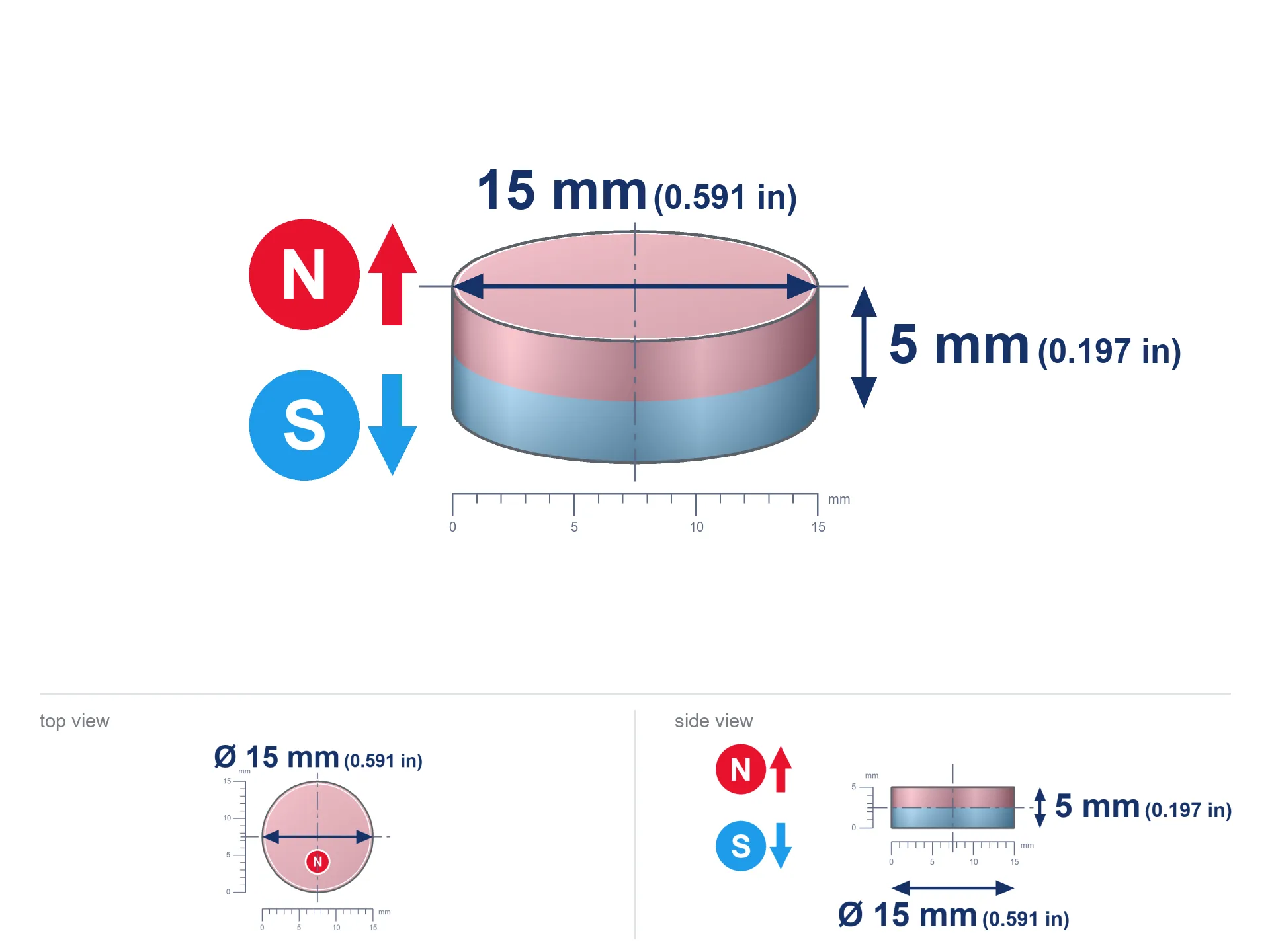
- Diameter Ø
- 42 mm [±1 mm]
- Height
- 20 mm [±1 mm]
- Height
- 9 mm [±1 mm]
- Weight
- 80 g
- Magnetization Direction
- ↑ axial
- Coating
- [NiCuNi] Nickel
How we measure these parameters — certificates and measurements
27.61 zł net / pcs
33.96 zł with VAT (23% VAT) / pcs
bulk discounts:
Need more?Frequently asked questions
Which magnetic holder is suitable for moving metal parts in a workshop?
How do I choose a holder for hanging a heavy item and check its real grip?
Which magnetic holders can be used outdoors?
How should I choose a strong threaded holder for field work?
Call us now
+48 888 99 98 98
alternatively let us know using
contact form
the contact section.
Specifications and structure of a neodymium magnet can be estimated using our
power calculator.
Order by 14:00 and we’ll ship today!
Technical details - UMGZ 42x20x9 [M8] GZ / N38 - magnetic holder external thread
Specification / characteristics - UMGZ 42x20x9 [M8] GZ / N38 - magnetic holder external thread
| properties | values |
|---|---|
| Cat. no. | 190332 |
| GTIN/EAN | 5906301813859 |
| Distributor | Dhit sp. z o.o. |
| Country of origin | Poland / China / Germany |
| Customs code | 85059029 |
| Diameter Ø | 42 mm [±1 mm] |
| Height | 20 mm [±1 mm] |
| Height | 9 mm [±1 mm] |
| Weight | 80 g |
| Magnetization Direction | ↑ axial |
| Load capacity ~ ? | 66.00 kg / 647.24 N |
| Coating | [NiCuNi] Nickel |
| Manufacturing Tolerance | ±1 mm |
Magnetic properties of material N38
| properties | values | units |
|---|---|---|
| Remanence Br ? | 12.2-12.6 | kGs |
| Remanence Br ? | 1220-1260 | mT |
| Coercivity bHc ? | 10.8-11.5 | kOe |
| Coercivity bHc ? | 860-915 | kA/m |
| Intrinsic coercivity iHc | ≥ 12 | kOe |
| Intrinsic coercivity iHc | ≥ 955 | kA/m |
| Energy product BHmax ? | 36-38 | BH max MGOe |
| Energy product BHmax ? | 287-303 | BH max KJ/m |
| Maximum working temperature ? | ≤ 80 | °C |
Physical properties of sintered neodymium magnets Nd2Fe14B at 20°C
| properties | values | units |
|---|---|---|
| Vickers hardness | ≥550 | Hv |
| Density | ≥7.4 | g/cm3 |
| Curie Temperature TC | 310 | °C |
| Curie Temperature TF | 590 | °F |
| Specific resistance | 150 | μΩ⋅cm |
| Bending strength | 250 | MPa |
| Compressive strength | 1000~1100 | MPa |
| Thermal expansion parallel (∥) to orientation (M) | (3-4) x 10-6 | °C-1 |
| Thermal expansion perpendicular (⊥) to orientation (M) | -(1-3) x 10-6 | °C-1 |
| Young's modulus | 1.7 x 10⁴ | kg/mm² |
Material specification
| iron (Fe) | 64% – 68% |
| neodymium (Nd) | 29% – 32% |
| boron (B) | 1.1% – 1.2% |
| dysprosium (Dy) | 0.5% – 2.0% |
| coating (Ni-Cu-Ni) | < 0.05% |
Environmental data
| recyclability (EoL) | 100% |
| recycled raw materials | ~10% (pre-cons) |
| carbon footprint | low / zredukowany |
| waste code (EWC) | 16 02 16 |
Other proposals
Pros and cons of Nd2Fe14B magnets.
Strengths
- They virtually do not lose strength, because even after ten years the performance loss is only ~1% (based on calculations),
- They do not lose their magnetic properties even under external field action,
- The use of an shiny coating of noble metals (nickel, gold, silver) causes the element to look better,
- The surface of neodymium magnets generates a intense magnetic field – this is one of their assets,
- Through (appropriate) combination of ingredients, they can achieve high thermal resistance, enabling operation at temperatures reaching 230°C and above...
- Considering the possibility of flexible molding and customization to unique requirements, NdFeB magnets can be created in a wide range of shapes and sizes, which expands the range of possible applications,
- Wide application in modern industrial fields – they are commonly used in HDD drives, brushless drives, diagnostic systems, and industrial machines.
- Thanks to efficiency per cm³, small magnets offer high operating force, occupying minimum space,
Limitations
- Brittleness is one of their disadvantages. Upon strong impact they can fracture. We recommend keeping them in a special holder, which not only protects them against impacts but also increases their durability
- Do not exceed this material temperature limit: 80°C. Overheating may permanently weaken the magnet.
- When exposed to humidity, magnets usually rust. To use them in conditions outside, it is recommended to use protective magnets, such as magnets in rubber or plastics, which prevent oxidation and corrosion.
- Limited ability of creating nuts in the magnet and complicated forms - preferred is a housing - magnetic holder.
- Health risk to health – tiny shards of magnets can be dangerous, in case of ingestion, which becomes key in the context of child health protection. Furthermore, small elements of these products are able to disrupt the diagnostic process medical after entering the body.
- High unit price – neodymium magnets cost more than other types of magnets (e.g. ferrite), which increases costs of application in large quantities
Holding force characteristics
Maximum lifting force for a neodymium magnet – what contributes to it?
- on a plate made of structural steel, effectively closing the magnetic flux
- with a thickness of at least 10 mm
- with a surface perfectly flat
- under conditions of gap-free contact (metal-to-metal)
- under vertical force direction (90-degree angle)
- at standard ambient temperature
Practical lifting capacity: influencing factors
- Gap (betwixt the magnet and the plate), as even a tiny clearance (e.g. 0.5 mm) leads to a decrease in lifting capacity by up to 50% (this also applies to paint, corrosion or dirt).
- Loading method – declared lifting capacity refers to detachment vertically. When attempting to slide, the magnet exhibits much less (typically approx. 20-30% of maximum force).
- Element thickness – for full efficiency, the steel must be adequately massive. Paper-thin metal limits the attraction force (the magnet "punches through" it).
- Steel type – mild steel attracts best. Higher carbon content decrease magnetic properties and lifting capacity.
- Plate texture – smooth surfaces guarantee perfect abutment, which increases field saturation. Uneven metal reduce efficiency.
- Operating temperature – NdFeB sinters have a sensitivity to temperature. At higher temperatures they are weaker, and in frost they can be stronger (up to a certain limit).
Lifting capacity was determined using a steel plate with a smooth surface of suitable thickness (min. 20 mm), under perpendicular pulling force, whereas under attempts to slide the magnet the holding force is lower. In addition, even a minimal clearance between the magnet’s surface and the plate decreases the load capacity.
Precautions when working with neodymium magnets
GPS Danger
GPS units and smartphones are extremely sensitive to magnetic fields. Close proximity with a powerful NdFeB magnet can decalibrate the sensors in your phone.
Do not overheat magnets
Do not exceed the maximum operating temperature stated in the specifications of the particular product. The limit depends on the material, geometry and operating arrangement; there is no single threshold for all neodymium magnets. Overheating can permanently weaken a magnet.
Dust is flammable
Fire warning: Neodymium dust is explosive. Avoid machining magnets without safety gear as this risks ignition.
Electronic hazard
Do not bring magnets close to a wallet, laptop, or TV. The magnetic field can irreversibly ruin these devices and wipe information from cards.
Crushing risk
Risk of injury: The attraction force is so great that it can result in hematomas, crushing, and broken bones. Use thick gloves.
Protective goggles
Beware of splinters. Magnets can explode upon violent connection, launching sharp fragments into the air. Eye protection is mandatory.
Do not give to children
Product intended for adults. Tiny parts can be swallowed, causing severe trauma. Store away from kids and pets.
Powerful field
Before starting, check safety instructions. Uncontrolled attraction can break the magnet or hurt your hand. Be predictive.
Allergic reactions
Medical facts indicate that nickel (the usual finish) is a potent allergen. If your skin reacts to metals, prevent direct skin contact or choose encased magnets.
Danger to pacemakers
Life threat: Strong magnets can turn off heart devices and defibrillators. Stay away if you have medical devices.
Tabela kosztu i czasu dostawy
Płatność przed wysyłką:

GLS kurier
Przesyłka będzie u Ciebie za 2-3 dni
14.99 ZŁ

InPost Paczkomaty 24/7
Przesyłka będzie u Ciebie za 1-2 dni
12.30 ZŁ
Płatność przy odbiorze (pobranie):
GLS kurier
Przesyłka będzie u Ciebie za 1-2 dni
23.00 ZŁ