

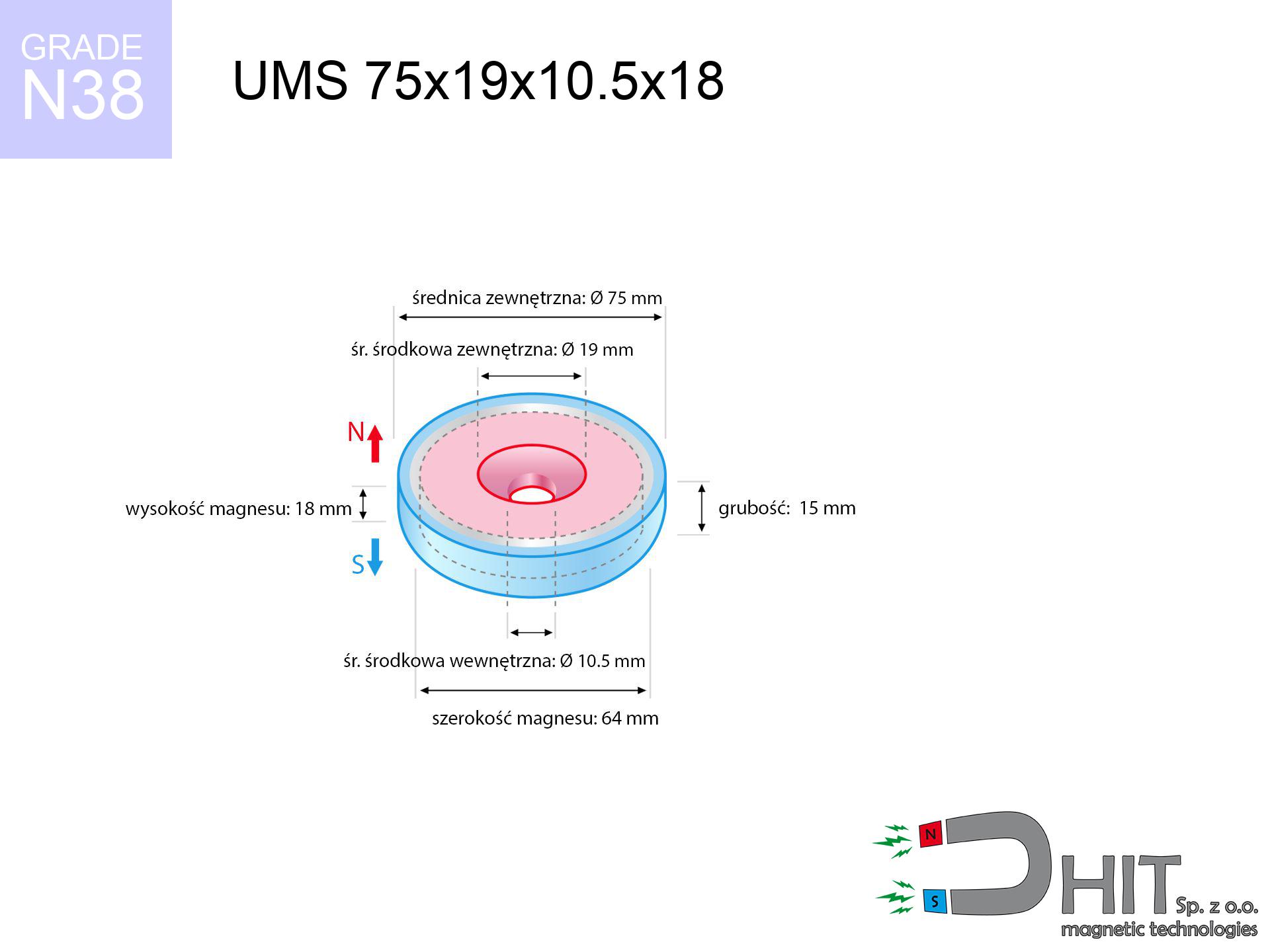
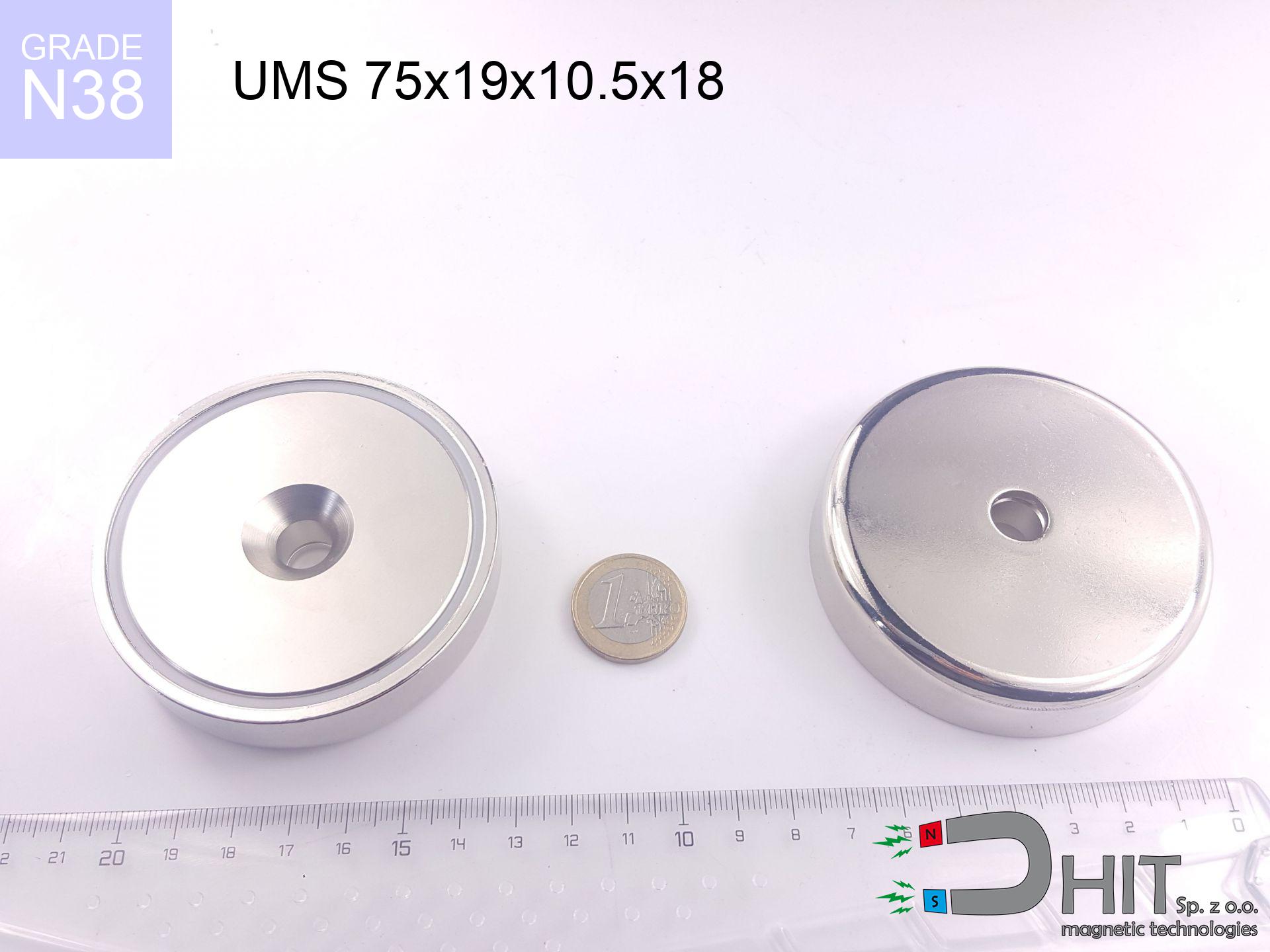
UMS 75x19x10.5x18 / N38 - conical magnetic holder
conical magnetic holder
Catalog no 220405
GTIN/EAN: 5906301814245
- Diameter Ø
- 75 mm [±1 mm]
- cone dimension Ø
- 19x10.5 mm [±1 mm]
- Height
- 18 mm [±1 mm]
- Weight
- 465 g
- Magnetization Direction
- ↑ axial
- Coating
- [NiCuNi] Nickel
How we measure these parameters — certificates and measurements
102.08 zł net / pcs
125.56 zł with VAT (23% VAT) / pcs
bulk discounts:
Need more?Frequently asked questions
Which magnetic holder is suitable for moving metal parts in a workshop?
How do I choose a holder for hanging a heavy item and check its real grip?
Which magnetic holders can be used outdoors?
How should I choose a strong threaded holder for field work?
Call us now
+48 888 99 98 98
alternatively let us know using
contact form
the contact section.
Specifications and structure of a neodymium magnet can be estimated using our
power calculator.
Order by 14:00 and we’ll ship today!
Product card - UMS 75x19x10.5x18 / N38 - conical magnetic holder
Specification / characteristics - UMS 75x19x10.5x18 / N38 - conical magnetic holder
| properties | values |
|---|---|
| Cat. no. | 220405 |
| GTIN/EAN | 5906301814245 |
| Production/Distribution | Dhit sp. z o.o. |
| Country of origin | Poland / China / Germany |
| Customs code | 85059029 |
| Diameter Ø | 75 mm [±1 mm] |
| cone dimension Ø | 19x10.5 mm [±1 mm] |
| Height | 18 mm [±1 mm] |
| Weight | 465 g |
| Magnetization Direction | ↑ axial |
| Load capacity ~ ? | 162.00 kg / 1588.68 N |
| Coating | [NiCuNi] Nickel |
| Manufacturing Tolerance | ±1 mm |
Magnetic properties of material N38
| properties | values | units |
|---|---|---|
| Remanence Br ? | 12.2-12.6 | kGs |
| Remanence Br ? | 1220-1260 | mT |
| Coercivity bHc ? | 10.8-11.5 | kOe |
| Coercivity bHc ? | 860-915 | kA/m |
| Intrinsic coercivity iHc | ≥ 12 | kOe |
| Intrinsic coercivity iHc | ≥ 955 | kA/m |
| Energy product BHmax ? | 36-38 | BH max MGOe |
| Energy product BHmax ? | 287-303 | BH max KJ/m |
| Maximum working temperature ? | ≤ 80 | °C |
Physical properties of sintered neodymium magnets Nd2Fe14B at 20°C
| properties | values | units |
|---|---|---|
| Vickers hardness | ≥550 | Hv |
| Density | ≥7.4 | g/cm3 |
| Curie Temperature TC | 310 | °C |
| Curie Temperature TF | 590 | °F |
| Specific resistance | 150 | μΩ⋅cm |
| Bending strength | 250 | MPa |
| Compressive strength | 1000~1100 | MPa |
| Thermal expansion parallel (∥) to orientation (M) | (3-4) x 10-6 | °C-1 |
| Thermal expansion perpendicular (⊥) to orientation (M) | -(1-3) x 10-6 | °C-1 |
| Young's modulus | 1.7 x 10⁴ | kg/mm² |
Material specification
| iron (Fe) | 64% – 68% |
| neodymium (Nd) | 29% – 32% |
| boron (B) | 1.1% – 1.2% |
| dysprosium (Dy) | 0.5% – 2.0% |
| coating (Ni-Cu-Ni) | < 0.05% |
Ecology and recycling (GPSR)
| recyclability (EoL) | 100% |
| recycled raw materials | ~10% (pre-cons) |
| carbon footprint | low / zredukowany |
| waste code (EWC) | 16 02 16 |
Other products
![SM 28x125 [2xM8] / N52 - magnetic separator](https://cdn3.dhit.pl/graphics/products/sm-28x125-2xm8-pof.jpg "SM 28x125 [2xM8] / N52 - magnetic separator")

Strengths and weaknesses of neodymium magnets.
Pros
- They virtually do not lose power, because even after 10 years the decline in efficiency is only ~1% (according to literature),
- Neodymium magnets prove to be exceptionally resistant to magnetic field loss caused by external field sources,
- In other words, due to the shiny finish of silver, the element becomes visually attractive,
- Magnetic induction on the surface of the magnet remains strong,
- Made from properly selected components, these magnets show impressive resistance to high heat, enabling them to function (depending on their form) at temperatures up to 230°C and above...
- Thanks to modularity in designing and the capacity to adapt to client solutions,
- Fundamental importance in electronics industry – they are utilized in mass storage devices, electromotive mechanisms, diagnostic systems, and technologically advanced constructions.
- Relatively small size with high pulling force – neodymium magnets offer high power in compact dimensions, which enables their usage in compact constructions
Limitations
- At very strong impacts they can crack, therefore we recommend placing them in strong housings. A metal housing provides additional protection against damage, as well as increases the magnet's durability.
- Do not exceed this material temperature limit: 80°C. Overheating may permanently weaken the magnet.
- They oxidize in a humid environment. For use outdoors we recommend using waterproof magnets e.g. in rubber, plastic
- We suggest casing - magnetic mount, due to difficulties in producing nuts inside the magnet and complicated forms.
- Potential hazard to health – tiny shards of magnets can be dangerous, when accidentally swallowed, which is particularly important in the context of child safety. Additionally, tiny parts of these products can complicate diagnosis medical when they are in the body.
- Due to complex production process, their price is relatively high,
Lifting parameters
Breakaway strength of the magnet in ideal conditions – what it depends on?
- with the use of a sheet made of low-carbon steel, guaranteeing maximum field concentration
- whose transverse dimension is min. 10 mm
- characterized by smoothness
- without any insulating layer between the magnet and steel
- during detachment in a direction perpendicular to the mounting surface
- at standard ambient temperature
Key elements affecting lifting force
- Distance – existence of any layer (rust, tape, gap) acts as an insulator, which reduces capacity rapidly (even by 50% at 0.5 mm).
- Force direction – note that the magnet has greatest strength perpendicularly. Under sliding down, the capacity drops significantly, often to levels of 20-30% of the maximum value.
- Steel thickness – too thin sheet causes magnetic saturation, causing part of the power to be wasted into the air.
- Material composition – different alloys reacts the same. Alloy additives weaken the interaction with the magnet.
- Smoothness – full contact is possible only on smooth steel. Any scratches and bumps reduce the real contact area, weakening the magnet.
- Heat – NdFeB sinters have a negative temperature coefficient. When it is hot they are weaker, and in frost gain strength (up to a certain limit).
Lifting capacity was measured using a smooth steel plate of optimal thickness (min. 20 mm), under vertically applied force, in contrast under parallel forces the lifting capacity is smaller. Additionally, even a minimal clearance between the magnet and the plate decreases the lifting capacity.
Precautions when working with neodymium magnets
Protective goggles
Despite the nickel coating, the material is delicate and not impact-resistant. Do not hit, as the magnet may shatter into sharp, dangerous pieces.
Avoid contact if allergic
Studies show that nickel (standard magnet coating) is a common allergen. If your skin reacts to metals, prevent direct skin contact and select encased magnets.
Pinching danger
Big blocks can crush fingers in a fraction of a second. Under no circumstances place your hand between two strong magnets.
Caution required
Before starting, read the rules. Sudden snapping can break the magnet or injure your hand. Think ahead.
Phone sensors
Be aware: rare earth magnets generate a field that disrupts sensitive sensors. Keep a separation from your phone, device, and GPS.
Keep away from computers
Equipment safety: Neodymium magnets can ruin payment cards and delicate electronics (pacemakers, medical aids, mechanical watches).
Life threat
Medical warning: Strong magnets can deactivate heart devices and defibrillators. Stay away if you have electronic implants.
Product not for children
Absolutely store magnets away from children. Choking hazard is significant, and the effects of magnets connecting inside the body are tragic.
Heat warning
Regular neodymium magnets (grade N) lose magnetization when the temperature exceeds 80°C. Damage is permanent.
Combustion hazard
Fire warning: Rare earth powder is explosive. Avoid machining magnets in home conditions as this risks ignition.
Tabela kosztu i czasu dostawy
Płatność przed wysyłką:

GLS kurier
Przesyłka będzie u Ciebie za 2-3 dni
14.99 ZŁ

InPost Paczkomaty 24/7
Przesyłka będzie u Ciebie za 1-2 dni
12.30 ZŁ
Płatność przy odbiorze (pobranie):
GLS kurier
Przesyłka będzie u Ciebie za 1-2 dni
23.00 ZŁ