

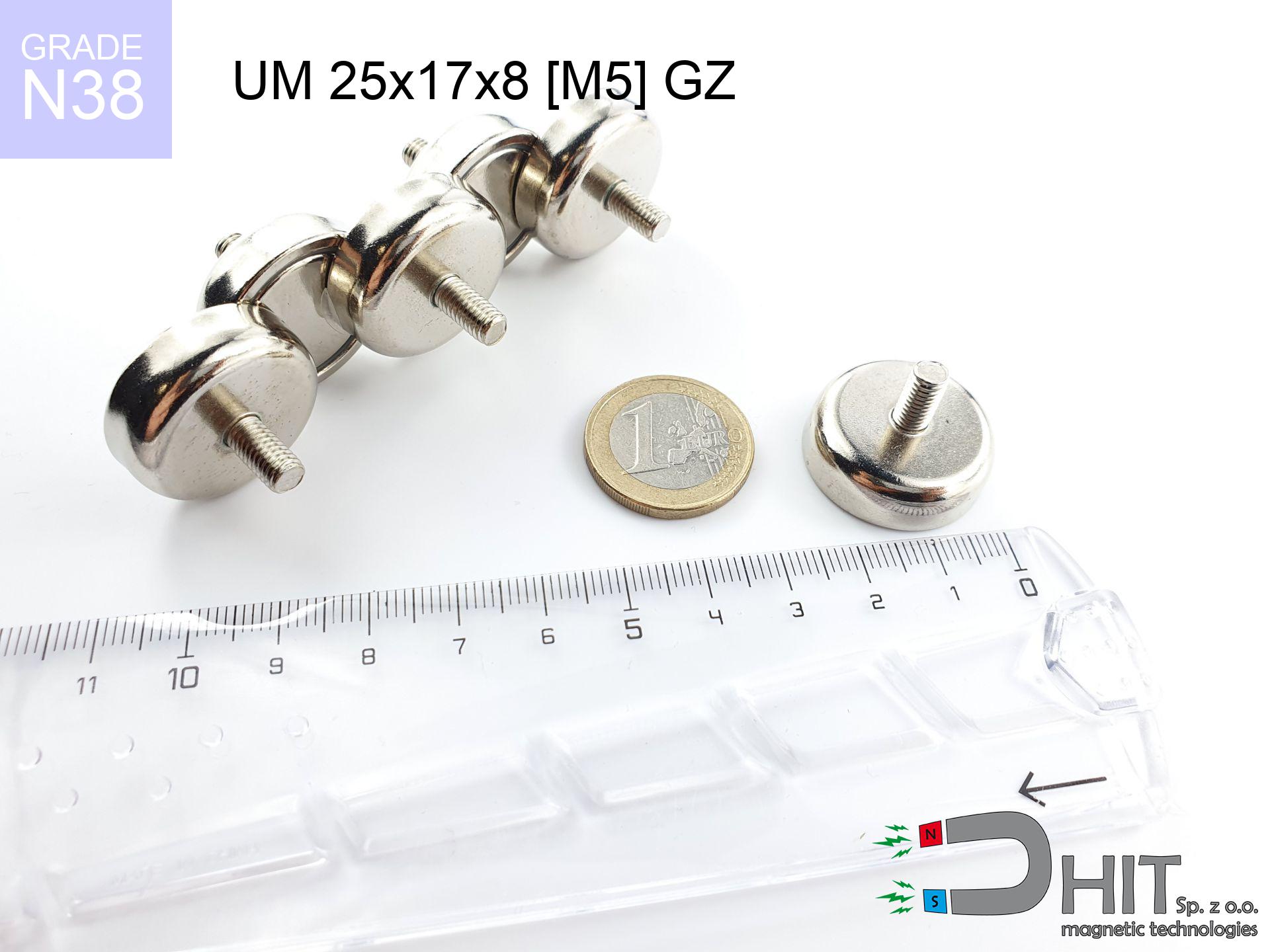
UMGZ 25x17x8 [M5] GZ / N38 - magnetic holder external thread
magnetic holder external thread
Catalog no 190323
GTIN/EAN: 5906301813828
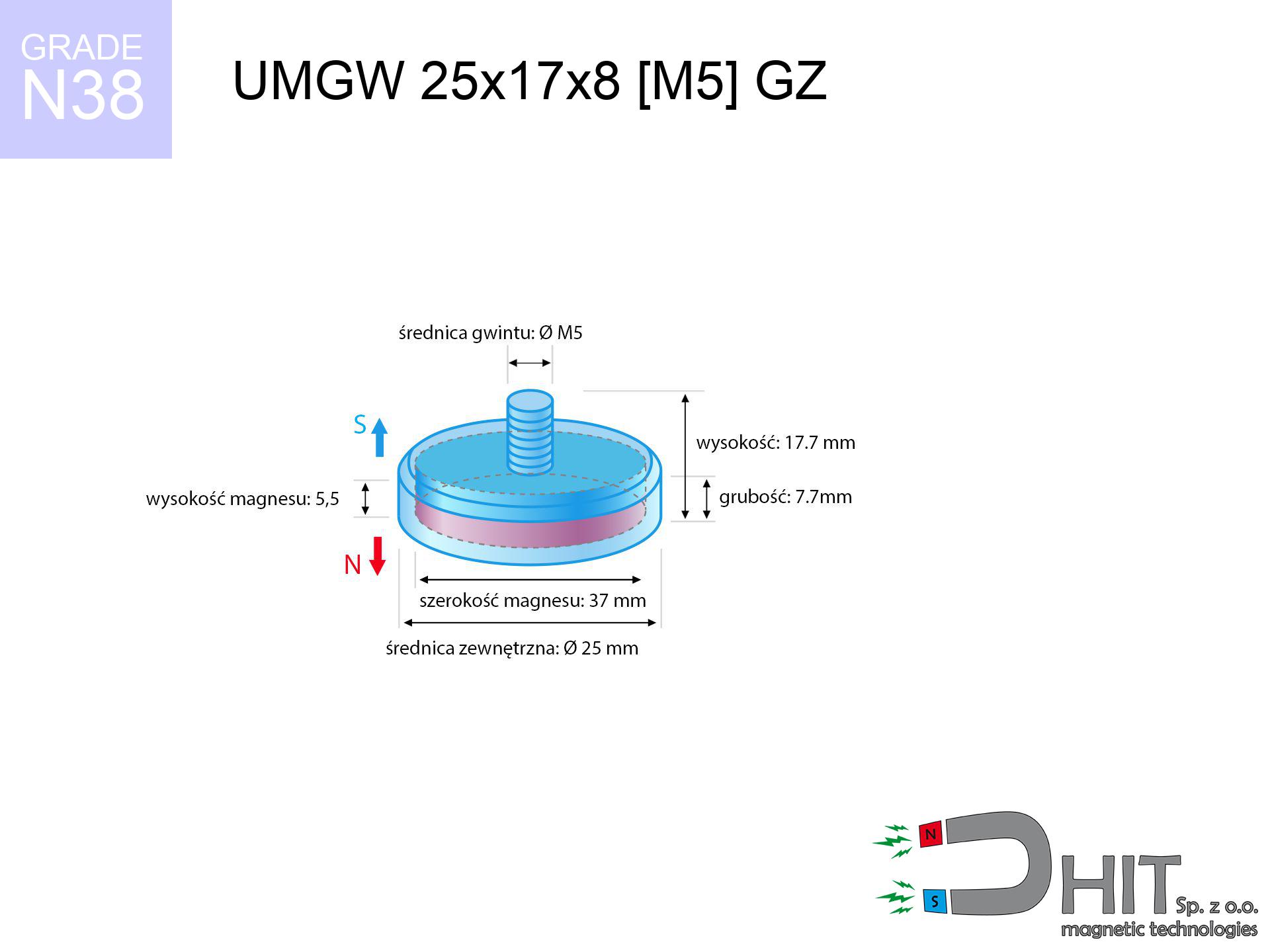
- Diameter Ø
- 25 mm [±1 mm]
- Height
- 17 mm [±1 mm]
- Height
- 8 mm [±1 mm]
- Weight
- 25 g
- Magnetization Direction
- ↑ axial
- Coating
- [NiCuNi] Nickel
How we measure these parameters — certificates and measurements
9.94 zł net / pcs
12.23 zł with VAT (23% VAT) / pcs
bulk discounts:
Need more?Frequently asked questions
Which magnetic holder is suitable for moving metal parts in a workshop?
How do I choose a holder for hanging a heavy item and check its real grip?
Which magnetic holders can be used outdoors?
How should I choose a strong threaded holder for field work?
Call us now
+48 888 99 98 98
alternatively let us know using
contact form
the contact section.
Specifications and structure of a neodymium magnet can be estimated using our
power calculator.
Order by 14:00 and we’ll ship today!
Technical specification of the product - UMGZ 25x17x8 [M5] GZ / N38 - magnetic holder external thread
Specification / characteristics - UMGZ 25x17x8 [M5] GZ / N38 - magnetic holder external thread
| properties | values |
|---|---|
| Cat. no. | 190323 |
| GTIN/EAN | 5906301813828 |
| Distributor | Dhit sp. z o.o. |
| Country of origin | Poland / China / Germany |
| Customs code | 85059029 |
| Diameter Ø | 25 mm [±1 mm] |
| Height | 17 mm [±1 mm] |
| Height | 8 mm [±1 mm] |
| Weight | 25 g |
| Magnetization Direction | ↑ axial |
| Load capacity ~ ? | 17.00 kg / 166.71 N |
| Coating | [NiCuNi] Nickel |
| Manufacturing Tolerance | ±1 mm |
Magnetic properties of material N38
| properties | values | units |
|---|---|---|
| Remanence Br ? | 12.2-12.6 | kGs |
| Remanence Br ? | 1220-1260 | mT |
| Coercivity bHc ? | 10.8-11.5 | kOe |
| Coercivity bHc ? | 860-915 | kA/m |
| Intrinsic coercivity iHc | ≥ 12 | kOe |
| Intrinsic coercivity iHc | ≥ 955 | kA/m |
| Energy product BHmax ? | 36-38 | BH max MGOe |
| Energy product BHmax ? | 287-303 | BH max KJ/m |
| Maximum working temperature ? | ≤ 80 | °C |
Physical properties of sintered neodymium magnets Nd2Fe14B at 20°C
| properties | values | units |
|---|---|---|
| Vickers hardness | ≥550 | Hv |
| Density | ≥7.4 | g/cm3 |
| Curie Temperature TC | 310 | °C |
| Curie Temperature TF | 590 | °F |
| Specific resistance | 150 | μΩ⋅cm |
| Bending strength | 250 | MPa |
| Compressive strength | 1000~1100 | MPa |
| Thermal expansion parallel (∥) to orientation (M) | (3-4) x 10-6 | °C-1 |
| Thermal expansion perpendicular (⊥) to orientation (M) | -(1-3) x 10-6 | °C-1 |
| Young's modulus | 1.7 x 10⁴ | kg/mm² |
Material specification
| iron (Fe) | 64% – 68% |
| neodymium (Nd) | 29% – 32% |
| boron (B) | 1.1% – 1.2% |
| dysprosium (Dy) | 0.5% – 2.0% |
| coating (Ni-Cu-Ni) | < 0.05% |
Sustainability
| recyclability (EoL) | 100% |
| recycled raw materials | ~10% (pre-cons) |
| carbon footprint | low / zredukowany |
| waste code (EWC) | 16 02 16 |
Other deals
Advantages and disadvantages of Nd2Fe14B magnets.
Strengths
- They virtually do not lose power, because even after 10 years the performance loss is only ~1% (according to literature),
- They possess excellent resistance to magnetism drop due to opposing magnetic fields,
- By using a reflective coating of silver, the element has an proper look,
- Magnets exhibit excellent magnetic induction on the working surface,
- Neodymium magnets are characterized by very high magnetic induction on the magnet surface and can work (depending on the form) even at a temperature of 230°C or more...
- Considering the possibility of free forming and adaptation to individualized requirements, magnetic components can be created in a wide range of forms and dimensions, which expands the range of possible applications,
- Universal use in future technologies – they are utilized in mass storage devices, brushless drives, medical devices, and technologically advanced constructions.
- Compactness – despite small sizes they provide effective action, making them ideal for precision applications
Weaknesses
- Brittleness is one of their disadvantages. Upon strong impact they can fracture. We advise keeping them in a strong case, which not only secures them against impacts but also raises their durability
- Do not exceed this material temperature limit: 80°C. Overheating may permanently weaken the magnet.
- Due to the susceptibility of magnets to corrosion in a humid environment, we advise using waterproof magnets made of rubber, plastic or other material immune to moisture, in case of application outdoors
- Limited ability of making threads in the magnet and complicated shapes - recommended is casing - magnetic holder.
- Potential hazard to health – tiny shards of magnets pose a threat, when accidentally swallowed, which gains importance in the aspect of protecting the youngest. It is also worth noting that small components of these devices are able to be problematic in diagnostics medical after entering the body.
- With large orders the cost of neodymium magnets is economically unviable,
Pull force analysis
Best holding force of the magnet in ideal parameters – what it depends on?
- using a sheet made of high-permeability steel, functioning as a ideal flux conductor
- whose thickness reaches at least 10 mm
- characterized by even structure
- with zero gap (no paint)
- under vertical force vector (90-degree angle)
- at ambient temperature room level
Lifting capacity in real conditions – factors
- Air gap (between the magnet and the plate), since even a microscopic clearance (e.g. 0.5 mm) leads to a reduction in force by up to 50% (this also applies to varnish, rust or dirt).
- Angle of force application – highest force is available only during perpendicular pulling. The force required to slide of the magnet along the surface is standardly several times lower (approx. 1/5 of the lifting capacity).
- Metal thickness – thin material does not allow full use of the magnet. Part of the magnetic field penetrates through instead of converting into lifting capacity.
- Plate material – low-carbon steel gives the best results. Alloy steels decrease magnetic properties and lifting capacity.
- Surface finish – ideal contact is obtained only on polished steel. Rough texture reduce the real contact area, reducing force.
- Temperature – temperature increase results in weakening of induction. Check the maximum operating temperature for a given model.
Lifting capacity testing was conducted on a smooth plate of optimal thickness, under a perpendicular pulling force, however under attempts to slide the magnet the lifting capacity is smaller. In addition, even a small distance between the magnet and the plate decreases the holding force.
H&S for magnets
Warning for heart patients
Individuals with a pacemaker should keep an safe separation from magnets. The magnetic field can disrupt the functioning of the implant.
Heat warning
Do not exceed the maximum operating temperature stated in the specifications of the particular product. The limit depends on the material, geometry and operating arrangement; there is no single threshold for all neodymium magnets. Overheating can permanently weaken a magnet.
Powerful field
Before use, check safety instructions. Uncontrolled attraction can destroy the magnet or injure your hand. Think ahead.
Metal Allergy
A percentage of the population experience a contact allergy to Ni, which is the common plating for NdFeB magnets. Extended handling can result in an allergic reaction. We recommend wear protective gloves.
Danger to the youngest
NdFeB magnets are not suitable for play. Accidental ingestion of several magnets can lead to them pinching intestinal walls, which constitutes a direct threat to life and requires immediate surgery.
Magnets are brittle
Despite the nickel coating, the material is delicate and not impact-resistant. Do not hit, as the magnet may crumble into sharp, dangerous pieces.
Pinching danger
Large magnets can smash fingers in a fraction of a second. Do not place your hand betwixt two attracting surfaces.
GPS Danger
GPS units and mobile phones are extremely susceptible to magnetism. Direct contact with a powerful NdFeB magnet can ruin the sensors in your phone.
Keep away from computers
Very strong magnetic fields can destroy records on credit cards, hard drives, and storage devices. Keep a distance of at least 10 cm.
Dust explosion hazard
Drilling and cutting of neodymium magnets poses a fire hazard. Magnetic powder reacts violently with oxygen and is difficult to extinguish.
Tabela kosztu i czasu dostawy
Płatność przed wysyłką:

GLS kurier
Przesyłka będzie u Ciebie za 2-3 dni
14.99 ZŁ

InPost Paczkomaty 24/7
Przesyłka będzie u Ciebie za 1-2 dni
12.30 ZŁ
Płatność przy odbiorze (pobranie):
GLS kurier
Przesyłka będzie u Ciebie za 1-2 dni
23.00 ZŁ