

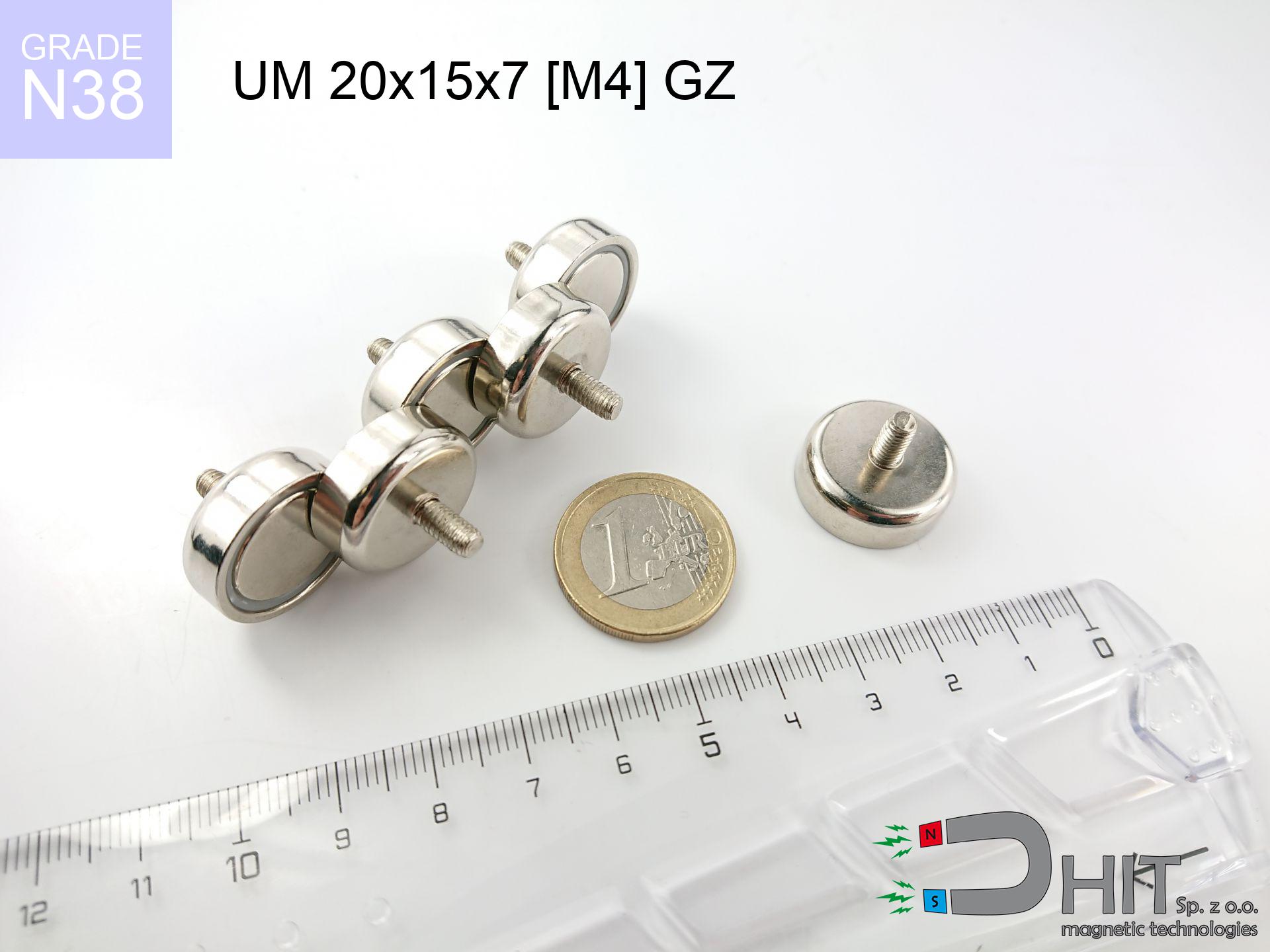
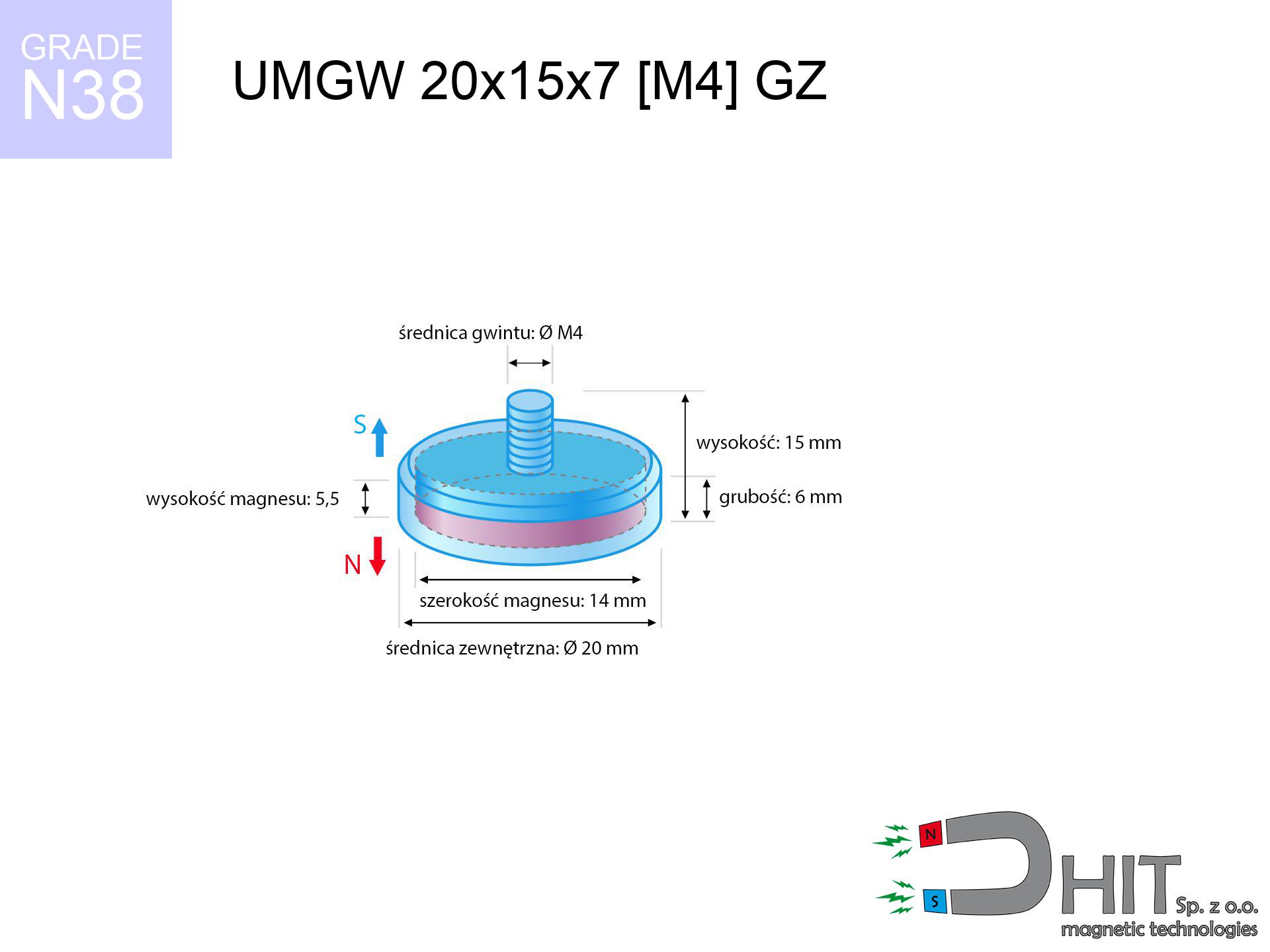
UMGZ 20x15x7 [M4] GZ / N38 - magnetic holder external thread
magnetic holder external thread
Catalog no 190322
GTIN/EAN: 5906301813811
- Diameter Ø
- 20 mm [±1 mm]
- Height
- 15 mm [±1 mm]
- Height
- 7 mm [±1 mm]
- Weight
- 14 g
- Magnetization Direction
- ↑ axial
- Coating
- [NiCuNi] Nickel
How we measure these parameters — certificates and measurements
5.87 zł net / pcs
7.22 zł with VAT (23% VAT) / pcs
bulk discounts:
Need more?Frequently asked questions
Which magnetic holder is suitable for moving metal parts in a workshop?
How do I choose a holder for hanging a heavy item and check its real grip?
Which magnetic holders can be used outdoors?
How should I choose a strong threaded holder for field work?
Call us now
+48 888 99 98 98
alternatively let us know using
contact form
the contact section.
Specifications and structure of a neodymium magnet can be estimated using our
power calculator.
Order by 14:00 and we’ll ship today!
Technical parameters of the product - UMGZ 20x15x7 [M4] GZ / N38 - magnetic holder external thread
Specification / characteristics - UMGZ 20x15x7 [M4] GZ / N38 - magnetic holder external thread
| properties | values |
|---|---|
| Cat. no. | 190322 |
| GTIN/EAN | 5906301813811 |
| Distributor | Dhit sp. z o.o. |
| Country of origin | Poland / China / Germany |
| Customs code | 85059029 |
| Diameter Ø | 20 mm [±1 mm] |
| Height | 15 mm [±1 mm] |
| Height | 7 mm [±1 mm] |
| Weight | 14 g |
| Magnetization Direction | ↑ axial |
| Load capacity ~ ? | 9.00 kg / 88.26 N |
| Coating | [NiCuNi] Nickel |
| Manufacturing Tolerance | ±1 mm |
Magnetic properties of material N38
| properties | values | units |
|---|---|---|
| Remanence Br ? | 12.2-12.6 | kGs |
| Remanence Br ? | 1220-1260 | mT |
| Coercivity bHc ? | 10.8-11.5 | kOe |
| Coercivity bHc ? | 860-915 | kA/m |
| Intrinsic coercivity iHc | ≥ 12 | kOe |
| Intrinsic coercivity iHc | ≥ 955 | kA/m |
| Energy product BHmax ? | 36-38 | BH max MGOe |
| Energy product BHmax ? | 287-303 | BH max KJ/m |
| Maximum working temperature ? | ≤ 80 | °C |
Physical properties of sintered neodymium magnets Nd2Fe14B at 20°C
| properties | values | units |
|---|---|---|
| Vickers hardness | ≥550 | Hv |
| Density | ≥7.4 | g/cm3 |
| Curie Temperature TC | 310 | °C |
| Curie Temperature TF | 590 | °F |
| Specific resistance | 150 | μΩ⋅cm |
| Bending strength | 250 | MPa |
| Compressive strength | 1000~1100 | MPa |
| Thermal expansion parallel (∥) to orientation (M) | (3-4) x 10-6 | °C-1 |
| Thermal expansion perpendicular (⊥) to orientation (M) | -(1-3) x 10-6 | °C-1 |
| Young's modulus | 1.7 x 10⁴ | kg/mm² |
Elemental analysis
| iron (Fe) | 64% – 68% |
| neodymium (Nd) | 29% – 32% |
| boron (B) | 1.1% – 1.2% |
| dysprosium (Dy) | 0.5% – 2.0% |
| coating (Ni-Cu-Ni) | < 0.05% |
Environmental data
| recyclability (EoL) | 100% |
| recycled raw materials | ~10% (pre-cons) |
| carbon footprint | low / zredukowany |
| waste code (EWC) | 16 02 16 |
See also proposals



Pros as well as cons of neodymium magnets.
Pros
- They have unchanged lifting capacity, and over around 10 years their attraction force decreases symbolically – ~1% (according to theory),
- They possess excellent resistance to magnetic field loss when exposed to opposing magnetic fields,
- By covering with a lustrous layer of nickel, the element has an elegant look,
- Neodymium magnets deliver maximum magnetic induction on a their surface, which increases force concentration,
- Thanks to resistance to high temperature, they are able to function (depending on the shape) even at temperatures up to 230°C and higher...
- Possibility of accurate modeling and optimizing to complex needs,
- Universal use in modern technologies – they serve a role in HDD drives, motor assemblies, medical devices, also industrial machines.
- Relatively small size with high pulling force – neodymium magnets offer strong magnetic field in small dimensions, which allows their use in miniature devices
Cons
- Susceptibility to cracking is one of their disadvantages. Upon intense impact they can fracture. We recommend keeping them in a special holder, which not only secures them against impacts but also raises their durability
- Do not exceed this material temperature limit: 80°C. Overheating may permanently weaken the magnet.
- Magnets exposed to a humid environment can rust. Therefore while using outdoors, we recommend using waterproof magnets made of rubber, plastic or other material resistant to moisture
- We suggest casing - magnetic holder, due to difficulties in producing threads inside the magnet and complex shapes.
- Potential hazard related to microscopic parts of magnets are risky, in case of ingestion, which is particularly important in the aspect of protecting the youngest. Furthermore, small elements of these products are able to be problematic in diagnostics medical after entering the body.
- Higher cost of purchase is one of the disadvantages compared to ceramic magnets, especially in budget applications
Holding force characteristics
Maximum lifting force for a neodymium magnet – what affects it?
- using a plate made of low-carbon steel, functioning as a magnetic yoke
- possessing a thickness of at least 10 mm to avoid saturation
- with an ideally smooth contact surface
- with total lack of distance (no impurities)
- during pulling in a direction perpendicular to the mounting surface
- at room temperature
Determinants of practical lifting force of a magnet
- Distance (between the magnet and the metal), since even a tiny distance (e.g. 0.5 mm) results in a drastic drop in lifting capacity by up to 50% (this also applies to varnish, rust or debris).
- Pull-off angle – remember that the magnet holds strongest perpendicularly. Under sliding down, the holding force drops significantly, often to levels of 20-30% of the nominal value.
- Wall thickness – the thinner the sheet, the weaker the hold. Magnetic flux penetrates through instead of generating force.
- Material composition – different alloys reacts the same. High carbon content weaken the interaction with the magnet.
- Plate texture – smooth surfaces ensure maximum contact, which improves field saturation. Rough surfaces reduce efficiency.
- Thermal environment – heating the magnet causes a temporary drop of induction. It is worth remembering the maximum operating temperature for a given model.
Lifting capacity was determined using a polished steel plate of suitable thickness (min. 20 mm), under perpendicular detachment force, however under shearing force the holding force is lower. In addition, even a slight gap between the magnet’s surface and the plate decreases the holding force.
Precautions when working with neodymium magnets
Safe operation
Be careful. Neodymium magnets act from a distance and snap with huge force, often faster than you can react.
Finger safety
Big blocks can break fingers instantly. Do not place your hand between two strong magnets.
Life threat
Medical warning: Strong magnets can turn off heart devices and defibrillators. Stay away if you have electronic implants.
Choking Hazard
Product intended for adults. Tiny parts can be swallowed, leading to intestinal necrosis. Store away from children and animals.
Flammability
Drilling and cutting of NdFeB material poses a fire hazard. Neodymium dust reacts violently with oxygen and is hard to extinguish.
Material brittleness
Despite metallic appearance, neodymium is brittle and cannot withstand shocks. Avoid impacts, as the magnet may crumble into sharp, dangerous pieces.
Metal Allergy
It is widely known that the nickel plating (standard magnet coating) is a common allergen. For allergy sufferers, refrain from touching magnets with bare hands and opt for encased magnets.
Magnetic media
Very strong magnetic fields can destroy records on payment cards, HDDs, and other magnetic media. Stay away of at least 10 cm.
Permanent damage
Do not exceed the maximum operating temperature stated in the specifications of the particular product. The limit depends on the material, geometry and operating arrangement; there is no single threshold for all neodymium magnets. Overheating can permanently weaken a magnet.
Compass and GPS
A strong magnetic field disrupts the functioning of compasses in smartphones and navigation systems. Maintain magnets close to a device to avoid breaking the sensors.
Tabela kosztu i czasu dostawy
Płatność przed wysyłką:

GLS kurier
Przesyłka będzie u Ciebie za 2-3 dni
14.99 ZŁ

InPost Paczkomaty 24/7
Przesyłka będzie u Ciebie za 1-2 dni
12.30 ZŁ
Płatność przy odbiorze (pobranie):
GLS kurier
Przesyłka będzie u Ciebie za 1-2 dni
23.00 ZŁ