

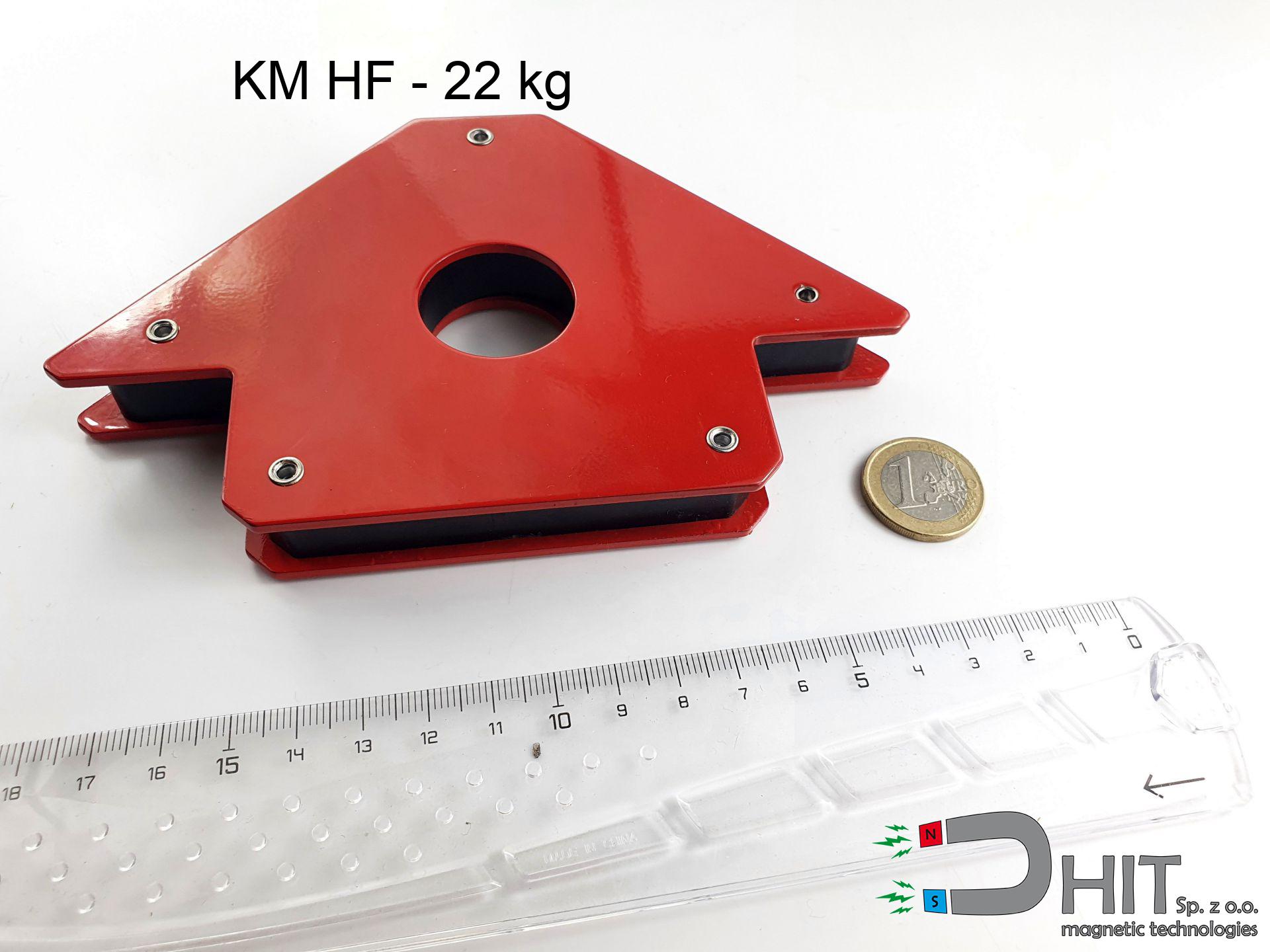
KM HF - 22 kg - magnetic bracket
magnetic bracket
Catalog no 170257
GTIN/EAN: 5906301813699
- Weight
- 593 g
How we measure these parameters — certificates and measurements
24.00 zł net / pcs
29.52 zł with VAT (23% VAT) / pcs
bulk discounts:
Need more?Frequently asked questions
Which magnetic holder is suitable for moving metal parts in a workshop?
How do I choose a holder for hanging a heavy item and check its real grip?
Which magnetic holders can be used outdoors?
How should I choose a strong threaded holder for field work?
Call us now
+48 888 99 98 98
alternatively let us know using
contact form
the contact section.
Specifications and structure of a neodymium magnet can be estimated using our
power calculator.
Order by 14:00 and we’ll ship today!
Detailed specification - KM HF - 22 kg - magnetic bracket
Specification / characteristics - KM HF - 22 kg - magnetic bracket
| properties | values |
|---|---|
| Cat. no. | 170257 |
| GTIN/EAN | 5906301813699 |
| Production/Distribution | Dhit sp. z o.o. |
| Country of origin | Poland / China / Germany |
| Customs code | 85059029 |
| Weight | 593 g |
| Load capacity ~ ? | 22.00 kg / 215.75 N |
| Manufacturing Tolerance | ±1 mm |
Physical properties of sintered neodymium magnets Nd2Fe14B at 20°C
| properties | values | units |
|---|---|---|
| Vickers hardness | ≥550 | Hv |
| Density | ≥7.4 | g/cm3 |
| Curie Temperature TC | 310 | °C |
| Curie Temperature TF | 590 | °F |
| Specific resistance | 150 | μΩ⋅cm |
| Bending strength | 250 | MPa |
| Compressive strength | 1000~1100 | MPa |
| Thermal expansion parallel (∥) to orientation (M) | (3-4) x 10-6 | °C-1 |
| Thermal expansion perpendicular (⊥) to orientation (M) | -(1-3) x 10-6 | °C-1 |
| Young's modulus | 1.7 x 10⁴ | kg/mm² |
Elemental analysis
| iron (Fe) | 64% – 68% |
| neodymium (Nd) | 29% – 32% |
| boron (B) | 1.1% – 1.2% |
| dysprosium (Dy) | 0.5% – 2.0% |
| coating (Ni-Cu-Ni) | < 0.05% |
Environmental data
| recyclability (EoL) | 100% |
| recycled raw materials | ~10% (pre-cons) |
| carbon footprint | low / zredukowany |
| waste code (EWC) | 16 02 16 |
Other proposals

![UMGW 16x13x5 [M4] GW / N38 - magnetic holder internal thread](https://cdn3.dhit.pl/graphics/products/um-16x13x5-m4-gw-fig.jpg "UMGW 16x13x5 [M4] GW / N38 - magnetic holder internal thread")
Strengths and weaknesses of Nd2Fe14B magnets.
Strengths
- They virtually do not lose strength, because even after 10 years the performance loss is only ~1% (in laboratory conditions),
- They have excellent resistance to weakening of magnetic properties as a result of external fields,
- By using a shiny coating of gold, the element gains an aesthetic look,
- The surface of neodymium magnets generates a powerful magnetic field – this is a distinguishing feature,
- Through (adequate) combination of ingredients, they can achieve high thermal strength, enabling operation at temperatures approaching 230°C and above...
- Thanks to versatility in constructing and the capacity to modify to individual projects,
- Huge importance in future technologies – they are used in data components, electromotive mechanisms, diagnostic systems, and technologically advanced constructions.
- Relatively small size with high pulling force – neodymium magnets offer strong magnetic field in compact dimensions, which enables their usage in small systems
Disadvantages
- They are fragile upon heavy impacts. To avoid cracks, it is worth securing magnets in special housings. Such protection not only protects the magnet but also increases its resistance to damage
- Heat sensitivity: observe the temperature specified for this product. Overheating may permanently weaken the magnet.
- Magnets exposed to a humid environment can corrode. Therefore during using outdoors, we suggest using water-impermeable magnets made of rubber, plastic or other material resistant to moisture
- Due to limitations in producing threads and complex shapes in magnets, we propose using cover - magnetic mount.
- Potential hazard resulting from small fragments of magnets can be dangerous, in case of ingestion, which is particularly important in the aspect of protecting the youngest. It is also worth noting that small components of these magnets are able to complicate diagnosis medical when they are in the body.
- Due to complex production process, their price exceeds standard values,
Pull force analysis
Maximum holding power of the magnet – what affects it?
- using a plate made of low-carbon steel, acting as a magnetic yoke
- possessing a massiveness of minimum 10 mm to avoid saturation
- with a surface cleaned and smooth
- with direct contact (without impurities)
- under vertical application of breakaway force (90-degree angle)
- in neutral thermal conditions
Lifting capacity in practice – influencing factors
- Space between magnet and steel – every millimeter of separation (caused e.g. by varnish or unevenness) drastically reduces the magnet efficiency, often by half at just 0.5 mm.
- Force direction – catalog parameter refers to pulling vertically. When applying parallel force, the magnet holds significantly lower power (typically approx. 20-30% of nominal force).
- Element thickness – for full efficiency, the steel must be adequately massive. Thin sheet limits the lifting capacity (the magnet "punches through" it).
- Steel grade – the best choice is high-permeability steel. Cast iron may attract less.
- Surface condition – ground elements guarantee perfect abutment, which improves field saturation. Rough surfaces weaken the grip.
- Thermal conditions – neodymium magnets have a negative temperature coefficient. At higher temperatures they lose power, and at low temperatures gain strength (up to a certain limit).
Lifting capacity testing was carried out on a smooth plate of optimal thickness, under a perpendicular pulling force, whereas under shearing force the lifting capacity is smaller. In addition, even a small distance between the magnet and the plate lowers the holding force.
Safety rules for work with neodymium magnets
Cards and drives
Avoid bringing magnets close to a wallet, computer, or TV. The magnetism can permanently damage these devices and erase data from cards.
Nickel coating and allergies
Certain individuals have a contact allergy to Ni, which is the standard coating for NdFeB magnets. Frequent touching might lead to skin redness. We strongly advise use protective gloves.
Medical interference
Warning for patients: Strong magnetic fields disrupt electronics. Maintain at least 30 cm distance or ask another person to work with the magnets.
Bone fractures
Watch your fingers. Two large magnets will join instantly with a force of massive weight, crushing anything in their path. Exercise extreme caution!
Danger to the youngest
Neodymium magnets are not toys. Eating multiple magnets may result in them pinching intestinal walls, which constitutes a severe health hazard and requires immediate surgery.
Magnet fragility
Beware of splinters. Magnets can explode upon uncontrolled impact, ejecting sharp fragments into the air. Wear goggles.
Powerful field
Before use, read the rules. Uncontrolled attraction can break the magnet or hurt your hand. Think ahead.
Heat warning
Standard neodymium magnets (grade N) lose power when the temperature exceeds 80°C. The loss of strength is permanent.
Fire risk
Powder produced during machining of magnets is self-igniting. Do not drill into magnets unless you are an expert.
Precision electronics
Navigation devices and mobile phones are highly susceptible to magnetism. Close proximity with a powerful NdFeB magnet can ruin the sensors in your phone.
Tabela kosztu i czasu dostawy
Płatność przed wysyłką:

GLS kurier
Przesyłka będzie u Ciebie za 2-3 dni
14.99 ZŁ

InPost Paczkomaty 24/7
Przesyłka będzie u Ciebie za 1-2 dni
12.30 ZŁ
Płatność przy odbiorze (pobranie):
GLS kurier
Przesyłka będzie u Ciebie za 1-2 dni
23.00 ZŁ