

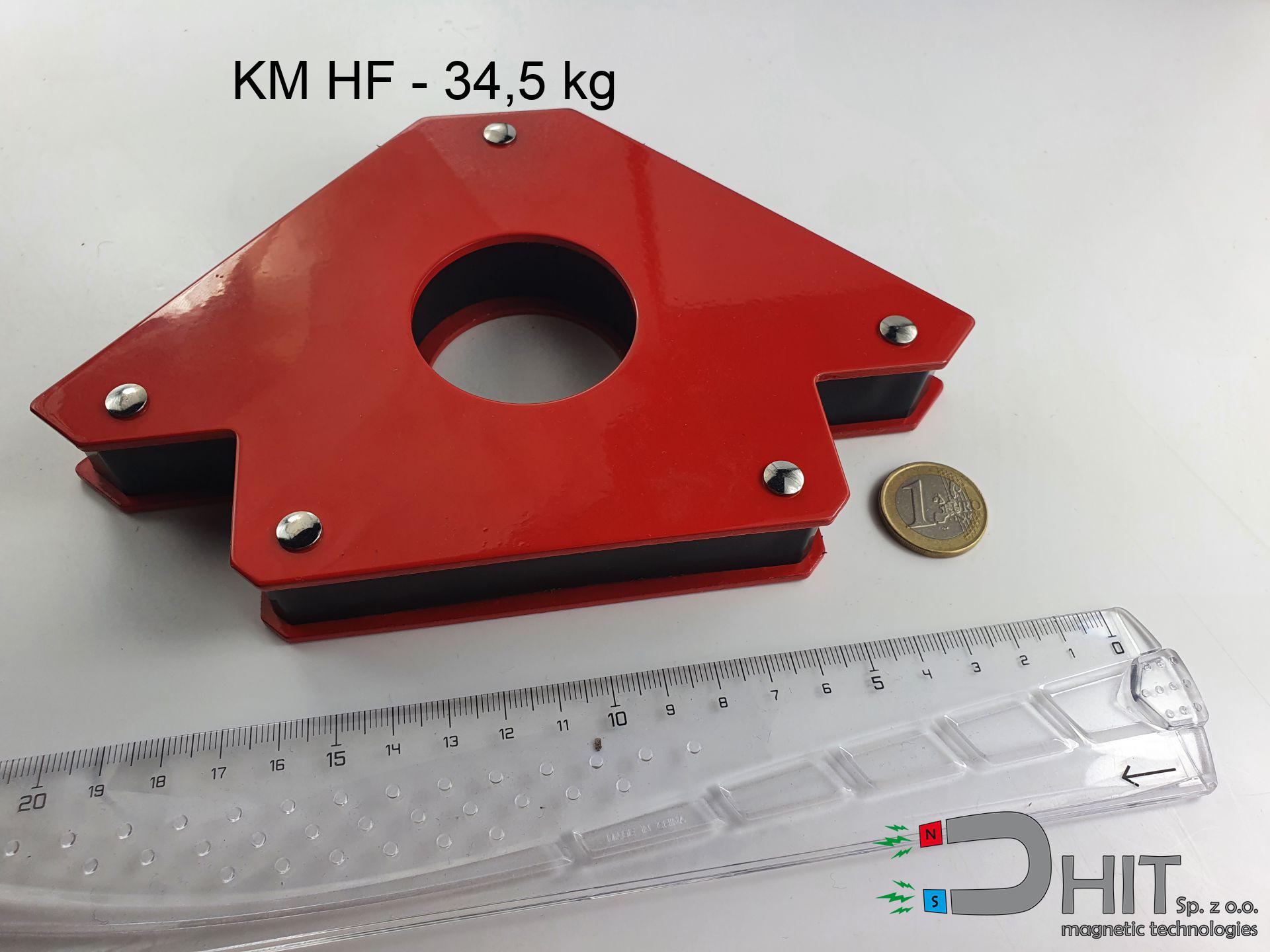
KM HF - 34,5 kg - magnetic bracket
magnetic bracket
Catalog no 170258
GTIN/EAN: 5906301813705
- Weight
- 1040 g
How we measure these parameters — certificates and measurements
28.00 zł net / pcs
34.44 zł with VAT (23% VAT) / pcs
bulk discounts:
Need more?Frequently asked questions
Which magnetic holder is suitable for moving metal parts in a workshop?
How do I choose a holder for hanging a heavy item and check its real grip?
Which magnetic holders can be used outdoors?
How should I choose a strong threaded holder for field work?
Call us now
+48 888 99 98 98
alternatively let us know using
contact form
the contact section.
Specifications and structure of a neodymium magnet can be estimated using our
power calculator.
Order by 14:00 and we’ll ship today!
Technical - KM HF - 34,5 kg - magnetic bracket
Specification / characteristics - KM HF - 34,5 kg - magnetic bracket
| properties | values |
|---|---|
| Cat. no. | 170258 |
| GTIN/EAN | 5906301813705 |
| Production/Distribution | Dhit sp. z o.o. |
| Country of origin | Poland / China / Germany |
| Customs code | 85059029 |
| Weight | 1040 g |
| Load capacity ~ ? | 34.50 kg / 338.33 N |
| Manufacturing Tolerance | ±1 mm |
Physical properties of sintered neodymium magnets Nd2Fe14B at 20°C
| properties | values | units |
|---|---|---|
| Vickers hardness | ≥550 | Hv |
| Density | ≥7.4 | g/cm3 |
| Curie Temperature TC | 310 | °C |
| Curie Temperature TF | 590 | °F |
| Specific resistance | 150 | μΩ⋅cm |
| Bending strength | 250 | MPa |
| Compressive strength | 1000~1100 | MPa |
| Thermal expansion parallel (∥) to orientation (M) | (3-4) x 10-6 | °C-1 |
| Thermal expansion perpendicular (⊥) to orientation (M) | -(1-3) x 10-6 | °C-1 |
| Young's modulus | 1.7 x 10⁴ | kg/mm² |
Chemical composition
| iron (Fe) | 64% – 68% |
| neodymium (Nd) | 29% – 32% |
| boron (B) | 1.1% – 1.2% |
| dysprosium (Dy) | 0.5% – 2.0% |
| coating (Ni-Cu-Ni) | < 0.05% |
Ecology and recycling (GPSR)
| recyclability (EoL) | 100% |
| recycled raw materials | ~10% (pre-cons) |
| carbon footprint | low / zredukowany |
| waste code (EWC) | 16 02 16 |
View also proposals
![BM 320x180x70 [4x M8] - magnetic beam](https://cdn3.dhit.pl/graphics/products/bm-320x180x70-4x-m8-rar.jpg "BM 320x180x70 [4x M8] - magnetic beam")

Strengths and weaknesses of neodymium magnets.
Benefits
- They retain full power for almost 10 years – the loss is just ~1% (in theory),
- They are extremely resistant to demagnetization induced by presence of other magnetic fields,
- The use of an metallic coating of noble metals (nickel, gold, silver) causes the element to look better,
- Magnets exhibit excellent magnetic induction on the outer side,
- Neodymium magnets are characterized by extremely high magnetic induction on the magnet surface and can work (depending on the form) even at a temperature of 230°C or more...
- Possibility of exact modeling and optimizing to complex applications,
- Fundamental importance in advanced technology sectors – they find application in HDD drives, electric drive systems, advanced medical instruments, and modern systems.
- Relatively small size with high pulling force – neodymium magnets offer impressive pulling force in tiny dimensions, which enables their usage in miniature devices
Limitations
- They are fragile upon too strong impacts. To avoid cracks, it is worth securing magnets using a steel holder. Such protection not only shields the magnet but also increases its resistance to damage
- Heat sensitivity: observe the temperature specified for this product. Overheating may permanently weaken the magnet.
- Due to the susceptibility of magnets to corrosion in a humid environment, we recommend using waterproof magnets made of rubber, plastic or other material immune to moisture, when using outdoors
- We suggest casing - magnetic mount, due to difficulties in creating nuts inside the magnet and complex forms.
- Potential hazard related to microscopic parts of magnets are risky, if swallowed, which is particularly important in the context of child safety. Furthermore, tiny parts of these devices are able to be problematic in diagnostics medical when they are in the body.
- With large orders the cost of neodymium magnets is a challenge,
Pull force analysis
Best holding force of the magnet in ideal parameters – what contributes to it?
- with the application of a yoke made of low-carbon steel, guaranteeing maximum field concentration
- whose thickness is min. 10 mm
- characterized by lack of roughness
- under conditions of no distance (surface-to-surface)
- during pulling in a direction vertical to the plane
- at temperature approx. 20 degrees Celsius
Determinants of practical lifting force of a magnet
- Space between magnet and steel – even a fraction of a millimeter of distance (caused e.g. by varnish or dirt) significantly weakens the magnet efficiency, often by half at just 0.5 mm.
- Force direction – catalog parameter refers to detachment vertically. When attempting to slide, the magnet holds significantly lower power (often approx. 20-30% of maximum force).
- Wall thickness – thin material does not allow full use of the magnet. Magnetic flux penetrates through instead of generating force.
- Plate material – mild steel gives the best results. Alloy steels reduce magnetic properties and holding force.
- Base smoothness – the more even the plate, the larger the contact zone and higher the lifting capacity. Roughness acts like micro-gaps.
- Temperature influence – high temperature weakens pulling force. Too high temperature can permanently damage the magnet.
Lifting capacity testing was performed on a smooth plate of optimal thickness, under perpendicular forces, in contrast under parallel forces the load capacity is reduced by as much as fivefold. Additionally, even a slight gap between the magnet’s surface and the plate decreases the lifting capacity.
Safe handling of NdFeB magnets
Serious injuries
Large magnets can smash fingers instantly. Never place your hand betwixt two attracting surfaces.
Caution required
Handle with care. Neodymium magnets attract from a long distance and snap with huge force, often quicker than you can move away.
Compass and GPS
A powerful magnetic field disrupts the operation of magnetometers in phones and navigation systems. Keep magnets close to a device to avoid breaking the sensors.
Pacemakers
People with a ICD have to keep an absolute distance from magnets. The magnetic field can stop the operation of the implant.
Skin irritation risks
Nickel alert: The Ni-Cu-Ni coating contains nickel. If skin irritation occurs, cease handling magnets and wear gloves.
Protect data
Very strong magnetic fields can erase data on payment cards, hard drives, and other magnetic media. Keep a distance of min. 10 cm.
No play value
Only for adults. Tiny parts pose a choking risk, causing serious injuries. Keep away from kids and pets.
Power loss in heat
Do not overheat. NdFeB magnets are susceptible to heat. If you require resistance above 80°C, ask us about HT versions (H, SH, UH).
Magnet fragility
Despite the nickel coating, neodymium is delicate and cannot withstand shocks. Do not hit, as the magnet may crumble into hazardous fragments.
Do not drill into magnets
Machining of NdFeB material carries a risk of fire risk. Neodymium dust reacts violently with oxygen and is difficult to extinguish.
Tabela kosztu i czasu dostawy
Płatność przed wysyłką:

GLS kurier
Przesyłka będzie u Ciebie za 2-3 dni
14.99 ZŁ

InPost Paczkomaty 24/7
Przesyłka będzie u Ciebie za 1-2 dni
12.30 ZŁ
Płatność przy odbiorze (pobranie):
GLS kurier
Przesyłka będzie u Ciebie za 1-2 dni
23.00 ZŁ