

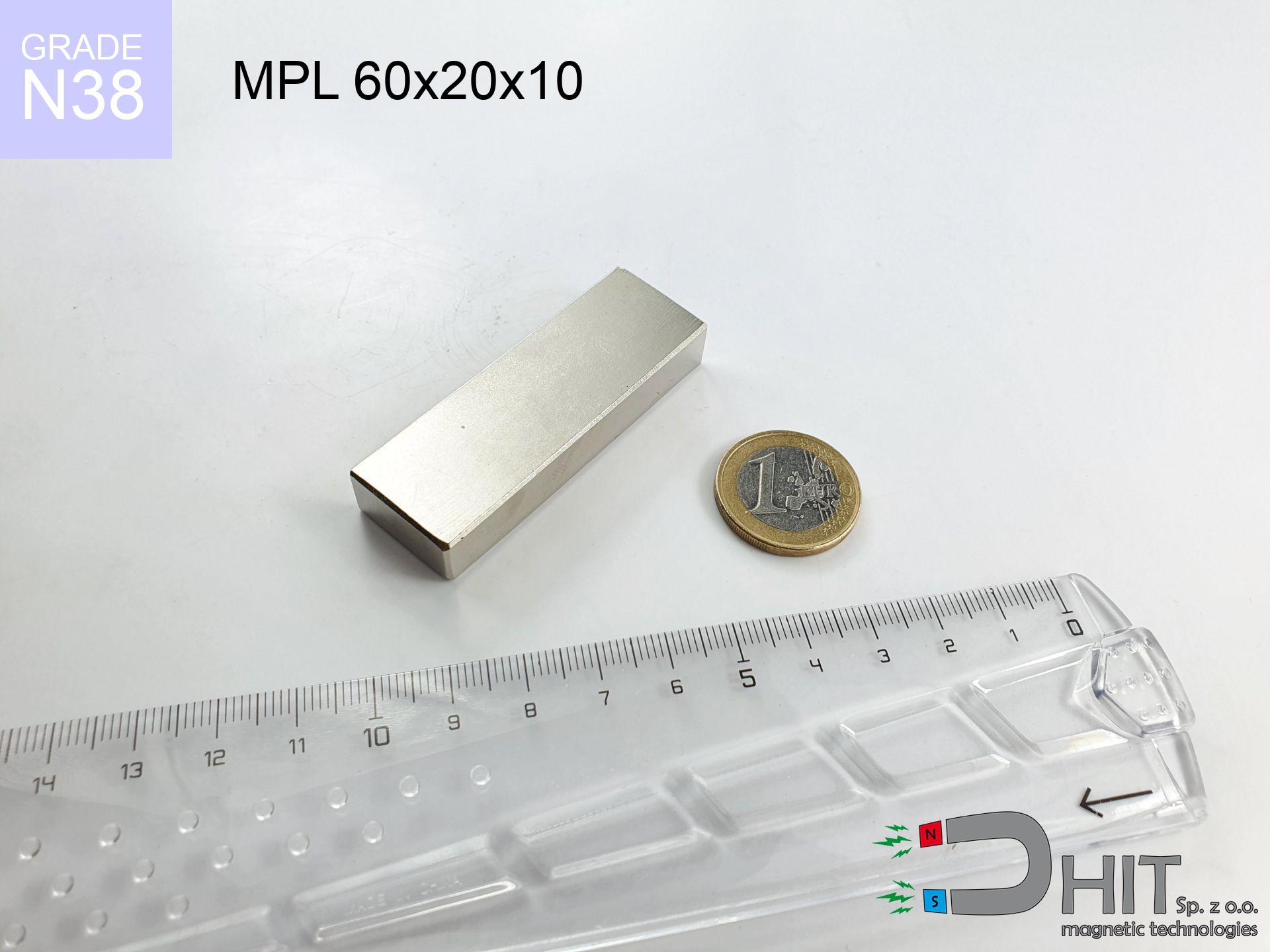
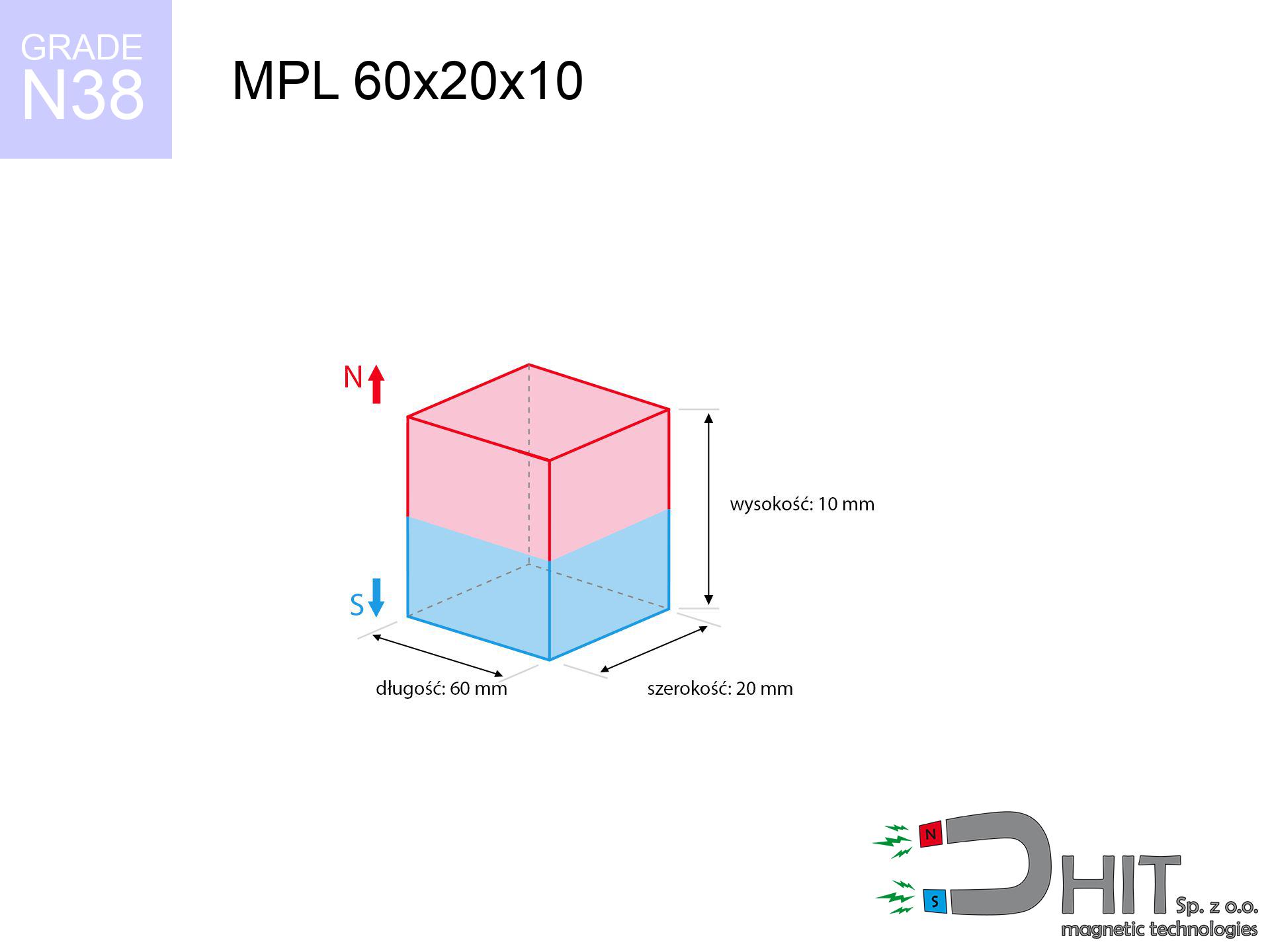
MPL 60x20x10 / N38 - lamellar magnet
lamellar magnet
Catalog no 020174
GTIN/EAN: 5906301811800
- length
- 60 mm [±0,1 mm]
- Width
- 20 mm [±0,1 mm]
- Height
- 10 mm [±0,1 mm]
- Weight
- 90 g
- Magnetization Direction
- ↑ axial
- Coating
- [NiCuNi] Nickel
How we measure these parameters — certificates and measurements
55.50 zł net / pcs
68.27 zł with VAT (23% VAT) / pcs
bulk discounts:
Need more?Frequently asked questions
What pull rating should I choose for a workshop block magnet?
Are block neodymium magnets available in more durable versions?
How should I choose block magnets for mounting a structure?
Engineering report for this magnet
Full PDF analysis: pull and shear force, effect of distance, temperature and plate thickness, safety distances and the demagnetization curve.
Call us now
+48 888 99 98 98
alternatively let us know using
contact form
the contact section.
Specifications and structure of a neodymium magnet can be estimated using our
power calculator.
Order by 14:00 and we’ll ship today!
Technical - MPL 60x20x10 / N38 - lamellar magnet
Specification / characteristics - MPL 60x20x10 / N38 - lamellar magnet
| properties | values |
|---|---|
| Cat. no. | 020174 |
| GTIN/EAN | 5906301811800 |
| Production/Distribution | Dhit sp. z o.o. |
| Country of origin | Poland / China / Germany |
| Customs code | 85059029 |
| length | 60 mm [±0,1 mm] |
| Width | 20 mm [±0,1 mm] |
| Height | 10 mm [±0,1 mm] |
| Weight | 90 g |
| Magnetization Direction | ↑ axial |
| Load capacity ~ ? | 35.61 kg / 349.34 N |
| Magnetic Induction ~ ? | 329.64 mT / 3296 Gs |
| Coating | [NiCuNi] Nickel |
| Manufacturing Tolerance | ±0.1 mm |
Magnetic properties of material N38
| properties | values | units |
|---|---|---|
| Remanence Br ? | 12.2-12.6 | kGs |
| Remanence Br ? | 1220-1260 | mT |
| Coercivity bHc ? | 10.8-11.5 | kOe |
| Coercivity bHc ? | 860-915 | kA/m |
| Intrinsic coercivity iHc | ≥ 12 | kOe |
| Intrinsic coercivity iHc | ≥ 955 | kA/m |
| Energy product BHmax ? | 36-38 | BH max MGOe |
| Energy product BHmax ? | 287-303 | BH max KJ/m |
| Maximum working temperature ? | ≤ 80 | °C |
Physical properties of sintered neodymium magnets Nd2Fe14B at 20°C
| properties | values | units |
|---|---|---|
| Vickers hardness | ≥550 | Hv |
| Density | ≥7.4 | g/cm3 |
| Curie Temperature TC | 310 | °C |
| Curie Temperature TF | 590 | °F |
| Specific resistance | 150 | μΩ⋅cm |
| Bending strength | 250 | MPa |
| Compressive strength | 1000~1100 | MPa |
| Thermal expansion parallel (∥) to orientation (M) | (3-4) x 10-6 | °C-1 |
| Thermal expansion perpendicular (⊥) to orientation (M) | -(1-3) x 10-6 | °C-1 |
| Young's modulus | 1.7 x 10⁴ | kg/mm² |
Engineering analysis of the product - data
These values constitute the direct effect of a engineering analysis. Results rely on algorithms for the class Nd2Fe14B. Real-world parameters may deviate from the simulation results. Use these calculations as a reference point for designers.
Table 1: Static force (force vs distance) - interaction chart
MPL 60x20x10 / N38
| Distance (mm) | Induction (Gauss) / mT | Pull Force (kg/lbs/g/N) | Risk Status |
|---|---|---|---|
| 0 mm |
3296 Gs
329.6 mT
|
35.61 kg / 78.51 pounds
35610.0 g / 349.3 N
|
crushing |
| 1 mm |
3087 Gs
308.7 mT
|
31.25 kg / 68.89 pounds
31248.2 g / 306.5 N
|
crushing |
| 2 mm |
2866 Gs
286.6 mT
|
26.93 kg / 59.37 pounds
26929.3 g / 264.2 N
|
crushing |
| 3 mm |
2643 Gs
264.3 mT
|
22.90 kg / 50.48 pounds
22895.5 g / 224.6 N
|
crushing |
| 5 mm |
2216 Gs
221.6 mT
|
16.10 kg / 35.50 pounds
16103.3 g / 158.0 N
|
crushing |
| 10 mm |
1397 Gs
139.7 mT
|
6.40 kg / 14.11 pounds
6402.3 g / 62.8 N
|
strong |
| 15 mm |
907 Gs
90.7 mT
|
2.70 kg / 5.95 pounds
2697.7 g / 26.5 N
|
strong |
| 20 mm |
615 Gs
61.5 mT
|
1.24 kg / 2.73 pounds
1239.2 g / 12.2 N
|
weak grip |
| 30 mm |
314 Gs
31.4 mT
|
0.32 kg / 0.71 pounds
322.6 g / 3.2 N
|
weak grip |
| 50 mm |
108 Gs
10.8 mT
|
0.04 kg / 0.09 pounds
38.6 g / 0.4 N
|
weak grip |
Table 2: Vertical hold (vertical surface)
MPL 60x20x10 / N38
| Distance (mm) | Friction coefficient | Pull Force (kg/lbs/g/N) |
|---|---|---|
| 0 mm | Stal (~0.2) |
7.12 kg / 15.70 pounds
7122.0 g / 69.9 N
|
| 1 mm | Stal (~0.2) |
6.25 kg / 13.78 pounds
6250.0 g / 61.3 N
|
| 2 mm | Stal (~0.2) |
5.39 kg / 11.87 pounds
5386.0 g / 52.8 N
|
| 3 mm | Stal (~0.2) |
4.58 kg / 10.10 pounds
4580.0 g / 44.9 N
|
| 5 mm | Stal (~0.2) |
3.22 kg / 7.10 pounds
3220.0 g / 31.6 N
|
| 10 mm | Stal (~0.2) |
1.28 kg / 2.82 pounds
1280.0 g / 12.6 N
|
| 15 mm | Stal (~0.2) |
0.54 kg / 1.19 pounds
540.0 g / 5.3 N
|
| 20 mm | Stal (~0.2) |
0.25 kg / 0.55 pounds
248.0 g / 2.4 N
|
| 30 mm | Stal (~0.2) |
0.06 kg / 0.14 pounds
64.0 g / 0.6 N
|
| 50 mm | Stal (~0.2) |
0.01 kg / 0.02 pounds
8.0 g / 0.1 N
|
Table 3: Vertical assembly (sliding) - vertical pull
MPL 60x20x10 / N38
| Surface type | Friction coefficient / % Mocy | Max load (kg/lbs/g/N) |
|---|---|---|
| Raw steel |
µ = 0.3
30% Nominalnej Siły
|
10.68 kg / 23.55 pounds
10683.0 g / 104.8 N
|
| Painted steel (standard) |
µ = 0.2
20% Nominalnej Siły
|
7.12 kg / 15.70 pounds
7122.0 g / 69.9 N
|
| Oily/slippery steel |
µ = 0.1
10% Nominalnej Siły
|
3.56 kg / 7.85 pounds
3561.0 g / 34.9 N
|
| Magnet with anti-slip rubber |
µ = 0.5
50% Nominalnej Siły
|
17.81 kg / 39.25 pounds
17805.0 g / 174.7 N
|
Table 4: Steel thickness (saturation) - sheet metal selection
MPL 60x20x10 / N38
| Steel thickness (mm) | % power | Real pull force (kg/lbs/g/N) |
|---|---|---|
| 0.5 mm |
|
1.78 kg / 3.93 pounds
1780.5 g / 17.5 N
|
| 1 mm |
|
4.45 kg / 9.81 pounds
4451.3 g / 43.7 N
|
| 2 mm |
|
8.90 kg / 19.63 pounds
8902.5 g / 87.3 N
|
| 3 mm |
|
13.35 kg / 29.44 pounds
13353.8 g / 131.0 N
|
| 5 mm |
|
22.26 kg / 49.07 pounds
22256.3 g / 218.3 N
|
| 10 mm |
|
35.61 kg / 78.51 pounds
35610.0 g / 349.3 N
|
| 11 mm |
|
35.61 kg / 78.51 pounds
35610.0 g / 349.3 N
|
| 12 mm |
|
35.61 kg / 78.51 pounds
35610.0 g / 349.3 N
|
Table 5: Thermal resistance (stability) - thermal limit
MPL 60x20x10 / N38
| Ambient temp. (°C) | Power loss | Remaining pull (kg/lbs/g/N) | Status |
|---|---|---|---|
| 20 °C | 0.0% |
35.61 kg / 78.51 pounds
35610.0 g / 349.3 N
|
OK |
| 40 °C | -2.2% |
34.83 kg / 76.78 pounds
34826.6 g / 341.6 N
|
OK |
| 60 °C | -4.4% |
34.04 kg / 75.05 pounds
34043.2 g / 334.0 N
|
|
| 80 °C | -6.6% |
33.26 kg / 73.33 pounds
33259.7 g / 326.3 N
|
|
| 100 °C | -28.8% |
25.35 kg / 55.90 pounds
25354.3 g / 248.7 N
|
Table 6: Two magnets (repulsion) - field range
MPL 60x20x10 / N38
| Gap (mm) | Attraction (kg/lbs) (N-S) | Shear Force (kg/lbs/g/N) | Repulsion (kg/lbs) (N-N) |
|---|---|---|---|
| 0 mm |
80.35 kg / 177.15 pounds
4 692 Gs
|
12.05 kg / 26.57 pounds
12053 g / 118.2 N
|
N/A |
| 1 mm |
75.49 kg / 166.43 pounds
6 389 Gs
|
11.32 kg / 24.96 pounds
11324 g / 111.1 N
|
67.94 kg / 149.79 pounds
~0 Gs
|
| 2 mm |
70.51 kg / 155.45 pounds
6 174 Gs
|
10.58 kg / 23.32 pounds
10577 g / 103.8 N
|
63.46 kg / 139.90 pounds
~0 Gs
|
| 3 mm |
65.58 kg / 144.58 pounds
5 955 Gs
|
9.84 kg / 21.69 pounds
9837 g / 96.5 N
|
59.02 kg / 130.12 pounds
~0 Gs
|
| 5 mm |
56.11 kg / 123.71 pounds
5 508 Gs
|
8.42 kg / 18.56 pounds
8417 g / 82.6 N
|
50.50 kg / 111.34 pounds
~0 Gs
|
| 10 mm |
36.34 kg / 80.11 pounds
4 432 Gs
|
5.45 kg / 12.02 pounds
5450 g / 53.5 N
|
32.70 kg / 72.10 pounds
~0 Gs
|
| 20 mm |
14.45 kg / 31.85 pounds
2 795 Gs
|
2.17 kg / 4.78 pounds
2167 g / 21.3 N
|
13.00 kg / 28.66 pounds
~0 Gs
|
| 50 mm |
1.38 kg / 3.05 pounds
865 Gs
|
0.21 kg / 0.46 pounds
208 g / 2.0 N
|
1.25 kg / 2.75 pounds
~0 Gs
|
| 60 mm |
0.73 kg / 1.60 pounds
627 Gs
|
0.11 kg / 0.24 pounds
109 g / 1.1 N
|
0.66 kg / 1.44 pounds
~0 Gs
|
| 70 mm |
0.40 kg / 0.89 pounds
467 Gs
|
0.06 kg / 0.13 pounds
60 g / 0.6 N
|
0.36 kg / 0.80 pounds
~0 Gs
|
| 80 mm |
0.23 kg / 0.51 pounds
355 Gs
|
0.03 kg / 0.08 pounds
35 g / 0.3 N
|
0.21 kg / 0.46 pounds
~0 Gs
|
| 90 mm |
0.14 kg / 0.31 pounds
275 Gs
|
0.02 kg / 0.05 pounds
21 g / 0.2 N
|
0.13 kg / 0.28 pounds
~0 Gs
|
| 100 mm |
0.09 kg / 0.19 pounds
217 Gs
|
0.01 kg / 0.03 pounds
13 g / 0.1 N
|
0.08 kg / 0.17 pounds
~0 Gs
|
Table 7: Safety (HSE) (electronics) - warnings
MPL 60x20x10 / N38
| Object / Device | Limit (Gauss) / mT | Safe distance |
|---|---|---|
| Pacemaker | 5 Gs (0.5 mT) | 16.5 cm |
| Hearing aid | 10 Gs (1.0 mT) | 13.0 cm |
| Timepiece | 20 Gs (2.0 mT) | 10.0 cm |
| Mobile device | 40 Gs (4.0 mT) | 8.0 cm |
| Remote | 50 Gs (5.0 mT) | 7.0 cm |
| Payment card | 400 Gs (40.0 mT) | 3.0 cm |
| HDD hard drive | 600 Gs (60.0 mT) | 2.5 cm |
Table 8: Impact energy (kinetic energy) - collision effects
MPL 60x20x10 / N38
| Start from (mm) | Speed (km/h) | Energy (J) | Predicted outcome |
|---|---|---|---|
| 10 mm |
22.47 km/h
(6.24 m/s)
|
1.75 J | |
| 30 mm |
24.71 km/h
(6.86 m/s)
|
2.12 J | |
| 50 mm |
24.85 km/h
(6.90 m/s)
|
2.14 J | |
| 100 mm |
24.88 km/h
(6.91 m/s)
|
2.15 J |
Table 9: Corrosion resistance
MPL 60x20x10 / N38
| Technical parameter | Value / Description |
|---|---|
| Coating type | [NiCuNi] Nickel |
| Layer structure | Nickel - Copper - Nickel |
| Layer thickness | 10-20 µm |
| Salt spray test (SST) ? | 24 h |
| Recommended environment | Indoors only (dry) |
Table 10: Construction data (Pc)
MPL 60x20x10 / N38
| Parameter | Value | SI Unit / Description |
|---|---|---|
| Magnetic Flux | 37 480 Mx | 374.8 µWb |
| Pc Coefficient | 0.35 | Low (Flat) |
Table 11: Hydrostatics and buoyancy
MPL 60x20x10 / N38
| Environment | Effective steel pull | Effect |
|---|---|---|
| Air (land) | 35.61 kg | Standard |
| Water (riverbed) |
40.77 kg
(+5.16 kg buoyancy gain)
|
+14.5% |
1. Sliding resistance
*Warning: On a vertical surface, the magnet holds only ~20% of its perpendicular strength.
2. Steel thickness impact
*Thin steel (e.g. 0.5mm PC case) significantly weakens the holding force.
3. Temperature resistance
N38: the maximum material working temperature is 80°C. Permitted conditions also depend on the shape and magnetic circuit.
4. Demagnetization curve and operating point (B-H)
chart generated for the permeance coefficient Pc (Permeance Coefficient) = 0.35
This simulation demonstrates the magnetic stability of the selected magnet under specific geometric conditions. The solid red line represents the demagnetization curve (material potential), while the dashed blue line is the load line based on the magnet's geometry. The Pc (Permeance Coefficient), also known as the load line slope, is a dimensionless value that describes the relationship between the magnet's shape and its magnetic stability. The intersection of these two lines (the black dot) is the operating point — it determines the actual magnetic flux density generated by the magnet in this specific configuration. A higher Pc value means the magnet is more 'slender' (tall relative to its area), resulting in a higher operating point and better resistance to irreversible demagnetization caused by external fields or temperature. A value of 0.42 is relatively low (typical for flat magnets), meaning the operating point is closer to the 'knee' of the curve — caution is advised when operating at temperatures near the maximum limit to avoid strength loss.
Chemical composition
| iron (Fe) | 64% – 68% |
| neodymium (Nd) | 29% – 32% |
| boron (B) | 1.1% – 1.2% |
| dysprosium (Dy) | 0.5% – 2.0% |
| coating (Ni-Cu-Ni) | < 0.05% |
Environmental data
| recyclability (EoL) | 100% |
| recycled raw materials | ~10% (pre-cons) |
| carbon footprint | low / zredukowany |
| waste code (EWC) | 16 02 16 |
Other products
![UI 17.5x5 [C310] / N38 - badge holder](https://cdn3.dhit.pl/graphics/products/ui17.5x5-c310-rud.jpg "UI 17.5x5 [C310] / N38 - badge holder")
![UMGGW 43x6 [M4] GW / N38 - magnetic holder rubber internal thread](https://cdn3.dhit.pl/graphics/products/umg-43x6-m6-gw-hel.jpg "UMGGW 43x6 [M4] GW / N38 - magnetic holder rubber internal thread")
Advantages and disadvantages of Nd2Fe14B magnets.
Advantages
- They have constant strength, and over around ten years their attraction force decreases symbolically – ~1% (in testing),
- They maintain their magnetic properties even under external field action,
- In other words, due to the shiny layer of silver, the element looks attractive,
- They show high magnetic induction at the operating surface, making them more effective,
- Thanks to resistance to high temperature, they are capable of working (depending on the shape) even at temperatures up to 230°C and higher...
- Possibility of custom machining as well as modifying to precise applications,
- Versatile presence in innovative solutions – they are used in hard drives, brushless drives, medical equipment, as well as complex engineering applications.
- Relatively small size with high pulling force – neodymium magnets offer strong magnetic field in compact dimensions, which makes them useful in compact constructions
Disadvantages
- They are fragile upon heavy impacts. To avoid cracks, it is worth securing magnets using a steel holder. Such protection not only protects the magnet but also improves its resistance to damage
- Do not exceed this material temperature limit: 80°C. Overheating may permanently weaken the magnet.
- Due to the susceptibility of magnets to corrosion in a humid environment, we advise using waterproof magnets made of rubber, plastic or other material immune to moisture, in case of application outdoors
- We suggest a housing - magnetic mount, due to difficulties in creating threads inside the magnet and complex shapes.
- Possible danger to health – tiny shards of magnets are risky, if swallowed, which gains importance in the context of child safety. It is also worth noting that small components of these devices can complicate diagnosis medical after entering the body.
- Higher cost of purchase is a significant factor to consider compared to ceramic magnets, especially in budget applications
Pull force analysis
Maximum lifting capacity of the magnet – what it depends on?
- on a base made of mild steel, optimally conducting the magnetic flux
- whose transverse dimension is min. 10 mm
- with a plane cleaned and smooth
- without any insulating layer between the magnet and steel
- for force applied at a right angle (in the magnet axis)
- at standard ambient temperature
Impact of factors on magnetic holding capacity in practice
- Clearance – existence of any layer (rust, tape, gap) interrupts the magnetic circuit, which lowers power steeply (even by 50% at 0.5 mm).
- Force direction – catalog parameter refers to pulling vertically. When slipping, the magnet exhibits much less (often approx. 20-30% of nominal force).
- Element thickness – to utilize 100% power, the steel must be adequately massive. Thin sheet restricts the attraction force (the magnet "punches through" it).
- Material type – ideal substrate is high-permeability steel. Cast iron may have worse magnetic properties.
- Plate texture – smooth surfaces ensure maximum contact, which improves force. Rough surfaces reduce efficiency.
- Thermal environment – temperature increase results in weakening of induction. It is worth remembering the thermal limit for a given model.
Lifting capacity testing was carried out on plates with a smooth surface of suitable thickness, under perpendicular forces, whereas under shearing force the lifting capacity is smaller. In addition, even a small distance between the magnet’s surface and the plate decreases the load capacity.
Safe handling of NdFeB magnets
Magnetic media
Equipment safety: Neodymium magnets can damage payment cards and sensitive devices (pacemakers, medical aids, mechanical watches).
Combustion hazard
Machining of NdFeB material poses a fire risk. Neodymium dust oxidizes rapidly with oxygen and is difficult to extinguish.
Medical interference
Patients with a pacemaker have to maintain an large gap from magnets. The magnetism can disrupt the functioning of the life-saving device.
Demagnetization risk
Regular neodymium magnets (grade N) lose power when the temperature goes above 80°C. This process is irreversible.
Finger safety
Risk of injury: The attraction force is so great that it can result in blood blisters, pinching, and broken bones. Use thick gloves.
Avoid contact if allergic
A percentage of the population have a contact allergy to nickel, which is the typical protective layer for NdFeB magnets. Frequent touching can result in dermatitis. We suggest use protective gloves.
Conscious usage
Before use, check safety instructions. Sudden snapping can destroy the magnet or hurt your hand. Think ahead.
Compass and GPS
Navigation devices and smartphones are highly susceptible to magnetism. Close proximity with a powerful NdFeB magnet can permanently damage the internal compass in your phone.
No play value
Absolutely keep magnets away from children. Risk of swallowing is high, and the effects of magnets connecting inside the body are fatal.
Risk of cracking
Watch out for shards. Magnets can fracture upon uncontrolled impact, ejecting shards into the air. Wear goggles.
Tabela kosztu i czasu dostawy
Płatność przed wysyłką:

GLS kurier
Przesyłka będzie u Ciebie za 2-3 dni
14.99 ZŁ

InPost Paczkomaty 24/7
Przesyłka będzie u Ciebie za 1-2 dni
12.30 ZŁ
Płatność przy odbiorze (pobranie):
GLS kurier
Przesyłka będzie u Ciebie za 1-2 dni
23.00 ZŁ