

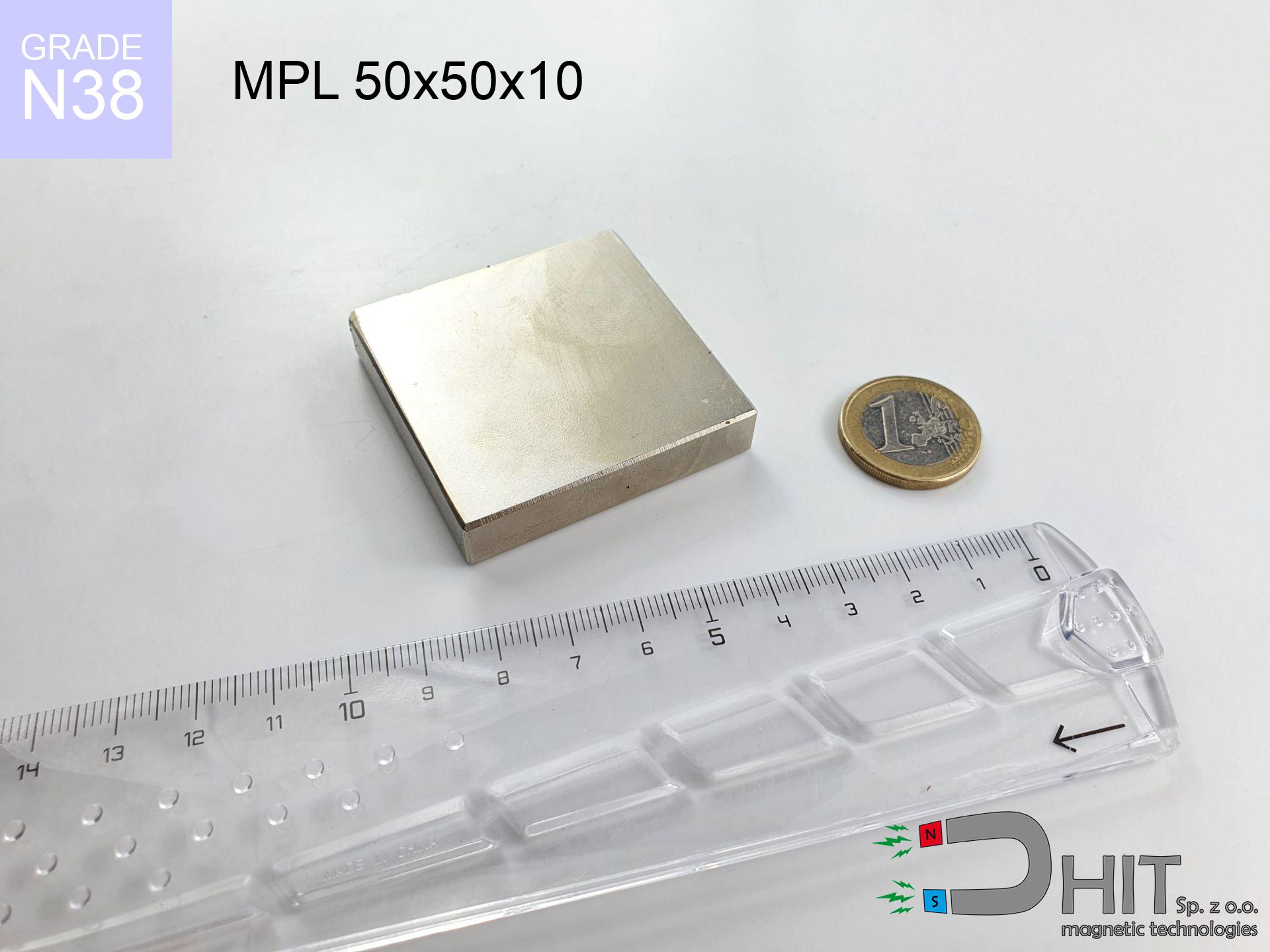
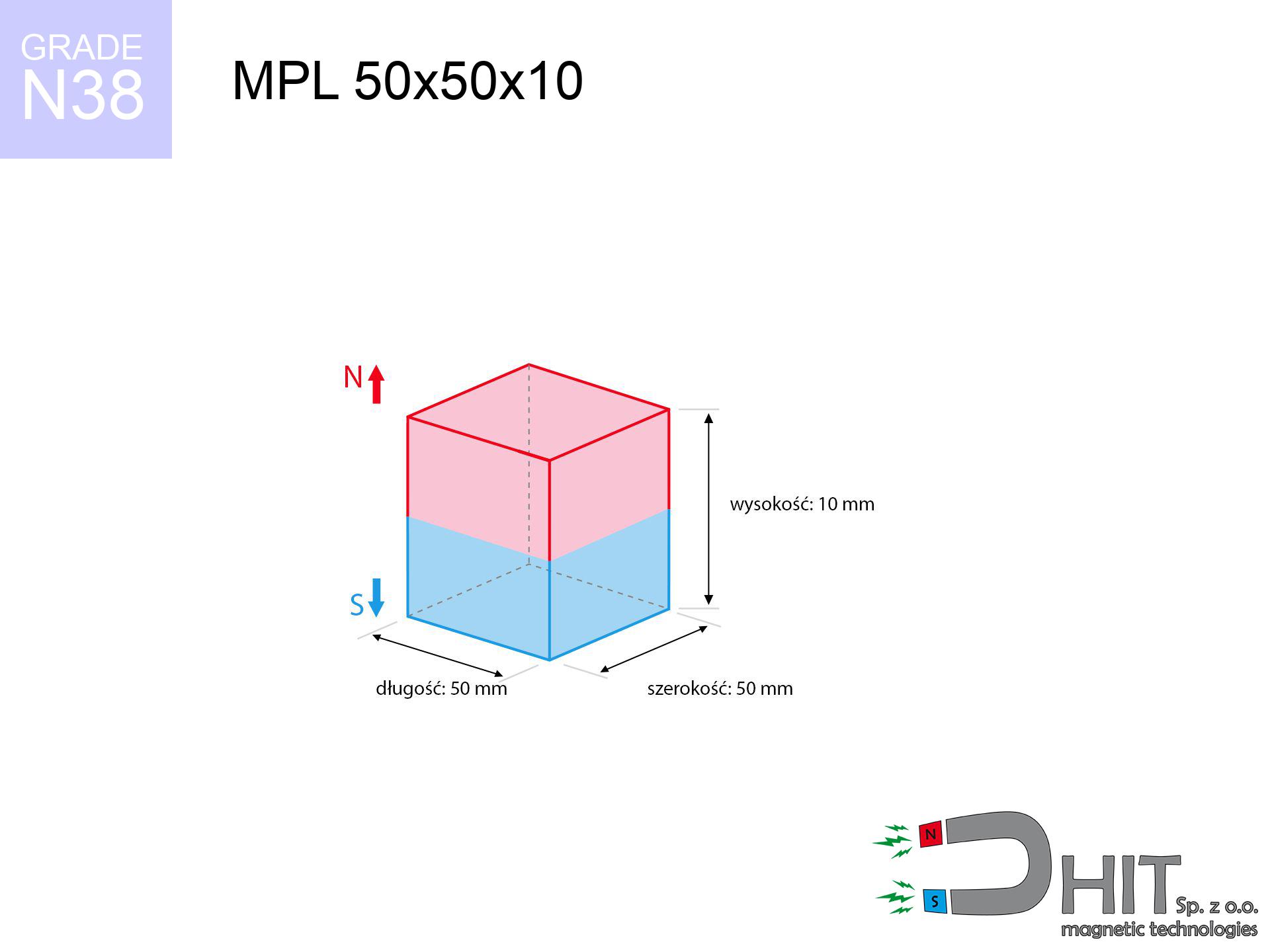
MPL 50x50x10 / N38 - lamellar magnet
lamellar magnet
Catalog no 020167
GTIN/EAN: 5906301811732
- length
- 50 mm [±0,1 mm]
- Width
- 50 mm [±0,1 mm]
- Height
- 10 mm [±0,1 mm]
- Weight
- 187.5 g
- Magnetization Direction
- ↑ axial
- Coating
- [NiCuNi] Nickel
How we measure these parameters — certificates and measurements
34.86 zł net / pcs
42.88 zł with VAT (23% VAT) / pcs
bulk discounts:
Need more?Frequently asked questions
What pull rating should I choose for a workshop block magnet?
Are block neodymium magnets available in more durable versions?
How should I choose block magnets for mounting a structure?
Engineering report for this magnet
Full PDF analysis: pull and shear force, effect of distance, temperature and plate thickness, safety distances and the demagnetization curve.
Call us now
+48 888 99 98 98
alternatively let us know using
contact form
the contact section.
Specifications and structure of a neodymium magnet can be estimated using our
power calculator.
Order by 14:00 and we’ll ship today!
Technical - MPL 50x50x10 / N38 - lamellar magnet
Specification / characteristics - MPL 50x50x10 / N38 - lamellar magnet
| properties | values |
|---|---|
| Cat. no. | 020167 |
| GTIN/EAN | 5906301811732 |
| Production/Distribution | Dhit sp. z o.o. |
| Country of origin | Poland / China / Germany |
| Customs code | 85059029 |
| length | 50 mm [±0,1 mm] |
| Width | 50 mm [±0,1 mm] |
| Height | 10 mm [±0,1 mm] |
| Weight | 187.5 g |
| Magnetization Direction | ↑ axial |
| Load capacity ~ ? | 33.73 kg / 330.92 N |
| Magnetic Induction ~ ? | 209.75 mT / 2097 Gs |
| Coating | [NiCuNi] Nickel |
| Manufacturing Tolerance | ±0.1 mm |
Magnetic properties of material N38
| properties | values | units |
|---|---|---|
| Remanence Br ? | 12.2-12.6 | kGs |
| Remanence Br ? | 1220-1260 | mT |
| Coercivity bHc ? | 10.8-11.5 | kOe |
| Coercivity bHc ? | 860-915 | kA/m |
| Intrinsic coercivity iHc | ≥ 12 | kOe |
| Intrinsic coercivity iHc | ≥ 955 | kA/m |
| Energy product BHmax ? | 36-38 | BH max MGOe |
| Energy product BHmax ? | 287-303 | BH max KJ/m |
| Maximum working temperature ? | ≤ 80 | °C |
Physical properties of sintered neodymium magnets Nd2Fe14B at 20°C
| properties | values | units |
|---|---|---|
| Vickers hardness | ≥550 | Hv |
| Density | ≥7.4 | g/cm3 |
| Curie Temperature TC | 310 | °C |
| Curie Temperature TF | 590 | °F |
| Specific resistance | 150 | μΩ⋅cm |
| Bending strength | 250 | MPa |
| Compressive strength | 1000~1100 | MPa |
| Thermal expansion parallel (∥) to orientation (M) | (3-4) x 10-6 | °C-1 |
| Thermal expansion perpendicular (⊥) to orientation (M) | -(1-3) x 10-6 | °C-1 |
| Young's modulus | 1.7 x 10⁴ | kg/mm² |
Technical analysis of the magnet - technical parameters
These values are the direct effect of a engineering analysis. Values rely on algorithms for the material Nd2Fe14B. Real-world performance might slightly deviate from the simulation results. Please consider these calculations as a supplementary guide during assembly planning.
Table 1: Static pull force (force vs gap) - characteristics
MPL 50x50x10 / N38
| Distance (mm) | Induction (Gauss) / mT | Pull Force (kg/lbs/g/N) | Risk Status |
|---|---|---|---|
| 0 mm |
2097 Gs
209.7 mT
|
33.73 kg / 74.36 pounds
33730.0 g / 330.9 N
|
dangerous! |
| 1 mm |
2056 Gs
205.6 mT
|
32.43 kg / 71.50 pounds
32430.0 g / 318.1 N
|
dangerous! |
| 2 mm |
2009 Gs
200.9 mT
|
30.96 kg / 68.27 pounds
30964.6 g / 303.8 N
|
dangerous! |
| 3 mm |
1957 Gs
195.7 mT
|
29.38 kg / 64.77 pounds
29380.4 g / 288.2 N
|
dangerous! |
| 5 mm |
1841 Gs
184.1 mT
|
25.99 kg / 57.30 pounds
25992.3 g / 255.0 N
|
dangerous! |
| 10 mm |
1514 Gs
151.4 mT
|
17.58 kg / 38.75 pounds
17577.6 g / 172.4 N
|
dangerous! |
| 15 mm |
1194 Gs
119.4 mT
|
10.93 kg / 24.10 pounds
10931.8 g / 107.2 N
|
dangerous! |
| 20 mm |
922 Gs
92.2 mT
|
6.51 kg / 14.36 pounds
6512.2 g / 63.9 N
|
medium risk |
| 30 mm |
543 Gs
54.3 mT
|
2.26 kg / 4.98 pounds
2260.0 g / 22.2 N
|
medium risk |
| 50 mm |
209 Gs
20.9 mT
|
0.33 kg / 0.74 pounds
334.1 g / 3.3 N
|
low risk |
Table 2: Slippage load (wall)
MPL 50x50x10 / N38
| Distance (mm) | Friction coefficient | Pull Force (kg/lbs/g/N) |
|---|---|---|
| 0 mm | Stal (~0.2) |
6.75 kg / 14.87 pounds
6746.0 g / 66.2 N
|
| 1 mm | Stal (~0.2) |
6.49 kg / 14.30 pounds
6486.0 g / 63.6 N
|
| 2 mm | Stal (~0.2) |
6.19 kg / 13.65 pounds
6192.0 g / 60.7 N
|
| 3 mm | Stal (~0.2) |
5.88 kg / 12.95 pounds
5876.0 g / 57.6 N
|
| 5 mm | Stal (~0.2) |
5.20 kg / 11.46 pounds
5198.0 g / 51.0 N
|
| 10 mm | Stal (~0.2) |
3.52 kg / 7.75 pounds
3516.0 g / 34.5 N
|
| 15 mm | Stal (~0.2) |
2.19 kg / 4.82 pounds
2186.0 g / 21.4 N
|
| 20 mm | Stal (~0.2) |
1.30 kg / 2.87 pounds
1302.0 g / 12.8 N
|
| 30 mm | Stal (~0.2) |
0.45 kg / 1.00 pounds
452.0 g / 4.4 N
|
| 50 mm | Stal (~0.2) |
0.07 kg / 0.15 pounds
66.0 g / 0.6 N
|
Table 3: Wall mounting (sliding) - behavior on slippery surfaces
MPL 50x50x10 / N38
| Surface type | Friction coefficient / % Mocy | Max load (kg/lbs/g/N) |
|---|---|---|
| Raw steel |
µ = 0.3
30% Nominalnej Siły
|
10.12 kg / 22.31 pounds
10119.0 g / 99.3 N
|
| Painted steel (standard) |
µ = 0.2
20% Nominalnej Siły
|
6.75 kg / 14.87 pounds
6746.0 g / 66.2 N
|
| Oily/slippery steel |
µ = 0.1
10% Nominalnej Siły
|
3.37 kg / 7.44 pounds
3373.0 g / 33.1 N
|
| Magnet with anti-slip rubber |
µ = 0.5
50% Nominalnej Siły
|
16.87 kg / 37.18 pounds
16865.0 g / 165.4 N
|
Table 4: Steel thickness (substrate influence) - sheet metal selection
MPL 50x50x10 / N38
| Steel thickness (mm) | % power | Real pull force (kg/lbs/g/N) |
|---|---|---|
| 0.5 mm |
|
1.69 kg / 3.72 pounds
1686.5 g / 16.5 N
|
| 1 mm |
|
4.22 kg / 9.30 pounds
4216.3 g / 41.4 N
|
| 2 mm |
|
8.43 kg / 18.59 pounds
8432.5 g / 82.7 N
|
| 3 mm |
|
12.65 kg / 27.89 pounds
12648.8 g / 124.1 N
|
| 5 mm |
|
21.08 kg / 46.48 pounds
21081.2 g / 206.8 N
|
| 10 mm |
|
33.73 kg / 74.36 pounds
33730.0 g / 330.9 N
|
| 11 mm |
|
33.73 kg / 74.36 pounds
33730.0 g / 330.9 N
|
| 12 mm |
|
33.73 kg / 74.36 pounds
33730.0 g / 330.9 N
|
Table 5: Thermal stability (stability) - thermal limit
MPL 50x50x10 / N38
| Ambient temp. (°C) | Power loss | Remaining pull (kg/lbs/g/N) | Status |
|---|---|---|---|
| 20 °C | 0.0% |
33.73 kg / 74.36 pounds
33730.0 g / 330.9 N
|
OK |
| 40 °C | -2.2% |
32.99 kg / 72.73 pounds
32987.9 g / 323.6 N
|
OK |
| 60 °C | -4.4% |
32.25 kg / 71.09 pounds
32245.9 g / 316.3 N
|
|
| 80 °C | -6.6% |
31.50 kg / 69.45 pounds
31503.8 g / 309.1 N
|
|
| 100 °C | -28.8% |
24.02 kg / 52.95 pounds
24015.8 g / 235.6 N
|
Table 6: Two magnets (attraction) - forces in the system
MPL 50x50x10 / N38
| Gap (mm) | Attraction (kg/lbs) (N-S) | Shear Strength (kg/lbs/g/N) | Repulsion (kg/lbs) (N-N) |
|---|---|---|---|
| 0 mm |
67.80 kg / 149.46 pounds
3 611 Gs
|
10.17 kg / 22.42 pounds
10169 g / 99.8 N
|
N/A |
| 1 mm |
66.54 kg / 146.70 pounds
4 156 Gs
|
9.98 kg / 22.01 pounds
9982 g / 97.9 N
|
59.89 kg / 132.03 pounds
~0 Gs
|
| 2 mm |
65.18 kg / 143.70 pounds
4 113 Gs
|
9.78 kg / 21.56 pounds
9777 g / 95.9 N
|
58.66 kg / 129.33 pounds
~0 Gs
|
| 3 mm |
63.74 kg / 140.53 pounds
4 067 Gs
|
9.56 kg / 21.08 pounds
9562 g / 93.8 N
|
57.37 kg / 126.48 pounds
~0 Gs
|
| 5 mm |
60.67 kg / 133.75 pounds
3 968 Gs
|
9.10 kg / 20.06 pounds
9101 g / 89.3 N
|
54.60 kg / 120.38 pounds
~0 Gs
|
| 10 mm |
52.24 kg / 115.18 pounds
3 682 Gs
|
7.84 kg / 17.28 pounds
7836 g / 76.9 N
|
47.02 kg / 103.66 pounds
~0 Gs
|
| 20 mm |
35.33 kg / 77.89 pounds
3 028 Gs
|
5.30 kg / 11.68 pounds
5299 g / 52.0 N
|
31.80 kg / 70.10 pounds
~0 Gs
|
| 50 mm |
7.69 kg / 16.96 pounds
1 413 Gs
|
1.15 kg / 2.54 pounds
1154 g / 11.3 N
|
6.92 kg / 15.26 pounds
~0 Gs
|
| 60 mm |
4.54 kg / 10.01 pounds
1 086 Gs
|
0.68 kg / 1.50 pounds
681 g / 6.7 N
|
4.09 kg / 9.01 pounds
~0 Gs
|
| 70 mm |
2.72 kg / 6.01 pounds
841 Gs
|
0.41 kg / 0.90 pounds
409 g / 4.0 N
|
2.45 kg / 5.41 pounds
~0 Gs
|
| 80 mm |
1.67 kg / 3.68 pounds
658 Gs
|
0.25 kg / 0.55 pounds
250 g / 2.5 N
|
1.50 kg / 3.31 pounds
~0 Gs
|
| 90 mm |
1.05 kg / 2.31 pounds
521 Gs
|
0.16 kg / 0.35 pounds
157 g / 1.5 N
|
0.94 kg / 2.08 pounds
~0 Gs
|
| 100 mm |
0.67 kg / 1.48 pounds
417 Gs
|
0.10 kg / 0.22 pounds
101 g / 1.0 N
|
0.60 kg / 1.33 pounds
~0 Gs
|
Table 7: Protective zones (electronics) - precautionary measures
MPL 50x50x10 / N38
| Object / Device | Limit (Gauss) / mT | Safe distance |
|---|---|---|
| Pacemaker | 5 Gs (0.5 mT) | 21.0 cm |
| Hearing aid | 10 Gs (1.0 mT) | 16.5 cm |
| Mechanical watch | 20 Gs (2.0 mT) | 13.0 cm |
| Phone / Smartphone | 40 Gs (4.0 mT) | 10.0 cm |
| Car key | 50 Gs (5.0 mT) | 9.5 cm |
| Payment card | 400 Gs (40.0 mT) | 4.0 cm |
| HDD hard drive | 600 Gs (60.0 mT) | 3.0 cm |
Table 8: Dynamics (cracking risk) - warning
MPL 50x50x10 / N38
| Start from (mm) | Speed (km/h) | Energy (J) | Predicted outcome |
|---|---|---|---|
| 10 mm |
18.75 km/h
(5.21 m/s)
|
2.54 J | |
| 30 mm |
23.65 km/h
(6.57 m/s)
|
4.05 J | |
| 50 mm |
24.20 km/h
(6.72 m/s)
|
4.24 J | |
| 100 mm |
24.32 km/h
(6.76 m/s)
|
4.28 J |
Table 9: Coating parameters (durability)
MPL 50x50x10 / N38
| Technical parameter | Value / Description |
|---|---|
| Coating type | [NiCuNi] Nickel |
| Layer structure | Nickel - Copper - Nickel |
| Layer thickness | 10-20 µm |
| Salt spray test (SST) ? | 24 h |
| Recommended environment | Indoors only (dry) |
Table 10: Electrical data (Pc)
MPL 50x50x10 / N38
| Parameter | Value | SI Unit / Description |
|---|---|---|
| Magnetic Flux | 61 501 Mx | 615.0 µWb |
| Pc Coefficient | 0.26 | Low (Flat) |
Table 11: Underwater work (magnet fishing)
MPL 50x50x10 / N38
| Environment | Effective steel pull | Effect |
|---|---|---|
| Air (land) | 33.73 kg | Standard |
| Water (riverbed) |
38.62 kg
(+4.89 kg buoyancy gain)
|
+14.5% |
1. Wall mount (shear)
*Note: On a vertical wall, the magnet retains only ~20% of its max power.
2. Steel thickness impact
*Thin steel (e.g. 0.5mm PC case) significantly weakens the holding force.
3. Thermal stability
N38: the maximum material working temperature is 80°C. Permitted conditions also depend on the shape and magnetic circuit.
4. Demagnetization curve and operating point (B-H)
chart generated for the permeance coefficient Pc (Permeance Coefficient) = 0.26
This simulation demonstrates the magnetic stability of the selected magnet under specific geometric conditions. The solid red line represents the demagnetization curve (material potential), while the dashed blue line is the load line based on the magnet's geometry. The Pc (Permeance Coefficient), also known as the load line slope, is a dimensionless value that describes the relationship between the magnet's shape and its magnetic stability. The intersection of these two lines (the black dot) is the operating point — it determines the actual magnetic flux density generated by the magnet in this specific configuration. A higher Pc value means the magnet is more 'slender' (tall relative to its area), resulting in a higher operating point and better resistance to irreversible demagnetization caused by external fields or temperature. A value of 0.42 is relatively low (typical for flat magnets), meaning the operating point is closer to the 'knee' of the curve — caution is advised when operating at temperatures near the maximum limit to avoid strength loss.
Chemical composition
| iron (Fe) | 64% – 68% |
| neodymium (Nd) | 29% – 32% |
| boron (B) | 1.1% – 1.2% |
| dysprosium (Dy) | 0.5% – 2.0% |
| coating (Ni-Cu-Ni) | < 0.05% |
Environmental data
| recyclability (EoL) | 100% |
| recycled raw materials | ~10% (pre-cons) |
| carbon footprint | low / zredukowany |
| waste code (EWC) | 16 02 16 |
See more deals


Pros and cons of Nd2Fe14B magnets.
Benefits
- Their strength remains stable, and after approximately 10 years it decreases only by ~1% (according to research),
- They retain their magnetic properties even under external field action,
- The use of an metallic finish of noble metals (nickel, gold, silver) causes the element to be more visually attractive,
- Magnetic induction on the working part of the magnet remains impressive,
- Through (appropriate) combination of ingredients, they can achieve high thermal resistance, allowing for operation at temperatures reaching 230°C and above...
- Considering the ability of free forming and adaptation to unique requirements, NdFeB magnets can be created in a wide range of geometric configurations, which makes them more universal,
- Universal use in high-tech industry – they serve a role in magnetic memories, motor assemblies, precision medical tools, and multitasking production systems.
- Compactness – despite small sizes they offer powerful magnetic field, making them ideal for precision applications
Limitations
- They are fragile upon too strong impacts. To avoid cracks, it is worth securing magnets using a steel holder. Such protection not only shields the magnet but also improves its resistance to damage
- Do not exceed this material temperature limit: 80°C. Overheating may permanently weaken the magnet.
- They oxidize in a humid environment - during use outdoors we recommend using waterproof magnets e.g. in rubber, plastic
- Due to limitations in realizing threads and complex shapes in magnets, we recommend using a housing - magnetic mount.
- Potential hazard resulting from small fragments of magnets are risky, when accidentally swallowed, which becomes key in the context of child health protection. Furthermore, small components of these magnets are able to be problematic in diagnostics medical in case of swallowing.
- With mass production the cost of neodymium magnets is a challenge,
Pull force analysis
Detachment force of the magnet in optimal conditions – what affects it?
- with the application of a yoke made of special test steel, ensuring full magnetic saturation
- with a thickness no less than 10 mm
- characterized by even structure
- with direct contact (without paint)
- for force applied at a right angle (pull-off, not shear)
- at ambient temperature approx. 20 degrees Celsius
Lifting capacity in real conditions – factors
- Gap (betwixt the magnet and the plate), as even a tiny clearance (e.g. 0.5 mm) results in a drastic drop in lifting capacity by up to 50% (this also applies to paint, rust or dirt).
- Pull-off angle – remember that the magnet has greatest strength perpendicularly. Under shear forces, the holding force drops drastically, often to levels of 20-30% of the maximum value.
- Wall thickness – the thinner the sheet, the weaker the hold. Magnetic flux passes through the material instead of converting into lifting capacity.
- Steel grade – ideal substrate is high-permeability steel. Hardened steels may have worse magnetic properties.
- Base smoothness – the more even the plate, the better the adhesion and higher the lifting capacity. Roughness acts like micro-gaps.
- Operating temperature – NdFeB sinters have a sensitivity to temperature. When it is hot they are weaker, and in frost they can be stronger (up to a certain limit).
Holding force was measured on the plate surface of 20 mm thickness, when the force acted perpendicularly, in contrast under parallel forces the holding force is lower. Moreover, even a slight gap between the magnet’s surface and the plate lowers the lifting capacity.
Safe handling of neodymium magnets
Metal Allergy
Medical facts indicate that the nickel plating (the usual finish) is a potent allergen. If you have an allergy, prevent touching magnets with bare hands or choose encased magnets.
Warning for heart patients
Life threat: Neodymium magnets can turn off heart devices and defibrillators. Do not approach if you have medical devices.
Do not overheat magnets
Watch the temperature. Exposing the magnet above 80 degrees Celsius will permanently weaken its properties and strength.
Precision electronics
Navigation devices and mobile phones are extremely susceptible to magnetic fields. Direct contact with a strong magnet can ruin the sensors in your phone.
No play value
Only for adults. Small elements can be swallowed, causing intestinal necrosis. Keep out of reach of kids and pets.
Electronic hazard
Powerful magnetic fields can destroy records on payment cards, hard drives, and other magnetic media. Maintain a gap of min. 10 cm.
Eye protection
Neodymium magnets are sintered ceramics, which means they are prone to chipping. Impact of two magnets will cause them shattering into shards.
Do not drill into magnets
Mechanical processing of neodymium magnets carries a risk of fire risk. Magnetic powder reacts violently with oxygen and is difficult to extinguish.
Caution required
Be careful. Rare earth magnets attract from a distance and snap with huge force, often quicker than you can move away.
Crushing risk
Protect your hands. Two large magnets will join instantly with a force of massive weight, destroying everything in their path. Be careful!
Tabela kosztu i czasu dostawy
Płatność przed wysyłką:

GLS kurier
Przesyłka będzie u Ciebie za 2-3 dni
14.99 ZŁ

InPost Paczkomaty 24/7
Przesyłka będzie u Ciebie za 1-2 dni
12.30 ZŁ
Płatność przy odbiorze (pobranie):
GLS kurier
Przesyłka będzie u Ciebie za 1-2 dni
23.00 ZŁ