

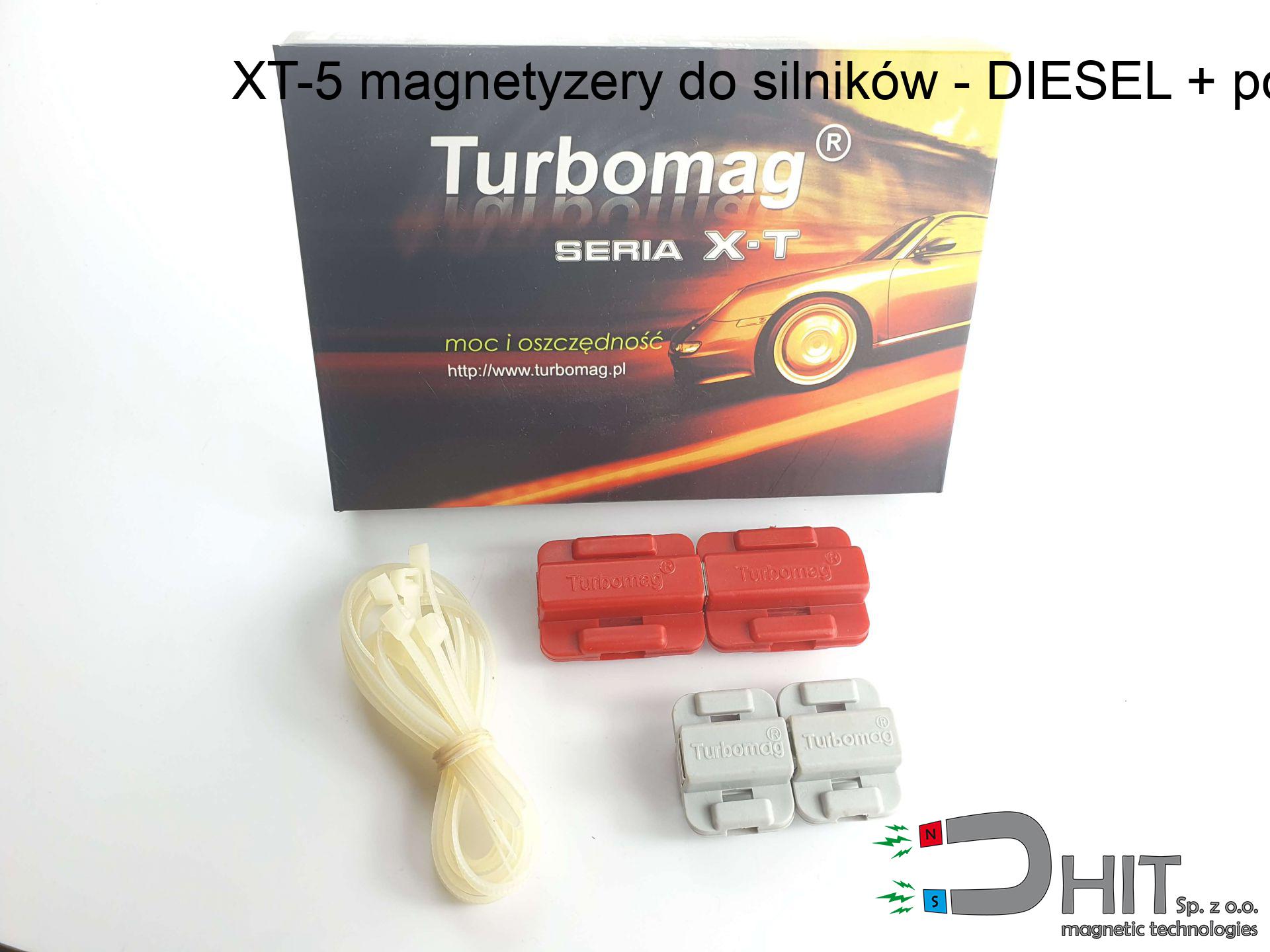
XT-5 magnetyzery do silników - DIESEL + powietrze - XT-5 magnetizer
XT-5 magnetizer
Catalog no 060246
GTIN/EAN: 5906301812401
77.23 zł net / pcs
94.99 zł with VAT (23% VAT) / pcs
bulk discounts:
Need more?Frequently asked questions
Which Turbomag® model should I choose?
Is a magnetizer used to capture metal swarf?
How do I match a model to an installation?
Where is a magnetizer fitted?
What are the fastening parts made of?
What operating temperature is allowed?
Guides from the knowledge base
Call us now
+48 888 99 98 98
alternatively let us know using
contact form
the contact section.
Specifications and structure of a neodymium magnet can be estimated using our
power calculator.
Order by 14:00 and we’ll ship today!
Detailed specification - XT-5 magnetyzery do silników - DIESEL + powietrze - XT-5 magnetizer
Specification / characteristics - XT-5 magnetyzery do silników - DIESEL + powietrze - XT-5 magnetizer
| properties | values |
|---|---|
| Cat. no. | 060246 |
| GTIN/EAN | 5906301812401 |
| Production/Distribution | Dhit sp. z o.o. |
| Country of origin | Poland / China / Germany |
| Customs code | 85059029 |
| Weight | 190 g |
| Manufacturing Tolerance | ±1 mm |
Physical properties of sintered neodymium magnets Nd2Fe14B at 20°C
| properties | values | units |
|---|---|---|
| Vickers hardness | ≥550 | Hv |
| Density | ≥7.4 | g/cm3 |
| Curie Temperature TC | 310 | °C |
| Curie Temperature TF | 590 | °F |
| Specific resistance | 150 | μΩ⋅cm |
| Bending strength | 250 | MPa |
| Compressive strength | 1000~1100 | MPa |
| Thermal expansion parallel (∥) to orientation (M) | (3-4) x 10-6 | °C-1 |
| Thermal expansion perpendicular (⊥) to orientation (M) | -(1-3) x 10-6 | °C-1 |
| Young's modulus | 1.7 x 10⁴ | kg/mm² |
Material specification
| iron (Fe) | 64% – 68% |
| neodymium (Nd) | 29% – 32% |
| boron (B) | 1.1% – 1.2% |
| dysprosium (Dy) | 0.5% – 2.0% |
| coating (Ni-Cu-Ni) | < 0.05% |
Sustainability
| recyclability (EoL) | 100% |
| recycled raw materials | ~10% (pre-cons) |
| carbon footprint | low / zredukowany |
| waste code (EWC) | 16 02 16 |
View also products
Strengths and weaknesses of neodymium magnets.
Pros
- They do not lose magnetism, even during nearly ten years – the drop in power is only ~1% (theoretically),
- Magnets effectively protect themselves against demagnetization caused by ambient magnetic noise,
- A magnet with a shiny nickel surface has an effective appearance,
- Magnetic induction on the working part of the magnet is impressive,
- Made from properly selected components, these magnets show impressive resistance to high heat, enabling them to function (depending on their shape) at temperatures up to 230°C and above...
- In view of the ability of flexible shaping and adaptation to unique projects, NdFeB magnets can be modeled in a broad palette of geometric configurations, which expands the range of possible applications,
- Huge importance in innovative solutions – they find application in hard drives, motor assemblies, advanced medical instruments, as well as other advanced devices.
- Relatively small size with high pulling force – neodymium magnets offer high power in small dimensions, which enables their usage in miniature devices
Limitations
- Brittleness is one of their disadvantages. Upon intense impact they can break. We advise keeping them in a strong case, which not only secures them against impacts but also raises their durability
- Heat sensitivity: observe the temperature specified for this product. Overheating may permanently weaken the magnet.
- Magnets exposed to a humid environment can corrode. Therefore while using outdoors, we recommend using waterproof magnets made of rubber, plastic or other material protecting against moisture
- Due to limitations in creating threads and complex shapes in magnets, we propose using casing - magnetic mount.
- Potential hazard resulting from small fragments of magnets can be dangerous, if swallowed, which becomes key in the aspect of protecting the youngest. It is also worth noting that small components of these magnets can be problematic in diagnostics medical after entering the body.
- Due to complex production process, their price is relatively high,
Holding force characteristics
Magnetic strength at its maximum – what it depends on?
- with the contact of a yoke made of low-carbon steel, ensuring full magnetic saturation
- whose thickness equals approx. 10 mm
- characterized by lack of roughness
- without any clearance between the magnet and steel
- under vertical force direction (90-degree angle)
- at temperature approx. 20 degrees Celsius
Lifting capacity in practice – influencing factors
- Gap between surfaces – even a fraction of a millimeter of separation (caused e.g. by veneer or unevenness) significantly weakens the magnet efficiency, often by half at just 0.5 mm.
- Force direction – catalog parameter refers to pulling vertically. When slipping, the magnet exhibits significantly lower power (typically approx. 20-30% of nominal force).
- Steel thickness – insufficiently thick sheet does not accept the full field, causing part of the power to be wasted to the other side.
- Plate material – low-carbon steel gives the best results. Higher carbon content lower magnetic permeability and holding force.
- Smoothness – full contact is obtained only on smooth steel. Any scratches and bumps reduce the real contact area, reducing force.
- Temperature – heating the magnet causes a temporary drop of force. Check the thermal limit for a given model.
Holding force was tested on a smooth steel plate of 20 mm thickness, when the force acted perpendicularly, however under shearing force the load capacity is reduced by as much as 75%. In addition, even a slight gap between the magnet’s surface and the plate decreases the holding force.
H&S for magnets
Impact on smartphones
Remember: rare earth magnets produce a field that disrupts sensitive sensors. Keep a separation from your mobile, device, and navigation systems.
Mechanical processing
Powder generated during machining of magnets is combustible. Do not drill into magnets without proper cooling and knowledge.
Nickel allergy
Some people experience a sensitization to nickel, which is the typical protective layer for NdFeB magnets. Extended handling might lead to an allergic reaction. It is best to use protective gloves.
Health Danger
Individuals with a ICD have to maintain an safe separation from magnets. The magnetic field can interfere with the functioning of the implant.
Conscious usage
Exercise caution. Neodymium magnets attract from a distance and connect with massive power, often faster than you can move away.
Operating temperature
Avoid heat. Neodymium magnets are sensitive to temperature. If you need operation above 80°C, inquire about special high-temperature series (H, SH, UH).
Serious injuries
Protect your hands. Two large magnets will join immediately with a force of several hundred kilograms, destroying everything in their path. Be careful!
Swallowing risk
Absolutely keep magnets out of reach of children. Risk of swallowing is high, and the effects of magnets connecting inside the body are fatal.
Threat to electronics
Very strong magnetic fields can corrupt files on payment cards, HDDs, and other magnetic media. Maintain a gap of min. 10 cm.
Protective goggles
Protect your eyes. Magnets can explode upon violent connection, ejecting shards into the air. Wear goggles.
Tabela kosztu i czasu dostawy
Płatność przed wysyłką:

GLS kurier
Przesyłka będzie u Ciebie za 2-3 dni
14.99 ZŁ

InPost Paczkomaty 24/7
Przesyłka będzie u Ciebie za 1-2 dni
12.30 ZŁ
Płatność przy odbiorze (pobranie):
GLS kurier
Przesyłka będzie u Ciebie za 1-2 dni
23.00 ZŁ