

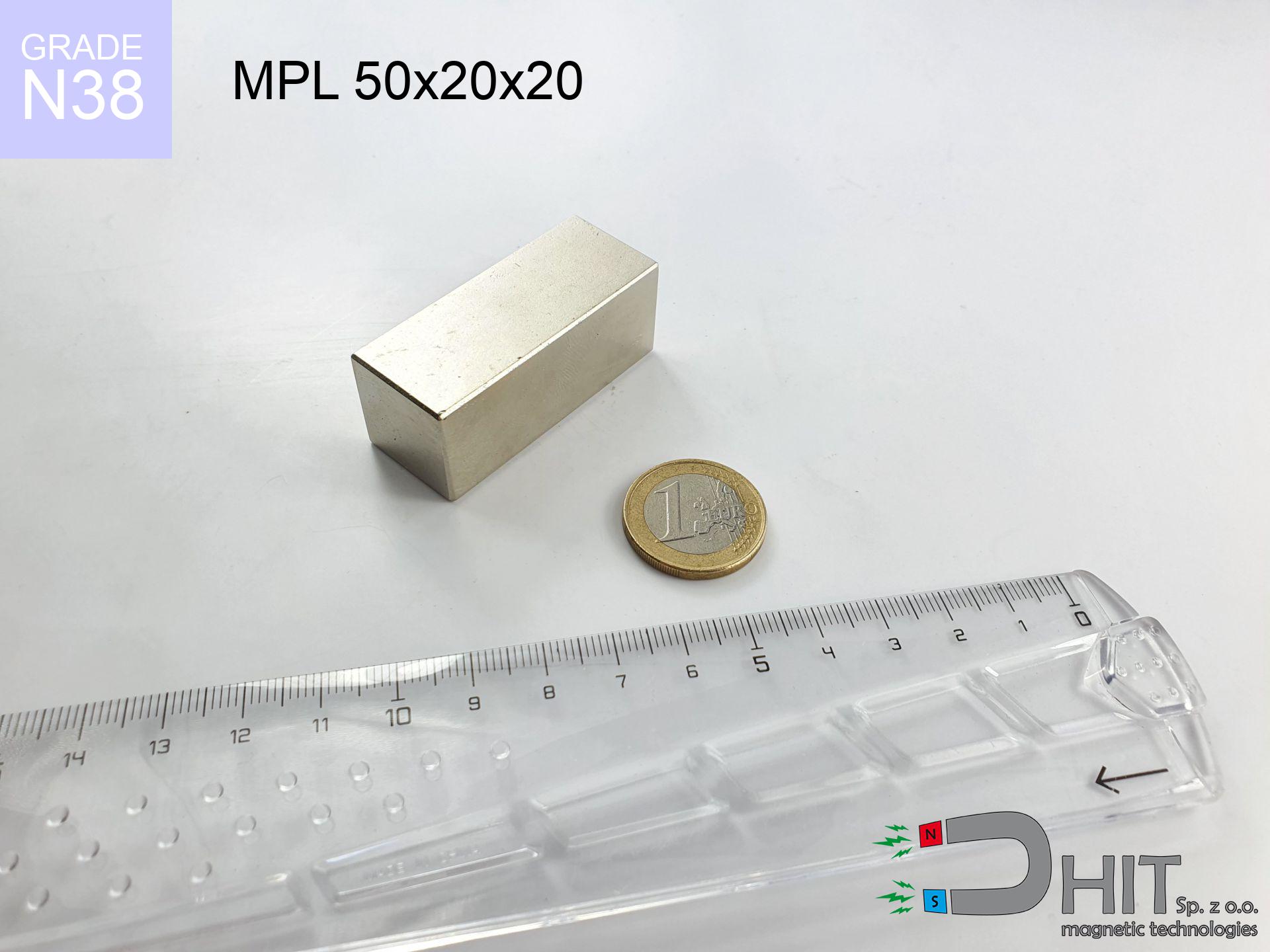
MPL 50x20x20 / N38 - lamellar magnet
lamellar magnet
Catalog no 020166
GTIN/EAN: 5906301811725
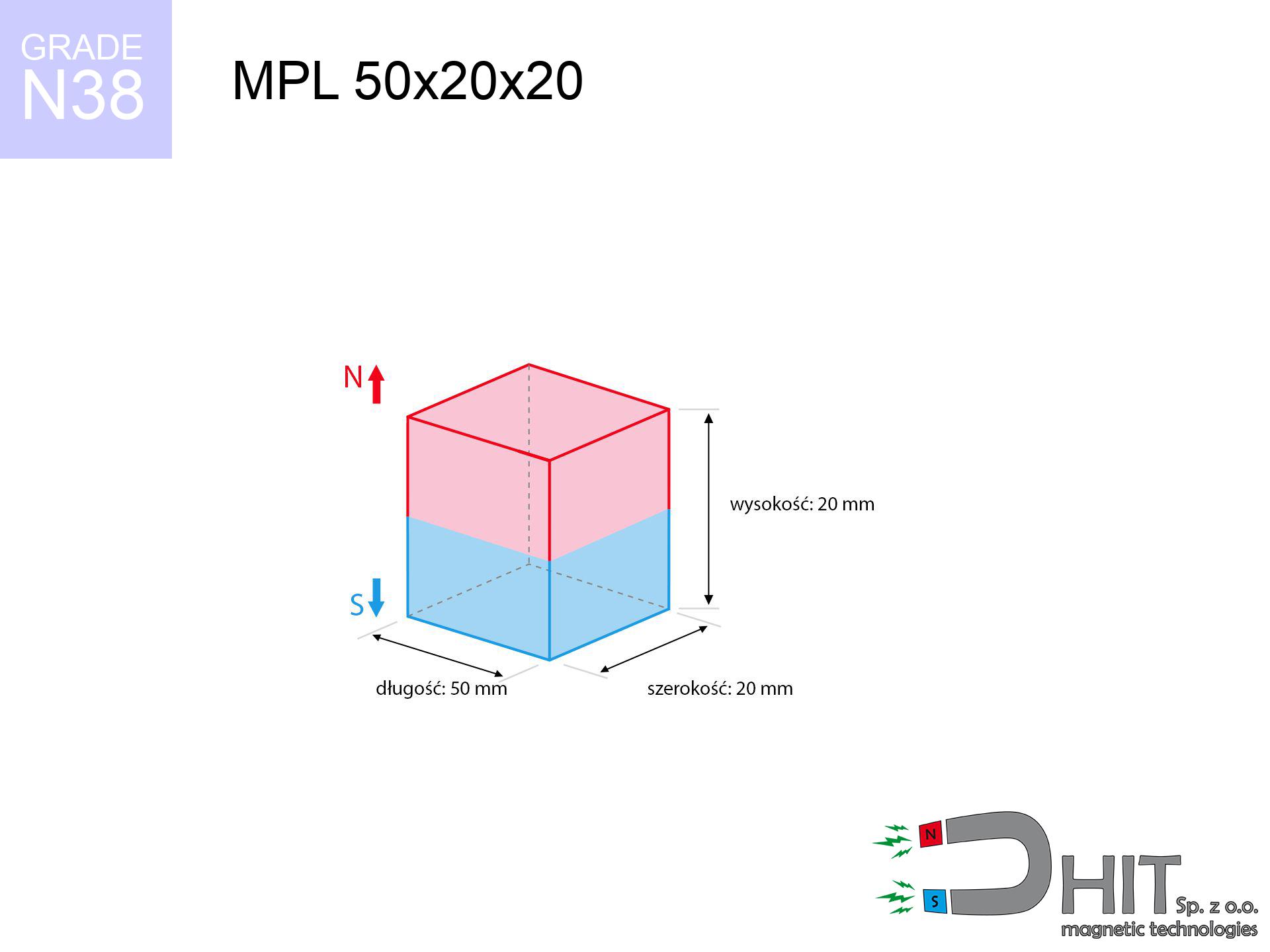
- length
- 50 mm [±0,1 mm]
- Width
- 20 mm [±0,1 mm]
- Height
- 20 mm [±0,1 mm]
- Weight
- 150 g
- Magnetization Direction
- ↑ axial
- Coating
- [NiCuNi] Nickel
How we measure these parameters — certificates and measurements
38.47 zł net / pcs
47.32 zł with VAT (23% VAT) / pcs
bulk discounts:
Need more?Frequently asked questions
What pull rating should I choose for a workshop block magnet?
Are block neodymium magnets available in more durable versions?
How should I choose block magnets for mounting a structure?
Engineering report for this magnet
Full PDF analysis: pull and shear force, effect of distance, temperature and plate thickness, safety distances and the demagnetization curve.
Call us now
+48 888 99 98 98
alternatively let us know using
contact form
the contact section.
Specifications and structure of a neodymium magnet can be estimated using our
power calculator.
Order by 14:00 and we’ll ship today!
Technical data of the product - MPL 50x20x20 / N38 - lamellar magnet
Specification / characteristics - MPL 50x20x20 / N38 - lamellar magnet
| properties | values |
|---|---|
| Cat. no. | 020166 |
| GTIN/EAN | 5906301811725 |
| Production/Distribution | Dhit sp. z o.o. |
| Country of origin | Poland / China / Germany |
| Customs code | 85059029 |
| length | 50 mm [±0,1 mm] |
| Width | 20 mm [±0,1 mm] |
| Height | 20 mm [±0,1 mm] |
| Weight | 150 g |
| Magnetization Direction | ↑ axial |
| Load capacity ~ ? | 42.18 kg / 413.81 N |
| Magnetic Induction ~ ? | 478.99 mT / 4790 Gs |
| Coating | [NiCuNi] Nickel |
| Manufacturing Tolerance | ±0.1 mm |
Magnetic properties of material N38
| properties | values | units |
|---|---|---|
| Remanence Br ? | 12.2-12.6 | kGs |
| Remanence Br ? | 1220-1260 | mT |
| Coercivity bHc ? | 10.8-11.5 | kOe |
| Coercivity bHc ? | 860-915 | kA/m |
| Intrinsic coercivity iHc | ≥ 12 | kOe |
| Intrinsic coercivity iHc | ≥ 955 | kA/m |
| Energy product BHmax ? | 36-38 | BH max MGOe |
| Energy product BHmax ? | 287-303 | BH max KJ/m |
| Maximum working temperature ? | ≤ 80 | °C |
Physical properties of sintered neodymium magnets Nd2Fe14B at 20°C
| properties | values | units |
|---|---|---|
| Vickers hardness | ≥550 | Hv |
| Density | ≥7.4 | g/cm3 |
| Curie Temperature TC | 310 | °C |
| Curie Temperature TF | 590 | °F |
| Specific resistance | 150 | μΩ⋅cm |
| Bending strength | 250 | MPa |
| Compressive strength | 1000~1100 | MPa |
| Thermal expansion parallel (∥) to orientation (M) | (3-4) x 10-6 | °C-1 |
| Thermal expansion perpendicular (⊥) to orientation (M) | -(1-3) x 10-6 | °C-1 |
| Young's modulus | 1.7 x 10⁴ | kg/mm² |
Physical simulation of the magnet - technical parameters
These data constitute the outcome of a mathematical analysis. Values were calculated on models for the class Nd2Fe14B. Actual parameters may differ from theoretical values. Treat these data as a supplementary guide during assembly planning.
Table 1: Static force (force vs distance) - interaction chart
MPL 50x20x20 / N38
| Distance (mm) | Induction (Gauss) / mT | Pull Force (kg/lbs/g/N) | Risk Status |
|---|---|---|---|
| 0 mm |
4789 Gs
478.9 mT
|
42.18 kg / 92.99 LBS
42180.0 g / 413.8 N
|
critical level |
| 1 mm |
4452 Gs
445.2 mT
|
36.46 kg / 80.38 LBS
36461.5 g / 357.7 N
|
critical level |
| 2 mm |
4114 Gs
411.4 mT
|
31.13 kg / 68.62 LBS
31126.5 g / 305.4 N
|
critical level |
| 3 mm |
3784 Gs
378.4 mT
|
26.34 kg / 58.06 LBS
26336.3 g / 258.4 N
|
critical level |
| 5 mm |
3173 Gs
317.3 mT
|
18.52 kg / 40.84 LBS
18523.4 g / 181.7 N
|
critical level |
| 10 mm |
2022 Gs
202.2 mT
|
7.52 kg / 16.59 LBS
7522.9 g / 73.8 N
|
medium risk |
| 15 mm |
1324 Gs
132.4 mT
|
3.22 kg / 7.10 LBS
3222.6 g / 31.6 N
|
medium risk |
| 20 mm |
899 Gs
89.9 mT
|
1.49 kg / 3.28 LBS
1487.5 g / 14.6 N
|
low risk |
| 30 mm |
458 Gs
45.8 mT
|
0.39 kg / 0.85 LBS
385.8 g / 3.8 N
|
low risk |
| 50 mm |
159 Gs
15.9 mT
|
0.05 kg / 0.10 LBS
46.4 g / 0.5 N
|
low risk |
Table 2: Vertical force (wall)
MPL 50x20x20 / N38
| Distance (mm) | Friction coefficient | Pull Force (kg/lbs/g/N) |
|---|---|---|
| 0 mm | Stal (~0.2) |
8.44 kg / 18.60 LBS
8436.0 g / 82.8 N
|
| 1 mm | Stal (~0.2) |
7.29 kg / 16.08 LBS
7292.0 g / 71.5 N
|
| 2 mm | Stal (~0.2) |
6.23 kg / 13.73 LBS
6226.0 g / 61.1 N
|
| 3 mm | Stal (~0.2) |
5.27 kg / 11.61 LBS
5268.0 g / 51.7 N
|
| 5 mm | Stal (~0.2) |
3.70 kg / 8.17 LBS
3704.0 g / 36.3 N
|
| 10 mm | Stal (~0.2) |
1.50 kg / 3.32 LBS
1504.0 g / 14.8 N
|
| 15 mm | Stal (~0.2) |
0.64 kg / 1.42 LBS
644.0 g / 6.3 N
|
| 20 mm | Stal (~0.2) |
0.30 kg / 0.66 LBS
298.0 g / 2.9 N
|
| 30 mm | Stal (~0.2) |
0.08 kg / 0.17 LBS
78.0 g / 0.8 N
|
| 50 mm | Stal (~0.2) |
0.01 kg / 0.02 LBS
10.0 g / 0.1 N
|
Table 3: Vertical assembly (sliding) - vertical pull
MPL 50x20x20 / N38
| Surface type | Friction coefficient / % Mocy | Max load (kg/lbs/g/N) |
|---|---|---|
| Raw steel |
µ = 0.3
30% Nominalnej Siły
|
12.65 kg / 27.90 LBS
12654.0 g / 124.1 N
|
| Painted steel (standard) |
µ = 0.2
20% Nominalnej Siły
|
8.44 kg / 18.60 LBS
8436.0 g / 82.8 N
|
| Oily/slippery steel |
µ = 0.1
10% Nominalnej Siły
|
4.22 kg / 9.30 LBS
4218.0 g / 41.4 N
|
| Magnet with anti-slip rubber |
µ = 0.5
50% Nominalnej Siły
|
21.09 kg / 46.50 LBS
21090.0 g / 206.9 N
|
Table 4: Steel thickness (substrate influence) - sheet metal selection
MPL 50x20x20 / N38
| Steel thickness (mm) | % power | Real pull force (kg/lbs/g/N) |
|---|---|---|
| 0.5 mm |
|
2.11 kg / 4.65 LBS
2109.0 g / 20.7 N
|
| 1 mm |
|
5.27 kg / 11.62 LBS
5272.5 g / 51.7 N
|
| 2 mm |
|
10.55 kg / 23.25 LBS
10545.0 g / 103.4 N
|
| 3 mm |
|
15.82 kg / 34.87 LBS
15817.5 g / 155.2 N
|
| 5 mm |
|
26.36 kg / 58.12 LBS
26362.5 g / 258.6 N
|
| 10 mm |
|
42.18 kg / 92.99 LBS
42180.0 g / 413.8 N
|
| 11 mm |
|
42.18 kg / 92.99 LBS
42180.0 g / 413.8 N
|
| 12 mm |
|
42.18 kg / 92.99 LBS
42180.0 g / 413.8 N
|
Table 5: Working in heat (material behavior) - resistance threshold
MPL 50x20x20 / N38
| Ambient temp. (°C) | Power loss | Remaining pull (kg/lbs/g/N) | Status |
|---|---|---|---|
| 20 °C | 0.0% |
42.18 kg / 92.99 LBS
42180.0 g / 413.8 N
|
OK |
| 40 °C | -2.2% |
41.25 kg / 90.95 LBS
41252.0 g / 404.7 N
|
OK |
| 60 °C | -4.4% |
40.32 kg / 88.90 LBS
40324.1 g / 395.6 N
|
OK |
| 80 °C | -6.6% |
39.40 kg / 86.85 LBS
39396.1 g / 386.5 N
|
|
| 100 °C | -28.8% |
30.03 kg / 66.21 LBS
30032.2 g / 294.6 N
|
Table 6: Two magnets (attraction) - field range
MPL 50x20x20 / N38
| Gap (mm) | Attraction (kg/lbs) (N-S) | Lateral Force (kg/lbs/g/N) | Repulsion (kg/lbs) (N-N) |
|---|---|---|---|
| 0 mm |
141.37 kg / 311.66 LBS
5 687 Gs
|
21.21 kg / 46.75 LBS
21205 g / 208.0 N
|
N/A |
| 1 mm |
131.73 kg / 290.41 LBS
9 245 Gs
|
19.76 kg / 43.56 LBS
19759 g / 193.8 N
|
118.55 kg / 261.37 LBS
~0 Gs
|
| 2 mm |
122.20 kg / 269.41 LBS
8 904 Gs
|
18.33 kg / 40.41 LBS
18330 g / 179.8 N
|
109.98 kg / 242.47 LBS
~0 Gs
|
| 3 mm |
113.05 kg / 249.23 LBS
8 564 Gs
|
16.96 kg / 37.38 LBS
16957 g / 166.4 N
|
101.74 kg / 224.31 LBS
~0 Gs
|
| 5 mm |
96.05 kg / 211.76 LBS
7 894 Gs
|
14.41 kg / 31.76 LBS
14408 g / 141.3 N
|
86.45 kg / 190.58 LBS
~0 Gs
|
| 10 mm |
62.08 kg / 136.87 LBS
6 347 Gs
|
9.31 kg / 20.53 LBS
9312 g / 91.4 N
|
55.87 kg / 123.18 LBS
~0 Gs
|
| 20 mm |
25.21 kg / 55.59 LBS
4 045 Gs
|
3.78 kg / 8.34 LBS
3782 g / 37.1 N
|
22.69 kg / 50.03 LBS
~0 Gs
|
| 50 mm |
2.46 kg / 5.43 LBS
1 264 Gs
|
0.37 kg / 0.81 LBS
370 g / 3.6 N
|
2.22 kg / 4.89 LBS
~0 Gs
|
| 60 mm |
1.29 kg / 2.85 LBS
916 Gs
|
0.19 kg / 0.43 LBS
194 g / 1.9 N
|
1.16 kg / 2.57 LBS
~0 Gs
|
| 70 mm |
0.71 kg / 1.58 LBS
681 Gs
|
0.11 kg / 0.24 LBS
107 g / 1.1 N
|
0.64 kg / 1.42 LBS
~0 Gs
|
| 80 mm |
0.41 kg / 0.91 LBS
518 Gs
|
0.06 kg / 0.14 LBS
62 g / 0.6 N
|
0.37 kg / 0.82 LBS
~0 Gs
|
| 90 mm |
0.25 kg / 0.55 LBS
402 Gs
|
0.04 kg / 0.08 LBS
37 g / 0.4 N
|
0.22 kg / 0.49 LBS
~0 Gs
|
| 100 mm |
0.16 kg / 0.34 LBS
318 Gs
|
0.02 kg / 0.05 LBS
23 g / 0.2 N
|
0.14 kg / 0.31 LBS
~0 Gs
|
Table 7: Hazards (electronics) - warnings
MPL 50x20x20 / N38
| Object / Device | Limit (Gauss) / mT | Safe distance |
|---|---|---|
| Pacemaker | 5 Gs (0.5 mT) | 19.0 cm |
| Hearing aid | 10 Gs (1.0 mT) | 15.0 cm |
| Timepiece | 20 Gs (2.0 mT) | 11.5 cm |
| Mobile device | 40 Gs (4.0 mT) | 9.0 cm |
| Remote | 50 Gs (5.0 mT) | 8.5 cm |
| Payment card | 400 Gs (40.0 mT) | 3.5 cm |
| HDD hard drive | 600 Gs (60.0 mT) | 3.0 cm |
Table 8: Dynamics (kinetic energy) - warning
MPL 50x20x20 / N38
| Start from (mm) | Speed (km/h) | Energy (J) | Predicted outcome |
|---|---|---|---|
| 10 mm |
18.74 km/h
(5.21 m/s)
|
2.03 J | |
| 30 mm |
20.65 km/h
(5.74 m/s)
|
2.47 J | |
| 50 mm |
20.78 km/h
(5.77 m/s)
|
2.50 J | |
| 100 mm |
20.80 km/h
(5.78 m/s)
|
2.50 J |
Table 9: Corrosion resistance
MPL 50x20x20 / N38
| Technical parameter | Value / Description |
|---|---|
| Coating type | [NiCuNi] Nickel |
| Layer structure | Nickel - Copper - Nickel |
| Layer thickness | 10-20 µm |
| Salt spray test (SST) ? | 24 h |
| Recommended environment | Indoors only (dry) |
Table 10: Electrical data (Pc)
MPL 50x20x20 / N38
| Parameter | Value | SI Unit / Description |
|---|---|---|
| Magnetic Flux | 46 654 Mx | 466.5 µWb |
| Pc Coefficient | 0.63 | High (Stable) |
Table 11: Hydrostatics and buoyancy
MPL 50x20x20 / N38
| Environment | Effective steel pull | Effect |
|---|---|---|
| Air (land) | 42.18 kg | Standard |
| Water (riverbed) |
48.30 kg
(+6.12 kg buoyancy gain)
|
+14.5% |
1. Sliding resistance
*Warning: On a vertical surface, the magnet holds merely ~20% of its nominal pull.
2. Steel saturation
*Thin steel (e.g. 0.5mm PC case) severely weakens the holding force.
3. Power loss vs temp
N38: the maximum material working temperature is 80°C. Permitted conditions also depend on the shape and magnetic circuit.
4. Demagnetization curve and operating point (B-H)
chart generated for the permeance coefficient Pc (Permeance Coefficient) = 0.63
This simulation demonstrates the magnetic stability of the selected magnet under specific geometric conditions. The solid red line represents the demagnetization curve (material potential), while the dashed blue line is the load line based on the magnet's geometry. The Pc (Permeance Coefficient), also known as the load line slope, is a dimensionless value that describes the relationship between the magnet's shape and its magnetic stability. The intersection of these two lines (the black dot) is the operating point — it determines the actual magnetic flux density generated by the magnet in this specific configuration. A higher Pc value means the magnet is more 'slender' (tall relative to its area), resulting in a higher operating point and better resistance to irreversible demagnetization caused by external fields or temperature. A value of 0.42 is relatively low (typical for flat magnets), meaning the operating point is closer to the 'knee' of the curve — caution is advised when operating at temperatures near the maximum limit to avoid strength loss.
Material specification
| iron (Fe) | 64% – 68% |
| neodymium (Nd) | 29% – 32% |
| boron (B) | 1.1% – 1.2% |
| dysprosium (Dy) | 0.5% – 2.0% |
| coating (Ni-Cu-Ni) | < 0.05% |
Ecology and recycling (GPSR)
| recyclability (EoL) | 100% |
| recycled raw materials | ~10% (pre-cons) |
| carbon footprint | low / zredukowany |
| waste code (EWC) | 16 02 16 |
Check out more offers
![UMH 25x8x45 [M5] / N38 - magnetic holder with hook](https://cdn3.dhit.pl/graphics/products/umh-25x8x45-m5-cep.jpg "UMH 25x8x45 [M5] / N38 - magnetic holder with hook")
![SM 32x100 [2xM8] / N52 - magnetic separator](https://cdn3.dhit.pl/graphics/products/sm-32x100-2xm8-war.jpg "SM 32x100 [2xM8] / N52 - magnetic separator")
Strengths and weaknesses of Nd2Fe14B magnets.
Benefits
- They have stable power, and over around ten years their attraction force decreases symbolically – ~1% (in testing),
- Magnets very well protect themselves against loss of magnetization caused by foreign field sources,
- Thanks to the shimmering finish, the layer of Ni-Cu-Ni, gold-plated, or silver gives an clean appearance,
- Magnets possess huge magnetic induction on the active area,
- Due to their durability and thermal resistance, neodymium magnets can operate (depending on the shape) even at high temperatures reaching 230°C or more...
- Thanks to modularity in shaping and the ability to adapt to client solutions,
- Huge importance in electronics industry – they are commonly used in data components, electric motors, medical equipment, as well as modern systems.
- Relatively small size with high pulling force – neodymium magnets offer impressive pulling force in compact dimensions, which enables their usage in small systems
Cons
- Brittleness is one of their disadvantages. Upon strong impact they can fracture. We recommend keeping them in a special holder, which not only secures them against impacts but also raises their durability
- Do not exceed this material temperature limit: 80°C. Overheating may permanently weaken the magnet.
- Due to the susceptibility of magnets to corrosion in a humid environment, we recommend using waterproof magnets made of rubber, plastic or other material resistant to moisture, in case of application outdoors
- We suggest casing - magnetic holder, due to difficulties in producing nuts inside the magnet and complex forms.
- Health risk resulting from small fragments of magnets pose a threat, in case of ingestion, which is particularly important in the aspect of protecting the youngest. Furthermore, small elements of these products can be problematic in diagnostics medical in case of swallowing.
- High unit price – neodymium magnets are more expensive than other types of magnets (e.g. ferrite), which can limit application in large quantities
Lifting parameters
Optimal lifting capacity of a neodymium magnet – what contributes to it?
- using a plate made of low-carbon steel, acting as a circuit closing element
- with a cross-section no less than 10 mm
- characterized by lack of roughness
- under conditions of no distance (surface-to-surface)
- under perpendicular force vector (90-degree angle)
- in stable room temperature
Key elements affecting lifting force
- Clearance – the presence of foreign body (paint, dirt, air) acts as an insulator, which lowers power steeply (even by 50% at 0.5 mm).
- Force direction – declared lifting capacity refers to pulling vertically. When slipping, the magnet exhibits significantly lower power (often approx. 20-30% of nominal force).
- Substrate thickness – for full efficiency, the steel must be sufficiently thick. Thin sheet limits the attraction force (the magnet "punches through" it).
- Steel type – low-carbon steel gives the best results. Alloy admixtures decrease magnetic properties and holding force.
- Surface finish – full contact is possible only on polished steel. Any scratches and bumps create air cushions, reducing force.
- Temperature – temperature increase results in weakening of induction. Check the maximum operating temperature for a given model.
Lifting capacity was assessed using a smooth steel plate of optimal thickness (min. 20 mm), under perpendicular detachment force, in contrast under attempts to slide the magnet the lifting capacity is smaller. Moreover, even a small distance between the magnet’s surface and the plate reduces the holding force.
H&S for magnets
Electronic hazard
Avoid bringing magnets near a wallet, computer, or TV. The magnetism can destroy these devices and erase data from cards.
Phone sensors
Navigation devices and mobile phones are highly sensitive to magnetism. Close proximity with a strong magnet can decalibrate the internal compass in your phone.
Choking Hazard
Absolutely keep magnets away from children. Risk of swallowing is significant, and the effects of magnets connecting inside the body are fatal.
Fire risk
Powder generated during cutting of magnets is combustible. Do not drill into magnets unless you are an expert.
Magnets are brittle
NdFeB magnets are sintered ceramics, meaning they are prone to chipping. Impact of two magnets leads to them breaking into small pieces.
Powerful field
Use magnets consciously. Their immense force can surprise even professionals. Plan your moves and respect their power.
Nickel allergy
Nickel alert: The Ni-Cu-Ni coating contains nickel. If redness happens, immediately stop working with magnets and wear gloves.
Bodily injuries
Large magnets can crush fingers instantly. Do not put your hand between two attracting surfaces.
Danger to pacemakers
For implant holders: Powerful magnets affect electronics. Maintain minimum 30 cm distance or ask another person to handle the magnets.
Do not overheat magnets
Avoid heat. Neodymium magnets are sensitive to heat. If you need operation above 80°C, inquire about special high-temperature series (H, SH, UH).
Tabela kosztu i czasu dostawy
Płatność przed wysyłką:

GLS kurier
Przesyłka będzie u Ciebie za 2-3 dni
14.99 ZŁ

InPost Paczkomaty 24/7
Przesyłka będzie u Ciebie za 1-2 dni
12.30 ZŁ
Płatność przy odbiorze (pobranie):
GLS kurier
Przesyłka będzie u Ciebie za 1-2 dni
23.00 ZŁ