

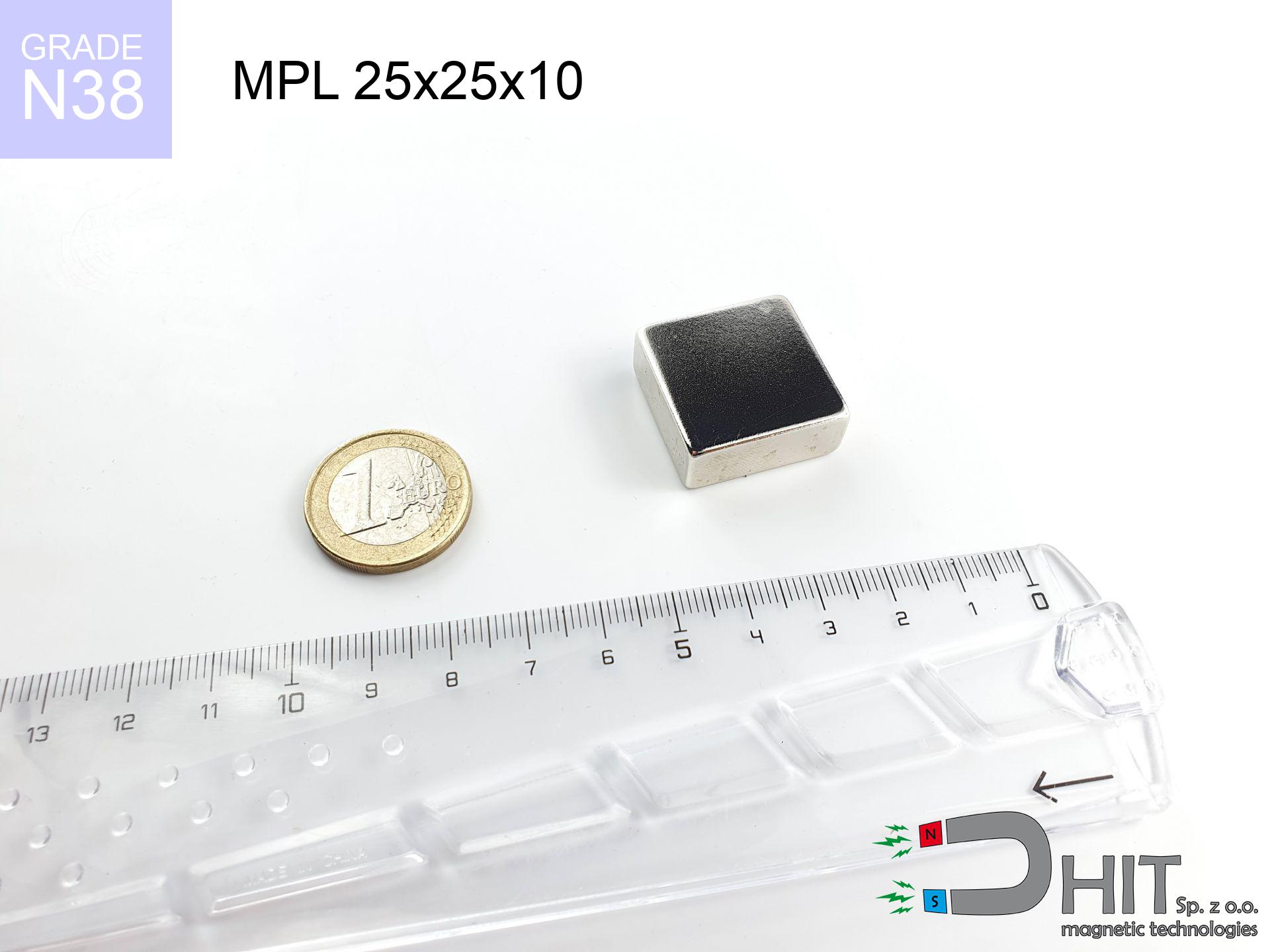
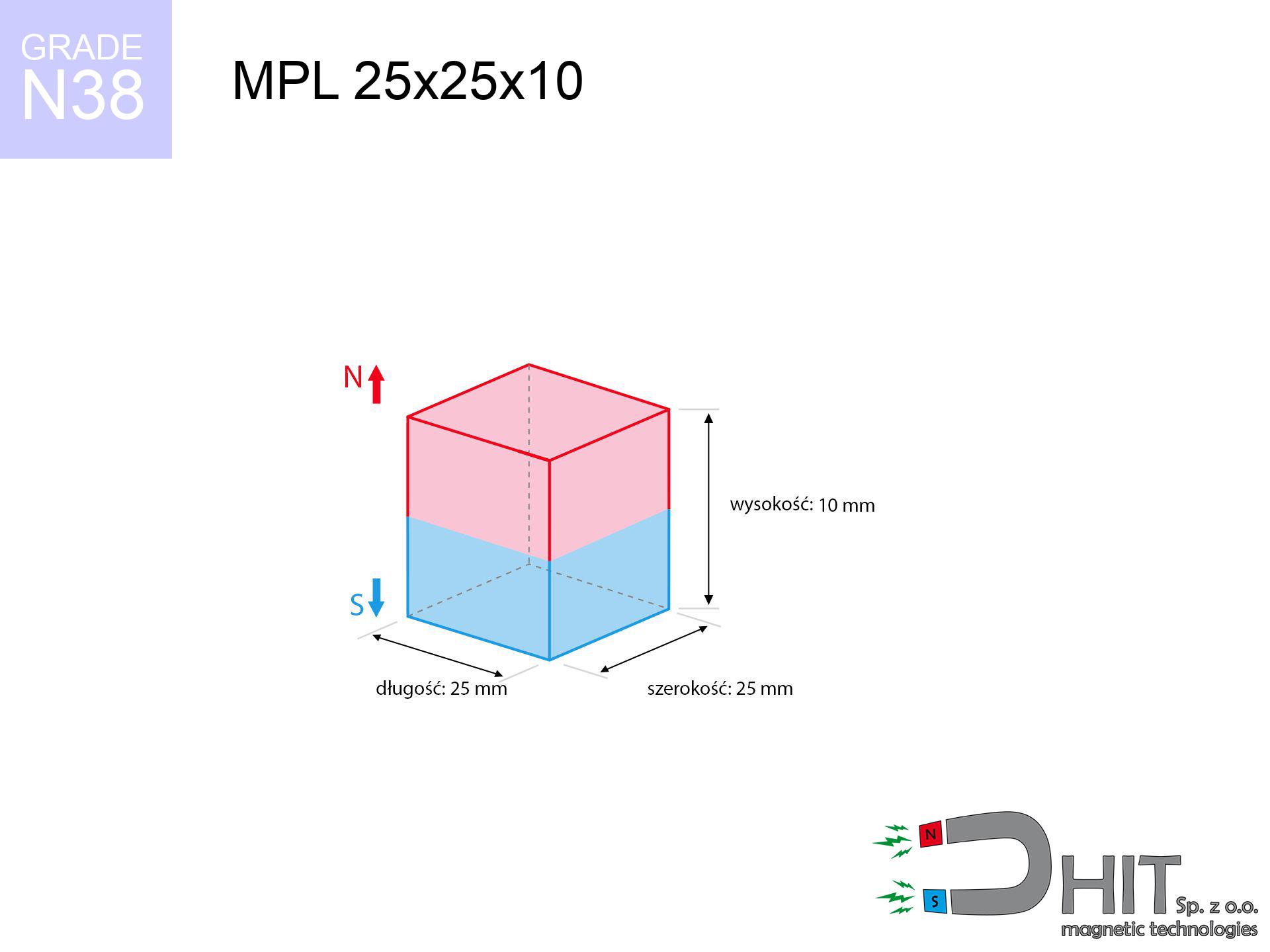
MPL 25x25x10 / N38 - lamellar magnet
lamellar magnet
Catalog no 020137
GTIN/EAN: 5906301811435
- length
- 25 mm [±0,1 mm]
- Width
- 25 mm [±0,1 mm]
- Height
- 10 mm [±0,1 mm]
- Weight
- 46.88 g
- Magnetization Direction
- ↑ axial
- Coating
- [NiCuNi] Nickel
How we measure these parameters — certificates and measurements
16.50 zł net / pcs
20.29 zł with VAT (23% VAT) / pcs
bulk discounts:
Need more?Frequently asked questions
What pull rating should I choose for a workshop block magnet?
Are block neodymium magnets available in more durable versions?
How should I choose block magnets for mounting a structure?
Engineering report for this magnet
Full PDF analysis: pull and shear force, effect of distance, temperature and plate thickness, safety distances and the demagnetization curve.
Call us now
+48 888 99 98 98
alternatively let us know using
contact form
the contact section.
Specifications and structure of a neodymium magnet can be estimated using our
power calculator.
Order by 14:00 and we’ll ship today!
Detailed specification - MPL 25x25x10 / N38 - lamellar magnet
Specification / characteristics - MPL 25x25x10 / N38 - lamellar magnet
| properties | values |
|---|---|
| Cat. no. | 020137 |
| GTIN/EAN | 5906301811435 |
| Production/Distribution | Dhit sp. z o.o. |
| Country of origin | Poland / China / Germany |
| Customs code | 85059029 |
| length | 25 mm [±0,1 mm] |
| Width | 25 mm [±0,1 mm] |
| Height | 10 mm [±0,1 mm] |
| Weight | 46.88 g |
| Magnetization Direction | ↑ axial |
| Load capacity ~ ? | 19.39 kg / 190.25 N |
| Magnetic Induction ~ ? | 361.04 mT / 3610 Gs |
| Coating | [NiCuNi] Nickel |
| Manufacturing Tolerance | ±0.1 mm |
Magnetic properties of material N38
| properties | values | units |
|---|---|---|
| Remanence Br ? | 12.2-12.6 | kGs |
| Remanence Br ? | 1220-1260 | mT |
| Coercivity bHc ? | 10.8-11.5 | kOe |
| Coercivity bHc ? | 860-915 | kA/m |
| Intrinsic coercivity iHc | ≥ 12 | kOe |
| Intrinsic coercivity iHc | ≥ 955 | kA/m |
| Energy product BHmax ? | 36-38 | BH max MGOe |
| Energy product BHmax ? | 287-303 | BH max KJ/m |
| Maximum working temperature ? | ≤ 80 | °C |
Physical properties of sintered neodymium magnets Nd2Fe14B at 20°C
| properties | values | units |
|---|---|---|
| Vickers hardness | ≥550 | Hv |
| Density | ≥7.4 | g/cm3 |
| Curie Temperature TC | 310 | °C |
| Curie Temperature TF | 590 | °F |
| Specific resistance | 150 | μΩ⋅cm |
| Bending strength | 250 | MPa |
| Compressive strength | 1000~1100 | MPa |
| Thermal expansion parallel (∥) to orientation (M) | (3-4) x 10-6 | °C-1 |
| Thermal expansion perpendicular (⊥) to orientation (M) | -(1-3) x 10-6 | °C-1 |
| Young's modulus | 1.7 x 10⁴ | kg/mm² |
Physical analysis of the assembly - report
Presented values represent the direct effect of a mathematical analysis. Results were calculated on models for the material Nd2Fe14B. Operational conditions might slightly differ. Please consider these data as a supplementary guide when designing systems.
Table 1: Static force (pull vs gap) - interaction chart
MPL 25x25x10 / N38
| Distance (mm) | Induction (Gauss) / mT | Pull Force (kg/lbs/g/N) | Risk Status |
|---|---|---|---|
| 0 mm |
3610 Gs
361.0 mT
|
19.39 kg / 42.75 pounds
19390.0 g / 190.2 N
|
critical level |
| 1 mm |
3392 Gs
339.2 mT
|
17.12 kg / 37.74 pounds
17117.7 g / 167.9 N
|
critical level |
| 2 mm |
3156 Gs
315.6 mT
|
14.82 kg / 32.68 pounds
14822.5 g / 145.4 N
|
critical level |
| 3 mm |
2913 Gs
291.3 mT
|
12.63 kg / 27.85 pounds
12631.8 g / 123.9 N
|
critical level |
| 5 mm |
2436 Gs
243.6 mT
|
8.83 kg / 19.46 pounds
8827.9 g / 86.6 N
|
warning |
| 10 mm |
1464 Gs
146.4 mT
|
3.19 kg / 7.04 pounds
3191.5 g / 31.3 N
|
warning |
| 15 mm |
872 Gs
87.2 mT
|
1.13 kg / 2.49 pounds
1131.5 g / 11.1 N
|
weak grip |
| 20 mm |
538 Gs
53.8 mT
|
0.43 kg / 0.95 pounds
430.4 g / 4.2 N
|
weak grip |
| 30 mm |
234 Gs
23.4 mT
|
0.08 kg / 0.18 pounds
81.8 g / 0.8 N
|
weak grip |
| 50 mm |
68 Gs
6.8 mT
|
0.01 kg / 0.02 pounds
6.9 g / 0.1 N
|
weak grip |
Table 2: Vertical capacity (vertical surface)
MPL 25x25x10 / N38
| Distance (mm) | Friction coefficient | Pull Force (kg/lbs/g/N) |
|---|---|---|
| 0 mm | Stal (~0.2) |
3.88 kg / 8.55 pounds
3878.0 g / 38.0 N
|
| 1 mm | Stal (~0.2) |
3.42 kg / 7.55 pounds
3424.0 g / 33.6 N
|
| 2 mm | Stal (~0.2) |
2.96 kg / 6.53 pounds
2964.0 g / 29.1 N
|
| 3 mm | Stal (~0.2) |
2.53 kg / 5.57 pounds
2526.0 g / 24.8 N
|
| 5 mm | Stal (~0.2) |
1.77 kg / 3.89 pounds
1766.0 g / 17.3 N
|
| 10 mm | Stal (~0.2) |
0.64 kg / 1.41 pounds
638.0 g / 6.3 N
|
| 15 mm | Stal (~0.2) |
0.23 kg / 0.50 pounds
226.0 g / 2.2 N
|
| 20 mm | Stal (~0.2) |
0.09 kg / 0.19 pounds
86.0 g / 0.8 N
|
| 30 mm | Stal (~0.2) |
0.02 kg / 0.04 pounds
16.0 g / 0.2 N
|
| 50 mm | Stal (~0.2) |
0.00 kg / 0.00 pounds
2.0 g / 0.0 N
|
Table 3: Vertical assembly (shearing) - vertical pull
MPL 25x25x10 / N38
| Surface type | Friction coefficient / % Mocy | Max load (kg/lbs/g/N) |
|---|---|---|
| Raw steel |
µ = 0.3
30% Nominalnej Siły
|
5.82 kg / 12.82 pounds
5817.0 g / 57.1 N
|
| Painted steel (standard) |
µ = 0.2
20% Nominalnej Siły
|
3.88 kg / 8.55 pounds
3878.0 g / 38.0 N
|
| Oily/slippery steel |
µ = 0.1
10% Nominalnej Siły
|
1.94 kg / 4.27 pounds
1939.0 g / 19.0 N
|
| Magnet with anti-slip rubber |
µ = 0.5
50% Nominalnej Siły
|
9.70 kg / 21.37 pounds
9695.0 g / 95.1 N
|
Table 4: Material efficiency (saturation) - sheet metal selection
MPL 25x25x10 / N38
| Steel thickness (mm) | % power | Real pull force (kg/lbs/g/N) |
|---|---|---|
| 0.5 mm |
|
0.97 kg / 2.14 pounds
969.5 g / 9.5 N
|
| 1 mm |
|
2.42 kg / 5.34 pounds
2423.8 g / 23.8 N
|
| 2 mm |
|
4.85 kg / 10.69 pounds
4847.5 g / 47.6 N
|
| 3 mm |
|
7.27 kg / 16.03 pounds
7271.3 g / 71.3 N
|
| 5 mm |
|
12.12 kg / 26.72 pounds
12118.8 g / 118.9 N
|
| 10 mm |
|
19.39 kg / 42.75 pounds
19390.0 g / 190.2 N
|
| 11 mm |
|
19.39 kg / 42.75 pounds
19390.0 g / 190.2 N
|
| 12 mm |
|
19.39 kg / 42.75 pounds
19390.0 g / 190.2 N
|
Table 5: Thermal stability (stability) - power drop
MPL 25x25x10 / N38
| Ambient temp. (°C) | Power loss | Remaining pull (kg/lbs/g/N) | Status |
|---|---|---|---|
| 20 °C | 0.0% |
19.39 kg / 42.75 pounds
19390.0 g / 190.2 N
|
OK |
| 40 °C | -2.2% |
18.96 kg / 41.81 pounds
18963.4 g / 186.0 N
|
OK |
| 60 °C | -4.4% |
18.54 kg / 40.87 pounds
18536.8 g / 181.8 N
|
|
| 80 °C | -6.6% |
18.11 kg / 39.93 pounds
18110.3 g / 177.7 N
|
|
| 100 °C | -28.8% |
13.81 kg / 30.44 pounds
13805.7 g / 135.4 N
|
Table 6: Two magnets (repulsion) - field range
MPL 25x25x10 / N38
| Gap (mm) | Attraction (kg/lbs) (N-S) | Shear Strength (kg/lbs/g/N) | Repulsion (kg/lbs) (N-N) |
|---|---|---|---|
| 0 mm |
50.20 kg / 110.68 pounds
5 073 Gs
|
7.53 kg / 16.60 pounds
7531 g / 73.9 N
|
N/A |
| 1 mm |
47.31 kg / 104.30 pounds
7 008 Gs
|
7.10 kg / 15.65 pounds
7097 g / 69.6 N
|
42.58 kg / 93.87 pounds
~0 Gs
|
| 2 mm |
44.32 kg / 97.71 pounds
6 783 Gs
|
6.65 kg / 14.66 pounds
6648 g / 65.2 N
|
39.89 kg / 87.94 pounds
~0 Gs
|
| 3 mm |
41.33 kg / 91.12 pounds
6 550 Gs
|
6.20 kg / 13.67 pounds
6200 g / 60.8 N
|
37.20 kg / 82.01 pounds
~0 Gs
|
| 5 mm |
35.49 kg / 78.25 pounds
6 070 Gs
|
5.32 kg / 11.74 pounds
5324 g / 52.2 N
|
31.94 kg / 70.43 pounds
~0 Gs
|
| 10 mm |
22.86 kg / 50.39 pounds
4 871 Gs
|
3.43 kg / 7.56 pounds
3429 g / 33.6 N
|
20.57 kg / 45.35 pounds
~0 Gs
|
| 20 mm |
8.26 kg / 18.22 pounds
2 929 Gs
|
1.24 kg / 2.73 pounds
1240 g / 12.2 N
|
7.44 kg / 16.40 pounds
~0 Gs
|
| 50 mm |
0.46 kg / 1.02 pounds
695 Gs
|
0.07 kg / 0.15 pounds
70 g / 0.7 N
|
0.42 kg / 0.92 pounds
~0 Gs
|
| 60 mm |
0.21 kg / 0.47 pounds
469 Gs
|
0.03 kg / 0.07 pounds
32 g / 0.3 N
|
0.19 kg / 0.42 pounds
~0 Gs
|
| 70 mm |
0.10 kg / 0.23 pounds
329 Gs
|
0.02 kg / 0.03 pounds
16 g / 0.2 N
|
0.09 kg / 0.21 pounds
~0 Gs
|
| 80 mm |
0.05 kg / 0.12 pounds
239 Gs
|
0.01 kg / 0.02 pounds
8 g / 0.1 N
|
0.05 kg / 0.11 pounds
~0 Gs
|
| 90 mm |
0.03 kg / 0.07 pounds
178 Gs
|
0.00 kg / 0.01 pounds
5 g / 0.0 N
|
0.03 kg / 0.06 pounds
~0 Gs
|
| 100 mm |
0.02 kg / 0.04 pounds
136 Gs
|
0.00 kg / 0.01 pounds
3 g / 0.0 N
|
0.02 kg / 0.04 pounds
~0 Gs
|
Table 7: Safety (HSE) (implants) - warnings
MPL 25x25x10 / N38
| Object / Device | Limit (Gauss) / mT | Safe distance |
|---|---|---|
| Pacemaker | 5 Gs (0.5 mT) | 13.0 cm |
| Hearing aid | 10 Gs (1.0 mT) | 10.5 cm |
| Timepiece | 20 Gs (2.0 mT) | 8.0 cm |
| Mobile device | 40 Gs (4.0 mT) | 6.5 cm |
| Remote | 50 Gs (5.0 mT) | 6.0 cm |
| Payment card | 400 Gs (40.0 mT) | 2.5 cm |
| HDD hard drive | 600 Gs (60.0 mT) | 2.0 cm |
Table 8: Dynamics (cracking risk) - warning
MPL 25x25x10 / N38
| Start from (mm) | Speed (km/h) | Energy (J) | Predicted outcome |
|---|---|---|---|
| 10 mm |
22.97 km/h
(6.38 m/s)
|
0.95 J | |
| 30 mm |
24.73 km/h
(6.87 m/s)
|
1.11 J | |
| 50 mm |
24.79 km/h
(6.89 m/s)
|
1.11 J | |
| 100 mm |
24.80 km/h
(6.89 m/s)
|
1.11 J |
Table 9: Corrosion resistance
MPL 25x25x10 / N38
| Technical parameter | Value / Description |
|---|---|
| Coating type | [NiCuNi] Nickel |
| Layer structure | Nickel - Copper - Nickel |
| Layer thickness | 10-20 µm |
| Salt spray test (SST) ? | 24 h |
| Recommended environment | Indoors only (dry) |
Table 10: Construction data (Flux)
MPL 25x25x10 / N38
| Parameter | Value | SI Unit / Description |
|---|---|---|
| Magnetic Flux | 23 497 Mx | 235.0 µWb |
| Pc Coefficient | 0.46 | Low (Flat) |
Table 11: Hydrostatics and buoyancy
MPL 25x25x10 / N38
| Environment | Effective steel pull | Effect |
|---|---|---|
| Air (land) | 19.39 kg | Standard |
| Water (riverbed) |
22.20 kg
(+2.81 kg buoyancy gain)
|
+14.5% |
1. Vertical hold
*Note: On a vertical wall, the magnet retains merely a fraction of its nominal pull.
2. Steel thickness impact
*Thin metal sheet (e.g. computer case) significantly limits the holding force.
3. Temperature resistance
N38: the maximum material working temperature is 80°C. Permitted conditions also depend on the shape and magnetic circuit.
4. Demagnetization curve and operating point (B-H)
chart generated for the permeance coefficient Pc (Permeance Coefficient) = 0.46
This simulation demonstrates the magnetic stability of the selected magnet under specific geometric conditions. The solid red line represents the demagnetization curve (material potential), while the dashed blue line is the load line based on the magnet's geometry. The Pc (Permeance Coefficient), also known as the load line slope, is a dimensionless value that describes the relationship between the magnet's shape and its magnetic stability. The intersection of these two lines (the black dot) is the operating point — it determines the actual magnetic flux density generated by the magnet in this specific configuration. A higher Pc value means the magnet is more 'slender' (tall relative to its area), resulting in a higher operating point and better resistance to irreversible demagnetization caused by external fields or temperature. A value of 0.42 is relatively low (typical for flat magnets), meaning the operating point is closer to the 'knee' of the curve — caution is advised when operating at temperatures near the maximum limit to avoid strength loss.
Material specification
| iron (Fe) | 64% – 68% |
| neodymium (Nd) | 29% – 32% |
| boron (B) | 1.1% – 1.2% |
| dysprosium (Dy) | 0.5% – 2.0% |
| coating (Ni-Cu-Ni) | < 0.05% |
Sustainability
| recyclability (EoL) | 100% |
| recycled raw materials | ~10% (pre-cons) |
| carbon footprint | low / zredukowany |
| waste code (EWC) | 16 02 16 |
Other products
![UMP 75x25 [M10x3] GW F200 GOLD DUAL Lina / N42 - search holder](https://cdn3.dhit.pl/graphics/products/ump-75x25-m10x3-gw-f200-gold-x2-lina-car.jpg "UMP 75x25 [M10x3] GW F200 GOLD DUAL Lina / N42 - search holder")


Strengths as well as weaknesses of Nd2Fe14B magnets.
Benefits
- They have unchanged lifting capacity, and over around 10 years their attraction force decreases symbolically – ~1% (according to theory),
- They feature excellent resistance to weakening of magnetic properties due to opposing magnetic fields,
- By applying a smooth layer of nickel, the element acquires an elegant look,
- Magnetic induction on the working layer of the magnet remains very high,
- Neodymium magnets are characterized by very high magnetic induction on the magnet surface and can work (depending on the form) even at a temperature of 230°C or more...
- Considering the option of flexible shaping and customization to custom needs, NdFeB magnets can be manufactured in a variety of shapes and sizes, which amplifies use scope,
- Key role in modern industrial fields – they are used in computer drives, brushless drives, medical equipment, as well as multitasking production systems.
- Relatively small size with high pulling force – neodymium magnets offer high power in compact dimensions, which makes them useful in miniature devices
Disadvantages
- At very strong impacts they can crack, therefore we recommend placing them in special holders. A metal housing provides additional protection against damage and increases the magnet's durability.
- Do not exceed this material temperature limit: 80°C. Overheating may permanently weaken the magnet.
- Due to the susceptibility of magnets to corrosion in a humid environment, we recommend using waterproof magnets made of rubber, plastic or other material resistant to moisture, in case of application outdoors
- Due to limitations in producing nuts and complex forms in magnets, we recommend using a housing - magnetic mechanism.
- Health risk resulting from small fragments of magnets pose a threat, in case of ingestion, which becomes key in the aspect of protecting the youngest. Furthermore, small elements of these devices can complicate diagnosis medical in case of swallowing.
- With budget limitations the cost of neodymium magnets can be a barrier,
Lifting parameters
Highest magnetic holding force – what contributes to it?
- on a base made of mild steel, effectively closing the magnetic flux
- with a cross-section of at least 10 mm
- with a surface free of scratches
- under conditions of ideal adhesion (surface-to-surface)
- during pulling in a direction perpendicular to the mounting surface
- at ambient temperature room level
Determinants of practical lifting force of a magnet
- Distance – existence of any layer (rust, tape, air) acts as an insulator, which reduces capacity steeply (even by 50% at 0.5 mm).
- Pull-off angle – note that the magnet holds strongest perpendicularly. Under sliding down, the capacity drops significantly, often to levels of 20-30% of the nominal value.
- Plate thickness – too thin plate causes magnetic saturation, causing part of the flux to be wasted to the other side.
- Material composition – different alloys reacts the same. Alloy additives worsen the interaction with the magnet.
- Surface structure – the smoother and more polished the plate, the better the adhesion and stronger the hold. Roughness creates an air distance.
- Heat – NdFeB sinters have a negative temperature coefficient. At higher temperatures they are weaker, and at low temperatures they can be stronger (up to a certain limit).
Lifting capacity testing was carried out on plates with a smooth surface of suitable thickness, under a perpendicular pulling force, whereas under attempts to slide the magnet the load capacity is reduced by as much as 5 times. Moreover, even a slight gap between the magnet and the plate lowers the lifting capacity.
Warnings
Flammability
Powder generated during machining of magnets is combustible. Avoid drilling into magnets without proper cooling and knowledge.
Electronic devices
Equipment safety: Neodymium magnets can damage payment cards and delicate electronics (pacemakers, medical aids, mechanical watches).
Keep away from electronics
Remember: rare earth magnets generate a field that interferes with precision electronics. Maintain a separation from your phone, tablet, and navigation systems.
Pacemakers
For implant holders: Powerful magnets affect medical devices. Keep minimum 30 cm distance or request help to handle the magnets.
Power loss in heat
Regular neodymium magnets (N-type) undergo demagnetization when the temperature goes above 80°C. The loss of strength is permanent.
Safe operation
Handle with care. Neodymium magnets attract from a distance and snap with massive power, often faster than you can react.
Magnets are brittle
Despite metallic appearance, the material is brittle and not impact-resistant. Avoid impacts, as the magnet may crumble into sharp, dangerous pieces.
Choking Hazard
Only for adults. Tiny parts can be swallowed, leading to serious injuries. Store away from kids and pets.
Warning for allergy sufferers
Nickel alert: The nickel-copper-nickel coating consists of nickel. If an allergic reaction happens, cease working with magnets and wear gloves.
Bodily injuries
Mind your fingers. Two powerful magnets will snap together immediately with a force of several hundred kilograms, destroying everything in their path. Exercise extreme caution!
Tabela kosztu i czasu dostawy
Płatność przed wysyłką:

GLS kurier
Przesyłka będzie u Ciebie za 2-3 dni
14.99 ZŁ

InPost Paczkomaty 24/7
Przesyłka będzie u Ciebie za 1-2 dni
12.30 ZŁ
Płatność przy odbiorze (pobranie):
GLS kurier
Przesyłka będzie u Ciebie za 1-2 dni
23.00 ZŁ