


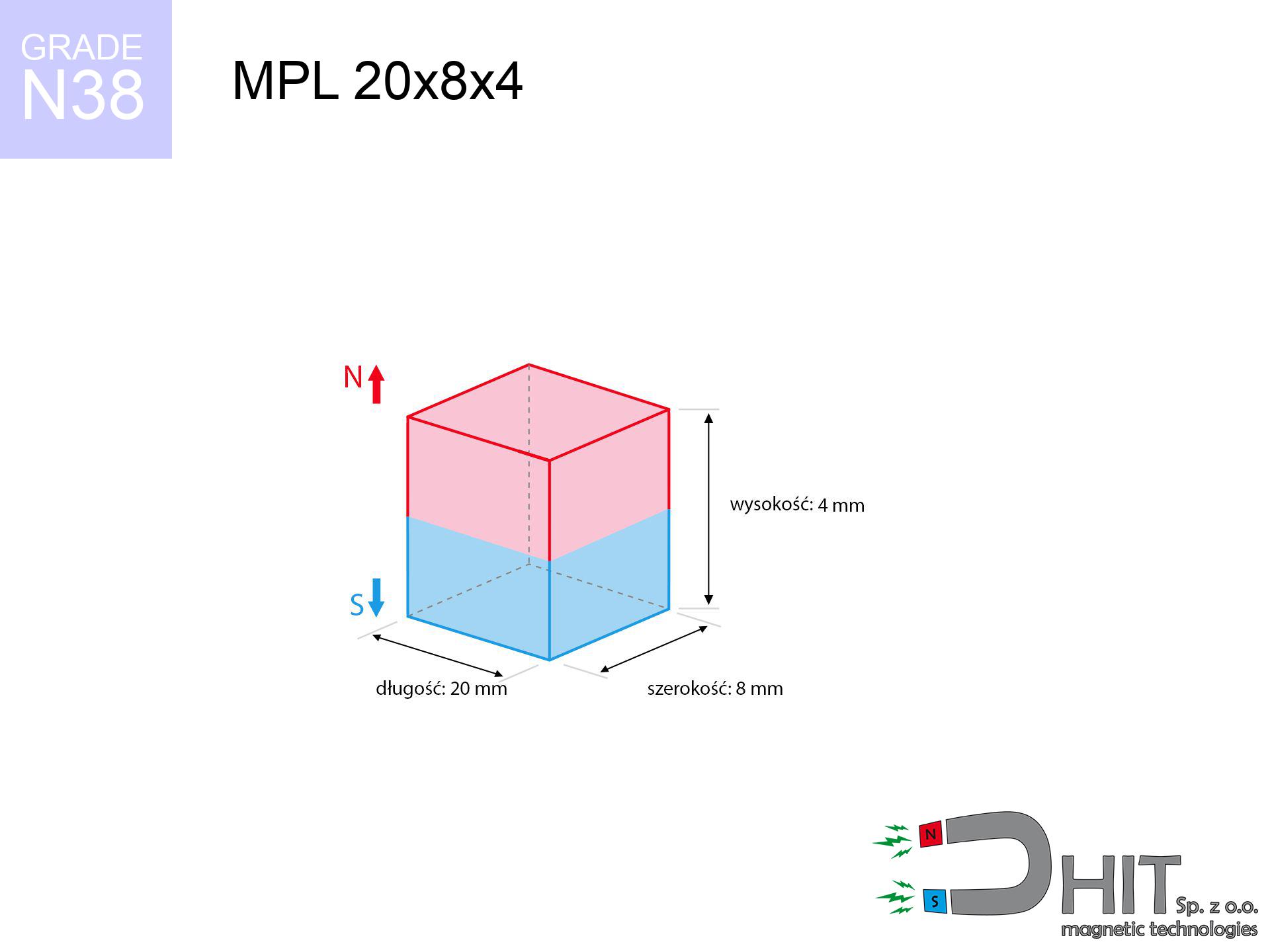
MPL 20x8x4 / N38 - lamellar magnet
lamellar magnet
Catalog no 020133
GTIN/EAN: 5906301811398
- length
- 20 mm [±0,1 mm]
- Width
- 8 mm [±0,1 mm]
- Height
- 4 mm [±0,1 mm]
- Weight
- 4.8 g
- Magnetization Direction
- ↑ axial
- Coating
- [NiCuNi] Nickel
How we measure these parameters — certificates and measurements
2.98 zł net / pcs
3.67 zł with VAT (23% VAT) / pcs
bulk discounts:
Need more?Frequently asked questions
What pull rating should I choose for a workshop block magnet?
Are block neodymium magnets available in more durable versions?
How should I choose block magnets for mounting a structure?
Engineering report for this magnet
Full PDF analysis: pull and shear force, effect of distance, temperature and plate thickness, safety distances and the demagnetization curve.
Call us now
+48 888 99 98 98
alternatively let us know using
contact form
the contact section.
Specifications and structure of a neodymium magnet can be estimated using our
power calculator.
Order by 14:00 and we’ll ship today!
Product card - MPL 20x8x4 / N38 - lamellar magnet
Specification / characteristics - MPL 20x8x4 / N38 - lamellar magnet
| properties | values |
|---|---|
| Cat. no. | 020133 |
| GTIN/EAN | 5906301811398 |
| Production/Distribution | Dhit sp. z o.o. |
| Country of origin | Poland / China / Germany |
| Customs code | 85059029 |
| length | 20 mm [±0,1 mm] |
| Width | 8 mm [±0,1 mm] |
| Height | 4 mm [±0,1 mm] |
| Weight | 4.8 g |
| Magnetization Direction | ↑ axial |
| Load capacity ~ ? | 4.79 kg / 46.98 N |
| Magnetic Induction ~ ? | 336.99 mT / 3370 Gs |
| Coating | [NiCuNi] Nickel |
| Manufacturing Tolerance | ±0.1 mm |
Magnetic properties of material N38
| properties | values | units |
|---|---|---|
| Remanence Br ? | 12.2-12.6 | kGs |
| Remanence Br ? | 1220-1260 | mT |
| Coercivity bHc ? | 10.8-11.5 | kOe |
| Coercivity bHc ? | 860-915 | kA/m |
| Intrinsic coercivity iHc | ≥ 12 | kOe |
| Intrinsic coercivity iHc | ≥ 955 | kA/m |
| Energy product BHmax ? | 36-38 | BH max MGOe |
| Energy product BHmax ? | 287-303 | BH max KJ/m |
| Maximum working temperature ? | ≤ 80 | °C |
Physical properties of sintered neodymium magnets Nd2Fe14B at 20°C
| properties | values | units |
|---|---|---|
| Vickers hardness | ≥550 | Hv |
| Density | ≥7.4 | g/cm3 |
| Curie Temperature TC | 310 | °C |
| Curie Temperature TF | 590 | °F |
| Specific resistance | 150 | μΩ⋅cm |
| Bending strength | 250 | MPa |
| Compressive strength | 1000~1100 | MPa |
| Thermal expansion parallel (∥) to orientation (M) | (3-4) x 10-6 | °C-1 |
| Thermal expansion perpendicular (⊥) to orientation (M) | -(1-3) x 10-6 | °C-1 |
| Young's modulus | 1.7 x 10⁴ | kg/mm² |
Technical modeling of the magnet - technical parameters
Presented data constitute the outcome of a mathematical simulation. Values rely on algorithms for the material Nd2Fe14B. Actual conditions might slightly differ. Treat these calculations as a reference point for designers.
Table 1: Static force (force vs distance) - power drop
MPL 20x8x4 / N38
| Distance (mm) | Induction (Gauss) / mT | Pull Force (kg/lbs/g/N) | Risk Status |
|---|---|---|---|
| 0 mm |
3368 Gs
336.8 mT
|
4.79 kg / 10.56 lbs
4790.0 g / 47.0 N
|
strong |
| 1 mm |
2818 Gs
281.8 mT
|
3.35 kg / 7.39 lbs
3352.3 g / 32.9 N
|
strong |
| 2 mm |
2266 Gs
226.6 mT
|
2.17 kg / 4.78 lbs
2167.6 g / 21.3 N
|
strong |
| 3 mm |
1794 Gs
179.4 mT
|
1.36 kg / 3.00 lbs
1358.6 g / 13.3 N
|
low risk |
| 5 mm |
1130 Gs
113.0 mT
|
0.54 kg / 1.19 lbs
538.9 g / 5.3 N
|
low risk |
| 10 mm |
416 Gs
41.6 mT
|
0.07 kg / 0.16 lbs
73.0 g / 0.7 N
|
low risk |
| 15 mm |
187 Gs
18.7 mT
|
0.01 kg / 0.03 lbs
14.7 g / 0.1 N
|
low risk |
| 20 mm |
97 Gs
9.7 mT
|
0.00 kg / 0.01 lbs
4.0 g / 0.0 N
|
low risk |
| 30 mm |
35 Gs
3.5 mT
|
0.00 kg / 0.00 lbs
0.5 g / 0.0 N
|
low risk |
| 50 mm |
9 Gs
0.9 mT
|
0.00 kg / 0.00 lbs
0.0 g / 0.0 N
|
low risk |
Table 2: Vertical force (vertical surface)
MPL 20x8x4 / N38
| Distance (mm) | Friction coefficient | Pull Force (kg/lbs/g/N) |
|---|---|---|
| 0 mm | Stal (~0.2) |
0.96 kg / 2.11 lbs
958.0 g / 9.4 N
|
| 1 mm | Stal (~0.2) |
0.67 kg / 1.48 lbs
670.0 g / 6.6 N
|
| 2 mm | Stal (~0.2) |
0.43 kg / 0.96 lbs
434.0 g / 4.3 N
|
| 3 mm | Stal (~0.2) |
0.27 kg / 0.60 lbs
272.0 g / 2.7 N
|
| 5 mm | Stal (~0.2) |
0.11 kg / 0.24 lbs
108.0 g / 1.1 N
|
| 10 mm | Stal (~0.2) |
0.01 kg / 0.03 lbs
14.0 g / 0.1 N
|
| 15 mm | Stal (~0.2) |
0.00 kg / 0.00 lbs
2.0 g / 0.0 N
|
| 20 mm | Stal (~0.2) |
0.00 kg / 0.00 lbs
0.0 g / 0.0 N
|
| 30 mm | Stal (~0.2) |
0.00 kg / 0.00 lbs
0.0 g / 0.0 N
|
| 50 mm | Stal (~0.2) |
0.00 kg / 0.00 lbs
0.0 g / 0.0 N
|
Table 3: Vertical assembly (sliding) - vertical pull
MPL 20x8x4 / N38
| Surface type | Friction coefficient / % Mocy | Max load (kg/lbs/g/N) |
|---|---|---|
| Raw steel |
µ = 0.3
30% Nominalnej Siły
|
1.44 kg / 3.17 lbs
1437.0 g / 14.1 N
|
| Painted steel (standard) |
µ = 0.2
20% Nominalnej Siły
|
0.96 kg / 2.11 lbs
958.0 g / 9.4 N
|
| Oily/slippery steel |
µ = 0.1
10% Nominalnej Siły
|
0.48 kg / 1.06 lbs
479.0 g / 4.7 N
|
| Magnet with anti-slip rubber |
µ = 0.5
50% Nominalnej Siły
|
2.40 kg / 5.28 lbs
2395.0 g / 23.5 N
|
Table 4: Steel thickness (substrate influence) - power losses
MPL 20x8x4 / N38
| Steel thickness (mm) | % power | Real pull force (kg/lbs/g/N) |
|---|---|---|
| 0.5 mm |
|
0.48 kg / 1.06 lbs
479.0 g / 4.7 N
|
| 1 mm |
|
1.20 kg / 2.64 lbs
1197.5 g / 11.7 N
|
| 2 mm |
|
2.40 kg / 5.28 lbs
2395.0 g / 23.5 N
|
| 3 mm |
|
3.59 kg / 7.92 lbs
3592.5 g / 35.2 N
|
| 5 mm |
|
4.79 kg / 10.56 lbs
4790.0 g / 47.0 N
|
| 10 mm |
|
4.79 kg / 10.56 lbs
4790.0 g / 47.0 N
|
| 11 mm |
|
4.79 kg / 10.56 lbs
4790.0 g / 47.0 N
|
| 12 mm |
|
4.79 kg / 10.56 lbs
4790.0 g / 47.0 N
|
Table 5: Working in heat (material behavior) - power drop
MPL 20x8x4 / N38
| Ambient temp. (°C) | Power loss | Remaining pull (kg/lbs/g/N) | Status |
|---|---|---|---|
| 20 °C | 0.0% |
4.79 kg / 10.56 lbs
4790.0 g / 47.0 N
|
OK |
| 40 °C | -2.2% |
4.68 kg / 10.33 lbs
4684.6 g / 46.0 N
|
OK |
| 60 °C | -4.4% |
4.58 kg / 10.10 lbs
4579.2 g / 44.9 N
|
|
| 80 °C | -6.6% |
4.47 kg / 9.86 lbs
4473.9 g / 43.9 N
|
|
| 100 °C | -28.8% |
3.41 kg / 7.52 lbs
3410.5 g / 33.5 N
|
Table 6: Magnet-Magnet interaction (repulsion) - field range
MPL 20x8x4 / N38
| Gap (mm) | Attraction (kg/lbs) (N-S) | Shear Force (kg/lbs/g/N) | Repulsion (kg/lbs) (N-N) |
|---|---|---|---|
| 0 mm |
11.19 kg / 24.67 lbs
4 784 Gs
|
1.68 kg / 3.70 lbs
1678 g / 16.5 N
|
N/A |
| 1 mm |
9.49 kg / 20.93 lbs
6 205 Gs
|
1.42 kg / 3.14 lbs
1424 g / 14.0 N
|
8.54 kg / 18.84 lbs
~0 Gs
|
| 2 mm |
7.83 kg / 17.26 lbs
5 635 Gs
|
1.17 kg / 2.59 lbs
1175 g / 11.5 N
|
7.05 kg / 15.54 lbs
~0 Gs
|
| 3 mm |
6.34 kg / 13.97 lbs
5 069 Gs
|
0.95 kg / 2.10 lbs
951 g / 9.3 N
|
5.70 kg / 12.57 lbs
~0 Gs
|
| 5 mm |
4.02 kg / 8.85 lbs
4 035 Gs
|
0.60 kg / 1.33 lbs
602 g / 5.9 N
|
3.61 kg / 7.97 lbs
~0 Gs
|
| 10 mm |
1.26 kg / 2.78 lbs
2 259 Gs
|
0.19 kg / 0.42 lbs
189 g / 1.9 N
|
1.13 kg / 2.50 lbs
~0 Gs
|
| 20 mm |
0.17 kg / 0.38 lbs
832 Gs
|
0.03 kg / 0.06 lbs
26 g / 0.3 N
|
0.15 kg / 0.34 lbs
~0 Gs
|
| 50 mm |
0.00 kg / 0.01 lbs
112 Gs
|
0.00 kg / 0.00 lbs
0 g / 0.0 N
|
0.00 kg / 0.00 lbs
~0 Gs
|
| 60 mm |
0.00 kg / 0.00 lbs
70 Gs
|
0.00 kg / 0.00 lbs
0 g / 0.0 N
|
0.00 kg / 0.00 lbs
~0 Gs
|
| 70 mm |
0.00 kg / 0.00 lbs
46 Gs
|
0.00 kg / 0.00 lbs
0 g / 0.0 N
|
0.00 kg / 0.00 lbs
~0 Gs
|
| 80 mm |
0.00 kg / 0.00 lbs
32 Gs
|
0.00 kg / 0.00 lbs
0 g / 0.0 N
|
0.00 kg / 0.00 lbs
~0 Gs
|
| 90 mm |
0.00 kg / 0.00 lbs
23 Gs
|
0.00 kg / 0.00 lbs
0 g / 0.0 N
|
0.00 kg / 0.00 lbs
~0 Gs
|
| 100 mm |
0.00 kg / 0.00 lbs
17 Gs
|
0.00 kg / 0.00 lbs
0 g / 0.0 N
|
0.00 kg / 0.00 lbs
~0 Gs
|
Table 7: Safety (HSE) (electronics) - precautionary measures
MPL 20x8x4 / N38
| Object / Device | Limit (Gauss) / mT | Safe distance |
|---|---|---|
| Pacemaker | 5 Gs (0.5 mT) | 6.5 cm |
| Hearing aid | 10 Gs (1.0 mT) | 5.0 cm |
| Timepiece | 20 Gs (2.0 mT) | 4.0 cm |
| Mobile device | 40 Gs (4.0 mT) | 3.0 cm |
| Car key | 50 Gs (5.0 mT) | 3.0 cm |
| Payment card | 400 Gs (40.0 mT) | 1.5 cm |
| HDD hard drive | 600 Gs (60.0 mT) | 1.0 cm |
Table 8: Collisions (kinetic energy) - collision effects
MPL 20x8x4 / N38
| Start from (mm) | Speed (km/h) | Energy (J) | Predicted outcome |
|---|---|---|---|
| 10 mm |
24.61 km/h
(6.84 m/s)
|
0.11 J | |
| 30 mm |
24.86 km/h
(6.91 m/s)
|
0.11 J | |
| 50 mm |
24.86 km/h
(6.91 m/s)
|
0.11 J | |
| 100 mm |
24.87 km/h
(6.91 m/s)
|
0.11 J |
Table 9: Corrosion resistance
MPL 20x8x4 / N38
| Technical parameter | Value / Description |
|---|---|
| Coating type | [NiCuNi] Nickel |
| Layer structure | Nickel - Copper - Nickel |
| Layer thickness | 10-20 µm |
| Salt spray test (SST) ? | 24 h |
| Recommended environment | Indoors only (dry) |
Table 10: Construction data (Pc)
MPL 20x8x4 / N38
| Parameter | Value | SI Unit / Description |
|---|---|---|
| Magnetic Flux | 5 277 Mx | 52.8 µWb |
| Pc Coefficient | 0.38 | Low (Flat) |
Table 11: Hydrostatics and buoyancy
MPL 20x8x4 / N38
| Environment | Effective steel pull | Effect |
|---|---|---|
| Air (land) | 4.79 kg | Standard |
| Water (riverbed) |
5.48 kg
(+0.69 kg buoyancy gain)
|
+14.5% |
1. Vertical hold
*Caution: On a vertical wall, the magnet holds merely ~20% of its perpendicular strength.
2. Plate thickness effect
*Thin steel (e.g. 0.5mm PC case) severely weakens the holding force.
3. Temperature resistance
N38: the maximum material working temperature is 80°C. Permitted conditions also depend on the shape and magnetic circuit.
4. Demagnetization curve and operating point (B-H)
chart generated for the permeance coefficient Pc (Permeance Coefficient) = 0.38
This simulation demonstrates the magnetic stability of the selected magnet under specific geometric conditions. The solid red line represents the demagnetization curve (material potential), while the dashed blue line is the load line based on the magnet's geometry. The Pc (Permeance Coefficient), also known as the load line slope, is a dimensionless value that describes the relationship between the magnet's shape and its magnetic stability. The intersection of these two lines (the black dot) is the operating point — it determines the actual magnetic flux density generated by the magnet in this specific configuration. A higher Pc value means the magnet is more 'slender' (tall relative to its area), resulting in a higher operating point and better resistance to irreversible demagnetization caused by external fields or temperature. A value of 0.42 is relatively low (typical for flat magnets), meaning the operating point is closer to the 'knee' of the curve — caution is advised when operating at temperatures near the maximum limit to avoid strength loss.
Material specification
| iron (Fe) | 64% – 68% |
| neodymium (Nd) | 29% – 32% |
| boron (B) | 1.1% – 1.2% |
| dysprosium (Dy) | 0.5% – 2.0% |
| coating (Ni-Cu-Ni) | < 0.05% |
Environmental data
| recyclability (EoL) | 100% |
| recycled raw materials | ~10% (pre-cons) |
| carbon footprint | low / zredukowany |
| waste code (EWC) | 16 02 16 |
Other deals
![UMGZ 32x18x8 [M6] GZ / N38 - magnetic holder external thread](https://cdn3.dhit.pl/graphics/products/um-32x18x8-m6-gz-jix.jpg "UMGZ 32x18x8 [M6] GZ / N38 - magnetic holder external thread")

Pros as well as cons of rare earth magnets.
Strengths
- They have stable power, and over more than ten years their attraction force decreases symbolically – ~1% (according to theory),
- Magnets effectively resist against loss of magnetization caused by ambient magnetic noise,
- Thanks to the shimmering finish, the plating of nickel, gold, or silver-plated gives an modern appearance,
- Magnets have very high magnetic induction on the working surface,
- Through (appropriate) combination of ingredients, they can achieve high thermal strength, enabling operation at temperatures reaching 230°C and above...
- Possibility of individual machining as well as adapting to specific conditions,
- Fundamental importance in future technologies – they are used in computer drives, brushless drives, diagnostic systems, also multitasking production systems.
- Compactness – despite small sizes they generate large force, making them ideal for precision applications
Disadvantages
- Brittleness is one of their disadvantages. Upon strong impact they can fracture. We advise keeping them in a steel housing, which not only secures them against impacts but also raises their durability
- Do not exceed this material temperature limit: 80°C. Overheating may permanently weaken the magnet.
- Magnets exposed to a humid environment can rust. Therefore when using outdoors, we suggest using waterproof magnets made of rubber, plastic or other material resistant to moisture
- Due to limitations in creating threads and complex shapes in magnets, we recommend using a housing - magnetic mount.
- Health risk related to microscopic parts of magnets are risky, when accidentally swallowed, which is particularly important in the context of child safety. It is also worth noting that tiny parts of these magnets can complicate diagnosis medical after entering the body.
- High unit price – neodymium magnets cost more than other types of magnets (e.g. ferrite), which hinders application in large quantities
Holding force characteristics
Maximum lifting capacity of the magnet – what contributes to it?
- using a sheet made of mild steel, acting as a magnetic yoke
- with a cross-section of at least 10 mm
- with a plane free of scratches
- with total lack of distance (no impurities)
- for force applied at a right angle (pull-off, not shear)
- at ambient temperature approx. 20 degrees Celsius
Magnet lifting force in use – key factors
- Distance – existence of any layer (paint, tape, air) interrupts the magnetic circuit, which lowers power rapidly (even by 50% at 0.5 mm).
- Load vector – maximum parameter is reached only during perpendicular pulling. The shear force of the magnet along the surface is typically several times lower (approx. 1/5 of the lifting capacity).
- Steel thickness – insufficiently thick steel causes magnetic saturation, causing part of the flux to be escaped to the other side.
- Steel grade – ideal substrate is pure iron steel. Hardened steels may have worse magnetic properties.
- Surface finish – full contact is obtained only on smooth steel. Rough texture create air cushions, reducing force.
- Operating temperature – NdFeB sinters have a sensitivity to temperature. At higher temperatures they are weaker, and in frost they can be stronger (up to a certain limit).
Holding force was tested on the plate surface of 20 mm thickness, when the force acted perpendicularly, in contrast under attempts to slide the magnet the load capacity is reduced by as much as fivefold. In addition, even a small distance between the magnet and the plate reduces the load capacity.
Warnings
Combustion hazard
Dust generated during machining of magnets is combustible. Do not drill into magnets unless you are an expert.
Heat warning
Watch the temperature. Heating the magnet above 80 degrees Celsius will permanently weaken its properties and strength.
Nickel allergy
Medical facts indicate that the nickel plating (the usual finish) is a potent allergen. If you have an allergy, refrain from touching magnets with bare hands and opt for encased magnets.
Material brittleness
Despite metallic appearance, the material is delicate and not impact-resistant. Do not hit, as the magnet may shatter into sharp, dangerous pieces.
Magnetic interference
Remember: rare earth magnets generate a field that disrupts precision electronics. Keep a separation from your mobile, device, and GPS.
Data carriers
Very strong magnetic fields can corrupt files on payment cards, hard drives, and other magnetic media. Stay away of min. 10 cm.
Hand protection
Pinching hazard: The pulling power is so great that it can cause hematomas, pinching, and broken bones. Use thick gloves.
Pacemakers
Warning for patients: Powerful magnets disrupt medical devices. Keep at least 30 cm distance or request help to work with the magnets.
Keep away from children
Neodymium magnets are not toys. Accidental ingestion of a few magnets may result in them pinching intestinal walls, which constitutes a direct threat to life and necessitates immediate surgery.
Conscious usage
Before starting, read the rules. Uncontrolled attraction can break the magnet or injure your hand. Think ahead.
Tabela kosztu i czasu dostawy
Płatność przed wysyłką:

GLS kurier
Przesyłka będzie u Ciebie za 2-3 dni
14.99 ZŁ

InPost Paczkomaty 24/7
Przesyłka będzie u Ciebie za 1-2 dni
12.30 ZŁ
Płatność przy odbiorze (pobranie):
GLS kurier
Przesyłka będzie u Ciebie za 1-2 dni
23.00 ZŁ