


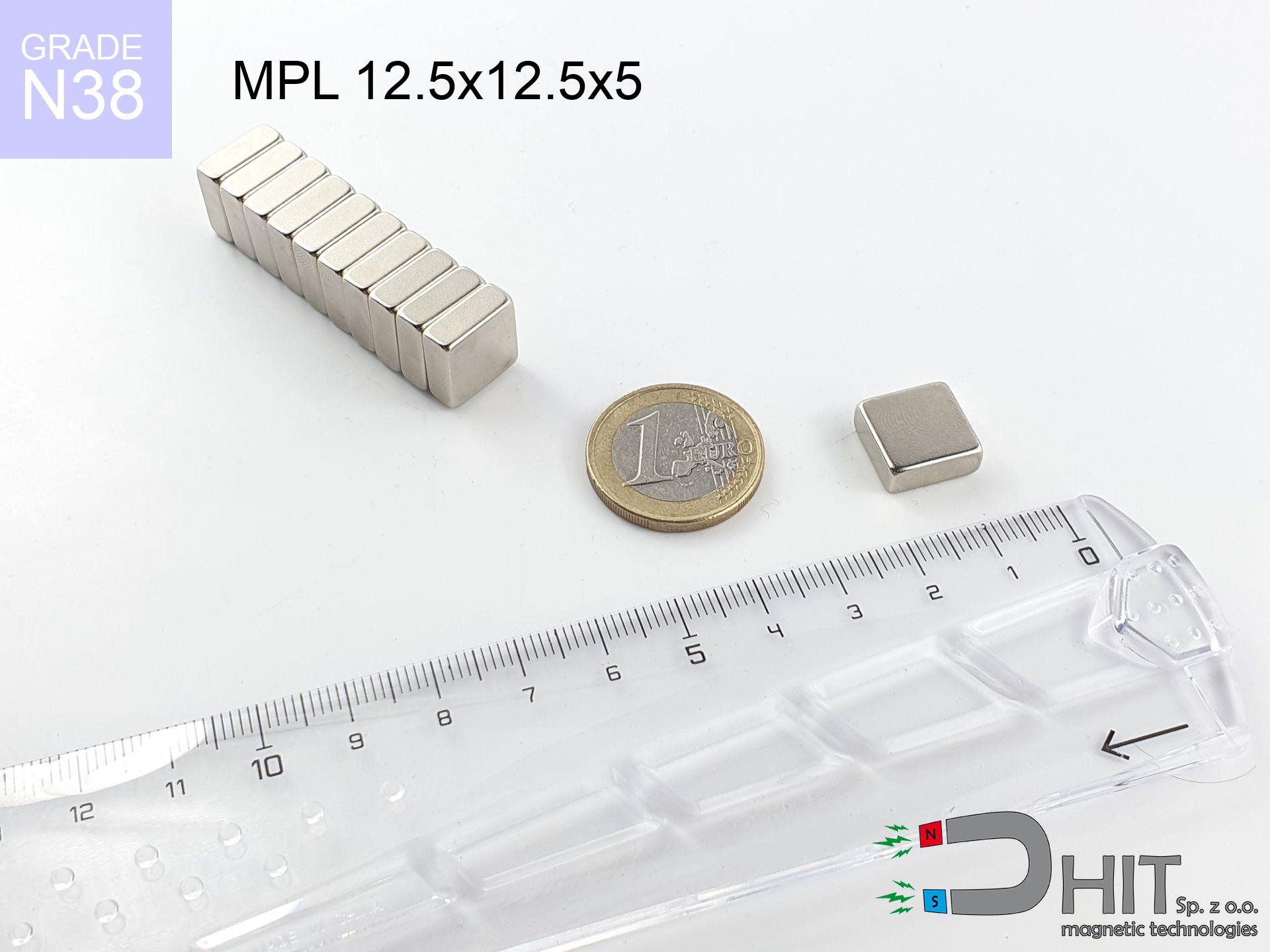
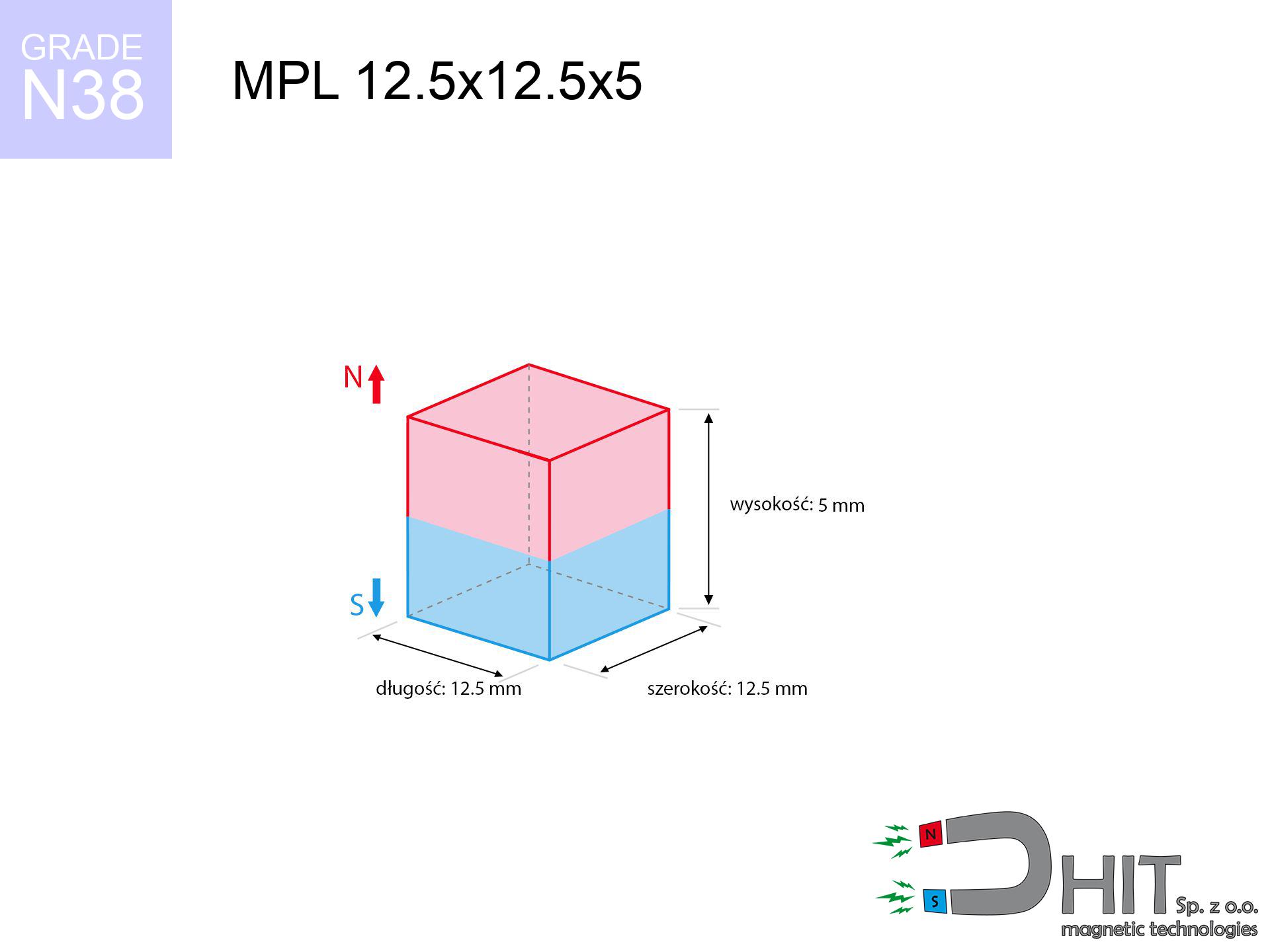
MPL 12.5x12.5x5 / N38 - lamellar magnet
lamellar magnet
Catalog no 020117
GTIN/EAN: 5906301811237
- length
- 12.5 mm [±0,1 mm]
- Width
- 12.5 mm [±0,1 mm]
- Height
- 5 mm [±0,1 mm]
- Weight
- 5.86 g
- Magnetization Direction
- ↑ axial
- Coating
- [NiCuNi] Nickel
How we measure these parameters — certificates and measurements
2.30 zł net / pcs
2.83 zł with VAT (23% VAT) / pcs
bulk discounts:
Need more?Frequently asked questions
What pull rating should I choose for a workshop block magnet?
Are block neodymium magnets available in more durable versions?
How should I choose block magnets for mounting a structure?
Engineering report for this magnet
Full PDF analysis: pull and shear force, effect of distance, temperature and plate thickness, safety distances and the demagnetization curve.
Call us now
+48 888 99 98 98
alternatively let us know using
contact form
the contact section.
Specifications and structure of a neodymium magnet can be estimated using our
power calculator.
Order by 14:00 and we’ll ship today!
Technical - MPL 12.5x12.5x5 / N38 - lamellar magnet
Specification / characteristics - MPL 12.5x12.5x5 / N38 - lamellar magnet
| properties | values |
|---|---|
| Cat. no. | 020117 |
| GTIN/EAN | 5906301811237 |
| Production/Distribution | Dhit sp. z o.o. |
| Country of origin | Poland / China / Germany |
| Customs code | 85059029 |
| length | 12.5 mm [±0,1 mm] |
| Width | 12.5 mm [±0,1 mm] |
| Height | 5 mm [±0,1 mm] |
| Weight | 5.86 g |
| Magnetization Direction | ↑ axial |
| Load capacity ~ ? | 4.84 kg / 47.51 N |
| Magnetic Induction ~ ? | 360.91 mT / 3609 Gs |
| Coating | [NiCuNi] Nickel |
| Manufacturing Tolerance | ±0.1 mm |
Magnetic properties of material N38
| properties | values | units |
|---|---|---|
| Remanence Br ? | 12.2-12.6 | kGs |
| Remanence Br ? | 1220-1260 | mT |
| Coercivity bHc ? | 10.8-11.5 | kOe |
| Coercivity bHc ? | 860-915 | kA/m |
| Intrinsic coercivity iHc | ≥ 12 | kOe |
| Intrinsic coercivity iHc | ≥ 955 | kA/m |
| Energy product BHmax ? | 36-38 | BH max MGOe |
| Energy product BHmax ? | 287-303 | BH max KJ/m |
| Maximum working temperature ? | ≤ 80 | °C |
Physical properties of sintered neodymium magnets Nd2Fe14B at 20°C
| properties | values | units |
|---|---|---|
| Vickers hardness | ≥550 | Hv |
| Density | ≥7.4 | g/cm3 |
| Curie Temperature TC | 310 | °C |
| Curie Temperature TF | 590 | °F |
| Specific resistance | 150 | μΩ⋅cm |
| Bending strength | 250 | MPa |
| Compressive strength | 1000~1100 | MPa |
| Thermal expansion parallel (∥) to orientation (M) | (3-4) x 10-6 | °C-1 |
| Thermal expansion perpendicular (⊥) to orientation (M) | -(1-3) x 10-6 | °C-1 |
| Young's modulus | 1.7 x 10⁴ | kg/mm² |
Physical simulation of the assembly - report
Presented values are the direct effect of a mathematical simulation. Values were calculated on algorithms for the material Nd2Fe14B. Operational performance may differ from theoretical values. Treat these calculations as a preliminary roadmap during assembly planning.
Table 1: Static force (force vs distance) - characteristics
MPL 12.5x12.5x5 / N38
| Distance (mm) | Induction (Gauss) / mT | Pull Force (kg/lbs/g/N) | Risk Status |
|---|---|---|---|
| 0 mm |
3608 Gs
360.8 mT
|
4.84 kg / 10.67 LBS
4840.0 g / 47.5 N
|
medium risk |
| 1 mm |
3156 Gs
315.6 mT
|
3.70 kg / 8.17 LBS
3704.2 g / 36.3 N
|
medium risk |
| 2 mm |
2671 Gs
267.1 mT
|
2.65 kg / 5.85 LBS
2653.8 g / 26.0 N
|
medium risk |
| 3 mm |
2211 Gs
221.1 mT
|
1.82 kg / 4.01 LBS
1817.7 g / 17.8 N
|
safe |
| 5 mm |
1464 Gs
146.4 mT
|
0.80 kg / 1.76 LBS
797.6 g / 7.8 N
|
safe |
| 10 mm |
538 Gs
53.8 mT
|
0.11 kg / 0.24 LBS
107.6 g / 1.1 N
|
safe |
| 15 mm |
234 Gs
23.4 mT
|
0.02 kg / 0.05 LBS
20.4 g / 0.2 N
|
safe |
| 20 mm |
119 Gs
11.9 mT
|
0.01 kg / 0.01 LBS
5.3 g / 0.1 N
|
safe |
| 30 mm |
42 Gs
4.2 mT
|
0.00 kg / 0.00 LBS
0.7 g / 0.0 N
|
safe |
| 50 mm |
10 Gs
1.0 mT
|
0.00 kg / 0.00 LBS
0.0 g / 0.0 N
|
safe |
Table 2: Sliding force (wall)
MPL 12.5x12.5x5 / N38
| Distance (mm) | Friction coefficient | Pull Force (kg/lbs/g/N) |
|---|---|---|
| 0 mm | Stal (~0.2) |
0.97 kg / 2.13 LBS
968.0 g / 9.5 N
|
| 1 mm | Stal (~0.2) |
0.74 kg / 1.63 LBS
740.0 g / 7.3 N
|
| 2 mm | Stal (~0.2) |
0.53 kg / 1.17 LBS
530.0 g / 5.2 N
|
| 3 mm | Stal (~0.2) |
0.36 kg / 0.80 LBS
364.0 g / 3.6 N
|
| 5 mm | Stal (~0.2) |
0.16 kg / 0.35 LBS
160.0 g / 1.6 N
|
| 10 mm | Stal (~0.2) |
0.02 kg / 0.05 LBS
22.0 g / 0.2 N
|
| 15 mm | Stal (~0.2) |
0.00 kg / 0.01 LBS
4.0 g / 0.0 N
|
| 20 mm | Stal (~0.2) |
0.00 kg / 0.00 LBS
2.0 g / 0.0 N
|
| 30 mm | Stal (~0.2) |
0.00 kg / 0.00 LBS
0.0 g / 0.0 N
|
| 50 mm | Stal (~0.2) |
0.00 kg / 0.00 LBS
0.0 g / 0.0 N
|
Table 3: Vertical assembly (shearing) - behavior on slippery surfaces
MPL 12.5x12.5x5 / N38
| Surface type | Friction coefficient / % Mocy | Max load (kg/lbs/g/N) |
|---|---|---|
| Raw steel |
µ = 0.3
30% Nominalnej Siły
|
1.45 kg / 3.20 LBS
1452.0 g / 14.2 N
|
| Painted steel (standard) |
µ = 0.2
20% Nominalnej Siły
|
0.97 kg / 2.13 LBS
968.0 g / 9.5 N
|
| Oily/slippery steel |
µ = 0.1
10% Nominalnej Siły
|
0.48 kg / 1.07 LBS
484.0 g / 4.7 N
|
| Magnet with anti-slip rubber |
µ = 0.5
50% Nominalnej Siły
|
2.42 kg / 5.34 LBS
2420.0 g / 23.7 N
|
Table 4: Material efficiency (substrate influence) - power losses
MPL 12.5x12.5x5 / N38
| Steel thickness (mm) | % power | Real pull force (kg/lbs/g/N) |
|---|---|---|
| 0.5 mm |
|
0.48 kg / 1.07 LBS
484.0 g / 4.7 N
|
| 1 mm |
|
1.21 kg / 2.67 LBS
1210.0 g / 11.9 N
|
| 2 mm |
|
2.42 kg / 5.34 LBS
2420.0 g / 23.7 N
|
| 3 mm |
|
3.63 kg / 8.00 LBS
3630.0 g / 35.6 N
|
| 5 mm |
|
4.84 kg / 10.67 LBS
4840.0 g / 47.5 N
|
| 10 mm |
|
4.84 kg / 10.67 LBS
4840.0 g / 47.5 N
|
| 11 mm |
|
4.84 kg / 10.67 LBS
4840.0 g / 47.5 N
|
| 12 mm |
|
4.84 kg / 10.67 LBS
4840.0 g / 47.5 N
|
Table 5: Thermal resistance (material behavior) - resistance threshold
MPL 12.5x12.5x5 / N38
| Ambient temp. (°C) | Power loss | Remaining pull (kg/lbs/g/N) | Status |
|---|---|---|---|
| 20 °C | 0.0% |
4.84 kg / 10.67 LBS
4840.0 g / 47.5 N
|
OK |
| 40 °C | -2.2% |
4.73 kg / 10.44 LBS
4733.5 g / 46.4 N
|
OK |
| 60 °C | -4.4% |
4.63 kg / 10.20 LBS
4627.0 g / 45.4 N
|
|
| 80 °C | -6.6% |
4.52 kg / 9.97 LBS
4520.6 g / 44.3 N
|
|
| 100 °C | -28.8% |
3.45 kg / 7.60 LBS
3446.1 g / 33.8 N
|
Table 6: Magnet-Magnet interaction (attraction) - forces in the system
MPL 12.5x12.5x5 / N38
| Gap (mm) | Attraction (kg/lbs) (N-S) | Lateral Force (kg/lbs/g/N) | Repulsion (kg/lbs) (N-N) |
|---|---|---|---|
| 0 mm |
12.54 kg / 27.64 LBS
5 069 Gs
|
1.88 kg / 4.15 LBS
1880 g / 18.4 N
|
N/A |
| 1 mm |
11.08 kg / 24.43 LBS
6 783 Gs
|
1.66 kg / 3.66 LBS
1662 g / 16.3 N
|
9.97 kg / 21.98 LBS
~0 Gs
|
| 2 mm |
9.59 kg / 21.15 LBS
6 312 Gs
|
1.44 kg / 3.17 LBS
1439 g / 14.1 N
|
8.63 kg / 19.04 LBS
~0 Gs
|
| 3 mm |
8.18 kg / 18.03 LBS
5 827 Gs
|
1.23 kg / 2.70 LBS
1226 g / 12.0 N
|
7.36 kg / 16.22 LBS
~0 Gs
|
| 5 mm |
5.71 kg / 12.60 LBS
4 871 Gs
|
0.86 kg / 1.89 LBS
857 g / 8.4 N
|
5.14 kg / 11.34 LBS
~0 Gs
|
| 10 mm |
2.07 kg / 4.55 LBS
2 929 Gs
|
0.31 kg / 0.68 LBS
310 g / 3.0 N
|
1.86 kg / 4.10 LBS
~0 Gs
|
| 20 mm |
0.28 kg / 0.61 LBS
1 076 Gs
|
0.04 kg / 0.09 LBS
42 g / 0.4 N
|
0.25 kg / 0.55 LBS
~0 Gs
|
| 50 mm |
0.00 kg / 0.01 LBS
136 Gs
|
0.00 kg / 0.00 LBS
1 g / 0.0 N
|
0.00 kg / 0.00 LBS
~0 Gs
|
| 60 mm |
0.00 kg / 0.00 LBS
84 Gs
|
0.00 kg / 0.00 LBS
0 g / 0.0 N
|
0.00 kg / 0.00 LBS
~0 Gs
|
| 70 mm |
0.00 kg / 0.00 LBS
56 Gs
|
0.00 kg / 0.00 LBS
0 g / 0.0 N
|
0.00 kg / 0.00 LBS
~0 Gs
|
| 80 mm |
0.00 kg / 0.00 LBS
39 Gs
|
0.00 kg / 0.00 LBS
0 g / 0.0 N
|
0.00 kg / 0.00 LBS
~0 Gs
|
| 90 mm |
0.00 kg / 0.00 LBS
28 Gs
|
0.00 kg / 0.00 LBS
0 g / 0.0 N
|
0.00 kg / 0.00 LBS
~0 Gs
|
| 100 mm |
0.00 kg / 0.00 LBS
21 Gs
|
0.00 kg / 0.00 LBS
0 g / 0.0 N
|
0.00 kg / 0.00 LBS
~0 Gs
|
Table 7: Hazards (implants) - warnings
MPL 12.5x12.5x5 / N38
| Object / Device | Limit (Gauss) / mT | Safe distance |
|---|---|---|
| Pacemaker | 5 Gs (0.5 mT) | 6.5 cm |
| Hearing aid | 10 Gs (1.0 mT) | 5.5 cm |
| Mechanical watch | 20 Gs (2.0 mT) | 4.0 cm |
| Mobile device | 40 Gs (4.0 mT) | 3.5 cm |
| Car key | 50 Gs (5.0 mT) | 3.0 cm |
| Payment card | 400 Gs (40.0 mT) | 1.5 cm |
| HDD hard drive | 600 Gs (60.0 mT) | 1.0 cm |
Table 8: Dynamics (cracking risk) - warning
MPL 12.5x12.5x5 / N38
| Start from (mm) | Speed (km/h) | Energy (J) | Predicted outcome |
|---|---|---|---|
| 10 mm |
24.51 km/h
(6.81 m/s)
|
0.14 J | |
| 30 mm |
24.80 km/h
(6.89 m/s)
|
0.14 J | |
| 50 mm |
24.80 km/h
(6.89 m/s)
|
0.14 J | |
| 100 mm |
24.81 km/h
(6.89 m/s)
|
0.14 J |
Table 9: Surface protection spec
MPL 12.5x12.5x5 / N38
| Technical parameter | Value / Description |
|---|---|
| Coating type | [NiCuNi] Nickel |
| Layer structure | Nickel - Copper - Nickel |
| Layer thickness | 10-20 µm |
| Salt spray test (SST) ? | 24 h |
| Recommended environment | Indoors only (dry) |
Table 10: Electrical data (Flux)
MPL 12.5x12.5x5 / N38
| Parameter | Value | SI Unit / Description |
|---|---|---|
| Magnetic Flux | 5 874 Mx | 58.7 µWb |
| Pc Coefficient | 0.46 | Low (Flat) |
Table 11: Submerged application
MPL 12.5x12.5x5 / N38
| Environment | Effective steel pull | Effect |
|---|---|---|
| Air (land) | 4.84 kg | Standard |
| Water (riverbed) |
5.54 kg
(+0.70 kg buoyancy gain)
|
+14.5% |
1. Shear force
*Note: On a vertical wall, the magnet holds only a fraction of its max power.
2. Steel thickness impact
*Thin metal sheet (e.g. computer case) drastically reduces the holding force.
3. Temperature resistance
N38: the maximum material working temperature is 80°C. Permitted conditions also depend on the shape and magnetic circuit.
4. Demagnetization curve and operating point (B-H)
chart generated for the permeance coefficient Pc (Permeance Coefficient) = 0.46
The chart above illustrates the magnetic characteristics of the material within the second quadrant of the hysteresis loop. The solid red line represents the demagnetization curve (material potential), while the dashed blue line is the load line based on the magnet's geometry. The Pc (Permeance Coefficient), also known as the load line slope, is a dimensionless value that describes the relationship between the magnet's shape and its magnetic stability. The intersection of these two lines (the black dot) is the operating point — it determines the actual magnetic flux density generated by the magnet in this specific configuration. A higher Pc value means the magnet is more 'slender' (tall relative to its area), resulting in a higher operating point and better resistance to irreversible demagnetization caused by external fields or temperature. A value of 0.42 is relatively low (typical for flat magnets), meaning the operating point is closer to the 'knee' of the curve — caution is advised when operating at temperatures near the maximum limit to avoid strength loss.
Material specification
| iron (Fe) | 64% – 68% |
| neodymium (Nd) | 29% – 32% |
| boron (B) | 1.1% – 1.2% |
| dysprosium (Dy) | 0.5% – 2.0% |
| coating (Ni-Cu-Ni) | < 0.05% |
Environmental data
| recyclability (EoL) | 100% |
| recycled raw materials | ~10% (pre-cons) |
| carbon footprint | low / zredukowany |
| waste code (EWC) | 16 02 16 |
Check out also deals

![HH 32x7.8 [M5] / N38 - through hole magnetic holder](https://cdn3.dhit.pl/graphics/products/hh-32x7.8-m5-war.jpg "HH 32x7.8 [M5] / N38 - through hole magnetic holder")
Advantages as well as disadvantages of rare earth magnets.
Strengths
- They have unchanged lifting capacity, and over nearly ten years their performance decreases symbolically – ~1% (in testing),
- They are noted for resistance to demagnetization induced by external disturbances,
- The use of an refined layer of noble metals (nickel, gold, silver) causes the element to look better,
- The surface of neodymium magnets generates a unique magnetic field – this is one of their assets,
- Thanks to resistance to high temperature, they are able to function (depending on the form) even at temperatures up to 230°C and higher...
- Possibility of individual creating and adapting to individual conditions,
- Wide application in innovative solutions – they find application in mass storage devices, motor assemblies, medical equipment, and modern systems.
- Thanks to concentrated force, small magnets offer high operating force, with minimal size,
Cons
- Susceptibility to cracking is one of their disadvantages. Upon strong impact they can fracture. We recommend keeping them in a steel housing, which not only protects them against impacts but also increases their durability
- Do not exceed this material temperature limit: 80°C. Overheating may permanently weaken the magnet.
- When exposed to humidity, magnets usually rust. For applications outside, it is recommended to use protective magnets, such as those in rubber or plastics, which prevent oxidation and corrosion.
- Limited ability of making threads in the magnet and complicated shapes - preferred is a housing - magnet mounting.
- Health risk resulting from small fragments of magnets are risky, in case of ingestion, which is particularly important in the aspect of protecting the youngest. Additionally, small components of these magnets are able to disrupt the diagnostic process medical after entering the body.
- With mass production the cost of neodymium magnets is economically unviable,
Holding force characteristics
Maximum holding power of the magnet – what it depends on?
- on a base made of structural steel, effectively closing the magnetic flux
- with a thickness minimum 10 mm
- with an polished touching surface
- without the slightest air gap between the magnet and steel
- under perpendicular application of breakaway force (90-degree angle)
- at standard ambient temperature
Lifting capacity in practice – influencing factors
- Gap between magnet and steel – every millimeter of separation (caused e.g. by veneer or unevenness) significantly weakens the pulling force, often by half at just 0.5 mm.
- Force direction – remember that the magnet holds strongest perpendicularly. Under shear forces, the holding force drops drastically, often to levels of 20-30% of the maximum value.
- Metal thickness – thin material does not allow full use of the magnet. Part of the magnetic field passes through the material instead of generating force.
- Chemical composition of the base – mild steel attracts best. Higher carbon content lower magnetic properties and lifting capacity.
- Surface quality – the more even the surface, the better the adhesion and higher the lifting capacity. Roughness acts like micro-gaps.
- Heat – NdFeB sinters have a negative temperature coefficient. At higher temperatures they are weaker, and at low temperatures gain strength (up to a certain limit).
Holding force was checked on a smooth steel plate of 20 mm thickness, when a perpendicular force was applied, in contrast under parallel forces the holding force is lower. Additionally, even a minimal clearance between the magnet’s surface and the plate lowers the holding force.
Precautions when working with neodymium magnets
Fire warning
Dust generated during cutting of magnets is self-igniting. Do not drill into magnets without proper cooling and knowledge.
Medical interference
Individuals with a heart stimulator should keep an large gap from magnets. The magnetism can stop the functioning of the life-saving device.
Nickel allergy
Certain individuals experience a contact allergy to nickel, which is the typical protective layer for neodymium magnets. Frequent touching can result in dermatitis. We recommend wear safety gloves.
Handling guide
Before use, check safety instructions. Uncontrolled attraction can break the magnet or injure your hand. Be predictive.
Do not give to children
NdFeB magnets are not suitable for play. Accidental ingestion of a few magnets may result in them connecting inside the digestive tract, which poses a direct threat to life and requires immediate surgery.
Crushing force
Large magnets can break fingers in a fraction of a second. Never put your hand betwixt two strong magnets.
Eye protection
Neodymium magnets are sintered ceramics, meaning they are very brittle. Impact of two magnets leads to them breaking into small pieces.
Maximum temperature
Standard neodymium magnets (N-type) lose power when the temperature exceeds 80°C. Damage is permanent.
Protect data
Do not bring magnets close to a purse, computer, or screen. The magnetism can destroy these devices and wipe information from cards.
Phone sensors
Note: neodymium magnets generate a field that disrupts precision electronics. Keep a safe distance from your mobile, device, and navigation systems.
Tabela kosztu i czasu dostawy
Płatność przed wysyłką:

GLS kurier
Przesyłka będzie u Ciebie za 2-3 dni
14.99 ZŁ

InPost Paczkomaty 24/7
Przesyłka będzie u Ciebie za 1-2 dni
12.30 ZŁ
Płatność przy odbiorze (pobranie):
GLS kurier
Przesyłka będzie u Ciebie za 1-2 dni
23.00 ZŁ