


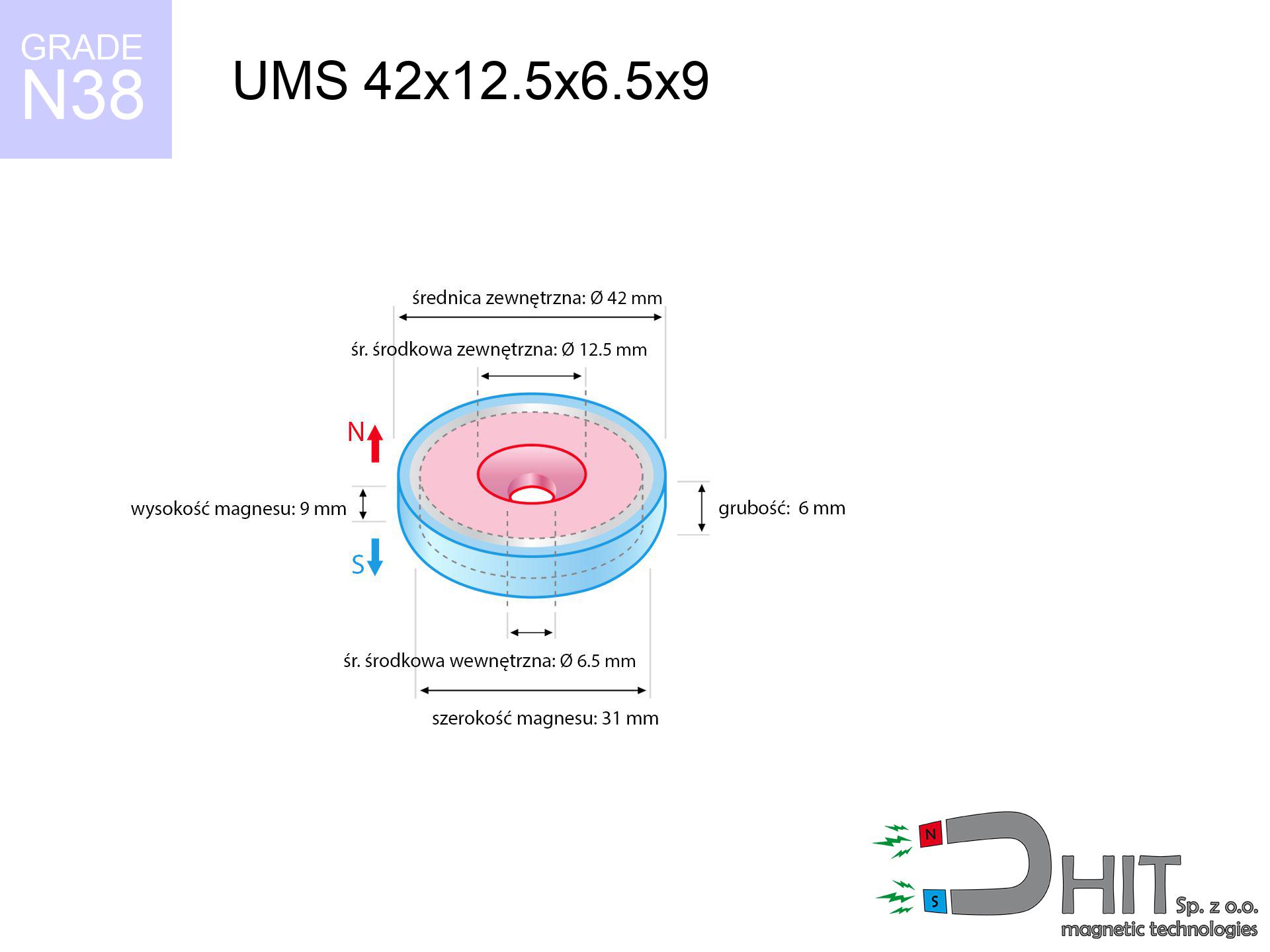
UMS 42x12.5x6.5x9 / N38 - conical magnetic holder
conical magnetic holder
Catalog no 220331
GTIN/EAN: 5906301814214
- Diameter Ø
- 42 mm [±1 mm]
- cone dimension Ø
- 12.5x6.5 mm [±1 mm]
- Height
- 9 mm [±1 mm]
- Weight
- 72 g
- Magnetization Direction
- ↑ axial
- Coating
- [NiCuNi] Nickel
How we measure these parameters — certificates and measurements
22.00 zł net / pcs
27.06 zł with VAT (23% VAT) / pcs
bulk discounts:
Need more?Frequently asked questions
Which magnetic holder is suitable for moving metal parts in a workshop?
How do I choose a holder for hanging a heavy item and check its real grip?
Which magnetic holders can be used outdoors?
How should I choose a strong threaded holder for field work?
Call us now
+48 888 99 98 98
alternatively let us know using
contact form
the contact section.
Specifications and structure of a neodymium magnet can be estimated using our
power calculator.
Order by 14:00 and we’ll ship today!
Technical - UMS 42x12.5x6.5x9 / N38 - conical magnetic holder
Specification / characteristics - UMS 42x12.5x6.5x9 / N38 - conical magnetic holder
| properties | values |
|---|---|
| Cat. no. | 220331 |
| GTIN/EAN | 5906301814214 |
| Production/Distribution | Dhit sp. z o.o. |
| Country of origin | Poland / China / Germany |
| Customs code | 85059029 |
| Diameter Ø | 42 mm [±1 mm] |
| cone dimension Ø | 12.5x6.5 mm [±1 mm] |
| Height | 9 mm [±1 mm] |
| Weight | 72 g |
| Magnetization Direction | ↑ axial |
| Load capacity ~ ? | 37.00 kg / 362.85 N |
| Coating | [NiCuNi] Nickel |
| Manufacturing Tolerance | ±1 mm |
Magnetic properties of material N38
| properties | values | units |
|---|---|---|
| Remanence Br ? | 12.2-12.6 | kGs |
| Remanence Br ? | 1220-1260 | mT |
| Coercivity bHc ? | 10.8-11.5 | kOe |
| Coercivity bHc ? | 860-915 | kA/m |
| Intrinsic coercivity iHc | ≥ 12 | kOe |
| Intrinsic coercivity iHc | ≥ 955 | kA/m |
| Energy product BHmax ? | 36-38 | BH max MGOe |
| Energy product BHmax ? | 287-303 | BH max KJ/m |
| Maximum working temperature ? | ≤ 80 | °C |
Physical properties of sintered neodymium magnets Nd2Fe14B at 20°C
| properties | values | units |
|---|---|---|
| Vickers hardness | ≥550 | Hv |
| Density | ≥7.4 | g/cm3 |
| Curie Temperature TC | 310 | °C |
| Curie Temperature TF | 590 | °F |
| Specific resistance | 150 | μΩ⋅cm |
| Bending strength | 250 | MPa |
| Compressive strength | 1000~1100 | MPa |
| Thermal expansion parallel (∥) to orientation (M) | (3-4) x 10-6 | °C-1 |
| Thermal expansion perpendicular (⊥) to orientation (M) | -(1-3) x 10-6 | °C-1 |
| Young's modulus | 1.7 x 10⁴ | kg/mm² |
Chemical composition
| iron (Fe) | 64% – 68% |
| neodymium (Nd) | 29% – 32% |
| boron (B) | 1.1% – 1.2% |
| dysprosium (Dy) | 0.5% – 2.0% |
| coating (Ni-Cu-Ni) | < 0.05% |
Sustainability
| recyclability (EoL) | 100% |
| recycled raw materials | ~10% (pre-cons) |
| carbon footprint | low / zredukowany |
| waste code (EWC) | 16 02 16 |
See more deals

![UI 17.5x5 [C310] / N38 - badge holder](https://cdn3.dhit.pl/graphics/products/ui17.5x5-c310-rud.jpg "UI 17.5x5 [C310] / N38 - badge holder")
Pros as well as cons of neodymium magnets.
Benefits
- They do not lose power, even after nearly 10 years – the reduction in power is only ~1% (according to tests),
- They retain their magnetic properties even under close interference source,
- In other words, due to the shiny finish of gold, the element becomes visually attractive,
- The surface of neodymium magnets generates a powerful magnetic field – this is a distinguishing feature,
- Through (adequate) combination of ingredients, they can achieve high thermal resistance, allowing for functioning at temperatures approaching 230°C and above...
- Thanks to modularity in forming and the ability to customize to unusual requirements,
- Significant place in advanced technology sectors – they find application in hard drives, electric drive systems, medical equipment, and complex engineering applications.
- Relatively small size with high pulling force – neodymium magnets offer strong magnetic field in small dimensions, which enables their usage in small systems
Weaknesses
- They are prone to damage upon too strong impacts. To avoid cracks, it is worth securing magnets using a steel holder. Such protection not only shields the magnet but also improves its resistance to damage
- Do not exceed this material temperature limit: 80°C. Overheating may permanently weaken the magnet.
- Magnets exposed to a humid environment can rust. Therefore while using outdoors, we suggest using water-impermeable magnets made of rubber, plastic or other material resistant to moisture
- Limited possibility of making threads in the magnet and complex shapes - recommended is casing - mounting mechanism.
- Health risk related to microscopic parts of magnets pose a threat, when accidentally swallowed, which is particularly important in the aspect of protecting the youngest. It is also worth noting that tiny parts of these devices can be problematic in diagnostics medical after entering the body.
- With mass production the cost of neodymium magnets can be a barrier,
Lifting parameters
Maximum magnetic pulling force – what contributes to it?
- using a base made of high-permeability steel, functioning as a magnetic yoke
- whose transverse dimension is min. 10 mm
- with an ground touching surface
- without the slightest clearance between the magnet and steel
- during detachment in a direction perpendicular to the mounting surface
- at room temperature
What influences lifting capacity in practice
- Distance – existence of any layer (rust, tape, air) acts as an insulator, which reduces capacity steeply (even by 50% at 0.5 mm).
- Force direction – catalog parameter refers to detachment vertically. When applying parallel force, the magnet holds significantly lower power (often approx. 20-30% of maximum force).
- Steel thickness – too thin sheet does not close the flux, causing part of the power to be wasted to the other side.
- Material composition – not every steel reacts the same. High carbon content worsen the interaction with the magnet.
- Base smoothness – the smoother and more polished the plate, the larger the contact zone and stronger the hold. Roughness creates an air distance.
- Temperature influence – hot environment weakens magnetic field. Exceeding the limit temperature can permanently damage the magnet.
Holding force was measured on a smooth steel plate of 20 mm thickness, when the force acted perpendicularly, whereas under attempts to slide the magnet the lifting capacity is smaller. Moreover, even a minimal clearance between the magnet’s surface and the plate reduces the load capacity.
Safety rules for work with NdFeB magnets
Warning for allergy sufferers
It is widely known that the nickel plating (standard magnet coating) is a common allergen. If your skin reacts to metals, avoid direct skin contact or opt for encased magnets.
Magnets are brittle
Watch out for shards. Magnets can explode upon uncontrolled impact, launching shards into the air. Eye protection is mandatory.
This is not a toy
Neodymium magnets are not toys. Eating several magnets can lead to them pinching intestinal walls, which poses a severe health hazard and requires urgent medical intervention.
Pacemakers
People with a heart stimulator must keep an absolute distance from magnets. The magnetism can interfere with the functioning of the life-saving device.
Fire risk
Drilling and cutting of NdFeB material carries a risk of fire risk. Magnetic powder reacts violently with oxygen and is hard to extinguish.
Immense force
Use magnets consciously. Their immense force can surprise even professionals. Stay alert and respect their power.
Magnetic media
Do not bring magnets near a wallet, computer, or TV. The magnetism can destroy these devices and wipe information from cards.
Permanent damage
Keep cool. Neodymium magnets are susceptible to temperature. If you require operation above 80°C, inquire about HT versions (H, SH, UH).
Precision electronics
Be aware: neodymium magnets generate a field that confuses precision electronics. Maintain a separation from your phone, tablet, and navigation systems.
Crushing risk
Risk of injury: The pulling power is so immense that it can cause blood blisters, pinching, and even bone fractures. Use thick gloves.
Tabela kosztu i czasu dostawy
Płatność przed wysyłką:

GLS kurier
Przesyłka będzie u Ciebie za 2-3 dni
14.99 ZŁ

InPost Paczkomaty 24/7
Przesyłka będzie u Ciebie za 1-2 dni
12.30 ZŁ
Płatność przy odbiorze (pobranie):
GLS kurier
Przesyłka będzie u Ciebie za 1-2 dni
23.00 ZŁ