


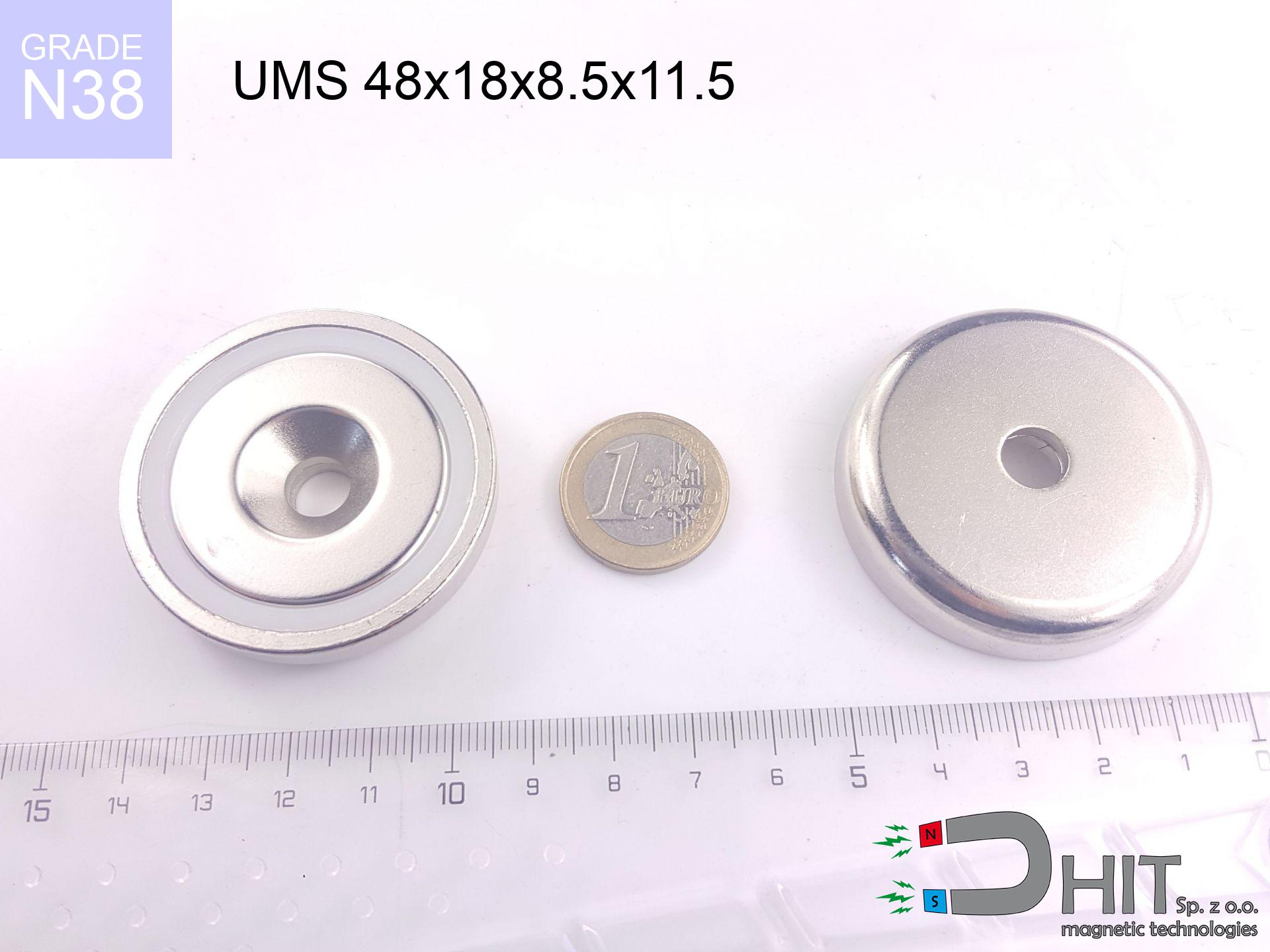
UMS 48x18x8.5x11.5 / N38 - conical magnetic holder
conical magnetic holder
Catalog no 220403
GTIN/EAN: 5906301814221
- Diameter Ø
- 48 mm [±1 mm]
- cone dimension Ø
- 18x8.5 mm [±1 mm]
- Height
- 11.5 mm [±1 mm]
- Weight
- 125 g
- Magnetization Direction
- ↑ axial
- Coating
- [NiCuNi] Nickel
How we measure these parameters — certificates and measurements
36.52 zł net / pcs
44.92 zł with VAT (23% VAT) / pcs
bulk discounts:
Need more?Frequently asked questions
Which magnetic holder is suitable for moving metal parts in a workshop?
How do I choose a holder for hanging a heavy item and check its real grip?
Which magnetic holders can be used outdoors?
How should I choose a strong threaded holder for field work?
Call us now
+48 888 99 98 98
alternatively let us know using
contact form
the contact section.
Specifications and structure of a neodymium magnet can be estimated using our
power calculator.
Order by 14:00 and we’ll ship today!
Technical data of the product - UMS 48x18x8.5x11.5 / N38 - conical magnetic holder
Specification / characteristics - UMS 48x18x8.5x11.5 / N38 - conical magnetic holder
| properties | values |
|---|---|
| Cat. no. | 220403 |
| GTIN/EAN | 5906301814221 |
| Production/Distribution | Dhit sp. z o.o. |
| Country of origin | Poland / China / Germany |
| Customs code | 85059029 |
| Diameter Ø | 48 mm [±1 mm] |
| cone dimension Ø | 18x8.5 mm [±1 mm] |
| Height | 11.5 mm [±1 mm] |
| Weight | 125 g |
| Magnetization Direction | ↑ axial |
| Load capacity ~ ? | 68.00 kg / 666.85 N |
| Coating | [NiCuNi] Nickel |
| Manufacturing Tolerance | ±1 mm |
Magnetic properties of material N38
| properties | values | units |
|---|---|---|
| Remanence Br ? | 12.2-12.6 | kGs |
| Remanence Br ? | 1220-1260 | mT |
| Coercivity bHc ? | 10.8-11.5 | kOe |
| Coercivity bHc ? | 860-915 | kA/m |
| Intrinsic coercivity iHc | ≥ 12 | kOe |
| Intrinsic coercivity iHc | ≥ 955 | kA/m |
| Energy product BHmax ? | 36-38 | BH max MGOe |
| Energy product BHmax ? | 287-303 | BH max KJ/m |
| Maximum working temperature ? | ≤ 80 | °C |
Physical properties of sintered neodymium magnets Nd2Fe14B at 20°C
| properties | values | units |
|---|---|---|
| Vickers hardness | ≥550 | Hv |
| Density | ≥7.4 | g/cm3 |
| Curie Temperature TC | 310 | °C |
| Curie Temperature TF | 590 | °F |
| Specific resistance | 150 | μΩ⋅cm |
| Bending strength | 250 | MPa |
| Compressive strength | 1000~1100 | MPa |
| Thermal expansion parallel (∥) to orientation (M) | (3-4) x 10-6 | °C-1 |
| Thermal expansion perpendicular (⊥) to orientation (M) | -(1-3) x 10-6 | °C-1 |
| Young's modulus | 1.7 x 10⁴ | kg/mm² |
Chemical composition
| iron (Fe) | 64% – 68% |
| neodymium (Nd) | 29% – 32% |
| boron (B) | 1.1% – 1.2% |
| dysprosium (Dy) | 0.5% – 2.0% |
| coating (Ni-Cu-Ni) | < 0.05% |
Sustainability
| recyclability (EoL) | 100% |
| recycled raw materials | ~10% (pre-cons) |
| carbon footprint | low / zredukowany |
| waste code (EWC) | 16 02 16 |
Check out more proposals


Pros as well as cons of neodymium magnets.
Strengths
- Their magnetic field is durable, and after around 10 years it drops only by ~1% (according to research),
- They do not lose their magnetic properties even under strong external field,
- In other words, due to the smooth layer of nickel, the element is aesthetically pleasing,
- Magnetic induction on the working layer of the magnet turns out to be extremely intense,
- Neodymium magnets are characterized by extremely high magnetic induction on the magnet surface and can work (depending on the shape) even at a temperature of 230°C or more...
- Possibility of individual creating and adapting to specific conditions,
- Universal use in modern technologies – they are used in hard drives, motor assemblies, diagnostic systems, as well as complex engineering applications.
- Compactness – despite small sizes they generate large force, making them ideal for precision applications
Disadvantages
- To avoid cracks upon strong impacts, we recommend using special steel housings. Such a solution secures the magnet and simultaneously improves its durability.
- Do not exceed this material temperature limit: 80°C. Overheating may permanently weaken the magnet.
- Due to the susceptibility of magnets to corrosion in a humid environment, we advise using waterproof magnets made of rubber, plastic or other material resistant to moisture, when using outdoors
- Limited ability of producing nuts in the magnet and complicated forms - preferred is casing - magnetic holder.
- Potential hazard to health – tiny shards of magnets pose a threat, when accidentally swallowed, which is particularly important in the context of child safety. Additionally, tiny parts of these products can be problematic in diagnostics medical in case of swallowing.
- Higher cost of purchase is a significant factor to consider compared to ceramic magnets, especially in budget applications
Pull force analysis
Maximum holding power of the magnet – what affects it?
- using a sheet made of mild steel, acting as a ideal flux conductor
- whose thickness reaches at least 10 mm
- characterized by smoothness
- under conditions of ideal adhesion (metal-to-metal)
- for force acting at a right angle (pull-off, not shear)
- at standard ambient temperature
Practical aspects of lifting capacity – factors
- Distance (between the magnet and the metal), as even a very small distance (e.g. 0.5 mm) can cause a decrease in lifting capacity by up to 50% (this also applies to varnish, rust or debris).
- Loading method – declared lifting capacity refers to pulling vertically. When slipping, the magnet holds much less (often approx. 20-30% of maximum force).
- Metal thickness – thin material does not allow full use of the magnet. Part of the magnetic field passes through the material instead of converting into lifting capacity.
- Material composition – different alloys attracts identically. Alloy additives weaken the interaction with the magnet.
- Smoothness – full contact is possible only on polished steel. Rough texture create air cushions, weakening the magnet.
- Thermal environment – temperature increase causes a temporary drop of induction. It is worth remembering the maximum operating temperature for a given model.
Lifting capacity testing was conducted on a smooth plate of suitable thickness, under a perpendicular pulling force, in contrast under attempts to slide the magnet the holding force is lower. In addition, even a slight gap between the magnet and the plate lowers the load capacity.
H&S for magnets
Fire warning
Fire warning: Rare earth powder is highly flammable. Avoid machining magnets in home conditions as this risks ignition.
Electronic hazard
Very strong magnetic fields can destroy records on credit cards, hard drives, and storage devices. Maintain a gap of at least 10 cm.
Threat to navigation
Note: neodymium magnets produce a field that disrupts precision electronics. Maintain a separation from your phone, tablet, and navigation systems.
Allergy Warning
Some people experience a hypersensitivity to Ni, which is the standard coating for neodymium magnets. Frequent touching may cause skin redness. We strongly advise wear safety gloves.
Demagnetization risk
Monitor thermal conditions. Exposing the magnet above 80 degrees Celsius will permanently weaken its magnetic structure and pulling force.
Crushing risk
Risk of injury: The attraction force is so immense that it can cause blood blisters, crushing, and broken bones. Use thick gloves.
No play value
Product intended for adults. Tiny parts can be swallowed, leading to serious injuries. Store away from kids and pets.
Danger to pacemakers
Individuals with a ICD should keep an absolute distance from magnets. The magnetism can stop the functioning of the implant.
Magnet fragility
Despite metallic appearance, neodymium is brittle and cannot withstand shocks. Avoid impacts, as the magnet may crumble into sharp, dangerous pieces.
Handling rules
Handle magnets consciously. Their powerful strength can surprise even experienced users. Be vigilant and do not underestimate their force.
Tabela kosztu i czasu dostawy
Płatność przed wysyłką:

GLS kurier
Przesyłka będzie u Ciebie za 2-3 dni
14.99 ZŁ

InPost Paczkomaty 24/7
Przesyłka będzie u Ciebie za 1-2 dni
12.30 ZŁ
Płatność przy odbiorze (pobranie):
GLS kurier
Przesyłka będzie u Ciebie za 1-2 dni
23.00 ZŁ